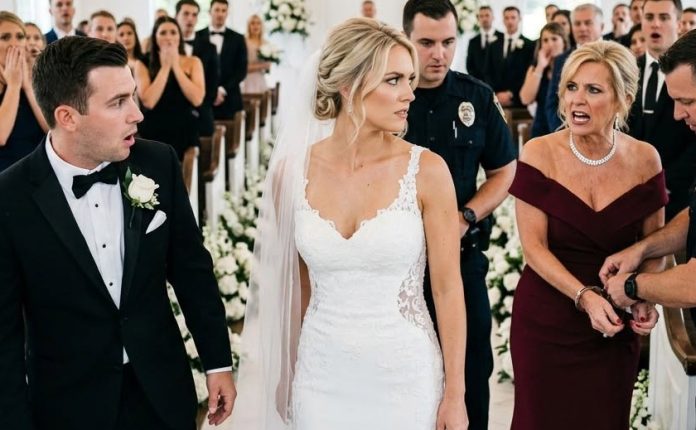
Chaos erupted through the chapel. Several relatives shouted Daniel’s name while others backed toward the walls. One elderly aunt began crying uncontrollably. A board member dropped his phone. Victor tried moving toward a side exit.
A detective blocked him immediately. Margaret remained beside the coffin, her face frozen between horror and disbelief. Daniel swung his legs carefully toward the side while a medical professional entered from the adjoining room.
“You’re alive,” Margaret finally whispered. Daniel looked at her. “That seems to be the part of today you find most upsetting.” Her expression hardened as soon as she realized everyone had heard him.
Margaret recovered quickly and turned toward the room. “This is some kind of grotesque trick,” she announced. “My son is obviously confused. He has been manipulated by that woman.”
Even after watching Daniel sit up at his own funeral, her first instinct was still to blame me. Detective Ortiz approached with another officer and asked Margaret to place her hands where they could be seen.
“What exactly are you accusing me of?” Margaret demanded. Ortiz told her she was being detained in connection with an ongoing investigation involving financial fraud, obstruction, conspiracy, and suspected attempts to harm Daniel.
Victor immediately shouted that he wanted an attorney. Margaret looked toward him with such fury that I knew his panic had broken whatever plan they had agreed upon.
Daniel stood only with help. He had recovered significantly, but spending part of the service inside a coffin under medical supervision had exhausted him. I wanted to run toward him, but investigators had instructed me beforehand not to disrupt the arrests.
Margaret saw me looking at Daniel and suddenly understood that I had known. “You,” she whispered. The hatred in that single word carried more truth than everything she had said during the funeral.
I finally allowed myself to answer. “Yes, Margaret. Me.” She demanded to know how long I had been part of the operation. I didn’t respond because Detective Ortiz was already reading her rights.
When officers placed handcuffs around Margaret’s wrists, the chapel became silent again. The woman who had spent years controlling every family room she entered suddenly had no authority over where she went next.
Victor was detained moments later. He protested loudly, claiming all financial decisions had been legitimate and approved by Daniel. Ortiz told him investigators would be happy to discuss his documents with counsel present.
Daniel looked toward him. “Especially the ones you wanted burned.” Victor’s face lost color. Margaret turned toward him so sharply that even handcuffed, she looked capable of striking him.
That reaction confirmed something I had suspected. Margaret and Victor were partners, but not equals. She believed Victor had been stupid enough to discuss evidence inside the chapel.
He apparently believed Margaret had promised the building was private. Their trust in one another began collapsing before police even led them outside.
The reporters waiting beyond the chapel doors captured images of Margaret being placed into an unmarked vehicle. Within an hour, every accusation she had made about me at the funeral was competing with a much larger headline.
Daniel Vale Alive After Covert Investigation; Mother and Uncle Detained.
Our attorney released only a brief statement confirming Daniel was alive, receiving medical care, and cooperating with investigators. We said nothing about the operational details because the criminal investigation was still developing.
Daniel returned to a secure medical facility. I rode with him. For the first ten minutes, neither of us spoke. Then he looked at my hands and noticed I was still holding the white rose.
“You kept it,” he said. I stared at the crushed petals and began laughing. The laughter turned into tears so quickly that I couldn’t stop them.
Daniel reached for my hand. “Hey.” That one word broke whatever composure remained. I leaned against him carefully, furious and relieved at the same time.
“You sat inside a coffin while your mother insulted me for forty minutes,” I said. Daniel gave me a tired smile. “I considered objecting, but I thought it might undermine the operation.”
I laughed despite myself. Then I hit his shoulder gently enough not to hurt him. He apologized, although both of us knew the funeral had captured exactly the evidence investigators needed.
The investigation widened over the following weeks. Search warrants were executed at several offices, properties, storage facilities, and corporate service providers connected to the suspicious consulting companies.
Investigators discovered that Victor had approved inflated contracts through vendors secretly linked to associates and relatives. Money moved through layered entities before portions were redirected into accounts and investments controlled indirectly by Victor and Margaret.
The total was far larger than the first numbers Daniel showed me. Over several years, more than $18 million had been diverted through questionable contracts, fabricated consulting arrangements, and transactions investigators later described as intentionally concealed.
Margaret had not personally signed every fraudulent invoice. She didn’t need to. Evidence indicated she had helped coordinate ownership structures, pressured employees who questioned unusual payments, and used family influence to prevent internal challenges.
One former finance manager had raised concerns eighteen months earlier. He was abruptly reassigned, then dismissed for what the company called performance issues. After Daniel survived, the man contacted investigators and provided copies of emails he had preserved.
Those emails changed everything. In one, Margaret warned Victor that Daniel was “becoming suspicious.” In another, Victor replied that they needed to “deal with the Elena problem” because my background made me dangerous.
Seeing my name inside their private messages made my skin crawl. I had suspected they disliked me. I hadn’t understood that my professional experience had made them consider me an obstacle requiring active management.
Investigators also examined Daniel’s medical collapse. I will never publicly describe the technical evidence, partly because some details remained sealed and partly because I refuse to turn what happened to my husband into instructions someone else could misuse.
What became public was enough. Prosecutors alleged that Daniel had been deliberately exposed to something intended to produce serious medical symptoms without immediately revealing an obvious cause.
Evidence linked the scheme to people connected with Margaret and Victor. Both denied involvement. Their attorneys insisted the medical event was unrelated to the financial investigation and accused prosecutors of combining separate circumstances to create a sensational case.
Then investigators recovered messages discussing Daniel’s worsening health alongside plans for control of his shares. One message from Victor asked Margaret whether “the transition” would occur before the quarterly board meeting.
Margaret replied, “It has to. Afterward, Elena signs or gets destroyed publicly.” That sentence had been sent two days before Daniel collapsed.
The funeral smear campaign suddenly made perfect sense. If Daniel died, Margaret needed me discredited before I could challenge suspicious estate documents or demand independent review of the company’s finances.
The invented affair provided moral scandal. The claim that I had drained Daniel’s accounts created financial motive. By the time anyone examined the company, Margaret planned to portray me as a dishonest widow fighting the grieving family for money.
There was one problem with that plan. Daniel and I kept our finances extraordinarily transparent because of my former profession. Every major transfer, property interest, trust amendment, and investment authorization had documentation that could survive aggressive scrutiny.
The supposed missing money never existed. The affair never existed. The accusation that I had ruined Vale Biotech collapsed immediately once independent auditors examined the company.
The real damage came from procurement fraud committed by people Margaret had protected. Vale Biotech’s board placed several senior employees on leave while an outside firm conducted a complete review.
Daniel refused to return immediately as CEO. Instead, he appointed an interim executive and concentrated on recovering. For the first time since we married, he spent entire mornings without checking corporate email.
We moved temporarily into a smaller property outside the city because our main home had become part of the investigation. At first, Daniel hated being away from his office.
Then something changed. We began eating breakfast together every morning. He walked slowly around the garden while rebuilding his strength. I rediscovered what our marriage felt like without a crisis sitting between us.
One morning, Daniel asked whether I regretted marrying into his family. I was pouring coffee and nearly dropped the pot. “That’s an unfair question before caffeine,” I told him.
He waited. I finally sat across from him and answered honestly. I regretted tolerating things I should have challenged earlier. I regretted assuming Margaret’s cruelty was merely personality rather than control.
But I did not regret Daniel. Separating a person from the family that raised them can be difficult, especially when that family teaches loyalty as obedience.
Daniel looked down at his coffee. “I kept thinking I could manage her.” I reminded him that children often spend decades believing they can eventually earn healthier behavior from difficult parents.
He gave me a small smile. “Is that your professional opinion?” I shook my head. “That one is personal.” Daniel reached across the table and took my hand.
The criminal case took nearly eighteen months to reach its final stage. Margaret remained defiant throughout most pretrial proceedings. She appeared in court wearing immaculate suits and behaving as though prosecutors were temporary inconveniences.
Victor was different. His confidence collapsed quickly once digital evidence connected him directly to vendor companies and concealed payments. His lawyers eventually began discussing cooperation.
Margaret considered that betrayal. Through counsel, she reportedly called Victor weak and ungrateful. The irony escaped no one who had watched her demand family loyalty while preparing to destroy her own daughter-in-law.
Victor ultimately accepted a plea agreement and agreed to testify about portions of the financial scheme. His cooperation included identifying documents Margaret believed had been destroyed.
Remember the storage unit he mentioned beside Daniel’s coffin? Investigators had already found it within hours of the funeral because the chapel recording captured enough information to support immediate follow-up.
Inside were archived contracts, handwritten notes, backup drives, company seals, and copies of documents used to create false authorization records. The material became some of the strongest evidence in the prosecution.
Among those files was the original template for the widow’s waiver Margaret tried to make me sign at the funeral. Metadata showed it had been drafted days before Daniel’s collapse, not after his supposed death.
That single fact destroyed her claim that the document was ordinary emergency estate planning. They had prepared to strip my rights before they supposedly had any reason to believe Daniel would die.
Prosecutors also presented evidence concerning the forged signature attached to the transfer authorization. A document specialist demonstrated inconsistencies with Daniel’s verified signatures and linked the image to an older corporate filing.
I sat beside Daniel during part of the trial. When the forged signature appeared on a large courtroom screen, his hand tightened around mine.
“That was from the Geneva acquisition,” he whispered. I remembered the document. Daniel had signed it five years earlier. Someone had apparently extracted the signature from archived corporate records.
Margaret rarely looked toward us. When she did, she focused on Daniel, not me. I wondered whether she still believed her son might eventually choose her if she refused to acknowledge what she had done.
Near the end of the trial, Daniel testified. The courtroom was packed. Margaret watched him walk toward the witness stand with an expression I couldn’t interpret.
Daniel described discovering irregular contracts, suspending Victor, preserving documents, and becoming increasingly concerned about unauthorized access to his files. Then prosecutors asked about his relationship with Margaret.
Daniel was quiet for several seconds. “She is my mother,” he said. “For most of my life, I believed that meant I had to keep giving her opportunities to behave differently.”
The prosecutor asked whether he still believed that. Daniel looked directly at Margaret. “No.” Her face barely moved, but I saw her fingers tighten around the edge of the defense table.
The jury eventually found Margaret guilty on multiple financial and conspiracy-related counts. The medical charges were more complex, but prosecutors secured convictions connected to the broader scheme and attempts to obstruct the investigation.
Victor’s plea resulted in a substantially shorter sentence than Margaret received. Several additional participants were convicted or entered agreements of their own. Vale Biotech recovered portions of the stolen money through asset forfeiture and civil actions.
Margaret was sentenced to a lengthy prison term. At sentencing, she finally addressed Daniel directly. She said everything she had done had been intended to protect his father’s legacy.
Daniel didn’t respond until the judge allowed him to speak. “My father’s legacy was a company,” he said. “You almost destroyed your son to control it.”
Margaret began crying. They were the first tears I had seen from her since the entire ordeal began. Maybe they were genuine. Maybe they were finally for herself.
Daniel continued. “You taught me that family loyalty meant protecting relatives from consequences. Elena taught me that real loyalty sometimes means refusing to participate in the lie.”
Margaret looked toward me then. There was no apology in her face. I didn’t need one. By that point, I had stopped imagining that closure required the person who harmed you to understand why you left.