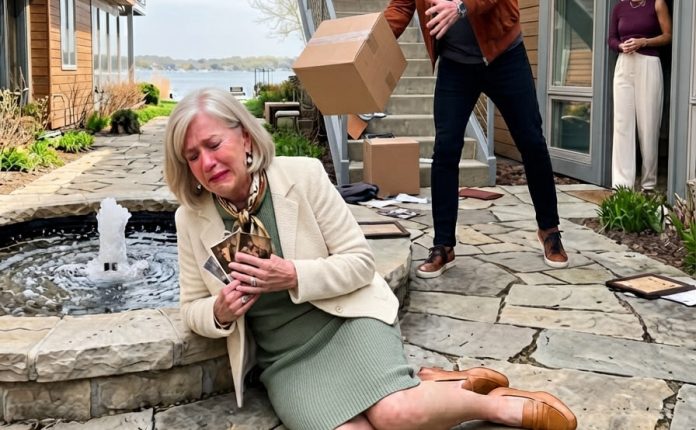
My husband crossed the kitchen and slapped me so hard my lip struck my teeth. For one stunned second, I tasted blood and heard nothing except the refrigerator humming behind me. Then Aaron pointed toward the back door and shouted, “Get out of my mother’s house.” His mother, Diane, stood behind him smiling as if she had just won an argument. “And don’t forget,” she added, “our ten-thousand-dollar allowance is due tomorrow.”
I wiped my mouth with the back of my hand and looked at the folder I had carried inside. Aaron thought it contained divorce papers. Diane thought it contained a payment agreement. Neither of them knew I had spent the previous six weeks quietly collecting deeds, bank statements, corporate records, and copies of every transfer Aaron had made without telling me. I set the folder on the marble island and opened it to the first page.
It was not a divorce petition. It was the recorded deed to the house. My name, Lena Mercer, was the only owner listed. Aaron’s name appeared nowhere. Diane leaned over the island, still wearing that satisfied little smile, but the expression disappeared as she read. Aaron reached for the folder. I covered it with my hand and said, “Don’t touch me again.” He stopped, not because he respected me, but because my phone was already recording.
Diane looked from the deed to her son. “Aaron, you told me the transfer was finished two years ago. You said this house was already mine.” Her voice was no longer smug. It was confused. That one sentence rearranged years of conversations in my head. Aaron had told me the monthly ten thousand dollars was repayment for money his mother had invested in his consulting company. He had told Diane something completely different: that she owned my house and the monthly payments were her rightful income.
Aaron’s face changed first. The anger drained out and calculation took its place. “Mom, she’s twisting this,” he said. “The paperwork was supposed to be updated.” Diane pointed at the deed. “You showed me a copy with my name on it.” I felt cold despite the warm kitchen. There had never been any legitimate transfer. If Diane had seen a deed naming her, it had either been altered or fabricated.
I had married Aaron nine years earlier, when I was thirty-one and building a specialty packaging company with my college friend, Maya. Aaron was charming, ambitious, and endlessly confident. He worked in corporate sales and knew how to make every room feel like it had been waiting for him. Diane lived three states away then, and our relationship was polite. She sent birthday cards, called on holidays, and occasionally complained that Aaron did not visit enough.
Everything changed after my aunt Celeste died. She had no children and left me the house where the confrontation was now happening, a renovated five-bedroom property outside Raleigh. I had spent summers there as a teenager and loved it long before it became valuable. The deed transferred directly to me through probate. Aaron knew the house was separate inherited property. At the time, he said that did not matter because we were a team.
Two years later, Diane sold her condo and moved nearby. Aaron persuaded me to let her stay in the guest suite “for a few months” while she looked for a place. Months became a year. Then she stopped looking. Aaron began referring to the house as “Mom’s place” in casual conversation. I corrected him at first. He laughed and said I was being literal. I did not realize he was building two different realities, one for each of us.
The ten-thousand-dollar payments started eighteen months after Diane moved in. Aaron told me his consulting company had hit a rough patch and that Diane had loaned him money. He said he was repaying her monthly from his business income. I asked how much he owed. He said two hundred thousand dollars. I thought the amount was reckless, but because he insisted it did not involve our household funds, I stayed out of it.
What I did not know was that Aaron had access to an operating account for my packaging company because I had added him as an emergency signer years earlier. He rarely touched it. Then, during a year when I was traveling constantly to open a second facility, small transfers began moving through a holding account before reaching Diane. Each one was labeled “vendor consulting.” Ten thousand dollars, almost every month.
I discovered the pattern by accident. A new controller at my company, Priya, asked why we were paying a consultant whose tax identification information was missing. I told her we were not. She pulled the ledger. My stomach dropped. The transfers traced back to an authorization token issued to Aaron. By then, one hundred and eighty thousand dollars had left the company. When I called him, I did not accuse him. I simply asked whether he had ever used my business account.
He lied without hesitation. “Never.” That answer changed the problem from accounting confusion to something else. I told Priya to freeze his access, preserve every log, and say nothing. Then I called an attorney, Marisol Grant, who specialized in business disputes and divorce. She warned me not to confront Aaron until we understood how far the deception reached. “People who lie about money often lie in layers,” she said. She was right.
Within two weeks, we found the transfers to Diane, an application for a home-equity line Aaron had started using a scanned copy of my signature, and several emails in which he described himself as the property owner. The loan application had not been completed because the lender requested direct confirmation from me. Aaron had apparently abandoned it rather than risk alerting me. We also found a PDF deed in his cloud storage naming Diane as grantee.
The PDF looked convincing until Marisol compared it with county records. The recording stamp was copied from another document. My signature had been lifted from an old closing form. The notary listed on the page had never notarized anything for us. It was a fake. Whether Aaron created it himself or paid someone to alter it was unclear, but he had used it to convince his mother she owned the house.
I wanted to confront Diane immediately, but Marisol told me to wait. We did not know whether she was part of the fraud or another target. That question mattered. Diane could be demanding money she knew was stolen, or she could genuinely believe her son had transferred property to her. Her entitlement made either possibility believable. So I watched, listened, and stopped giving Aaron information.
Over the next month, his behavior became stranger. He asked whether I had considered selling the packaging company. He suggested refinancing the house for “tax planning.” He became irritated when I said no. Then he told me Diane wanted a formal lease because she worried I might someday force her out. I said I would discuss it after the holidays. He accused me of making his mother feel insecure in her own home.
That phrase stayed with me: her own home.
I checked the security cameras I had installed outside after a package theft. One camera also captured audio near the side patio. In a recording from three weeks earlier, Aaron and Diane were discussing renovations. Diane said, “Once the deed issue is completely settled, I want Lena’s office turned into a sitting room.” Aaron replied, “It’s handled. She won’t be able to challenge anything.” Diane then asked when the next ten thousand would arrive. Aaron said, “Like clockwork.”
I played the clip for Marisol. She said it still did not prove Diane knew the deed was false. In fact, her question about the deed issue suggested Aaron had told her there had been some administrative delay. We decided I needed a controlled confrontation. I would bring copies, keep originals elsewhere, record where lawful, and have a friend nearby. I also changed my company passwords, moved personal funds into an account Aaron could not access, and prepared to file for divorce.
I chose a Saturday afternoon because Diane’s sister was visiting nearby and Aaron expected a family dinner. I arrived at the house after spending the previous night with Maya. Aaron had noticed money moving and knew something was wrong. He met me in the kitchen already angry. Diane stood by the island with a glass of wine. I placed the folder down and told them we needed to discuss the house and the payments.
Aaron immediately tried to control the conversation. He said I had embarrassed him by freezing his company access and demanded I restore it. I said no. Diane interrupted to remind me that her monthly allowance was due the next morning. I asked why she called it an allowance. She laughed. “Because Aaron manages the property and sends me my share. We’ve explained this to you enough times.”
Nobody had ever explained that to me.
I asked Diane what property she meant. She stared at me as if I were stupid. “This house.” Aaron cut in, saying we were not discussing ownership. I said we absolutely were. That was when he crossed the room and slapped me. The impact snapped my head sideways. Diane did not flinch. Instead, she smiled and told me to leave her house. Aaron shouted the same thing.
Then I opened the folder.
Now, standing over the real deed, Diane looked genuinely shaken. “You said she signed it over willingly,” she told Aaron. “You said it was part of the agreement after your business failed.” I turned to him. “What agreement?” Diane answered before he could. She said Aaron had told her I agreed to compensate her because she had supposedly sacrificed her retirement savings to help us buy the house.
I almost laughed from disbelief. Celeste had owned the house outright. No one helped us buy it. Diane had never contributed a dollar. Aaron had constructed a story in which he was simultaneously repaying a business loan to his mother, managing rental income for her, and compensating her for a home purchase that never happened. Each story explained the same ten-thousand-dollar transfer to a different person.
Diane sank onto a stool. “Where has the money actually been coming from?” she asked.
“My company,” I said.
For the first time, she looked horrified rather than offended. Aaron started talking fast. He claimed he had always intended to repay the company. He said the transfers were temporary. He said Diane deserved support because she had sold her condo too cheaply. He said marriage meant shared assets. Every sentence contradicted the one before it.
I picked up my phone and called the police.
Aaron laughed at first. “For what? A family argument?” I touched my split lip. “For assault.” Then I pointed to the folder. “And my attorney will handle the rest.” Diane stood and moved away from him. The shift was small but unmistakable. Aaron looked at his mother as though betrayal had just happened to him.
Officers arrived eleven minutes later. I showed them the video from my phone and explained the slap. Aaron insisted I had provoked him by stealing financial records. One officer asked him to step outside. He refused, then reconsidered when the officer repeated himself. I gave a statement while another officer photographed my lip. Diane quietly told them she had seen him hit me.
That mattered more than I expected.
Aaron spent the night away from the house under an emergency protective order. I changed the locks the next morning after confirming the process with my attorney. Diane packed a suitcase but did not leave immediately. She sat at the kitchen table staring at copies of the fake deed. “I believed him,” she said. There was no apology in the sentence, only shock.
I told her believing him did not excuse the way she had treated me. She had smiled when he hit me. She had watched him order me from a house she had never legally owned. She had accepted money every month without ever asking why I seemed unaware of the arrangement. Diane started crying. I did not comfort her. Some consequences need silence around them.
She moved into her sister’s apartment that afternoon.
The divorce filing went in on Monday. Marisol also referred the forged deed and attempted loan application to investigators. My company’s insurer and forensic accountant documented the unauthorized transfers. Because Aaron had been an authorized signer, recovering every dollar was complicated, but authorization to access an account was not permission to disguise personal transfers as vendor expenses. The records were clear.
Diane returned one hundred and twenty thousand dollars within two months. She had spent the rest on living expenses, renovations, travel, and gifts. Her attorney negotiated a repayment schedule for the remaining amount. She claimed she had believed the money was legitimately hers, and the evidence largely supported that. I still did not trust her, but I stopped viewing her as Aaron’s partner in every part of the scheme.
Aaron’s situation was different.
The forensic review found he had created the fake invoices, altered the deed PDF, and submitted my scanned signature with the unfinished equity application. He eventually admitted enough through his attorney that the civil case did not need a long trial. He agreed to repay the company, surrender claims to several marital assets, and accept a divorce settlement heavily shaped by the documented financial misconduct.
The assault charge also followed him. He entered a plea that required counseling, probation, and compliance with the protective order. I did not celebrate. Watching someone you once loved dismantle his own life is not satisfying in the way revenge stories pretend. Mostly, it was exhausting.
The hardest part was accepting how long I had explained away warning signs. Aaron had always treated confidence as evidence. If he spoke forcefully enough, I assumed he had checked the facts. If he said his mother needed money, I believed there was a reason. If he called me suspicious, I backed away from questions. He had not fooled me because I was stupid. He had benefited from years of trust he had never deserved.
Six months after the confrontation, I moved back into the house permanently. For weeks, the kitchen island made me remember the slap. I considered selling, but then I realized leaving would give that afternoon too much authority over a place I had loved since childhood. I repainted the kitchen, replaced the lights, and turned Diane’s former suite into a reading room and guest space.
My company recovered. Priya became chief financial officer, with stronger controls than we had ever used before. No spouse, relative, or executive could authorize certain transfers alone. I learned that trust and safeguards are not opposites. Good systems protect honest people too.
The strangest adjustment was learning how peaceful ordinary evenings could feel. There were no arguments about money, no whispered conversations that stopped when I entered a room, and no pressure to prove that my memories were accurate. I cooked dinner, answered emails, and sometimes sat alone on the back porch listening to traffic beyond the trees. At first the quiet felt empty. Eventually it felt safe. I began seeing friends again, sleeping through the night, and making plans without wondering how Aaron might twist them into evidence that I was selfish.
Diane wrote me a letter near the first anniversary of the divorce. She apologized without asking for forgiveness. She admitted she had enjoyed believing the house belonged to her because it made her feel important. She said she ignored inconsistencies because Aaron’s lies benefited her. “I was deceived,” she wrote, “but I was also willing to be deceived.”
That sentence was more honest than anything she had said in years.
I never restored our old relationship. We exchanged occasional messages, mostly practical updates about repayment. She eventually sold jewelry and a small investment account to finish returning the money. When the final payment cleared, I felt no triumph. I simply closed the spreadsheet.
Aaron contacted me once through our attorneys after probation ended. He asked if I would speak with him. I declined. There was nothing I needed him to explain. I already understood enough.
People later asked what was in the folder besides the deed. The answer was everything I had needed to stop doubting myself: bank logs, transfer records, the fake deed, the rejected loan application, screenshots, emails, and a timeline Marisol had helped me build. But the real power of that folder was not the paperwork.
It was certainty.
For years, Aaron had survived by making everyone question what they knew. He told me Diane’s money was a loan. He told Diane my house belonged to her. He told lenders he owned property he did not own. He told employees the transfers were legitimate. Every lie worked because each person saw only one piece.
The moment the pieces were placed on one kitchen island, his entire story collapsed.
I still have the original deed in a safe deposit box. Occasionally, when I pass the county records office, I remember Diane leaning over the folder and watching her confidence disappear. But what I remember most clearly is what happened immediately before that.
Aaron hit me and told me to leave.
For years he had believed ownership meant whoever spoke loudest, demanded most, or frightened everyone else into compliance. That afternoon taught me the opposite.
The house was mine because the record said so. The company was mine because I had built it. My future was mine because I finally stopped letting his certainty replace my own judgment.
And when I walked back into that kitchen after the locks were changed, I did not feel like I had won his mother’s house.
I felt like I had finally come home.