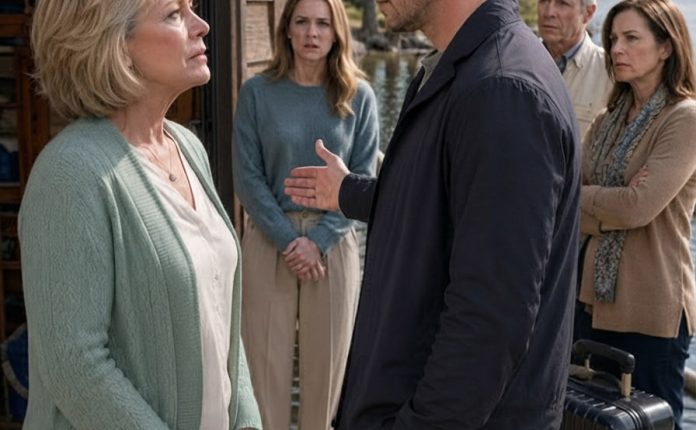
At sixty-eight years old, I never imagined I would stand barefoot on my own front lawn while my only son threw my clothes into the street. Two suitcases landed beside me, followed by a cardboard box that split open across the sidewalk.
“Get out, Mom.” Daniel’s voice was flat, almost bored. I stared at him from the bottom step of the red-brick house in Columbus where Robert and I had lived for forty-three years, unable to recognize the man standing above me.
“This is my home,” I said. Daniel laughed and told me his father had left the property to him. Robert had been dead only six weeks, and I was still waking every morning expecting to hear him moving in the kitchen.
Daniel’s wife, Vanessa, stood behind him with her arms crossed. “You need to stop making this harder than it has to be,” she said while another box landed beside my suitcase and several old photographs spilled across the concrete.
One picture showed Daniel at seven years old, missing his front teeth and hugging me after his first baseball game. The adult version of that little boy stepped directly over the photograph without even looking down.
“You said I could stay,” I whispered. Daniel explained that he and Vanessa had changed their minds because they wanted to renovate. When I told him I had nowhere else to go, he shrugged. “That isn’t my problem.”
Something inside me became very still. I had expected grief after losing Robert. I knew loneliness would come. What I had never imagined was betrayal from the child whose fevers I had sat through and whose college tuition we had carefully saved to pay.
Across the street, our neighbor Margaret Campbell watched in disbelief. Daniel grabbed my purse from the hallway and tossed it into the grass. Then he told me I was embarrassing myself and should simply accept that things had changed.
Finally, he said the sentence I would remember forever. “As far as I’m concerned, you’re not my mother anymore.” Then he slammed the door, leaving me beside my belongings while Robert’s photographs scattered across the sidewalk.
For several seconds, I could not move. Then my phone began ringing inside the purse lying in the grass. I almost ignored it until I saw the caller’s name: Michael Harris, the attorney who had handled Robert’s legal affairs for nearly twenty years.
“Mrs. Whitmore?” Michael asked. He sounded relieved when I answered. He had apparently been trying to reach me because the probate documents had been reviewed and Robert had left specific instructions concerning me and Daniel.
My throat tightened. “What instructions?” Michael paused before explaining that Robert had anticipated the possibility of a dispute with our son. I turned toward the locked front door while the meaning of those words slowly reached me.
“The house does not belong to Daniel,” Michael said. “In fact, your son inherited almost nothing.” I lowered myself onto one of the suitcases because suddenly my knees felt too weak to hold me upright.
Michael told me Robert had changed his estate plan three months before his death. I knew he had met privately with Michael, but Robert told me it involved routine documents while he underwent treatment for pancreatic cancer.
At the time, I was consumed with medications, appointments, insurance forms, and making him comfortable. Robert, apparently, had been spending some of those same final months quietly trying to protect me from what he feared might happen afterward.
The deed had been transferred into a revocable trust. I was the primary beneficiary and successor trustee, with full rights to live in and control the property during my lifetime. Daniel had no ownership interest whatsoever.
“But Daniel showed me papers,” I said. Michael explained that the documents Daniel had shown me were copies of an older will from 2016. The simple truth was almost difficult to understand after everything that morning.
“He lied,” Michael said. I closed my eyes. Daniel had confidently stood in my doorway, thrown me outside, and claimed his father had given him the house while knowing the paperwork he carried was outdated.
Michael continued. Robert had also documented several financial transfers Daniel requested during the final eighteen months of his life. Some were described as loans, while others involved pressure serious enough that Robert had started recording detailed notes.
I knew Daniel frequently needed money. There had been a failed restaurant investment, credit-card problems, a new SUV, and a supposed business opportunity involving luxury rental properties. Robert complained, but we usually helped anyway.
“What kind of pressure?” I asked. Michael said Robert believed Daniel was attempting to persuade him to alter the estate plan while he was seriously ill. My hands began trembling just as the front door opened again.
Daniel stepped outside and demanded to know why I was still there. I covered the phone and told him I was speaking with Michael Harris. His face changed immediately, not dramatically, but enough that I noticed.
Vanessa appeared behind him and asked what Michael wanted. I stood while the attorney spoke through the phone. “Do not leave your property unless you believe you are physically unsafe. Daniel has no legal right to remove you.”
I looked at my son. “Michael says the house belongs to me.” Daniel’s jaw tightened. He insisted that was not what Robert had told him. I added that Michael said he had used an old will.
Vanessa turned toward Daniel with uncertainty in her face. Daniel came down the steps and ordered me to give him the phone. I refused and stepped backward while Margaret continued watching from across the street.
Another neighbor had appeared too. Daniel noticed the witnesses and immediately lowered his voice. Suddenly he was telling me everything was simply a misunderstanding rather than the permanent eviction he had announced minutes earlier.
“You threw me outside,” I reminded him. Daniel claimed I had been difficult. I pointed toward Robert’s photographs scattered near the sidewalk. Then Daniel said something that revealed how frightened he had become.
“Whatever that lawyer told you, don’t sign anything.” Michael heard him and strongly recommended that I contact police and document exactly what happened. Daniel appeared to understand what was being said even though he could not hear every word.
“You call the police on me, and we’re done,” Daniel warned. I looked at the man in front of me and remembered every excuse I had made for his selfishness, temper, financial mistakes, and endless requests.
Whenever Robert said Daniel needed to grow up, I defended him. “He’s our son,” I would say. Now Daniel had finally shown me what being his mother meant to him: loyalty, money, silence, and obedience whenever he demanded them.
I put the phone back to my ear. “Michael, send me everything. And call whoever you think needs to be involved.” Daniel’s face went pale. For the first time that afternoon, he looked genuinely frightened rather than angry.
He had finally realized that throwing me out had not made him powerful. It had exposed exactly what he had done. The police arrived twenty-two minutes later, after Margaret crossed the street and helped me gather my belongings.
Margaret was seventy-one, widowed, sharp-minded, and completely unimpressed by my son. She immediately told the officers she had seen Daniel pull me by the arm and force me from the porch while throwing my belongings outside.
Daniel denied dragging me. Margaret looked directly at him and replied, “I watched you.” Daniel looked away. Officer Reynolds then asked me to describe the morning from the beginning.
Daniel and Vanessa had arrived with two men from a moving company, claiming they needed to clear several rooms before renovations. When I objected, Daniel announced that Robert had left him the house and ordered me to leave.
I refused. Daniel grabbed my upper arm, pulled me toward the door, and moved my suitcases outside. He had not punched me or thrown me to the ground, but he used enough force to leave a visible red mark.
Officer Reynolds photographed my arm. Daniel stared at her and asked whether she was serious. “Very,” she replied before requesting proof that he legally owned the house he had tried to take.
Daniel produced the old 2016 will. The second officer glanced through it and explained that it did not prove current ownership. Daniel’s confidence weakened almost immediately. He stepped away and called someone, probably his own lawyer.
Police allowed me back inside while ownership was being clarified. The house looked violated. Kitchen drawers stood open. Boxes had been packed. Robert’s reading chair had been shoved against the wall, and his framed Navy photograph lay face down.
For the first time since Robert died, grief changed into real anger. My husband had spent his final months worrying about what might happen to me. I had spent those same months insisting Daniel would eventually become responsible.
I had been wrong.