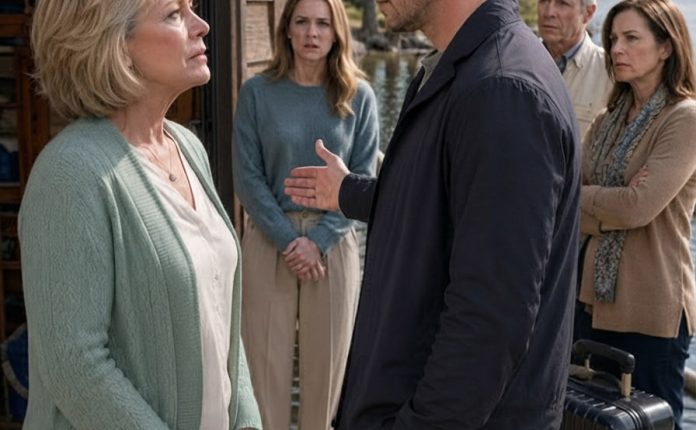
At six that evening, Michael arrived carrying a thick folder and leather briefcase. Daniel and Vanessa were still there because officers had instructed everyone to wait until the legal ownership of the property was properly clarified.
Michael greeted me before turning toward Daniel. “I believe you and I should speak.” Daniel folded his arms and accused Michael of ignoring what Robert supposedly wanted. Michael answered without hesitation.
“Your father was extremely clear.” He placed three documents on the dining table: the trust agreement, Robert’s updated will, and the deed transfer. My name appeared repeatedly throughout all three.
Michael pointed to the relevant paragraph explaining that upon Robert’s death, Eleanor Whitmore became successor trustee and retained full beneficial use of the property for the remainder of her life. Daniel stared at the page in silence.
Vanessa leaned over his shoulder and asked what happened after my death. Michael explained that the house would then be sold, with the proceeds divided between two charities and a trust created for Daniel’s daughter, Emily.
Daniel turned toward me. “You cut me out?” I told him truthfully that I had known nothing about the arrangements. “Dad cut me out?” he demanded. Michael answered, “Mostly.”
Daniel wanted to know why. Michael removed another collection of documents and told us Robert had written a letter explaining his reasoning. I had never known about the letter either.
Michael handed it to me first. Robert’s handwriting covered three pages, the lines uneven because medication had caused his hands to tremble during his final months. The letter was addressed directly to Daniel.
Robert began by saying he loved his son, but love did not require financing Daniel’s choices forever. Then he listed money Daniel had borrowed over several years, far more than I had realized.
There was thirty thousand dollars for the failed restaurant, sixteen thousand for credit-card debt, twenty-two thousand for the SUV, and nearly fifty thousand for a property investment that apparently never existed.
I looked up immediately. “Fifty thousand?” Daniel said nothing. Michael explained that Robert had withdrawn the money from his private investment account. I stared at my son because he had told us he needed only fifteen thousand.
“The deal changed,” Daniel muttered. I asked what property he had been purchasing. He tried to dismiss the question, but Vanessa now looked equally confused. Apparently, she had not known either.
Daniel finally claimed the investment had fallen through. Michael interrupted. Robert did not believe there had ever been a real property deal because he repeatedly requested documentation and Daniel never produced any.
Vanessa stepped away from her husband. “What did you do with fifty thousand dollars?” Daniel told her it was not the time. Michael calmly said there was more.
Robert had discovered that Daniel was gambling online. Not occasionally. Over three years, he accumulated serious losses, borrowed money from friends, used cash advances, and opened a line of credit without telling Vanessa.
The supposed property investment had been another lie used to obtain money from his father. Vanessa slowly sat down, her face losing color as Michael explained what Robert had uncovered.
“You told me we were buying a duplex,” she whispered. Daniel remained silent. Vanessa reminded him that he had even shown her photographs of the supposed property. Still, he offered no explanation.
Something inside me finally snapped, though strangely it did not feel painful. For years, an invisible rope had tied me to the version of Daniel I desperately wanted to believe still existed.
I imagined the loving son, confused young man, pressured husband, and father who needed only one more chance. Standing in that dining room, I finally accepted that much of that person had always existed mostly in my imagination.
Michael placed Robert’s letter in front of Daniel. My son refused to take it. Then Michael explained that Robert had also anticipated Daniel might try taking possession of the house before I understood the trust.
Daniel laughed bitterly and asked whether his father had considered him some kind of criminal. Michael did not respond emotionally. Instead, he said Robert had inserted a specific clause into the estate plan.
“If you harass, threaten, coerce, or attempt to unlawfully remove your mother from the residence, your remaining inheritance is forfeited.” Daniel’s smile disappeared immediately.
“What remaining inheritance?” he asked. Michael explained that a brokerage account valued at approximately $180,000 had been reserved for him, provided he respected the conditions Robert created to protect me.
Nobody moved. Daniel looked from Michael to me before accusing him of lying. Michael opened another document. “No.” Daniel grabbed the page and read quickly, his eyes moving across the language.
“What exactly does forfeited mean?” he asked. Michael answered plainly. “It means you lose it.” Daniel demanded to know whether his actions that morning were enough to trigger the clause.
Michael explained that the matter would need formal review, but there were witnesses, police documentation, photographs, and my statement. Daniel suddenly looked much younger—scared, desperate, and cornered.
“Mom,” he said softly. I recognized that tone immediately. He had used it after wrecking his first car, when the restaurant failed, and every other time he needed me to rescue him from consequences.
He claimed he had only been upset. I reminded him that he told me I was no longer his mother and threw my belongings into the street. Daniel called everything a terrible mistake.
Margaret, still near the kitchen doorway, made a quiet sound of disbelief. Daniel ignored her and moved closer, insisting Robert had been sick and possibly confused when he changed the estate documents.
Michael calmly explained that argument would be difficult to support. Daniel pointed at him and ordered him out of the conversation. “He is my lawyer,” I said.
Daniel immediately switched tactics. “I’m your son.” The word he had rejected only hours earlier suddenly became useful again. I repeated it slowly. “My son.”
“Yes,” he said. I reminded him again that he had declared I was no longer his mother. Daniel insisted he had only been angry. I looked at him and thought about my own grief.
“So was I when your father died,” I said. Daniel asked what that had to do with anything. “Grief did not make me throw you into the street.”
Before he could answer, Vanessa stood and announced she was leaving with Emily to stay at her sister’s home. Daniel looked stunned and told her not to overreact.
Vanessa’s voice broke as she confronted him about the gambling losses and years of lies. Daniel told her they could discuss everything privately at home. She answered with one word.
“No.” Suddenly Daniel’s entire life seemed to be collapsing in the same room: the house he believed he controlled, the inheritance he expected, his marriage, his reputation, and the lies he had protected.
Yet somehow he still looked at me and said, “You did this.” I stared at him, unable to understand. Daniel blamed me for calling Michael.
“Michael called me,” I reminded him. Daniel froze. I pointed toward my purse. “You threw me outside. Then my phone rang.” He opened his mouth, but nothing came out.
That was the moment he finally understood there had been no revenge plan. No trap. No calculated confrontation. He had destroyed himself through arrogance, entitlement, and the assumption that I would never defend myself.
Michael closed the folder and recommended changing the locks that evening. Daniel looked at me incredulously. “You’re kicking me out?” I reminded him that the house was not his residence.
He asked whether I was really willing to do this to my own son. I thought about every birthday, school concert, parent-teacher meeting, loan, second chance, and excuse I had given him.
Then I looked toward the photographs still lying near the doorway. One showed Daniel at seven years old with his arm wrapped around my waist and his face pressed against my winter coat.
I remembered that child. I loved that child. Perhaps some part of me always would. But the adult man standing before me had spent years making choices the child in that photograph had not made.
“Yes,” I said. Daniel stared at me for several seconds before walking upstairs and packing a bag. He and Vanessa left separately that evening.
Two weeks later, Michael confirmed that Daniel’s conduct had triggered the forfeiture clause. Daniel hired an attorney and challenged the provision, claiming Robert had not been mentally competent when he changed the estate plan.
The challenge failed. Robert had been careful. Two physicians documented his mental competence, and Michael had video from the signing in which Robert clearly explained every provision and why he wanted it included.
Daniel received nothing from the $180,000 brokerage account. Most of the money was redirected into Emily’s trust. I supported that completely because my sixteen-year-old granddaughter had done nothing wrong.
For three months, Daniel did not contact me. Then one evening my phone rang. I almost ignored it, but eventually answered. “Mom?” His voice sounded exhausted rather than demanding.
“Yes,” I said. Daniel told me he wanted to apologize. I waited. His first words were that he had been under enormous pressure, and I nearly ended the call.
Then he added something I had rarely heard from him. “But that doesn’t excuse what I did.” He told me Vanessa had filed for separation and that he had entered a gambling recovery program.
He had sold his truck, moved into a small apartment near Dayton, and started trying to rebuild his finances. “I know you probably hate me,” he said. I told him I did not.
“Then can we go back to normal?” Daniel asked. My answer came quietly but immediately. “No.” There was a long silence before he repeated the word as though he had never expected to hear it from me.
I explained that maybe one day I could forgive him, but normal was exactly what had allowed everything to happen. Normal meant I rescued him every time his decisions became painful.
Daniel started crying. I had heard him cry only twice as an adult—when Emily was born and at Robert’s funeral. “Mom, I lost everything,” he said.
I looked around my living room. Robert’s reading chair was back beside the window, his Navy photograph stood upright on the mantel, and the house was peaceful again.
“No,” I said. “You lost the things you believed you were entitled to.” Daniel became silent. I reminded him he still had his life, his daughter, and time to become someone she could trust.
We spoke for another ten minutes. I did not offer money, invite him home, or promise to solve anything. When the call ended, I cried alone in Robert’s chair.
I did not cry because I regretted protecting myself. I cried because understanding someone’s failures does not automatically erase love. Sometimes understanding simply means refusing to let love continue making every decision.