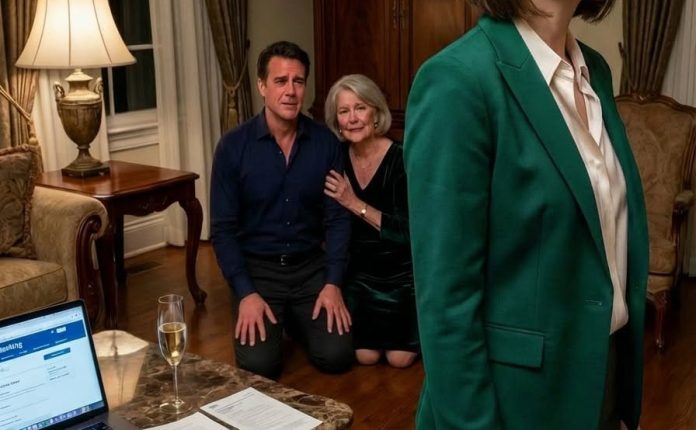
Part Three Maya told me not to confront Aaron until we had authenticated the documents. She requested copies through formal channels and hired forensic accountant Leo Grant to examine our accounts. I spent the next week nursing Benjamin, helping four daughters with homework, and pretending our house was not filled with invisible tripwires.
Aaron became attentive again. He made coffee, packed lunches, and offered to take night feedings. Once, he sat beside me while Benjamin slept and said, “I know the trust surprised you. I should have explained earlier.”
“Why didn’t you?”
“Because Dad’s condition was ridiculous, and I hated admitting it mattered.”
That answer almost sounded human.
Then he added, “But now it’s done. We can finally breathe.”
I looked at him. “We?”
He did not notice the question inside the word.
Leo’s first report arrived Friday morning. Mercer Strategic Holdings had used the borrowed money to purchase two commercial properties with Aaron’s college friend, Travis Cole. Both projects were losing money. Loan interest had accumulated. Several lenders expected repayment within ninety days of the trust distribution.
Aaron had not been waiting for a son because he dreamed of baseball games.
He needed Benjamin’s birth to stop a financial collapse.
Worse, ninety thousand dollars from our joint savings had covered interest payments. Another forty-five thousand had been transferred from accounts labeled for the girls’ education.
When I saw that, I stopped breathing.
Each daughter had a college account funded by birthday gifts, my freelance work, and money Richard gave them annually. Aaron had withdrawn from all four.
Sophie had lost eighteen thousand dollars.
Grace, eleven.
Mia, nine.
Evelyn, seven.
I stared at the spreadsheet until the numbers blurred.
I remembered helping Sophie choose a savings chart for school and hearing Aaron praise her for putting birthday money away. He had taught our daughters to save while quietly taking from them. That contradiction hurt differently from the debt. Money could be restored. Their belief that their father protected what belonged to them would take much longer to repair, if it ever could be repaired.
The next discovery was worse.
My supposed electronic signature on the loan guarantee had been generated using a digital certificate linked to Aaron’s private office computer. Leo found metadata showing the file was created while I was at an obstetric appointment.
Maya advised immediate legal action to freeze certain marital assets.
I agreed.
The court issued a temporary financial restraint before Aaron knew I had filed. That afternoon, his company card stopped working during a lunch meeting. He came home furious.
“What did you do?”
The girls were upstairs.
Benjamin was asleep against my chest.
“I protected what remains.”
Aaron stared at me. “You froze our accounts?”
“Extraordinary transfers. Household expenses are untouched.”
His face changed. “Maya told you to say that?”
“No. The court order says it.”
He paced the kitchen. “You have no idea what you’re interfering with.”
“Then explain it.”
“I have obligations.”
“To lenders who gave you three point four million dollars because you promised them money from your father’s trust?”
He stopped.
The silence confirmed everything.
I continued. “Did you forge my signature?”
“No.”
“Did you take money from the girls?”
“I borrowed it.”
“Without telling me.”
“I was going to replace every dollar.”
“When Benjamin unlocked the trust.”
Aaron slammed his palm against the counter. Benjamin startled and began crying. I stood immediately.
“Do not do that near him.”
Aaron lowered his voice, but anger still shook it. “I was trying to protect this family.”
“You gambled our savings and our daughters’ money on investments tied to a child who had not even been conceived.”
“You think small. That has always been your problem.”
The sentence landed differently than he intended.
I looked around the kitchen where I had managed meals, school forms, doctor visits, budgets, birthday parties, laundry, pregnancies, and every invisible task holding seven people together.
“Small?”
“You care about pennies while I build assets.”
“You stole from children.”
“I invested for them.”
“You borrowed against a trust you might never receive.”
“But I received it.”
“No. Benjamin was born. That is not the same thing as you earning anything.”
His expression hardened.
Then he said, “This is why Dad never discussed business with you.”
I almost smiled.
“Your father discussed more with me than you think.”
That was not a bluff. Richard had once told me privately that he worried Aaron confused risk with intelligence. At the time, I defended my husband.
The next day, Richard’s estate attorney called me.
His name was Samuel Park.
“I understand you have questions about the Mercer Legacy Trust.”
“Yes.”
“There is something your husband may not have explained.”
I gripped the phone.
Samuel asked me to come to his office with my attorney.
Maya and I arrived that afternoon. Samuel placed the trust instrument on the table. The provision Aaron described was real, but his interpretation was incomplete.
Richard had indeed created a conditional distribution involving a male descendant. If Aaron had a biological or legally adopted son before the youngest existing grandchild turned five, certain business interests would remain in the Mercer family trust.
But Aaron was not the automatic beneficiary.
The qualifying child was.
Benjamin.
The twelve million dollars in assets did not belong to Aaron. They would remain in trust for Benjamin until adulthood, managed by independent trustees.
Aaron could receive limited distributions only for Benjamin’s health, education, and welfare.
He could not use the trust to repay personal loans.
I laughed from sheer disbelief.
“So the three point four million he borrowed…”
“Was based on lenders believing he expected substantial personal access,” Samuel said. “Whether he misrepresented that is for them to determine.”
Maya leaned forward. “Did Richard know Aaron was borrowing?”
Samuel’s expression became grim. “Near the end of his life, yes.”
He opened another file.
Richard had discovered one lender presentation describing the trust as Aaron’s “pending inheritance.” He confronted Aaron six weeks before his death and demanded the documents be corrected. Aaron promised they would be.
Richard then amended the trust.
If Aaron attempted to pledge, divert, or misrepresent Benjamin’s trust assets for personal benefit, Aaron would be removed from every management role and lose his own separate inheritance.
“How much was Aaron’s separate inheritance?” I asked.
“Approximately four million dollars.”
My stomach dropped again.
Samuel continued. “Richard also left instructions that if a qualifying grandson were born, the child’s mother must receive independent notice of the trust within thirty days.”
Benjamin was nine days old.
Aaron had been racing to make me sign something before that notice arrived.
The “routine estate documents” suddenly made sense.
I asked Samuel to show them if he had copies.
He did.
One document appointed Aaron sole family representative for communications regarding Benjamin’s trust. Another acknowledged that I had received independent legal advice.
I had not.
A third authorized reimbursement of “prenatal and household expenditures” from trust-related funds up to six hundred thousand dollars.
Maya stared at the page.
“Aaron wanted her signature on this?”
Samuel nodded. “He submitted drafts yesterday asking whether signed copies would accelerate distribution.”
My hands turned cold.
Aaron was not simply hiding debt.
He was preparing to use our newborn son’s trust to rescue himself.
Samuel’s phone rang. He answered, listened, and looked at me.
“What happened?” I asked.
He ended the call.
“Aaron is downstairs.”
“With whom?”
Samuel looked toward Maya.
“His mother and two lenders.”
Then he added, “And they believe you already signed.”