Part Two I drove back to Raleigh that night with both hands tight around the steering wheel. The victory I had imagined never arrived. Beneath the anger was an old ache, because some foolish part of me had brought the restructuring papers hoping Dad might finally see my competence and accept help without turning it into a contest.
At 11:40, I called Naomi Chen, Rowan Bridge’s attorney and one of my partners. She listened without interrupting as I described the threat. “He may be bluffing,” she said, “but we treat specific language seriously.” Within twenty minutes, she had alerted our litigation counsel and the loan’s collateral monitor.
The next morning, we requested an emergency inspection permitted under the default provisions. We also searched public filings for new liens and transfers. Nothing had moved yet. That did not comfort me. Dad understood construction, Uncle Victor controlled accounting, and Evan signed whatever they placed in front of him. Together, they could cause enormous damage quickly.
Madison called while I was reviewing bank statements. She was twenty-seven, a middle-school music teacher, and the only family member who occasionally challenged Dad in public. “Mom cried after you left,” she said. “Dad told everyone you forged the papers. Victor kept saying they could move the yellow equipment before Monday.”
I asked where. Madison hesitated. Helping me meant opposing the people who had paid her college tuition and treated loyalty like a permanent debt. Finally, she said Evan owned a dormant company called Queen City Site Services. She had designed its logo two years earlier when he claimed he might start renting excavators.
Naomi found the company within minutes. Its registered address belonged to Aunt Patricia, and it had filed no meaningful revenue. At 2:15 Saturday afternoon, a security camera at Hayes Development’s equipment yard showed two lowboy trailers entering through the rear gate. Our collateral monitor sent still photographs while the machinery was being loaded.
We did not race there and create a dramatic confrontation. Naomi called local counsel, who contacted a judge assigned to emergency matters. The loan documents, Dad’s statement, and live photographs supported a temporary restraining order against transferring collateral. A sheriff’s deputy delivered it before the first trailer left the property.
Dad telephoned me six times. I answered the seventh. “You sent police to my company,” he shouted. I corrected him: a civil order had been served by a deputy after someone attempted to move pledged equipment to an insider’s shell business. “That is theft,” he said. “Those machines belong to me.”
“They belong to the company, and the company pledged them.” He accused me of setting a trap. I reminded him that I had offered time, working capital, and a path through the default. He had answered by attempting an undisclosed transfer less than twelve hours later. His silence lasted just long enough to confirm Uncle Victor’s involvement.
On Monday, our counsel filed for a limited receivership. Dad’s attorneys argued that Rowan Bridge was exploiting family information, but they could not explain the missed payments, hidden liens, or attempted transfer. The judge appointed Elena Ruiz, a respected restructuring professional, to oversee cash, protect collateral, and investigate transactions while operations continued.
Elena arrived at Hayes Development on Tuesday morning. I went with her, not as Dad’s daughter but as a representative of the secured lender. The receptionist, Denise, stared at me with damp eyes. She had slipped restaurant gift cards into my coat pocket when I was an underpaid coordinator working late near Christmas.
“Are we losing our jobs?” she asked. I told her our first priority was keeping viable work moving and wages paid. I could promise a fair process, not a painless one. That answer was less comforting than a lie, but Denise nodded. Employees who build real things generally know the difference between reassurance and a plan.
Dad waited in the conference room with Victor and two lawyers. His birthday confidence had vanished. Elena explained her authority, requested passwords, and froze payments to officers and related companies pending review. When Victor objected, she showed him the court order. Dad stared through the glass wall as staff members watched from their desks.
“You wanted this,” he said after Elena left to meet the controller. “You wanted to parade me past my employees.” I closed the door. “I wanted you to sign a restructuring agreement at dinner. You chose the parade.” He said the equipment transfer was temporary storage, a claim no document supported.
Before leaving the conference room, I asked Dad to cooperate with the audit. I told him Rowan Bridge would consider restoring management authority if he disclosed related-party payments and helped recover the funds. He folded his arms and asked whether I expected him to beg. I said I expected him to protect the business he claimed to love. Victor interrupted, insisting the accountants would find bookkeeping errors, nothing more. Elena returned with a banker’s box recovered from Victor’s locked cabinet. Its folders contained duplicate invoices bearing different descriptions but identical amounts. Dad glanced at the labels before looking away. That small movement convinced me he recognized them. I left the room understanding that his pride was no longer the greatest obstacle. Someone inside the family had been using the company as a bank.
I asked why Hawthorne Commons was seventeen months late when its presales had been strong. Dad blamed labor shortages, interest rates, city inspectors, rain, and an unreasonable lender. All were real pressures, but none explained why three million dollars had disappeared from a project account without corresponding construction expenses.
For the first time, he looked frightened instead of furious. Victor immediately said I had misunderstood consolidated cash management. I had heard that phrase from dishonest owners before. It sometimes meant one project temporarily supported another. Here, repeated round-number transfers had flowed to vendors with no visible crews, materials, or contracts.
Elena’s forensic accountant discovered that Queen City Site Services had received 620,000 dollars over eighteen months. Another vendor, Piedmont Strategic Consulting, had received 410,000. Its mailing address was a condominium owned by Victor’s girlfriend. Dad had approved every payment above 100,000 dollars, although Victor claimed they were routine field expenses.
At noon, Mom arrived carrying Dad’s medication and a paper bag of sandwiches. She looked small inside the lobby Dad had decorated with photographs of himself beside cranes. When she saw me, she asked whether I was enjoying this. The question landed harder than his insults because her voice carried genuine bewilderment.
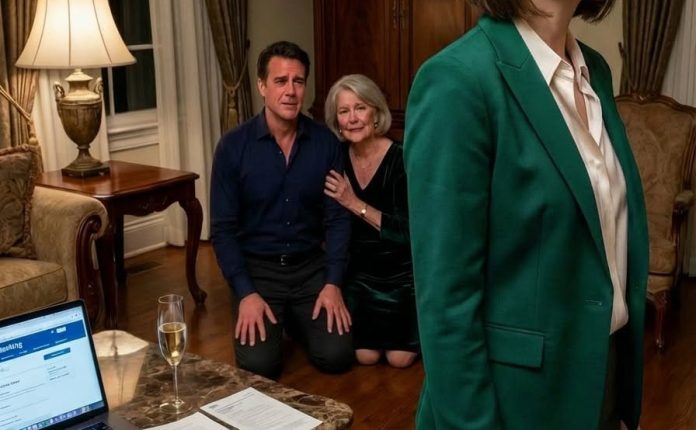
I took her into an empty office and showed her the attempted transfer photographs. Mom looked away. “Your father panicked,” she said. “You embarrassed him in front of everyone.” I asked why his embarrassment mattered more than a company supporting eighty-three households. She told me family should solve problems quietly, although quiet had always meant protecting Dad.
Then I asked whether she understood the personal guarantee. She said Dad had mentioned signing routine renewal papers but assured her their home and retirement accounts were protected. When I explained that the guarantee referenced jointly owned property, all color left her face. “I never signed anything involving the house,” she said.
Elena entered carrying a scanned closing document. Beneath Dad’s signature was my mother’s name, written in slanted blue ink. Mom gripped the desk and stared at it. “That isn’t mine,” she whispered. Before I could answer, Elena said the original lender’s notary log showed both my parents supposedly appearing together on a day Mom had been hospitalized.