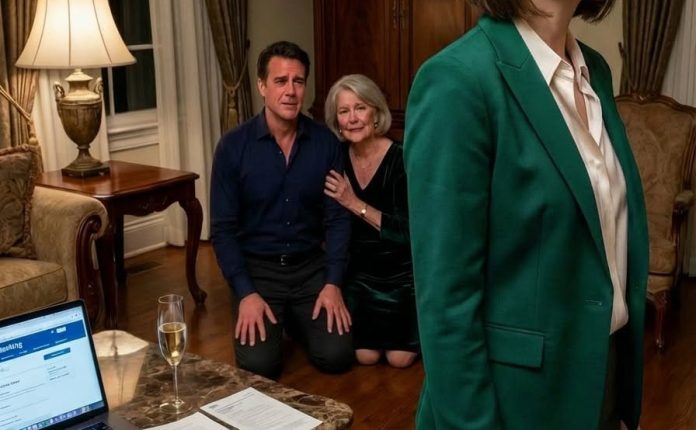
Part Four For several minutes, I felt twelve years old again, waiting outside his study with a report card he dismissed because one grade was not perfect. Then the feeling passed. His plan had failed because I had not ordered a reckless seizure. Every step after dinner had been documented, reviewed by partners, and approved through lawful channels.
Naomi preserved the drive and delivered a forensic copy to Elena. Our attorneys notified the judge and the original lender’s compliance department. The executive who corresponded with Dad was placed on leave. Federal investigators later examined whether he had disclosed confidential bidding information and expected compensation. I made no public accusations beyond confirmed filings.
Dad’s attorneys withdrew his challenge to the receivership. Victor attempted to negotiate immunity by blaming Dad, while Evan claimed he believed Queen City’s payments were legitimate equipment-rental revenue. The invoices contradicted him. Elena froze the boat, recovered two machines hidden on Patricia’s property, and sought repayment of fraudulent transfers through civil claims.
Mom filed a police report concerning her signature and hired separate counsel. A handwriting examiner supported her account, and hospital records established she could not have appeared before the notary. The guarantee against her interest in the house was eventually declared unenforceable. Dad’s personal interest remained exposed, but Mom was allowed to protect hers during their separation.
The company’s recovery took months, not one triumphant afternoon. Hawthorne Commons was too damaged to finish under the original plan, so Elena negotiated a sale to a regional developer. The price repaid project liens, stabilized cash flow, and reduced Rowan Bridge’s balance. Two smaller commercial builds reached completion under new supervision.
I spent Tuesdays in Charlotte reviewing schedules with Elena and the remaining managers. Some employees distrusted me, reasonably. I answered questions, published payment priorities, and never asked them to call me their savior. Denise became office operations manager after demonstrating she understood the company’s obligations better than three executives had.
We laid off eleven employees whose divisions had no sustainable work. I met each person with the receiver, explained severance limits, and provided references and placement contacts. Saving a business did not mean saving every position. That was the hardest truth, and I refused to disguise it with speeches about resilience.
Dad resigned as chief executive under a settlement approved by the court. He surrendered his voting control, his interest in the lake property, and claims against the company. In return, civil recovery actions did not pursue certain exempt retirement funds. Separate investigations into the forgery and insider transfers continued without promises from us.
Victor ultimately pleaded guilty to a financial crime involving falsified invoices and agreed to restitution. Evan avoided prison but sold the boat and refinanced his house to resolve the receiver’s claims. Aunt Patricia stopped inviting us to holidays, telling relatives I had destroyed the family over paperwork. Madison replied that signatures and stolen money were not paperwork.
Dad was charged under state law for the forged guarantee. He entered a plea that included probation, community service, and restitution after prosecutors weighed his age, lack of prior convictions, and cooperation. Some people said the outcome was too lenient. Others said any charge was cruel. Neither group had lived inside our family.
Rowan Bridge did not take over an empire for pennies. After asset sales, recoveries, fees, and our additional financing, the loan produced a modest profit over eighteen difficult months. More importantly, a buyer acquired Hayes Development’s healthy operations and retained sixty-four employees. The Hayes name disappeared from the trucks the following spring.
I worried that losing the name would hurt. Instead, seeing the new blue lettering felt like watching a building finally removed from unstable ground. I remained with Rowan Bridge, expanded our restructuring work, and instituted a rule requiring direct employee-impact reviews before any distressed investment. Experience had made our spreadsheets more human.
Mom rented a townhouse near Madison’s school. She started therapy, learned online banking, and discovered Dad had handled money partly to keep her dependent. Her recovery was uneven. Some mornings she defended him; some evenings she remembered another deception and cried. I stopped demanding that she understand thirty-seven years all at once.
She apologized for looking at her plate during the birthday dinner. “I told myself staying quiet kept things from getting worse,” she said. “It only told him whom he could hurt.” I accepted the apology without pretending it erased every earlier silence. We began having breakfast twice a month, building trust through ordinary promises kept.
Madison never released the restaurant video publicly, though copies continued circulating. She paid the legitimate portion of her graduate-school loan through an attorney, refusing Dad’s invented penalties. She also started teaching a weekend music program for children whose parents worked construction schedules. Denise helped her find the first families.
My father called months later. By then, he lived in a furnished condominium and consulted occasionally for an old friend. He asked to meet at a coffee shop. Naomi saw no legal concern, and my therapist asked what outcome I wanted. I said I wanted to stop rehearsing answers.
Dad arrived early, wearing the same expensive watch he had displayed at countless dinners. He looked older but not transformed. For ten minutes, he explained interest rates, Victor’s pressure, and the humiliation of losing his company. I listened. Then I asked whether he understood why forging Mom’s signature and baiting me were wrong.
He stared out the window. “I knew you were smart,” he said. “I thought making you angry made you stronger.” It was not an apology. It was another attempt to rename cruelty as instruction. I told him strength had grown wherever his approval stopped controlling me, not because he withheld it.
When I stood to leave, he finally said, “I should not have called you useless.” I waited, but he added nothing about the scheme, the employees, or Mom. “No,” I said. “You shouldn’t have believed anyone’s usefulness determined whether they deserved a chair.” Then I paid for my coffee and left.
Two months later, Denise invited former employees to a picnic celebrating the last successful project completion. Folding tables filled a public park, children chased one another between trees, and people brought food in mismatched dishes. No private room, carved chairs, or expensive watches decided who belonged there.
Mom sat beside me. Madison tuned a borrowed guitar while Elena argued cheerfully with a superintendent about barbecue sauce. Denise raised a paper cup and thanked everyone who had told the truth when silence was easier. She did not mention my father. His absence no longer occupied the center of every gathering.
I thought about that birthday chair and the sentence I had delivered beside it: You just made a very expensive mistake. At the time, I meant the loan, the collateral, and the generous terms Dad had thrown away. Those losses were enormous, but they were not his greatest cost.
His real mistake was believing humiliation created loyalty, that money erased accountability, and that a quiet daughter remained powerless forever. Mine had been believing success would eventually persuade him to value me. It did not. Success simply gave me enough distance to understand that his judgment had never measured my worth.
Denise waved me toward the buffet because the children were taking all the cornbread. I stood, pulled out a folding chair for Mom, and then took the empty one beside her. Nobody pushed it away. Nobody asked what I owned. We ate while Madison played, and for once, belonging cost nothing.
THE END!
Disclaimer: This fictional story is for entertainment only. It does not represent any person or organization and does not encourage inappropriate behavior.