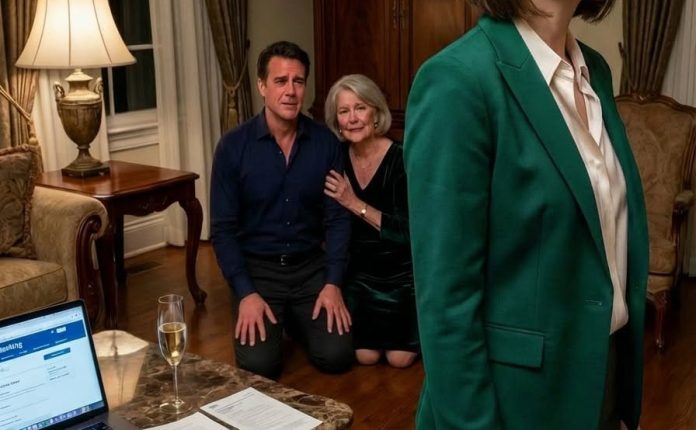
Part Four The bank record frightened me because it resembled the evidence that had destroyed Claire the first time. A number, a signature, and a story simple enough to believe. Eleven years earlier, Adrian had looked at papers like those and chosen them over his sister. Sitting beside her now, I understood how easily history could repeat itself.
Claire withdrew her hand.
“I need some air.”
I followed her into the corridor.
She turned before I could speak. “You think I took it.”
“I don’t know what I think.”
“That is what Adrian said.”
The comparison stung.
“I am not Adrian.”
“Then don’t look at one page and decide who I am.”
“I didn’t.”
“You hesitated.”
“Yes, because I have discovered more about my wife in three weeks than I learned in eight years.”
She went quiet.
Finally she said, “Then let’s find out what the page means.”
That became the difference between my response and Adrian’s. I did not have to pretend certainty. I only had to refuse to turn uncertainty into a verdict.
The account had indeed been opened in Claire Wentworth’s name, but the address belonged to a serviced office leased by one of Victor’s companies. The identification copy came from personnel records. The money left the account within twenty-four hours and moved through three entities controlled by Victor.
The signature was convincing because it had been traced from a genuine board document.
Claire had never received the money.
For once, the truth had records strong enough to survive a man’s denial.
A retired bank employee then remembered Victor personally delivering paperwork while claiming Claire was traveling and needed the transaction handled urgently. Archived visitor logs confirmed he had entered the branch that afternoon.
The evidence that once looked devastating became another piece of the fraud.
When Eleanor called with the result, Claire cried.
I sat beside her on our kitchen floor because neither of us had made it farther than the doorway.
“I’m sorry I hesitated,” I said.
She shook her head. “You were allowed to.”
“I wish I hadn’t.”
“I gave you reasons not to know what was possible.”
That was the first honest conversation we had about forgiveness.
Claire apologized without explaining her secrecy away. I admitted that part of my pride had been tied to seeing myself as the man who recognized her goodness when everyone else failed. Discovering I had not known her entire history injured that pride.
“You did know me,” she said.
“I knew the life we built.”
“That is me too.”
Slowly, I believed that.
Victor’s trial began five months later. Prosecutors presented shell-company records, forged authorizations, deleted emails, the attempted settlement, and testimony from former employees. Claire testified for two days.
Victor watched her from the defense table.
When his barrister suggested she had disappeared because she was guilty, Claire answered calmly.
“I disappeared because everyone with power around me told me the lie was stronger than I was.”
Then she looked toward Adrian.
“My brother believed them. I believed them too.”
The courtroom became silent.
Victor was eventually convicted of fraud, forgery, conspiracy, and offenses related to concealing estate assets. The court imposed a lengthy prison sentence. Civil judgments recovered substantial property, though several million pounds were never found.
Money could be traced.
Years could not.
The probate court recognized Charles’s codicil and restored Claire’s shares.
On paper, our family became wealthy.
In practice, the first thing Claire bought was a new washing machine because ours had been making a terrible grinding noise for six months.
The second was a reliable used truck for me.
I refused anything more expensive.
“You married a beggar,” she teased. “Apparently I married a stubborn farmer.”
We did not leave Ashcombe.
Claire hired professional advisers, placed most assets in managed trusts, and sold enough shares to reduce her exposure to the company without abandoning the inheritance her father intended. She kept a smaller voting stake and required stronger independent financial oversight at Wentworth Maritime.
Adrian remained chairman for another three years.
His relationship with Claire was harder to rebuild than newspaper stories suggested. He apologized many times. She accepted the apology before she trusted him.
At first they met only with me present.
Then for coffee.
Then occasional family dinners.
Adrian’s children met Samuel and Lily.
Nobody pretended eleven missing years could be repaired by one reunion.
Ruth adjusted to the wealth by continuing to tell Claire when her pastry was dry.
“I am apparently the only person left who will criticize a millionaire’s apple tart,” she announced.
Claire hugged her.
The village became its own comedy.
People who had called my marriage foolish suddenly described it as romantic destiny. A man who once said Claire would steal my chickens asked whether she could invest in his holiday cottages.
She declined politely.
We did spend money in ways that mattered.
Claire created the Evelyn House Fund, named after my mother and hers together, supporting women leaving homelessness with temporary housing, legal advice, and employment assistance. She refused to put her own photograph on brochures.
“I know what it feels like when people make your suffering into their story,” she said.
We also funded a small community kitchen beside the market where we had first met.
The original bakery wall remained visible from its windows.
Sometimes Claire volunteered there anonymously enough that newcomers assumed she was staff.
One winter afternoon, I found her sitting beside a frightened young woman who had arrived without a coat. Claire was not promising miracles. She was helping her complete a housing form while soup cooled between them.
I waited outside.
When she joined me, I asked whether the memory hurt.
“Less now.”
Years passed.
Samuel became interested in agriculture rather than shipping. Lily loved music and eventually learned piano, making Claire cry the first time she played one of the lullabies her mother remembered from childhood.
Neither child grew up believing money made them extraordinary.
We made mistakes, certainly.
But our cottage remained full of muddy boots, arguments over chores, burned dinners, and chickens that escaped at inconvenient times.
On our twentieth anniversary, Claire and I returned to the market before sunrise.
Most stalls were still being assembled.
We sat on the same stone ledge where I first learned her name.
“You know,” she said, “your marriage proposal was objectively ridiculous.”
“I’ve been told.”
“You barely knew me.”
“I knew enough.”
She smiled.
“Would you do it again?”
I considered everything that followed: two children, eight years of hidden history, anger, courtrooms, wealth, forgiveness, and the terror on her face when those cars arrived.
“Yes,” I said. “But this time I’d ask more questions.”
Claire laughed.
Then she rested her head against my shoulder.
The town had once believed I rescued a beggar.
Later it decided I had accidentally married an heiress.
Both versions were too simple.
Claire did not become valuable when nineteen million pounds appeared on paper, and I had not given her a life she could never have built without me.
We had rescued pieces of each other.
I gave her a place where her surname did not matter.
She gave my quiet life laughter, children, courage, and complications I never could have imagined.
The three luxury cars revealed where she came from.
They did not reveal who she was.
I had already learned that beside a freezing market wall, when a hungry woman accepted two rice cakes and thanked me for treating her like a person.
Everything after that was only proof.
THE END!
Disclaimer: This fictional story is for entertainment only. It does not represent any person or organization and does not encourage inappropriate behavior.