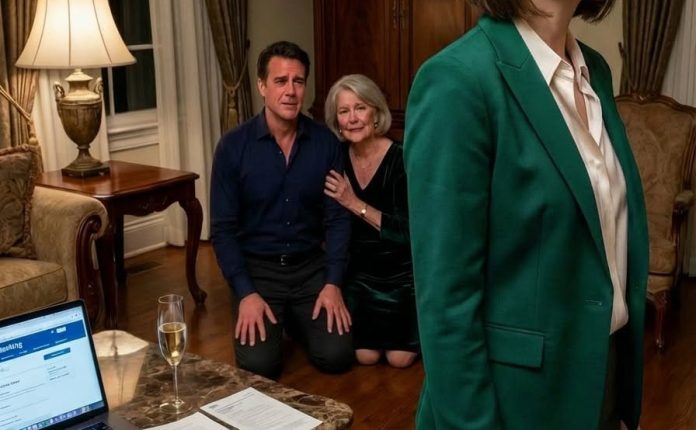
Part Three We watched Charles Wentworth’s recording in our kitchen after the children went to Ruth’s house. Eleanor opened a laptop, inserted the encrypted drive, and entered a password supplied by the retired solicitor. The screen flickered before a man appeared, seated behind a desk with rain streaking tall windows behind him.
Claire gripped my hand.
Her father looked ill. One side of his mouth sagged slightly, and his voice was weaker than expected from photographs Adrian had shown me. Still, his eyes were sharp.
“Claire,” he began, “if you are watching this, then I failed to say something while I still had the courage to say it in person.”
Claire made a small sound.
Charles explained that he had begun reviewing unusual company payments shortly before his stroke. He did not yet know who was responsible, but he had discovered access records connected to Victor’s office and feared his daughter might be blamed because she had challenged several transactions.
“I have been proud of your questions even when they irritated me,” he said. “Do not let anyone convince you that loyalty requires silence.”
The recording lasted eleven minutes.
Near the end, Charles apologized for spending too much of Claire’s childhood working and too little understanding how lonely wealth could make a family. He said he trusted Adrian but worried his son sought approval too easily from older men, especially Victor.
Adrian lowered his head.
Then Charles spoke about the shares.
“I divided control because neither of my children should ever depend entirely on the judgment of the other. Claire, your portion is yours. Not Victor’s. Not Adrian’s. Yours.”
When the screen went dark, Claire walked outside and was sick beside the hedge.
I followed but gave her space.
Eventually she sat on the back step.
“He knew,” she whispered.
“Some of it.”
“He knew enough to warn me, and Victor buried it.”
I sat beside her.
After a while, I asked the question that had been growing since morning.
“Why didn’t you ever tell me who you were?”
Claire wiped her face.
“Because I liked who I was with you.”
“That isn’t an answer.”
“It is part of one.”
She told me that when she first reached Ashcombe, she had been sleeping in a hostel under her mother’s surname. She expected every police car to stop for her and every stranger to recognize the newspaper photograph Victor had circulated. Months passed. Nothing happened. Fear slowly became embarrassment.
Then she met me.
“You looked at me without knowing my father’s name,” she said. “Do you understand how rare that was in my old life?”
“I understand why you didn’t tell me at the market. I don’t understand eight years.”
She stared at the garden.
“After Samuel was born, I tried.”
“When?”
“One night when he had a fever. You were asleep holding him. I thought if I told you everything, I might destroy the safest thing I had ever had.”
“So you decided for me.”
“Yes.”
The admission hurt because it was true.
Then she revealed something else.
Two years after our wedding, a London solicitor had found her. He represented a company associated with Victor and offered two hundred fifty thousand pounds if she signed away any future claim against Wentworth Maritime and agreed never to challenge the probate settlement.
My anger sharpened.
“You never told me.”
“No.”
“What did you do?”
“I refused.”
“Where is the letter?”
“I kept it.”
She retrieved it from an old sewing box in our bedroom. The document was yellowing at the folds but legible.
I read every line.
The offer was real.
So was the threat beneath it: accepting would resolve “outstanding concerns regarding prior financial conduct.”
“You kept this in our house for six years.”
“Yes.”
“While telling me you had nobody.”
“I was terrified, Benjamin.”
“I know. But you trusted me with children, a mortgage, every ordinary part of your life, and still didn’t trust me with your name.”
Claire cried silently.
I hated seeing it, but I did not take the words back.
Love did not make the deception harmless.
The next morning, Eleanor examined the settlement letter and immediately called investigators. It became important evidence because the company named in the offer was one of Victor’s shell entities.
Within days, police requested Claire’s formal statement.
That meant London.
We traveled as a family, though I nearly stayed behind. Ruth finally said, “You can be furious with her and still stand beside her while she faces the man who ruined her life.”
So I went.
The Wentworth offices occupied twelve floors overlooking the Thames. Claire stopped outside the glass entrance as though facing a battlefield. Samuel took one hand. Lily took the other.
Inside, employees stared.
Some recognized her.
An older receptionist began crying.
“Miss Wentworth,” she whispered.
Claire answered, “Mrs. Cole.”
That mattered to me more than I expected.
The investigation consumed weeks. Claire gave statements about the original transactions, the missing records, and Victor’s threats. Handwriting experts examined the settlement offer. Digital specialists confirmed authorization codes had been generated from devices Claire never used.
The newspapers rediscovered her.
The headlines were unbearable.
MISSING HEIRESS FOUND LIVING SIMPLE VILLAGE LIFE.
BEGGAR BRIDE MAY INHERIT MILLIONS.
FROM ROADSIDE TO BOARDROOM.
Reporters arrived in Ashcombe.
People who had once mocked Claire suddenly claimed they always knew she was “different.” The baker who once asked her to leave the doorway told television cameras he had treated her like family.
Claire turned off the news.
Then opportunists appeared.
A distant cousin called.
An old university friend sent flowers.
Two charities requested meetings before Claire had received a penny.
Mr. Pritchard joked that he hoped we remembered our neighbors when the millions arrived.
I started locking our gate.
The children struggled differently. Samuel wanted to know whether he was rich. Lily wanted to know whether we had to move.
Claire answered both questions the same way.
“We are still us.”
But I was not sure yet.
Our marriage had become polite. We slept in the same bed but often faced opposite directions. I loved her. I also felt foolish for defending her honesty to people who had mocked our wedding while a sealed letter sat upstairs proving she had hidden an entire war.
One evening in London, Adrian asked me to walk with him.
“I understand why you’re angry,” he said.
“You barely know me.”
“I know what secrets do to families.”
I looked at him.
He continued, “Do not make my mistake. Being hurt can feel like permission to stop listening.”
I disliked receiving useful advice from him.
The criminal case against Victor moved toward trial, while civil proceedings sought to restore Claire’s shares and recover diverted assets.
Then Victor’s defense filed its response.
Eleanor read it in our solicitor’s office.
Victor claimed Claire had never been forced into hiding.
He claimed she had participated in the fraud and accepted money to disappear.
Attached was a bank record showing a payment of five hundred thousand pounds into an account bearing Claire Wentworth’s name three days after she vanished.
I looked at my wife.
Claire stared at the page.
“I have never seen that account.”
The solicitor turned to her.
“There’s more.”
Beneath the transfer was a scanned withdrawal authorization.
The signature looked exactly like Claire’s.
For the first time since the cars arrived, even Eleanor had no explanation. Claire reached for my hand, but I hesitated before taking it. She noticed. The hurt in her face was worse than anger.