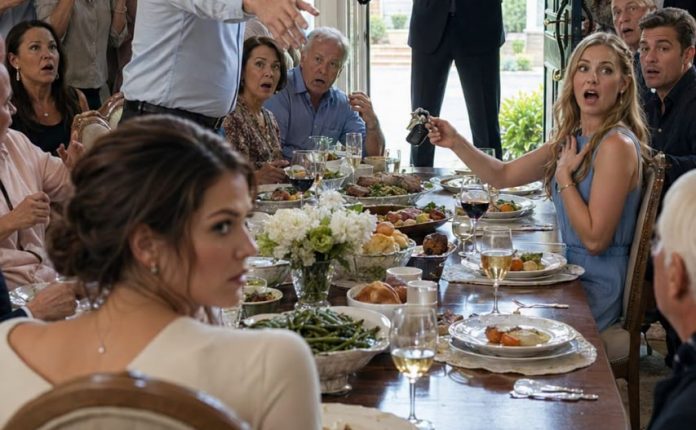
Dad tried anyway. “The foundation issue was something I was considering using the money for indirectly.” Uncle Martin stared at him. “Indirectly?” Dad rubbed a hand across his forehead. “There were multiple financial pressures.” Grandma Evelyn’s voice stayed quiet.
“You told me my daughter’s house was in danger.” “I said there were issues affecting the house.” “You said foundation.” Dad’s jaw tightened. “I was trying to keep the family from panicking.” Mom gave a hollow laugh. “You mean me.”
“Linda—” “You asked my mother for fifty thousand dollars behind my back?” “I was looking at options.” She backed away from him. That was the moment I stopped feeling triumphant. I had imagined exposing the truth would feel satisfying.
Instead, it felt like watching wallpaper peel away from a wall and discovering rot underneath. Uncle Martin asked, “How bad is it?” Dad didn’t answer immediately. Then he admitted the lender had started increasing collection pressure.
Because he and Mom had guaranteed Evan’s loan, they could be pursued if Evan and Marissa didn’t bring the account current. Dad had convinced himself he could patch the problem before Mom fully understood how exposed they were. Borrow from Grandma. Move Evan into my house. Reduce his expenses.
Get payments flowing again. Nobody would need to know how close things had come. It was almost elegant, as long as everyone cooperated. Especially me. Mom sat down hard in a lawn chair. Evan looked furious rather than ashamed.
“So what?” he said. Several people turned toward him. He spread his hands. “Everybody’s acting like I committed some crime. The business didn’t work the way we expected. That happens.” “You stopped paying rent,” Uncle Martin said.
“I had cash-flow issues.” “You went on vacation.” “That was already planned.” “You kept buying product.” “You have to spend money to grow.” Martin looked exhausted. “Evan, you were spending money you didn’t have while your parents were guaranteeing debt for you.”
Evan looked at me. “And Claire has a whole house.” That sentence ended something in me. Not loudly. Not dramatically. But permanently. I had spent my entire life wondering if he understood the imbalance between us. He did.
He simply believed it was correct. I folded my arms. “My house has nothing to do with your debt.” “You’re my sister.” “And?” His face registered genuine shock. “And family helps each other.” I nodded toward the folders.
“Family also tells each other the truth.” Marissa stood beside him. “We never asked your parents to make all these decisions.” I looked at her. “You arrived at my house in a moving truck after I had already said no.” She had no answer.
Grandma Evelyn addressed Dad. “I will not be lending you fifty thousand dollars.” He lowered his head. “I understand.” “No,” she said. “I don’t think you do.” Everyone became still again.
“I love you. I love Linda. I love Evan. Loving people does not require financing every mistake they refuse to face.” Evan looked away. Grandma continued. “You tried to shift the consequences of one child’s choices onto another child who had no part in making them.”
Dad started to interrupt. She raised one hand. “I’m still speaking.” He stopped. “You decided Claire’s discipline made her resources available to the rest of you. Then you punished her when she objected.” Grandma glanced at me.
“She was right to say no.” I swallowed. Those five words affected me more than I expected, maybe because nobody in my immediate family had said them. Grandma looked back at Dad. “You need a financial adviser. You need an attorney.”
“You need to stop borrowing privately to hide one problem underneath another.” Then she looked at Evan. “And you need a job.” Evan laughed bitterly. “I have a business.” “No,” Grandma said. “You have debt.” Nobody improved on that sentence.
The cookout limped along for another hour, but it was over emotionally. People left earlier than usual. Aunt Melissa approached me before she went. “I owe you an apology.” I didn’t rescue her from the discomfort. “Yes.”
She blinked, then nodded. “Yes. You’re right.” “I appreciate you saying it.” Mom avoided me. Dad didn’t. As I was carrying my empty serving bowl toward the gate, he followed me. “Claire.” I stopped.
He looked older than he had that morning. “I know you think you proved something today.” “This wasn’t about proving anything.” “You didn’t need to destroy the family to make your point.” I stared at him.
“You planned to use my house without telling me the truth.” “We were trying to survive a difficult situation.” “You were trying to survive it with my money.” “Your money?” “My mortgage. My utilities. My space. My peace. Those have value.”
He shook his head slowly. “You’ve become very transactional.” That almost made me angry. Then I realized I was too tired. “No, Dad. You became transactional a long time ago. I just finally started reading the invoice.”
His face tightened. I walked away. That night I blocked Mom, Dad, Evan, and Marissa. Phone. Email. Group chat. Everything. I expected guilt to arrive. Instead, for the first time since closing day, I slept through the night.
The months after the Fourth of July were quieter than I expected. There was no dramatic collapse. No one lost a house overnight. No one appeared at my door begging. Real consequences were slower than that.
Evan and Marissa moved into a small studio apartment about forty minutes away. It wasn’t in the neighborhood they wanted. It didn’t have a pool or fitness center or enough room for boxes of unsold supplements. Marissa began taking more clients at the salon where she worked.
Evan got a full-time job at a distribution warehouse. From what I heard through Grandma, he stopped ordering VitalRise inventory. My parents met with a financial adviser and eventually negotiated a structured repayment arrangement with the lender.
Their budget became uncomfortable. Trips were canceled. Dad sold a fishing boat he rarely used. Mom increased her hours at the dental office. But they kept their house. When Grandma told me that, I was relieved. That surprised me.
I had spent weeks angry enough to imagine I wanted them to suffer. I didn’t. I wanted them to stop making me responsible for preventing their suffering. Those were very different things. For four months, I kept them blocked.
I didn’t spend those months waiting for an apology. I spent them living. I painted the smaller bedroom a soft gray and turned it into an office. The guest room stayed a guest room. That mattered to me.
Not because it needed to remain empty as some monument to the argument, but because I wanted to choose who slept there. Rachel stayed one weekend after we went to a concert downtown. A college friend visited from Chicago.
Grandma even spent a night after a storm knocked out power in her neighborhood. Every time someone put a suitcase in that room, I felt the same small satisfaction. Invitation. That was the difference.
In October, a handwritten envelope appeared in my mailbox. Mom’s handwriting. I stood in the kitchen turning it over in my hands. For a moment, I considered throwing it away unopened. Then I made tea and read it.
She wrote that the summer had forced her to confront “choices that got out of control.” She admitted she and Dad should never have promised my space to Evan. She said she regretted how she had spoken to me. She said she missed me.
What she did not write was, “We were wrong to treat you as a resource instead of a daughter.” She didn’t say, “We punished you for being responsible while protecting your brother from the results of being irresponsible.” She didn’t say, “I am sorry.”
Not exactly. It was an acknowledgment. Not accountability. I folded the letter and put it in a kitchen drawer. I did not answer. A week later, Grandma asked about it over dinner. She always ordered grilled salmon.
I usually got chicken or pasta, depending on whether I was trying to pretend I hadn’t already eaten half a basket of bread. “Your mother said she wrote you.” “She did.” “Are you going to respond?” “I don’t know.”
Grandma cut into her salmon. “That’s allowed.” I smiled. She looked at me over her glasses. “Silence can be an answer while you’re deciding.” That was one of the things I loved about her. She rarely told me what to do.
She assumed I was capable of deciding. Months earlier, that would have seemed like such a small thing. Now it felt enormous. Dad eventually sent one email through an address I hadn’t blocked. His message was shorter.
He said he disagreed with how I had handled the cookout but recognized they should have asked before making plans involving my house. He said he hoped “time would allow us all to move past this.” I read the sentence several times.
Move past this. Not repair. Not apologize. Move past. As if time itself was supposed to erase the part where they had tried to turn my home into a debt-management strategy. I deleted the email.
I didn’t hate my father. That would almost have been easier. I simply stopped needing his approval. Evan contacted me through a cousin around Christmas. He wanted to know whether I would be willing to “clear the air.”
I declined. Apparently, he told people I was holding a grudge. Maybe I was. I think the phrase “holding a grudge” gets used too often when someone actually means “remembering what happened.” I remembered.
I remembered the U-Haul tires in my new grass. I remembered Marissa holding that ridiculous succulent while telling me they had nowhere else to go. I remembered my father publicly praising me right before trying to shame me. I remembered Mom saying she didn’t know who raised me.
Most of all, I remembered Evan looking at me at Grandma’s cookout and saying, “Claire has a whole house,” as if everything I had sacrificed to build automatically belonged partly to him. I was not interested in clearing that away for his comfort.
By the following summer, my backyard looked completely different. The raised beds were full of tomatoes, basil, peppers, and zucchini. I had no idea what I was doing at first. I watched videos, overwatered everything, killed two basil plants, and eventually figured it out.
One Saturday, Rachel came over with a bottle of wine. We sat beneath the oak tree while the sprinklers clicked across the lawn. The sky turned that deep late-summer gold that makes ordinary things look important.
My house smelled faintly of the garlic bread we had burned because we were talking and forgot about it. Rachel leaned back in her chair. “Do you realize this is the first summer you’ve lived here without anybody trying to move in against your will?”
I laughed. “Please don’t challenge the universe.” She raised her glass. “To locked doors.” “To locked doors.” We tapped our glasses together. Later, after she left, I stood alone on the porch. The street was quiet.
A porch light glowed across the road. Somebody several houses away was mowing their lawn too late in the evening. Inside, the dishwasher hummed. My shoes were by the door. A stack of hospital paperwork waited on the kitchen table for Monday.
Nothing about the moment was glamorous. That was why I loved it. For nine years, I had imagined buying a house would feel like achievement. I was wrong. Achievement had been closing day. Ownership was this.
An ordinary evening. A locked front door. Nobody arriving with a truck because someone else had promised away what was mine. For most of my twenties, I had worked hard enough for two people. Partly because I wanted security.
Partly because some embarrassed, younger version of me still believed that if I became successful enough, dependable enough, easy enough, my parents might finally look at me with the kind of uncomplicated pride they had always given Evan.
I understand something now that I wish I had understood at twenty-two. Love that only appears when you are useful is not the kind of love worth organizing your life around. My parents taught me independence because they expected it from me.
Then they resented me when that independence became strong enough to include the word “no.” I don’t forgive them. Maybe someday that will change. Maybe it won’t. But forgiveness, if it ever comes, will not mean access.
It will not mean a spare key. It will not mean pretending nothing happened. It certainly will not mean giving my brother a room because my parents decided his consequences belonged to me. Grandma and I still have dinner once a month.
Rachel still comes over too often and complains that my outdoor chairs are uncomfortable. Evan and I barely speak. Mom sends holiday cards. Dad sends birthday texts. I answer when I feel like answering. That is the relationship now.
Limited. Civil when necessary. No longer powerful enough to disturb my peace. Sometimes I think about the first afternoon I stood on this porch with that new key in my hand. Mom had looked past me into the hallway and acted as though one of the rooms had already been assigned.
Back then, I thought the hardest thing I would ever have to do was tell my parents no. I was wrong about that too. The hardest part was accepting that people who loved me could still feel entitled to what I had built.
Once I accepted that, saying no became easy. The mortgage is mine. The garden is mine. The quiet at the end of the day is mine. And every time I unlock my front door, I remember the one decision that protected all of it.
I never handed over the key.
THE END!
Disclaimer: Our stories are inspired by real-life events but are carefully rewritten for entertainment. Any resemblance to actual people or situations is purely coincidental.