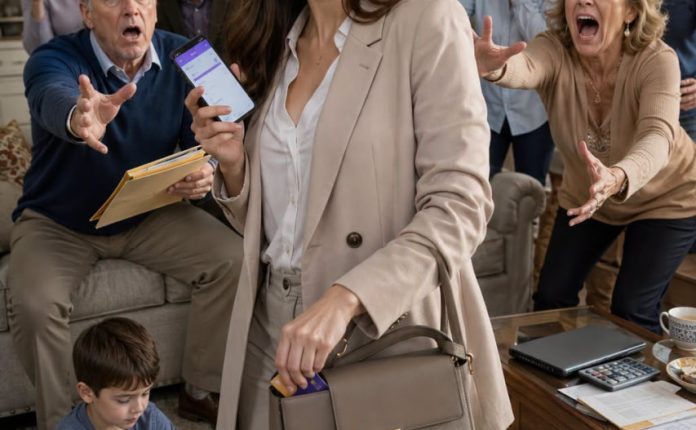
My name is Claire Bennett, and I was thirty-one years old when I learned that apparently buying a house by yourself did not mean your family believed it belonged to you. I was standing on the front porch with a brand-new key pressed into my palm when my mother crossed the lawn.
“We already talked to your brother,” she said, as casually as if she were reminding me to take out the trash. “He and Marissa can use your guest room until they get back on their feet.” For a second, I genuinely thought I had misunderstood her.

Behind me was the house I had spent nine years saving for. Three bedrooms. Hardwood floors. A deep front porch with white columns. A narrow kitchen with sunlight falling across the counters. Out back stood a huge old oak tree surrounded by raised garden beds the previous owners had built from weathered cedar.
It wasn’t a mansion. It wasn’t inherited. Nobody had handed me a down payment. It was mine because I had spent most of my twenties making boring choices. I worked as a billing manager at a regional hospital, spending my days handling insurance denials, spreadsheets, phone calls, coding disputes, and frightened patients.
I regularly had to explain why a claim worth more than someone’s annual salary had been rejected over one missing line. The work wasn’t glamorous, but it paid well, and I was careful. I drove a used sedan long after I could have financed something nicer. I packed lunches and skipped vacations.
Every raise went partly into savings. Every bonus went almost entirely there. At twenty-two, I had decided I wanted one thing no one could threaten to take away from me: a home with only my name on it. The morning I closed, I sat in my car outside the title company and called my best friend, Rachel.
“I did it,” I said. That was all I managed before my throat closed. Rachel started laughing and crying at the same time. “You actually did it.” “I actually did.” Then I hung up because I was crying too hard to drive.
My parents knew I was buying a house, but only because I had mentioned it in passing. They hadn’t contributed financially. They hadn’t helped me look. They hadn’t come to the inspection. That was normal. With me, independence had always been treated as the bare minimum. With my younger brother, independence was treated like an optional hobby.
Evan was three years younger than me and had gone through life with the confidence of someone who believed a mattress would appear beneath him whenever he fell. When he moved into his first apartment, my parents covered the deposit and first month’s rent. When his car died, Dad spent three weekends helping him shop for another.
When Evan became obsessed with starting a YouTube channel, Mom told everyone at Thanksgiving that he had “a real entrepreneurial mind.” When he switched to selling nutritional supplements online, Dad began calling him “a business owner.” When I moved into my first apartment at twenty-three, my parents gave me a greeting card with twenty dollars inside.
The note said, “Proud of you. Be smart.” I kept the twenty. I threw away the note. By thirty-one, I had mostly stopped resenting the difference. Mostly. But I had never imagined my new house would become the next cushion under Evan before I had even unpacked.
I looked at Mom. “You promised him what?” She sighed impatiently. “Your guest room. Just temporarily.” “You can’t promise somebody a room in my house.” Dad had climbed out of the passenger side of Mom’s minivan by then and approached with his hands in his pockets.
He wore the expression I knew better than almost any other. Calm. Reasonable. Already decided. “Your brother is going through something,” he said. “This is what families do.” “What exactly is he going through?” Mom waved the question away. “They need a place to stay.”
“You have four bedrooms.” Her mouth tightened. “That isn’t the point.” It was such a strange answer that I almost missed it. I looked from her to Dad. Their house was less than fifteen minutes away. It had a finished basement, a full bathroom downstairs, and more storage space than mine.
They adored Evan. If he needed somewhere temporary, why wasn’t he moving in with them? I filed the question away. “This house is mine,” I said. “Evan and Marissa are adults. Nobody asked me, and the answer is no.” Mom’s face changed immediately.
“You would really do this to your own brother?” “Yes.” “What happened to you?” “Nothing happened to me.” “I don’t know who raised you.” That one almost made me laugh. Dad’s voice stayed low. “Claire, don’t turn this into a bigger issue than it needs to be.”
“I’m not. You told two adults they could live in a house you don’t own.” “We’re asking you to help.” “No. You’re informing me what you already decided.” The distinction made him angry. I could see it in his jaw. I stepped backward into my house.
“I’m asking both of you to leave.” Mom stared at me as if I had slapped her. Dad gave one slow shake of his head. “You’re going to regret making family your enemy over a bedroom.” I closed the door after them.
The house felt different once they were gone. Still mine, but no longer untouched. I stood in the empty living room listening to the quiet hum of the refrigerator from the kitchen and tried to shake off the argument. Two mornings later, an engine rumbled outside my bedroom window.
I pulled back the curtain. A rented U-Haul was backing onto my lawn, and my brother was standing beside it with his arms folded, waiting for me to open the door. I went outside in pajama pants, an old college T-shirt, and bare feet.
The morning grass was damp enough to soak the cuffs around my ankles. Evan stood beside the U-Haul in a baseball cap, scrolling through his phone like he was waiting for someone else to finish inconveniencing him. Marissa climbed down from the passenger seat holding a little succulent in a white ceramic pot.
The plant was so absurdly cheerful that I stared at it before I looked at her. She smiled nervously. “We brought you a housewarming gift.” I looked at the truck, then at the plant, then at Evan. “What are you doing?”
He finally slipped his phone into his pocket. “We figured we’d start with the boxes.” “No.” He frowned. “What?” “You’re not moving in.” His expression wasn’t angry yet. It was confused. That bothered me more. “Mom said you just needed a couple days to cool off.”
“Mom doesn’t own my house.” “She said you were upset because they sprung it on you.” “They did spring it on me. And I said no.” Marissa hugged the little plant against her chest. “We don’t have anywhere else right now.”
“I’m sorry you’re dealing with that, but this is not your apartment.” Her eyes immediately filled. Evan stepped toward me. “Seriously, Claire?” “Seriously.” “You have two rooms you’re not even using.” “That doesn’t make them yours.” “We’re family.”
“You keep saying that like it’s a lease agreement.” His face hardened. “We’re not asking to stay forever.” “You shouldn’t be asking after I already said no.” “Mom and Dad said it was handled.” “Then Mom and Dad lied to you.”
Marissa made a small wounded sound. It felt rehearsed. Maybe that sounds cruel, but she had a particular way of checking whether I was watching every time she wiped under one eye. My phone started ringing inside the house. I didn’t need to look at it to know who it was.
Mom. It stopped, then started again. Evan gestured at the truck. “We already paid for this.” “That was your decision.” “We already packed everything.” “Also your decision.” “So what do you expect us to do?” I stared at him.
There was the problem in one sentence. Not, “What are we going to do?” What do you expect us to do? As if responsibility had traveled across my lawn and become mine simply because I had a spare bedroom. “I expect you to move the truck off my property.”
He laughed once, not because anything was funny. “You’re unbelievable.” He walked toward the back of the U-Haul. I followed. “Evan, do not unload anything.” “We don’t have time for this.” He lifted the metal latch. I put my hand on the door before he could raise it.
“I am telling you clearly. You do not have permission to enter my house or move anything onto my property.” He stared at me. For one second, I saw something behind the entitlement. Fear. Real fear. Then it vanished.
“You’re going to call the cops on your own brother?” I hadn’t said anything about the police. The fact that his mind went there told me he knew exactly what boundary he was crossing. I went inside. Mom had left two voicemails already.
I ignored them and called the non-emergency police number. The officer who arrived was patient, which I appreciated because I was shaking harder than I wanted anyone to see. He checked my ID and closing documents, then spoke to Evan.
Whatever version Evan expected to hear, he didn’t get it. The officer explained that being related to the homeowner did not create a right to occupy the property. He said that if I had refused permission, Evan and Marissa needed to leave. Marissa started crying for real then.
Evan looked at me over the officer’s shoulder. “You’re actually doing this.” “You came here after I told you no.” “That’s cold.” “No. It’s clear.” The U-Haul pulled away with two muddy tire tracks left in my grass.
I stood in the driveway until the sound disappeared. Then I went inside and locked the door. By lunchtime, the family group chat had exploded. My aunt Melissa, whom I heard from maybe twice a year, wrote, “There are ways to handle disagreements without humiliating your own blood.”
A cousin posted, “Crazy how a little money changes people.” My mother sent eleven messages. The first few were controlled. “You need to call me.” “This can still be fixed.” “Your brother is devastated.” Then the tone changed.
“You embarrassed us.” “You embarrassed yourself.” “Your father cannot even look at his phone because of what people are saying.” Finally: “I genuinely do not know who raised you.” That evening, Rachel brought takeout and helped me move a bookshelf.
I had spent so much of the day fighting with my family that I hadn’t unpacked anything. Rachel read some of the messages. “They’re acting like you burned down an orphanage.” “I called the police on my brother.” “After he showed up with a moving truck.”
“I know.” “You’re allowed to know and still feel terrible.” That helped more than she probably realized. The next morning, Marissa posted a video online. She was standing in what looked like a motel parking lot beneath ugly fluorescent lights.
Her voice was quiet. She talked about being “blindsided by someone we trusted” and suddenly having nowhere safe to stay. She never said my name. She didn’t have to. By that afternoon, people I had known since middle school were tagging me.
One woman commented, “I can’t imagine doing this to family.” Another wrote, “Some people buy one house and forget where they came from.” I watched Marissa’s video once. Then I saved it. Not because I planned to retaliate, but because something about it did not fit.
Evan and Marissa had lived in the same apartment for almost two years. People don’t usually wake up one morning and discover a two-year lease has ended. And my parents had a larger house than mine. If Evan was truly homeless, why were they fighting so hard to put him under my roof instead of theirs?
I made coffee, sat at my new kitchen table, and opened my laptop. At work, when a billing story doesn’t add up, I don’t argue with the story. I follow the paperwork. So that’s what I did.
The county clerk’s public records website looked like it had been designed sometime around 2009 and never forgiven anyone for noticing. Gray boxes. Tiny blue links. Drop-down menus that made no sense. I searched Evan’s full legal name. There was a small access fee.
I paid it. Several records appeared. A parking dispute. An old traffic matter. Then a civil case opened seven weeks earlier. The plaintiff was the property management company that owned Evan and Marissa’s apartment complex. The case status made me sit straighter.
Eviction judgment entered for plaintiff. Enforcement pending. I opened the docket. This wasn’t a lease that had quietly expired. This wasn’t a landlord suddenly refusing to renew. This was nonpayment. Four consecutive months.
The attached rent ledger showed missed payments, written notices, two separate payment arrangements, and two broken promises. They had known. For months. I leaned back in my chair and looked out the kitchen window. Morning light had started touching the upper branches of the oak tree.
Everything outside looked peaceful. Inside, my stomach had turned cold. Marissa’s video had been carefully worded. “Blindsided.” “Suddenly.” “Nowhere to go.” None of those things matched the court record. I pulled out a notebook.
At work, I’ve learned that complicated situations become less emotional when you put them in chronological order. So I wrote the months down. First missed rent payment. Second. Third. Fourth. Notice. Court filing. Judgment. Then I opened Marissa’s social media.
I scrolled back to the month of the first missed payment. There she was by a swimming pool in a bright blue swimsuit, sunglasses pushed into her hair, holding a drink with a slice of lime on the rim. Evan was behind her in the water.
The caption said something about learning to choose experiences instead of fear. I stared at it. Maybe the vacation had been prepaid. Maybe someone else had covered it. I wasn’t going to build an accusation from one photograph. So I kept scrolling.
The following month, Evan appeared in pictures from a huge convention center. He stood behind a table loaded with supplement bottles, branded shaker cups, and glossy brochures. A banner behind him carried the name of the company he’d been talking about for months.
VitalRise Nutrition. Dad had described it to relatives as Evan’s “distribution company.” Mom had told people he was “building his own sales network.” I searched VitalRise. The more I read, the worse it looked.
The company relied heavily on independent distributors buying inventory and recruiting other sellers. Consumer complaints described expensive starter packages, recurring product orders, and earnings that rarely matched the promises distributors talked about online. I found an income disclosure.
Most participants were not making anything close to a full-time living after expenses. Then I found a discussion thread from months earlier titled, “Is anyone actually making money with VitalRise?” I read until my coffee went cold.
One former distributor described filling a spare bedroom with products he couldn’t sell because he had been convinced he needed to “stay active.” Another said his upline kept telling him that failure meant he wasn’t investing enough in himself. I thought about Evan’s apartment.
The missing rent. The convention. The vacation. Then I thought about Dad referring to him proudly as a business owner. I could already hear the defense. You don’t understand entrepreneurship. You’re being negative. Every business requires investment. Maybe. But landlords still expected rent.
I saved copies of the eviction filing and the social-media posts. Then I returned to the county records portal. I almost stopped there. The eviction alone was enough to prove Evan and Marissa had lied about being surprised.
But it still didn’t answer the question that bothered me most. Why my house? Why were Mom and Dad willing to turn the entire extended family against me rather than let their favorite child use the finished basement? So I searched my parents.
Their mortgage records looked normal. Taxes paid. No foreclosure filings. Nothing immediately alarming. Then I saw another entry tied to their property address. A recorded security interest connected to a commercial loan. I clicked it.
Borrowers: Evan Bennett and Marissa Cole. Co-signers: my parents. Loan amount: $75,000. I stopped breathing for a second. The purpose field listed startup capital for an independent nutrition distribution business. VitalRise. The agreement had been signed five months earlier.
I scrolled through the filing slowly. The interest rate was ugly. Then I reached the most recent notation. Notice of delinquency. The account had already gone into default. I read the entire document again, certain I had misunderstood. I hadn’t.
My parents hadn’t merely encouraged Evan’s business. They had personally tied themselves to $75,000 of his debt. And now the loan wasn’t being paid. I stood and walked around my kitchen because sitting still suddenly felt impossible.
Pieces began clicking into place. Evan couldn’t pay rent. His business wasn’t producing enough money. My parents were liable for his debt. But that still left one question. Why couldn’t Evan simply live with them while he worked?
There had to be another pressure somewhere. Another number. Another obligation. I printed the documents, then sat at the kitchen table with the pages spread out around me. The smell of warm toner mixed with my forgotten coffee.
At the bottom of the loan agreement, my father’s signature was unmistakable. I had seen that same looping R on birthday cards, school permission slips, and checks my entire life. For the first time, I wasn’t looking at my family through memory. I was looking at them through evidence.
And the story they had told me was beginning to collapse.