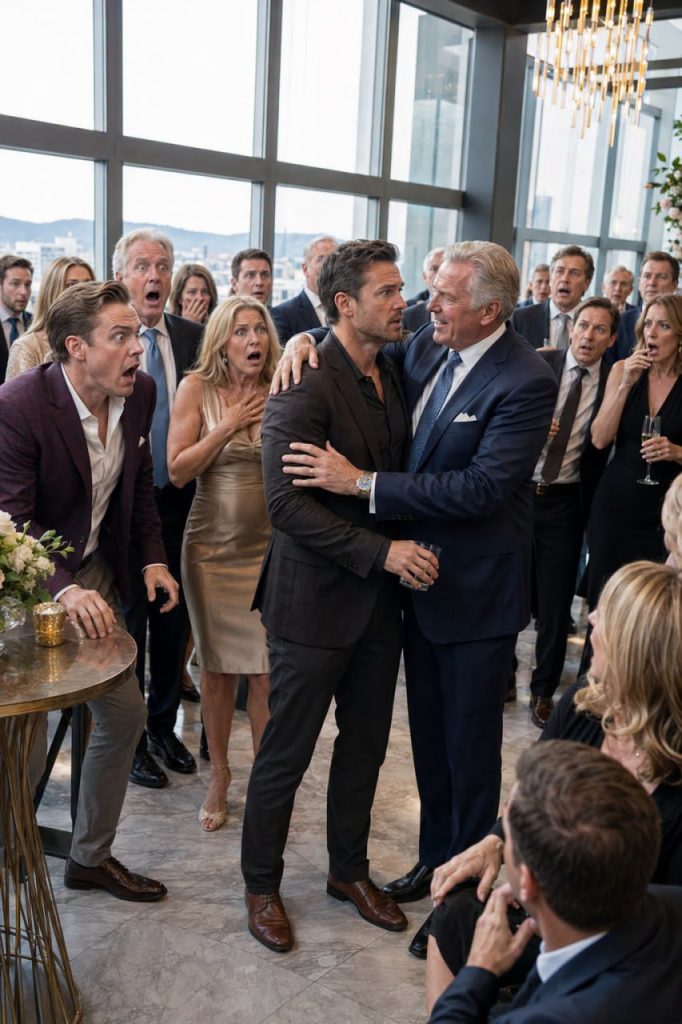
“My CEO will be here,” my brother said. “Don’t come. You’ll make me look bad.” At the party, family whispered, “That’s the failure.” Then CEO Vanessa Hart walked past my brother, embraced me, and asked, “Ethan! How’s your $340 million tech company?” My brother’s face went sheet white.
My brother’s message arrived late on a Tuesday night while I was sitting alone in my home office in Palo Alto. “Big news. I’m being promoted to Senior VP of Operations at Tech Core Industries.” A second message appeared before I could answer. “Mom is throwing a dinner Saturday at The Heights. Vanessa Hart will be there.”
Vanessa was Tech Core’s CEO. Then came the part Nathan apparently considered most important. “Don’t come. You’ll embarrass me in front of her.” I stared at the screen until it dimmed in my hand. Outside my window, the distant lights around Stanford blurred against the dark California sky.
On the corner of my desk sat an award I rarely noticed anymore: Forbes 30 Under 30, Enterprise Technology. Beside it were three folders from attorneys, a half-empty mug of cold coffee, and an acquisition proposal worth $340 million. I typed one sentence. “Congratulations. You earned it.”
Nathan answered almost immediately. “I’m serious, Ethan. This is the biggest night of my career. Vanessa doesn’t need to know there’s a failure in the family.” That word used to hurt. Failure. Now it mostly made me tired. I put the phone facedown and returned to the document on my monitor.
Data Shield Solutions, the cybersecurity company I had started eight years earlier, had received an acquisition offer from a Fortune 100 corporation. The initial cash proposal was $340 million, with performance provisions that could raise the final value substantially. My CFO, Molly Greene, had sent me a message earlier that day.
“They’ve improved the terms again. It’s a serious offer. We need your decision before the next board meeting.” I should have been thinking about that. Instead, I was remembering Thanksgiving years earlier, when Nathan had sat across from me at our parents’ table wearing a new watch and talking about the corporate leadership program that recruited him after his MBA.
I had recently left Stanford. “You’re making a huge mistake,” he told me in front of everyone. “You think every dropout with a laptop becomes some legendary founder?” My mother lowered her eyes. My father actually laughed. Nathan leaned back in his chair. “You’re not special, Ethan.”
Back then, Data Shield was three people working out of borrowed space with folding chairs and unreliable air-conditioning. Now we had 280 employees. We protected the networks of forty-seven Fortune 500 corporations. Our annual revenue had climbed to $89 million, and our threat-detection technology was used from finance to healthcare.
One of our largest clients was Tech Core Industries, Nathan’s employer. Tech Core paid Data Shield $4.2 million a year. Nathan had no idea. That probably sounded impossible, but my brother worked in operations, not cybersecurity procurement. Our contracts passed through separate teams, attorneys, information-security executives, and vendor-management systems.
“Cole” wasn’t exactly a rare last name, either. More importantly, Nathan had never once asked what my company was called. Neither had my parents. They knew I had “some computer business.” That was about it. For years, family gatherings followed the same pattern.
Nathan would describe promotions, stock options, business trips, and executive meetings. Dad would beam. Mom would tell everyone how proud she was. Then somebody would eventually turn toward me and ask, “So, Ethan, are you still doing that startup thing?” Or, “Have you thought about going back and finishing school?”
My personal favorite was, “When are you going to get something stable?” At first I defended myself. Then I tried explaining. Sometime around 2019, I stopped coming. Life became easier. The people who knew me best weren’t relatives anymore. They were Molly, Caleb Ross, and Tessa Ward.
Molly had left a safe career to join Data Shield when we had twelve employees. Caleb, my college roommate and CTO, stayed through every disaster. Tessa helped us win our first major corporate customer. Those people sat beside me through failed product launches, overnight security incidents, investor meetings, and weeks when our bank account looked terrifying.
They knew what Data Shield cost me. My family only knew that I had dropped out of Stanford. My phone rang the next afternoon. Mom. I almost let it go to voicemail. Instead, I answered. “Hi, Mom.” “Did Nathan tell you?” Her voice glowed with excitement.
“About the promotion? Yes.” “Senior vice president at thirty-one. Can you believe it?” “He worked hard.” “And Vanessa Hart is actually coming to dinner. Ethan, do you understand how important she is?” I looked at my computer. An email from Vanessa Hart herself sat near the top of my inbox.
Subject: Quarterly Security Strategy Review. “I know who she is.” Mom laughed softly, as though I had made a joke. “Of course you’ve probably heard her name.” Then her tone changed. “Nathan told me he asked you not to come Saturday.” I waited. She continued.
“I think that’s best.” Something inside me went very still. “He’s trying to make an impression. We don’t want awkward questions about why you left Stanford and never found a normal career.” I could hear dishes clinking in her kitchen. Normal sounds. Normal afternoon. A mother casually explaining why one son was too embarrassing to sit beside the other.
“I understand,” I said. “If you had stayed in school, things might have been different.” “Maybe.” “You could still turn things around, Ethan.” I looked through the glass wall of my office at hundreds of people working for the company I had built. “Maybe,” I said again.
When the call ended, I didn’t feel angry. That surprised me. What I felt was something colder. Recognition. They hadn’t misunderstood me. They had simply never bothered to look. And Saturday night was about to prove just how little my family actually knew.
By Thursday morning, the family group chat had become unbearable. Aunt Cheryl wrote, “Our Nathan is going places!” Uncle Paul replied, “Senior VP at thirty-one. That’s what discipline looks like.” Then my cousin Jenna added, “Some people build careers. Some people chase fantasies.” Nobody used my name.
They didn’t need to. Nathan reacted with a laughing emoji before posting a photograph of the private invitation to The Heights. “Hard work pays off.” I muted the conversation. Ten minutes later, I walked into a conference room where my executive team waited to discuss an $8.9 million pharmaceutical cybersecurity contract.
The contrast would have been funny if it weren’t so depressing. For two hours we debated liability language, encryption standards, staffing capacity, and implementation dates. Nobody asked whether I had a degree. Nobody cared that I wore sneakers most days. Nobody needed me to prove I belonged in the room. I solved problems. That was enough.
Friday’s board meeting went past dinner. The acquisition offer dominated the conversation. One director wanted to sell immediately. Another thought Data Shield could be worth twice as much within three years. Molly wanted me to consider what I actually wanted instead of letting the numbers make the decision for me.
When everyone finally left, she remained by the window. “Are you going tomorrow?” “To what?” She gave me a look. “Don’t do that.” I closed my laptop. “No.” “Your brother’s dinner.” “I wasn’t invited.” “I know.” “Then there’s your answer.”
Molly folded her arms. She had known me long enough to ignore my attempts at ending conversations. “They’re celebrating Nathan’s promotion in front of the CEO of one of your biggest clients while deliberately keeping you away because they think you’re unsuccessful.” “That summarizes it.” “And you’re just going to work?”
“Probably.” “Ethan.” I sighed. “What do you want me to do? Walk in carrying financial statements?” “I want you to stop disappearing every time your family tells you that you don’t matter.” That landed harder than I expected. “I’m not disappearing.” “You absolutely are.”
“I don’t need their approval.” “I didn’t say you did.” She stepped closer to the table. “There’s a difference between not needing approval and helping people erase you.” I didn’t answer. Saturday arrived bright and clear. The dinner was scheduled for seven at The Heights, an expensive restaurant occupying the upper floor of a glass tower in San Francisco’s Financial District.
At six, I was still in my Palo Alto office. My jacket hung untouched behind the door. Then my phone rang. Vanessa Hart. I answered. “Vanessa.” “Ethan, I just realized something deeply uncomfortable.” Her voice had the clipped efficiency that made people sit straighter even over the phone.
“What?” “Nathan Cole is your brother.” I leaned back. “You finally connected the last name?” “I was reviewing tonight’s attendees. I knew Nathan worked here, but I didn’t realize the promotion dinner I agreed to attend was a family event.” “It’s fine.” “No, I’m not sure it is.”
“It’s his night.” There was a pause. “Are you attending?” “No.” “Why?” I watched traffic moving far below my office. “I wasn’t invited.” Silence. Vanessa spoke again, more slowly. “Your own brother excluded you from his promotion dinner?” “Family dynamics.” “Ethan.” “It doesn’t matter.”
“It clearly matters.” I rubbed my forehead. “He’s proud of what he’s achieved. He thinks having me there would complicate things.” “Does he know who you are?” “He knows I’m his younger brother.” “You know exactly what I mean.” “No.” Another silence followed.
Vanessa exhaled. “I’m going to respect your wishes, but I’m not going to lie if somebody asks me something directly.” “I wouldn’t ask you to.” “And for what it’s worth, this situation is absurd.” “That makes two of us.” After we hung up, Caleb called.
His first words were, “Please tell me you’re going tonight.” “Why?” “Because I am.” I frowned. “What?” “Tech Core invited key strategic partners. Their security leadership team asked me to attend.” Then he started laughing. “Your brother still doesn’t know, does he?” “No.”
“Oh, Ethan.” “Don’t.” “This could be the greatest dinner of my adult life.” “You’re enjoying this too much.” “I am bringing emotional popcorn.” I hung up on him. At six forty, Molly appeared in my doorway. A navy suit hung over her arm. “No.” “Yes.”
“Molly.” “I had it sent over from your apartment.” “That is disturbing on multiple levels.” “I also arranged a car.” “I can fire you.” “You won’t. Our financial reporting would collapse.” I looked at the suit. “I don’t want to prove anything.” “Then don’t.”
She put the jacket on the back of a chair. “Go because you’re done allowing other people to decide whether you belong.” Twenty minutes later, I was heading north toward San Francisco. The entire drive, I considered telling the driver to turn around. By the time I reached The Heights, dinner had already started.
Through the glass outside the private room, I saw my mother in her nicest dress. Dad sat beside her. Nathan occupied the place of honor near the head of the table. Vanessa sat two seats away, listening while he spoke with animated confidence. I could have left.
Then my phone buzzed. Caleb had sent me a photograph from inside. Under it, he wrote, “Your brother just explained to Vanessa what real corporate success looks like. I nearly choked.” Against my better judgment, I smiled. Then I walked toward the private dining-room entrance.
The maître d’ checked his tablet. “Name?” “Ethan Cole.” His eyes moved down the list. “I’m sorry, sir. I don’t see you.” “You won’t.” “I’m afraid this is a private function.” Before I could answer, a familiar voice came from behind him.
“Ethan?” Vanessa had stepped into the hallway. Her entire face brightened. “You came.” Then, before I could say anything, the CEO my brother had spent all week trying to impress walked straight toward me and wrapped me in a warm hug. Over Vanessa’s shoulder, I saw Nathan standing inside the dining room.
His smile was gone.