Bethany started therapy before she tried talking to me. Lucas mentioned it, and I told him not to keep updating me. “If she wants me to know something, she can tell me herself.” A month later, she did.
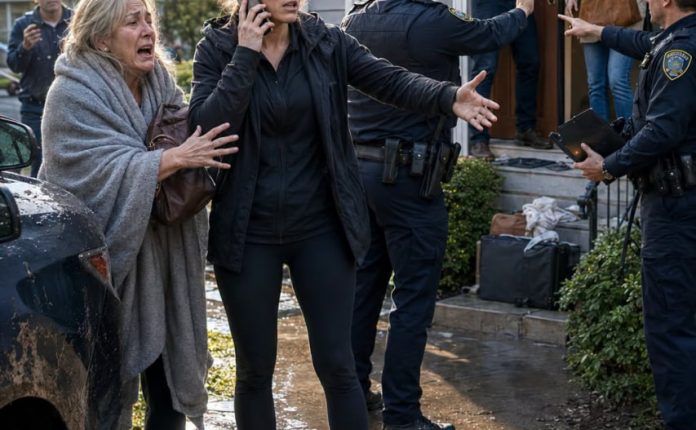
She sat in her car at the curb after dropping Ellie off. Through the front window, I watched her remain there for nearly ten minutes. Eventually, she walked toward the porch. I opened the door. She looked thinner than I remembered. Tired. No makeup. No carefully prepared tears.
“I don’t want money,” she said. “Okay.” “I don’t want anything.” I waited. Bethany glanced toward the kitchen and asked whether Ellie was inside. “She’s washing flour off the dog.” For the briefest second, my daughter almost smiled. Then the expression disappeared.
“I’ve been trying to figure out what to say.” I told her she didn’t have to say anything, but she shook her head. “I do.” Looking down, Bethany said, “I used her.” No explanation was necessary. We both knew she meant Ellie.
“I told myself I was protecting the family,” Bethany continued. “Then I told myself Derek was making the decisions. Then I blamed Mitchell because he always made everything sound normal.” She rubbed her thumb against her hand. “But I told my daughter to pretend she was sick.”
I said nothing. “I can’t make that unhappen.” “No,” I answered. “I know.” That mattered. There was no “but,” no demand that I forget, no request that I acknowledge how difficult her own life had been. For once, Bethany simply stood inside the truth.
“I’m sorry,” she said. “I believe you.” Her eyes filled. “Do you forgive me?” There it was—the question I had expected for months. I thought about Margaret, the ruined pierogi on the porch, and Ellie wondering whether her mother would make her pretend to be sick again.
“I don’t know if forgiveness matters as much as you think it does,” I told her. Bethany looked confused. “You want me to say we’re okay.” Her expression crumpled. “We aren’t.” She whispered, “I know.”
“You want a doorway back to how things used to be.” Bethany nodded. “I’m not opening that doorway.” Quiet tears began falling. I let them. Then I told her that if she became a better mother, Ellie would know. If she became honest, Noah would know. If she fixed her finances, she would know.
“You don’t need me to erase what happened for those things to count.” Bethany wiped her cheeks and asked, “What about us?” I answered with the only truth I had. “I don’t know.” She nodded slowly, then left. I didn’t hug her or invite her inside.
I slept well that night, which surprised me. When I was younger, I imagined closure meant everybody sitting around a table, saying exactly the right things, perhaps sharing a meal afterward. Life rarely works that neatly. Sometimes closure is simply being able to sleep after telling the truth.
Mitchell stayed away. No birthday card. No Christmas call. No apology. Lucas heard through someone that Mitchell sold his truck and resigned from the golf club. I didn’t ask for details. That was his life. For decades, I had treated my children’s problems like alarms wired directly into my nervous system.
I was learning to let their consequences belong to them. Lucas, meanwhile, continued coming on Sunday mornings. He repaid small pieces of what he owed whenever he could. I never demanded the money, and he never delivered speeches about it.
One Sunday, he handed me an envelope. “Don’t push it back.” I smiled. “Bossy now?” Lucas grinned. “Learned it from you.” Inside was another repayment. I placed it in the drawer and asked if he wanted coffee. “Already made.” He carried two mugs to the back porch.
The air smelled like cut grass and distant rain. After a while, Lucas said, “You know I don’t expect you to change the trust for me, right?” I told him I knew. “I’m not doing this because I think there’s something waiting at the end.” Again, I said, “I know.”
Lucas looked across the yard. “Good.” I believed him. That didn’t mean I restored him to my estate. I didn’t. People often assume reconciliation requires restoring every privilege somebody once possessed. It doesn’t.
If a man burns down your porch and then spends years proving he has changed, perhaps someday you invite him into your kitchen. You still don’t hand him matches. Lucas became part of my life again, not simply because he was my son, but because he behaved like somebody I wanted around.
Meanwhile, Ellie and I slowly improved our pierogi. Not much, but enough. We created a rule that every ugly one belonged to the cook, which meant I ate most of them. One afternoon, she asked, “Grandpa, why did Grandma write dates on everything?”
“Because your grandmother believed memory lies.” Ellie frowned. “Memory lies?” I explained that it doesn’t lie deliberately; it simply changes things. Holding one of Margaret’s old freezer bags, I told her, “Numbers don’t care how you feel.” Ellie considered that. “That sounds mean.”
“It can be helpful too,” I said. That evening, after Ellie left, I opened Margaret’s ledger again. Nineteen transfers in four years. Nearly forty-seven thousand dollars. Yet money was no longer what unsettled me most.
What bothered me was that before I counted, I could not have told anyone the truth. I only knew how each act of giving had felt. Every individual emergency seemed reasonable. Each request arrived wrapped in love, worry, panic, or obligation. Taken separately, none seemed large enough to change our family.
Together, they had shaped everything. In the factory, every tool had a limited number of regrinds. A die could produce thousands of perfect parts before its edge dulled. You removed it, ground away a little material, squared the surface, and returned it to service.
Maybe you could do that six times. Eight. Ten if you were lucky. The dangerous part was that a die reground eight times might still look beautiful sitting on the bench—bright steel, smooth surface, no obvious crack. You couldn’t see how little material remained unless someone had kept count.
Margaret had kept count. Not because she expected our family to fail, but because she understood wear. I only wished I had understood what she was seeing while she was still alive.
A year after the birthday that changed everything, I turned sixty-eight. I woke before sunrise. Old habits. Coffee. One egg. Gray November sky. The same kitchen table. But this time, I didn’t place my phone beside my hand. I left it charging in the living room.
Around eight o’clock, someone knocked. Lucas stood outside holding two coffees and a grocery-store cake—the same small kind I had bought for myself the previous year. “You bought the ugly one on purpose,” I said. Lucas shrugged. “They all looked ugly.”
Ten minutes after he arrived, Noah came through the door. Then Ellie showed up carrying a paper bag full of flour because she had apparently decided birthday pierogi were now mandatory. Bethany remained beside her car. When I looked through the window, she raised one hand.
I raised mine. That was all. We were not reconciled, not fully. Maybe we never would be. But Ellie could love both of us without being turned into a bridge between us. That mattered.
Mitchell did not come. Around noon, he sent a text. “Happy birthday, Dad. Hope you’re doing okay.” No request followed. No bill. No excuse. I read the message and put the phone down. I didn’t answer immediately, but not because I was trying to punish him.
I simply wasn’t waiting anymore. That difference meant more than I can explain. For almost my entire life, I had understood love through availability. You called, I answered. You needed money, I transferred it. Your car broke, I drove. You panicked, I fixed it.
That was fatherhood to me. After Margaret died, I became worse. I had been unable to save her, and perhaps part of me reacted by trying to save everybody else. If Mitchell’s business struggled, I helped. If Bethany cried, I helped. If Lucas was drowning, I helped.
Every rescue temporarily reassured me that I was still useful. Usefulness can become addictive after the person who loved you without needing anything is gone. That was the part I had to accept responsibility for.
My children learned bad habits from me because I repeatedly rewarded those habits. Every emergency ended with money. Every request eventually succeeded. I believed I was showing love. Sometimes I was. Other times, I was teaching them that my boundaries were temporary.
That did not make their choices acceptable. Two truths can occupy the same room. I enabled them. They exploited me. I contributed to the pattern. They were adults who chose to continue it. Understanding my part did not require surrendering myself again.
That afternoon, Ellie and I made pierogi. We finally opened another one of Margaret’s original bags. For years, I had been afraid to reduce the number. Four bags became three. Three became two. Every time I opened the freezer, loss seemed to stare back at me.
But I no longer wanted Margaret’s food kept frozen until freezer burn destroyed it. We boiled half the bag. Lucas fried onions. Noah set the table. I took one bite and had to look away for a moment.
Same potato. Same cheese. Same little pinch in the dough where Margaret’s fingers had closed it. Ellie noticed my face. “Are you sad?” “Yes.” “Because Grandma made them?” “Yes.” She thought for a moment, then placed one of her own crooked pierogi on my plate.
“Eat this one too.” It was terrible—thick dough, barely sealed, almost no filling. I laughed. Margaret would have laughed too. That was when I understood the freezer had never been the memorial.
The kitchen was. The recipes. The arguments. The flour scattered across the floor. The people willing to show up without needing something from me. Later, after everyone left, I sat alone at the same table where I had spent my sixty-seventh birthday.
Alone did not feel the same anymore. The house was quiet, but it wasn’t abandoned. Quiet. There is a difference. Margaret’s ledger still rested above the phone. I opened it to a blank page near the back and wrote something myself, although my handwriting looked terrible beside hers.
“Before saying yes to money, wait three days.” That became my rule. Family, friend, neighbor—it doesn’t matter how urgent the request sounds. I don’t immediately say yes, and I don’t immediately say no. I say, “I’ll give you an answer in three days.”
Real problems usually survive three days. Manipulation often cannot tolerate three hours. People with genuine needs tend to answer, “Okay.” People who believe they own your answer become angry. That anger tells you something.
I wish I had learned that at forty. I wish I had understood it before Margaret died. But wishing is another way of arguing with numbers, and numbers do not change because you are sorry.
Nineteen requests. Nearly forty-seven thousand dollars. Eleven years of access. One birthday. A whole day of silence followed by dozens of calls the moment the money stopped. That was my hit count.
Like any worn tool, I had finally reached the point where another regrind would remove more material than I could afford to lose. So I stopped the press. I did not destroy my family. I stopped helping them destroy me.
Lucas and I are building something new, slowly. Not father-and-son debt. Not rescuer and rescue. Just two grown men drinking coffee together on Sundays. Bethany and I remain distant. I forgive her enough to genuinely wish her well. I do not forgive enough to pretend our old trust has returned.
Maybe it never will. I can live with that. Mitchell remains outside my life. I love him, and I suspect I always will. But love is no longer a key to my bank account, my house, my peace, or my future.
Late love without changed behavior is simply another request dressed differently. Noah is studying engineering. Ellie still makes terrible pierogi. The trust remains exactly as I signed it. There are no loopholes, no parents controlling it, and no future pressure campaign capable of changing it.
I no longer worry that I’ll regret the decision when I’m eighty. If I reach eighty, I hope I’m sitting at this same kitchen table while Ellie complains that I still fold the dough incorrectly. I hope Lucas still brings coffee and Noah has machine dust or grease on his hands from building something useful.
And if Mitchell or Bethany ever return to my life in a real way, I hope it is because they finally learned the lesson I learned much too late: being someone’s father does not make me their permanent emergency fund.
Being needed is not the same thing as being loved. And if the only thing making someone reach for you is the moment your money disappears, then the silence before that moment was already your answer.
I simply hadn’t been willing to hear it.
Margaret had.
She kept the count.
Now I do too.
THE END!
Disclaimer: Our stories are inspired by real-life events but are carefully rewritten for entertainment. Any resemblance to actual people or situations is purely coincidental.