At midnight, with three counties already under flash-flood warnings, my phone vibrated across the kitchen counter. I almost ignored it. The number was not saved, and rain hammered my apartment windows so violently it sounded like handfuls of gravel being thrown against the glass.
The local news had repeated the same warning for nearly an hour: stay off the roads unless absolutely necessary. Then I answered. “Emily?” I recognized my mother’s voice immediately. I also knew something was terribly wrong.
My name is Emily Carter. I was thirty-four that night, living almost 180 miles from the house where I grew up. My mother, Linda Carter, was sixty-eight. “Mom?” I said. There was rain on her end too, louder than mine, and I could hear her teeth clicking between words.
“I’m at a motel,” she whispered. “I don’t think it’s open.” I straightened so quickly my chair scraped across the tile. “What motel?” She gave me a name I barely understood through the storm. “Where’s Ryan?” My older brother had been living with Mom for almost a year.
There was a pause. Then she said, “My key doesn’t work.” Somebody in the background shouted that he needed his phone back. “Mom, whose phone are you using?” I asked. “A man’s. He was kind enough—” The line went dead.
I called back immediately. Voicemail. I stood in my kitchen staring at the screen while every ordinary sound suddenly became unbearable—the refrigerator motor, rain pouring through the gutters, the television murmuring uselessly from the living room. For nearly a year, whenever I asked about Mom, Ryan gave me the same answer.
“I’ve got it handled.” He and his wife, Melissa, moved into Mom’s house after her knee replacement. It was supposed to last six weeks. Six weeks became three months, then six, then almost a year.
At first, I had been grateful. Ryan lived fifteen minutes away before moving in. I lived nearly three hours away on a good day. I worked full-time, traveled occasionally, and had convinced myself that calling twice a week counted as being present.
Ryan took Mom to appointments. Melissa cooked. They picked up prescriptions and groceries. At least, that was what I had been told. I called Ryan. No answer. I tried again. Still nothing.
Then I searched the motel name Mom had given me: Pine Ridge Motor Lodge. The recorded message made the hair along my arms rise. “Temporarily closed due to flood-related electrical damage.” I listened twice. Closed.
My mother was standing outside a closed motel in the middle of a flood. I called Ryan a third time. This time he answered immediately. “Emily?” His voice was calm. Too calm.
“Where is Mom?” He sighed as though I were the problem. “Don’t start panicking.” I repeated, “Where is she?” Ryan said, “She got confused and wandered off.”
I gripped the kitchen counter. “You told me you were taking care of her.” He replied, “We are. Melissa and I booked her a room because she got agitated.” I stared into the dark apartment.
“At a motel that’s closed?” Silence. Only half a second, but enough. “You have the wrong motel,” Ryan said. “Mom probably gave you the wrong name. That proves what I’ve been trying to tell you.”
“What exactly have you been trying to tell me?” I asked. His voice softened. “That she’s not herself.” Rain rushed against my windows.
Suddenly, memories I had dismissed began returning. In May, Mom called because her electric bill had doubled. Ryan took the phone from her and laughed. “She mixed up two statements.” In July, Mom whispered that her checkbook was missing.
Ten minutes later, Ryan texted me: Found it. She put it somewhere strange. Please don’t upset her about it. In September, she asked if I remembered the green folder Dad kept in the study. I had been late for a meeting and changed the subject.
Those memories came back one after another, and they no longer looked harmless. “Why doesn’t her house key work?” I asked. Ryan said, “We replaced the lock.” “Why?” “It broke.”
“And you didn’t tell her?” He said, “I did.” Then his voice became gentle again. “You shouldn’t be driving tonight. Melissa and I are looking for her. Stay home.”
Behind him, I heard a television. Then ice clinking against glass. Ryan was not outside searching through a flood. He was sitting comfortably inside Mom’s house. I opened the banking app.
Years earlier, Mom had given me view-only access to her primary account. I rarely checked it between statements. That night, I checked. My stomach dropped.
Her savings once held more than $240,000. Now there was barely enough money left to cover one month of ordinary expenses. Three large transfers were already complete. Another was pending. All four led to a company I had never heard of.
MLR Home Solutions. My brother’s wife had been Melissa Lauren Reid before she married him. MLR. I stared at those letters until they blurred.
Then I pulled on boots and threw blankets, dry clothes, water, Mom’s medical folder, and a flashlight into my car. At the door, my phone buzzed. Ryan.
Don’t go looking for her. Police have been notified. Mom is safe. I read it twice. He wanted a written record showing concern, and he wanted me nowhere near that motel before morning. I grabbed my keys.
That was the moment I understood something I should have understood months earlier. Ryan was not asking me to trust him. He was asking me not to look.
Twenty miles into the drive, the highway nearly disappeared beneath rain. White lane markers flashed and vanished under sheets of water. Tractor-trailers threw walls of spray across my windshield. Every few minutes, navigation rerouted me around another closure.
I should have turned around. That was what every warning said. But every time fear told me to stop, I heard Mom whispering, “I don’t think it’s open.” Not I’m lost. Not I forgot where I am. She knew exactly what was wrong.
Nobody was there. At a gas station glowing beneath emergency lights, I called the bank. The representative could not discuss Mom’s accounts because my access was limited.
“I understand,” I said. “But I believe an elderly account holder is being financially exploited.” The woman’s tone changed immediately. She could not freeze anything based only on my call, but she opened a fraud case and placed an internal alert for the bank’s elder-abuse team.
I took screenshots of every transaction. The pending transfer was slightly more than sixty thousand dollars. If it cleared in the morning, I had no idea whether we would ever recover it. Then I noticed something else.
Three weeks earlier, Mom’s account notifications had been changed from electronic alerts to mailed statements. That explained why nothing had reached me. Ryan had blamed a “bank update.” I believed him because believing him had been convenient.
My phone rang. Ryan. I put him on speaker. “Where are you?” he demanded. I asked, “Why?” He said, “Because you sound like you’re driving.” I ignored that. “I asked where Mom is.”
“Emily, listen to me. She’s been having episodes.” I asked, “What kind of episodes?” He answered, “You know. Confusion.” “No, I don’t know.” His patience cracked.
“You’re there twice a year. You don’t see what we see.” That hurt because part of it was true. I lived far away. I had missed birthdays and shortened visits because of work.
Guilt is useful to people who want you quiet because it makes even obvious questions feel like accusations against yourself. Ryan knew exactly where to press.
“You think you can show up once in a while and judge us?” he continued. “We rearranged our entire lives for her.” I asked, “Then why is she outside?” Ryan said, “She wandered away.”
“With no coat?” Silence. Then I asked, “Why are large transfers leaving her account?” That was my mistake. I heard his breathing change.
“What transfers?” I should not have warned him. I knew it instantly. “Emily, Mom agreed to help us financially.” I asked, “With what?” He said, “It’s family money.”
“No. It’s Mom’s money.” Ryan replied, “You’re being dramatic.” I asked, “Then explain MLR Home Solutions.” This silence lasted longer.
Finally, Ryan laughed, not because anything was funny, but because he needed time. “You’ve always hated Melissa.” That was how arguments worked inside our family.
Ask about money and get accused of jealousy. Ask about behavior and get reminded of an old fight. Ask for facts and receive emotion. I ended the call.
A few minutes later, brown water stretched across the road ahead. The SUV in front of me entered it and stopped. For one sickening second, its rear end slid sideways.
I slammed on the brakes. Water reached my front tires. My steering wheel jerked. The car suddenly felt lighter. I reversed until gravel caught beneath the tires.
A volunteer firefighter wearing a reflective jacket ran along the shoulder, waving traffic toward a farm road climbing above the creek. “Not this way!” he shouted. I followed the detour.
My hands did not stop shaking for ten minutes. Somewhere along that narrow ridge road, I finally admitted what frightened me more than the flood.
What if Ryan was right? What if Mom truly had become confused? What if she agreed to something and forgot? What if I drove through dangerous weather only to tear apart my family over misunderstandings?
Then another memory surfaced. Three months earlier, Mom had quietly asked, “Did your father ever tell you who gets the house if something happens to me?” I laughed.
“Mom, nothing’s happening to you.” She did not laugh back. “I just wonder what Ryan thinks.” I should have asked why. I did not.
At almost three in the morning, another message appeared from Ryan: Mom is safe. Go home. I ignored it.
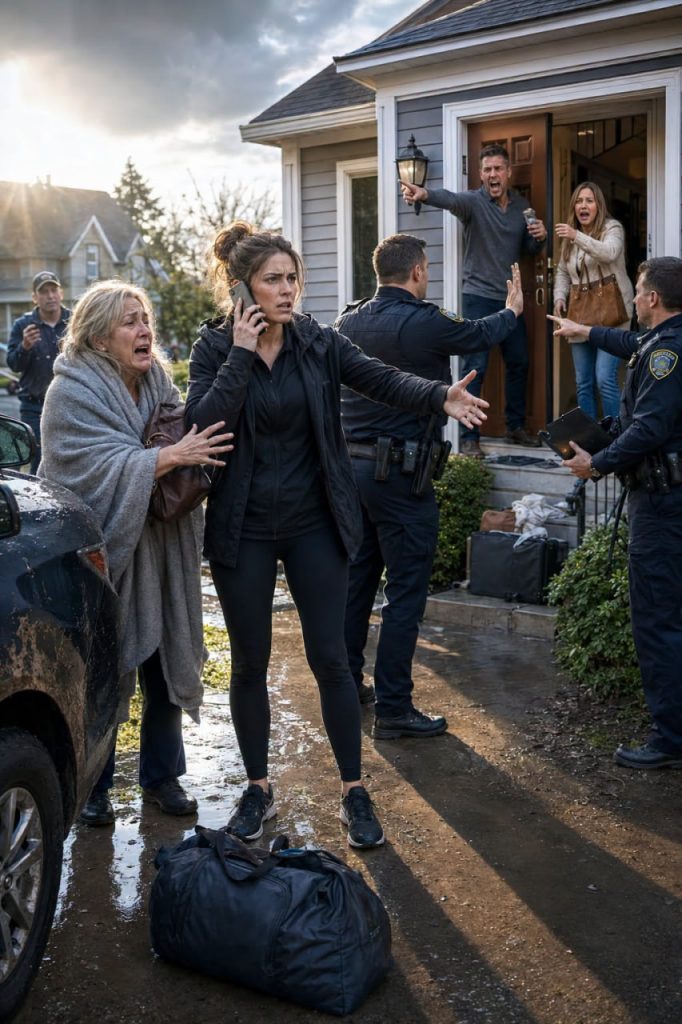
When I finally reached Pine Ridge, the motel sign was dark. The office windows were covered with plywood. Yellow closure tape snapped violently in the wind.
I drove past once because I saw nobody. Then I turned around. My headlights swept across the awning outside the office. Something moved beside an old ice machine.
At first, I thought it was luggage. Then one hand rose into the light. I stopped so violently my seat belt locked across my chest. “Mom.” I barely managed the word.
I parked crooked across two spaces, grabbed a blanket, and ran. She sat on the wet concrete with her knees drawn toward her chest. Her blue cardigan had been soaked almost black by the rain.
Her hair clung to her forehead. She held a grocery bag tightly against her body with both hands. When she looked up, relief did not reach her face first. Shame did.
“I’m sorry,” she whispered. “I know you have work in the morning.” That sentence broke something inside me. I knelt in the rain beside her and wrapped the blanket around her shoulders.
“You didn’t have to come all this way,” she said. I touched her freezing cheek. “Yes,” I answered. “Yes, Mom. I did.”
When I helped her stand, she winced. A dark purple mark circled one wrist. My anger arrived so quickly it almost made me dizzy. But I did not call Ryan. Not yet.
I got Mom into the car, turned the heat as high as possible, and opened the grocery bag containing everything my brother apparently believed she deserved to keep.
Inside were a nightgown, toothbrush, two prescription bottles, a can of soup, and one rain-bent envelope. Mom watched me remove it. Her face changed.
“Emily,” she whispered. Inside that envelope was the first proof that whatever Ryan had done was much larger than missing money.
The envelope contained a bank notice, a photocopy of Mom’s deed, and an application for a loan against her house. I knew Mom’s signature.
I had watched her write birthday cards my entire life. Her genuine signature tilted slightly forward, especially the “L.” The signature on the deed copy stood unnaturally straight.
Careful. Slow. Wrong. I laid both pages across my lap. “Mom, did you sign this?” She stared down. “No.” There was no hesitation.
“Did you agree to borrow money against the house?” “No.” “Did you give Ryan permission?” Her mouth tightened. “No.” That was when I called 911.
I reported finding a sixty-eight-year-old woman outside a condemned motel during a flood emergency without a coat, phone, wallet, or working key to her own house.
While paramedics were coming, I asked Mom what happened. Not everything. Just enough. “They said I was spending too much,” she explained.
“Who?” “Ryan and Melissa.” She rubbed the blanket between her fingers. “They took my card because they said I kept losing things.” I asked whether she had been losing things.
“Sometimes,” she said, embarrassed. “I forget where I put my glasses. I forgot an appointment once.” I replied, “That doesn’t mean they get your bank card.”
“I know.” But her voice told me they had spent months teaching her otherwise. “What happened yesterday?” I asked. She said, “I asked for the green folder.”
Dad’s folder. My chest tightened. “Ryan got angry.” I asked what he said. “He said I didn’t need it.” “And then?”
“Melissa said I had promised them the house.” I asked, “Did you?” Mom’s answer came more sharply. “No. I told them I was grateful they were helping me. I never gave them my house.”
She swallowed. “Ryan said I was upsetting myself. He held my arm.” Her fingers drifted toward the bruise. I looked at it.
“He said not hard,” Mom added quickly. “Just enough to make me listen.” Even now, she was defending him. That hurt more than if she had cursed his name.
“What happened after that?” I asked. “Melissa packed the bag.” I looked at the grocery sack. Everything she was allowed to take from her own home fit inside something meant to carry bread and milk.
“They said I needed a few days away to calm down. Ryan drove me here after dinner.” I reminded her, “The motel was already closed.” She said they told her there was a reservation.
Mom pulled a wrinkled receipt from the envelope. I searched the confirmation number. It belonged to an entirely different motel almost seventy miles north.
Ryan had not simply made a mistake. He had given Mom paperwork convincing enough to make her doubt herself. “Why didn’t you call me when you left the house?” I asked.
Mom looked away. “He said you were tired of dealing with my problems.” I stopped breathing for a moment. “He said what?”
“He said you told him to handle me because you had your own life.” I felt physically sick. I had never said that. But I had said things close enough for Ryan to construct the lie.
I’m buried at work.
Thanks for handling Mom.
I can’t get down there this weekend.
Can you take care of it?
Ryan had not invented every brick. I had handed him some.
The paramedics arrived and wrapped Mom in heated blankets. They said she was mildly hypothermic but alert, oriented, and able to answer questions clearly. That mattered.
Ryan’s entire defense depended on convincing everyone she no longer knew what she was saying. At the hospital, Mom kept asking whether police really needed to become involved.
“Maybe they can give the money back,” she said. “Maybe we don’t have to ruin the family.” I stared at her.
She had been abandoned outside a closed motel during a flood, yet she still believed consequences would be the thing that ruined us. That was when I remembered the attorney.
Dad and Mom had used the same estate lawyer for years. Her name was Evelyn Shaw. Her card was inside Mom’s medical folder. I called shortly after four in the morning.
I expected voicemail. A woman answered after several rings. “Evelyn Shaw.” I said, “My name is Emily Carter. You represented my parents.”
There was a pause. “Linda Carter’s daughter?” “Yes.” Her voice sharpened. “What happened?” I explained as quickly as possible.
She asked questions I had not considered. “Is your mother conscious?” “Yes.” “Does she understand where she is?” “Yes.” “Does she understand the transfers?”
“She says she never approved them.” Evelyn asked, “Did she authorize anyone to change title to her home?” “No.” Then she asked, “Can she tell me that herself?”
I handed Mom the phone. Evelyn spoke with her for several minutes. When Mom gave it back, Evelyn’s next words changed the entire night.
“Emily, three years ago your mother signed an immediately effective durable financial power of attorney naming you as her agent.” I closed my eyes.
I vaguely remembered signing something at Evelyn’s office after Mom’s surgery. I had forgotten what it was. “Ryan isn’t listed?” I asked. “No.”
“Melissa?” “No. Only you.” Evelyn continued. “I also have an original bank certification your mother completed when she gave you emergency authority.”
My grip tightened around the phone. “What can we do?” Evelyn remained calm. “We do not have a magic button. We do have documentation.”
She explained that the bank might place a temporary administrative hold if it verified Mom’s identity, my authority, and credible evidence of financial exploitation. Recovering completed transfers would be harder.
The pending transfer was our best chance. “How long do we have?” I asked. Evelyn answered, “Until the morning processing batch.”
Thunder rolled across the hospital roof. I looked at Mom lying beneath warm blankets. Then Evelyn added, “There’s another issue.”
“What?” I asked. “If Ryan believes he’s close to losing access, he may destroy evidence inside that house.” I looked at my phone.
Ryan had called four times while Evelyn and I spoke. Then a fifth call appeared. I ignored it. A message immediately followed.
Emily, stop whatever you’re doing right now. For the first time in my life, my brother sounded afraid of me.