The first time Ethan Caldwell defended me, I was standing behind a hotel reception desk with cold coffee staining my blouse while a furious guest shouted six inches from my face. It was almost eleven at night, and the lobby smelled of lemon cleaner, rain-soaked coats, and exhaustion.
A technology conference had filled every room in the building. Phones rang constantly. Suitcases crowded the marble floor. Near the elevators, a child cried while his exhausted father argued with the valet. The angry guest slapped his confirmation page against the counter as though I had personally betrayed him.
“I reserved a suite. Do I look like someone who sleeps in a standard room?” I had already apologized three times and explained that a plumbing emergency forced us to close the suite. He did not want a solution. He wanted an audience.
That was when a man wearing a navy jacket stepped out of the conference crowd. “She didn’t break the plumbing,” he said calmly. “And yelling won’t repair it.” The guest turned toward him, prepared for another argument, but something in the stranger’s expression made him hesitate.
The man offered to exchange rooms because he had been assigned a larger one than he needed. Five minutes later, the furious guest disappeared. The stranger returned and placed a fresh cup of coffee beside my keyboard. “You looked like you could use a replacement.”
His name was Ethan. He was a software engineer attending the conference upstairs, and unlike most guests that week, he never mentioned his job title until I asked. During my break, we talked in a quiet corner near the vending machines while the hotel slowly settled around us.
He asked about my rotating shifts, laughed when I described my elderly neighbor’s habit of vacuuming at two in the morning, and listened closely enough to remember that I hated hazelnut coffee. By the end of the night, he had written his phone number on the back of a hotel receipt.
At twenty-eight, I had lived in Sacramento for nearly three years. My apartment was a cramped studio above a laundromat, my sedan rattled whenever I drove faster than fifty miles an hour, and I knew exactly which grocery store marked down vegetables on Sunday evenings.
That life had been my choice. My parents died in an accident when I was nine, and my grandfather, Graham Foster, raised me afterward. He gave me a safe home, an excellent education, and more protection than I sometimes wanted.
By my mid-twenties, however, I felt as though every decision I made had been softened by a cushion I had not earned. I wanted to discover who I was when nobody recognized my last name. Grandpa objected at first.
“You don’t need to struggle to prove you have character,” he told me. I answered, “I need to know that for myself.” Eventually, he agreed to let me leave, but only after I promised to call if I ever found myself in genuine danger.
I shortened my surname on job applications, avoided discussing my childhood, and asked Grandpa not to interfere. Ethan knew my parents were dead and that my grandfather had raised me. He knew nothing else. He never pressed for details, which felt like another reason to trust him.
Our relationship grew through ordinary moments. We ate takeout on my apartment floor because I owned only one chair. He replaced the battery in my smoke detector after I spent a week hitting it with a broom. When I worked late, he waited outside the hotel with the heater running.
For the first six months, I believed I had found the rarest kind of man: someone gentle without being weak. The first warning arrived during our anniversary dinner. We were sharing pasta at a small restaurant when his phone buzzed.
The screen displayed one word: Mom. Ethan immediately put down his fork. “I have to take this.” He spent twenty-three minutes pacing beneath the red glow of the restaurant sign. By the time he returned, my dinner was cold.
“Is everything okay?” I asked. Ethan sat down. “She couldn’t find the warranty paperwork for her refrigerator.” I stared at him, waiting for the joke. He was completely serious.
After that, I began noticing how often his mother interrupted our lives. She called during movies, grocery trips, and once while Ethan was driving me to urgent care with a badly sprained wrist. He always answered.
Whenever I asked whether she knew about me, Ethan squeezed my hand and gave me the same reassuring smile he had worn in the hotel lobby. “Let me handle her.” I mistook those words for confidence.
A year after we met, Ethan took me to a park overlooking the Sacramento River. The evening smelled of dry grass and wood smoke, and the setting sun transformed the water into copper. Near an empty bench, he stopped walking and lowered himself onto one knee.
The ring was modest, and his hands trembled as he held it toward me. “I don’t want a complicated life,” he said. “I want mornings with you, grocery lists with you, and every difficult day with you. I promise I’ll always stand beside you.”
I said yes before he finished. For several minutes, we held each other beside the river while cyclists passed behind us and geese called from the darkening water. Then Ethan’s phone buzzed.
He looked at the screen, and the happiness drained from his face. “My mother wants us at dinner next Sunday,” he said. It should have sounded like an invitation. Instead, it sounded like a summons.
The Caldwell house looked expensive from a distance. Up close, it looked like an imitation of wealth. Two stone lions guarded the driveway. Oversized white columns framed the entrance, and every shrub had been clipped so precisely that the yard resembled a showroom rather than a home.
Inside, gold-painted furniture crowded the living room beneath a chandelier made of glass crystals. Ethan’s mother, Vivian, greeted me wearing a stiff cream dress and a pearl necklace better suited for a gala. His younger sister, Camille, stood beside her with a glass of wine.
Camille’s eyes traveled from my shoes to my handbag before finally reaching my face. “I saw you pull up,” she said. “Is that gray car yours?” I said yes. She smiled. “I didn’t realize they still made parts for those.”
Ethan laughed nervously. “It gets her to work.” The comment bothered me less than his laughter. Dinner was served on polished silver-rimmed plates while Vivian spent twenty minutes describing charity committees, private club events, and Camille’s growing media agency.
She mentioned influential people without explaining how she knew them and referred to ordinary vacations as “summering.” Eventually, Vivian looked directly at me. “Ethan says you work downtown. Which firm are you with?”
“I work at the Riverside Grand Hotel.” Her expression brightened. “In management?” I answered, “I’m a front desk receptionist.” Camille’s fork stopped halfway to her mouth.
The room went so quiet I could hear the dining-room clock ticking behind me. “A receptionist?” Vivian repeated. “Yes. I handle reservations, guest issues, and front desk operations.”
“How temporary.” I told her it was not temporary. Vivian leaned back, and her smile disappeared as though someone had turned off a lamp.
“My son has an important career. His wife will attend industry dinners, executive retreats, and social events. She should understand how to represent him.” I said calmly, “I know how to behave at dinner.”
“That is not what I meant.” Her gaze settled on my inexpensive blouse. Of course it was not. Vivian continued, “I respect honest work, but there is an obvious difference between serving successful people and belonging among them.”
I looked toward Ethan. He was studying his plate. I waited for the man who once stepped between me and an abusive hotel guest to tell his mother my work mattered. I waited for anything.
He cleared his throat. “Camille, how is your new advertising campaign going?” Camille smiled at me over the rim of her wineglass. The conversation moved on.
During the drive home, streetlights crossed Ethan’s face in alternating bands of gold and darkness. “You let her humiliate me,” I said. He replied, “She didn’t humiliate you. She’s blunt.”
“She said I don’t belong among successful people.” Ethan answered, “She needs time to adjust.” I stared at him. “To what? The terrible shock of meeting someone with a job?”
His hands tightened around the steering wheel. “I told you I would handle her.” I said, “You didn’t handle anything.” For the rest of the drive, the only sound was the loose dashboard vent rattling whenever we stopped.
Three days later, Vivian invited me for coffee. She was already seated when I arrived, a thick manila folder resting beside her espresso. She did not stand or offer a greeting. She simply pushed the folder toward me.
“Read it.” Inside was a prenuptial agreement drafted by her attorney. It separated every asset, eliminated support after divorce, and required me to assume responsibility for expenses her family might later classify as personal debts.
I had no interest in Ethan’s money, but the document did not treat me as his future wife. It treated me like a threat requiring containment. Vivian folded her hands. “This protects my son.”
“Did Ethan ask for this?” I asked. She replied, “He understands the necessity.” That was not an answer. I closed the folder. “I’ll have an independent attorney review it.”
“There is another condition.” Vivian rested both hands on the table. “You will resign from the hotel immediately after the wedding.” I almost laughed because the demand was so outrageous.
“Why?” Vivian answered, “I will not have my daughter-in-law standing behind a counter, carrying bags, and being ordered around by strangers. You will manage Ethan’s home and support his career.”
“You want me to give up my income after signing away every financial protection.” Vivian replied, “If your intentions are honorable, independence should not matter.” That sentence told me everything.
She wanted me dependent because dependence was easier to control. I pushed the folder back toward her. “I’m not signing this, and I’m not quitting my job.”
Vivian’s coffee cup struck the saucer sharply. “You are making a serious mistake.” I stood. “No. I’m preventing one.” That evening, Ethan arrived at my apartment already angry.
“Why couldn’t you just be reasonable?” he demanded. I stared at him. “Your mother told me to surrender my legal rights and my job.” Ethan waved one hand dismissively.
“It’s paperwork. She worries about people taking advantage of me.” I said, “She called me a gold digger without using the words.” He rubbed both hands over his face.
“Just sign it, Lena. I earn enough for us. Other women would be grateful.” The refrigerator hummed in the silence between us. I asked, “What happens when your mother demands something else?”
“She’ll calm down once she feels respected.” I replied, “And I’m supposed to purchase her calm with my freedom?” Ethan grabbed his jacket.
“Why does everything have to become a battle with you?” The door slammed hard enough to shake a framed photograph on my wall.
The following morning, a large black box appeared outside my apartment. Inside was a dress Vivian had selected for our engagement party. Pinned to the tissue paper was a short note: Do not embarrass us again.
Vivian’s dress was covered in silver rhinestones that scratched my fingers when I lifted it from the box. The neckline plunged almost to the waist, the fabric was a red so bright it seemed to glow beneath my kitchen light, and the stiff skirt practically stood without support.
It was expensive. It was also hideous. My phone rang before I could close the box. “I assume it arrived,” Vivian said. “Yes.” She continued, “You’ll need shoes. Camille will send recommendations.”
“I’m not wearing it.” A short silence followed. Then Vivian laughed. “You don’t have another suitable option.” I told her I had already chosen my dress.
“I saw the clothing in your closet when Ethan showed Camille photographs of your apartment. Nothing you own is appropriate.” The fact that they had studied photographs of my home made my skin crawl.
“I’ll decide what is appropriate for my engagement party.” Vivian’s voice sharpened. “You are joining the Caldwell family. Your decisions now affect our reputation.”
“My clothing is not a public-relations emergency.” She answered, “Wear the dress, Lena, or don’t come.” Then she disconnected.
I carried the box into the hallway and left it beside the trash chute. Afterward, I opened my bedroom closet and reached behind my work uniforms. A cream garment bag hung at the back.
The zipper whispered softly as I lowered it. Inside was my mother’s dress. It was midnight blue, modestly cut, and shaped with the kind of careful tailoring that never demanded attention.
Delicate lace covered the shoulders. My mother had sewn part of that lace by hand after deciding the original neckline looked too plain. She wore the dress at her final birthday dinner.
I remembered sitting beneath the restaurant table at nine years old, tracing the tiny beads near the hem while adults laughed above me. The dress still carried a faint trace of cedar and lavender from the preservation box Grandpa used after my parents died.
To anyone else, it was old-fashioned. To me, it was the closest thing I had to my mother’s embrace. Ethan called an hour later. “Did you reject the dress?” I said yes.
“My mother spent thousands of dollars.” I answered, “I didn’t ask her to.” He demanded, “Why can’t you let her have one thing?” I said, “Because it never stops at one thing.”
I explained why I had chosen my mother’s dress. I told him about the hand-sewn lace, the birthday dinner, and why wearing it made me feel as though some piece of my mother would stand beside me.
Ethan sighed. “Nobody cares about an old dress, Lena.” The words were so casually cruel that I could not answer immediately. Finally, I said, “I care.”
“Well, you’re embarrassing my mother. Wear what she sent, or don’t bother showing up.” The call ended. I stood in my bedroom holding the phone to my ear long after the line went silent.
I should have ended the engagement then. Part of me knew it. Another part wanted to see what Ethan would do once avoidance became impossible. I needed to know whether one final reserve of courage existed beneath all that obedience.
I sent Grandpa a short message: I may need you nearby Saturday night. His reply came almost immediately. Are you in danger?
Not yet.
Tell me where.
I sent the hotel name and asked him not to enter unless I called. That Saturday, I dressed slowly. The midnight-blue fabric settled around me with familiar weight.
I fastened my mother’s small pearl earrings, pinned my hair back, and studied my reflection. I did not look wealthy. I did not look poor. I looked like her.
The engagement party was held inside the Grand Meridian Ballroom, one of Sacramento’s most elaborate event spaces. Crystal chandeliers burned overhead, polished marble reflected the lights, and white roses filled tall glass vases around the walls.
When I entered, conversations stopped. First came the glances, then whispers. Women wearing glittering gowns leaned toward one another. Several guests raised their phones. Somewhere beside the champagne fountain, someone laughed.
Vivian appeared from the center of the room with her face already red. “What is the meaning of this?” I answered, “This is the dress I chose.”
“We are a wealthy family, and you showed up to your own engagement party in a cheap dress.” Her voice carried beneath the high ceiling. Every guest heard her.
“This belonged to my mother,” I said. Vivian looked at it with disgust. “It belongs in a garbage bag.” I searched the crowd and found Ethan near the stage.
He stared at me, then turned toward his mother. He did not move. Camille stepped forward, her champagne glass swinging loosely from one hand.
“She’s doing this deliberately,” she announced. “She wants everyone to think we couldn’t afford to dress her.” I said, “No. I wore it because it matters to me.”
Camille’s smile sharpened. “You’re trying to humiliate our family.” She set down her champagne glass and walked directly toward me. Then she reached for my shoulder.
— PAGE BREAK —
“Don’t touch me,” I said. Camille ignored me. Her fingers closed around the lace covering my right shoulder. “Take it off.” I twisted away, but she tightened her grip.
“Camille, stop.” Vivian stood beside us without intervening. In fact, she looked almost satisfied, as though her daughter were solving a problem nobody else had the courage to handle.
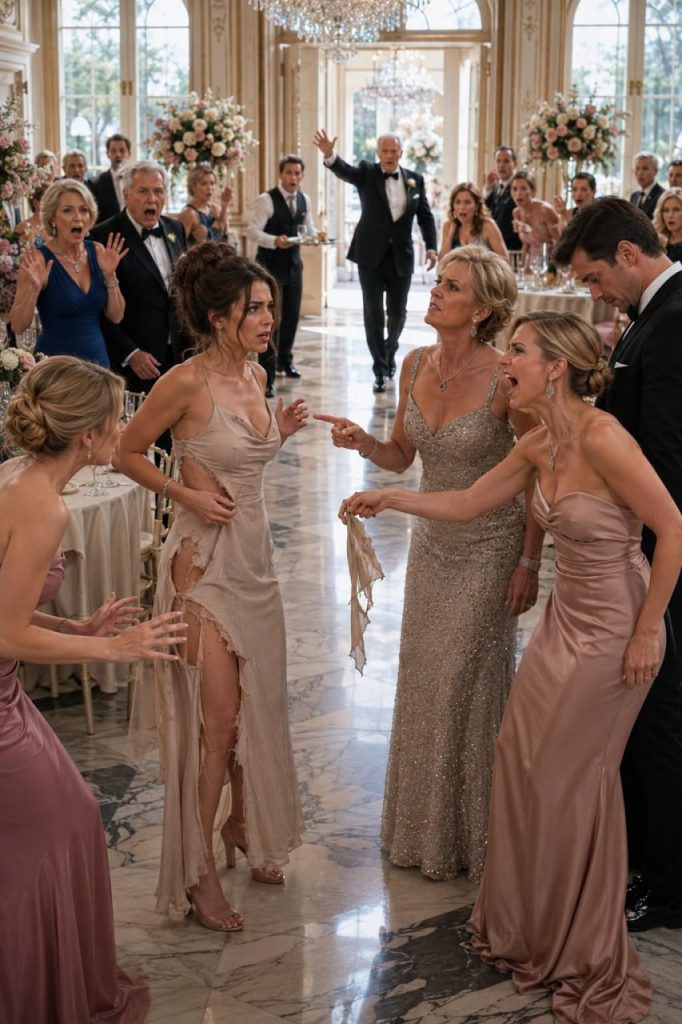
Camille pulled. The first sound was small—a few threads snapping near my collarbone. Then she grabbed harder and yanked with both hands. The lace tore with a sharp ripping sound that carried through the silent ballroom.
Cold air touched my exposed shoulder. For one stunned second, I forgot how to breathe. A narrow strip of fabric hung from Camille’s fist. Tiny blue beads scattered across the marble and bounced beneath tables like drops of glass rain.
Someone gasped. More phones rose. I pressed one hand against the torn neckline and stared at the ruined lace my mother had stitched more than twenty years earlier.
Camille released the fabric. “There. Now maybe you’ll put on something decent.” My ears rang. I looked toward Ethan.
He stood no more than fifteen feet away. There was no confusion in his expression. He had seen everything. Our eyes met. This was the moment I had been waiting for.
I expected him to rush forward, demand an apology, show anger, disgust, anything. Instead, Ethan looked toward Vivian. She gave him a warning glance.
He lowered his head. Then he took one step backward. It was a tiny movement, almost invisible among the guests, but I felt it more deeply than Camille’s hands tearing my dress.
The man who had promised to stand beside me through every difficult day retreated into the crowd because defending me would upset his mother. Something inside me became completely still.
I stopped waiting for him. Vivian pointed toward the hallway. “Go change before you ruin the entire evening.” I looked down at the beads surrounding my shoes.
“You allowed her to tear my clothing.” Vivian answered, “You created this scene.” I looked directly at her. “No. You did.” Her mouth tightened.
“You ungrateful little nobody. We tried to improve you. We gave you an opportunity women like you dream about, and all you have done is resist.” Camille laughed.
“She thought marrying Ethan made her equal to us.” Before I could answer, the ballroom doors crashed open. The sound echoed so violently that nearly everyone turned.
My grandfather entered between two members of his security team. Graham Foster was seventy-two, silver-haired, and slightly shorter than Ethan. He never needed height to command a room.
He moved with the quiet certainty of someone accustomed to being obeyed without raising his voice. He found me immediately. His eyes dropped to my exposed shoulder, shredded lace, and the blue beads scattered across the floor.
His face changed. I had seen Grandpa negotiate strikes, lawsuits, and hostile business meetings without losing composure. I had watched him receive terrible news with little more than a tightening jaw.
That night, fury appeared in every line of his body. He crossed the ballroom while the guests moved out of his path before he said a word.
When Grandpa reached me, he removed his suit jacket and gently settled it over my shoulders. The dark wool covered the torn fabric and shielded me from the cameras.
“Are you hurt?” he asked. “No.” His eyes remained on my face. “Did someone put their hands on you?” I looked toward Camille.
“Yes.” Grandpa turned. “Who?” His voice was quiet, but in the silence a nearby server bumped a table and the glassware rattled loudly.
Vivian stepped forward. “Security should not have allowed you inside. This is a private family event.” Grandpa studied her as though attempting to understand how anyone could make such a foolish statement with such confidence.
“Private?” he repeated. “Yes. You need to leave.” Grandpa answered, “Not without my granddaughter.” The word moved through the ballroom like a wave.
Granddaughter. Camille’s face immediately lost color. Vivian looked from him to me. “You’re Lena’s grandfather?” “Yes.”
She recovered quickly, mistaking restraint for weakness. “Then perhaps you can explain that when someone is invited into a respectable family, she has certain obligations. Your granddaughter arrived dressed like a thrift-store reject and caused a public spectacle.”
Grandpa’s eyes dropped toward the damaged lace. “I recognize that dress.” He touched the torn edge with surprising gentleness. “My daughter wore it.”
His daughter. My mother. When Grandpa looked at Camille again, there was no gentleness left. “You tore apart the last dress my daughter ever wore.”
Camille stepped behind Vivian. “It was an accident.” I immediately said, “No. It wasn’t.” Vivian lifted her chin.
“I don’t know who you think you are, but you cannot enter our event and threaten us.” Grandpa slowly looked around the ballroom—the chandeliers, marble columns, uniformed staff, and gold emblem mounted above the stage.
Then he turned back toward Vivian. “You are standing in my building.” At first, she smiled as if she believed Grandpa was joking.
Then the hotel’s general manager hurried across the ballroom. “Mr. Foster,” he said breathlessly. “We weren’t informed you would be attending.”
Everyone nearby fell silent. The manager had worked at the Grand Meridian for fifteen years. Vivian had spent weeks bragging that he personally supervised only the hotel’s most important clients.
Now he stood beside my grandfather with his hands clasped respectfully in front of him. Grandpa looked at Vivian.
“This ballroom belongs to Foster Crown Hospitality. So does the hotel beneath it, the restaurant downstairs, and forty-seven other properties across the country.”
A murmur spread among the guests. Someone near the back whispered Grandpa’s name. That was enough. Faces changed one after another as people recognized him.
Phones that had been pointed at me lowered. Men who ignored my arrival straightened their jackets. Several of Vivian’s supposed friends quietly stepped away from her.
Grandpa continued. “My granddaughter chose to live independently. She asked me not to reveal her identity because she wanted to build a life without people judging her according to my money.”
His gaze moved slowly across the room. “She worked behind the desk in this hotel, solved your problems, absorbed your complaints, and treated you with dignity. Tonight, many of you decided honest work made her an acceptable target.”
Nobody spoke. Vivian’s mouth opened, but no words came out. Grandpa pointed toward Camille. “You assaulted her.”
“I only touched the dress,” Camille whispered. Grandpa answered, “You grabbed her clothing and tore it from her body.” Camille’s voice trembled.
“It was old. I didn’t know it was valuable.” The sentence hurt more than an apology would have because she still believed the dress mattered only if it possessed financial value.
Grandpa understood immediately. “That is your defense? You believed it was cheap?” Camille started shaking. Vivian grabbed her arm.
“There has been a misunderstanding. Lena never told us who she was.” Grandpa’s expression remained cold. “That is precisely why there has been no misunderstanding.”
“You believed she had nothing to offer you, so you showed her your real character.” He turned toward the hotel manager.
“Cancel the Caldwell family’s preferred event discount. Invoice the full cost of the ballroom, catering, security, and staff.” Vivian went pale.
“We have a signed agreement.” The manager replied carefully, “You have an agreement containing a discretionary corporate courtesy. The discount can be revoked for misconduct or damage to hotel property.”
Grandpa nodded toward Camille. “Preserve every security recording from tonight. Preserve all guest footage voluntarily provided to the hotel as well.”
Camille’s champagne glass slipped from her fingers and shattered against the floor. Grandpa continued, “Review every active vendor relationship involving Camille Caldwell’s agency. If any contract permits termination for violence, reputational harm, or misconduct at a corporate property, send it to legal counsel.”
“You can’t do that,” Camille cried. “Your hotel account is half my company’s revenue.” Grandpa looked directly at her.
“Then you should have considered your employees before attacking the granddaughter of your largest client.” Vivian stepped suddenly toward him.
“Please. We didn’t know.” I stared at her. Those three words revealed everything she did not intend to admit.
She was not sorry she humiliated me. She was sorry she had humiliated somebody powerful. Grandpa looked toward me. “Would you like the police called?”
Camille made a choking sound. Every face turned toward me. I thought about the lace ripping, the phones, and Ethan stepping backward.
I also thought about making a permanent decision while still shaking from grief and anger. “I want a formal incident report,” I said. “I want the footage preserved, and I want time to speak with an attorney.”
Grandpa nodded. “That will be done.” Vivian’s knees weakened. She grabbed the edge of a table and lowered herself before falling completely.
“Lena, sweetheart, please forgive us. We were trying to help you fit in.” I looked at her. “You called me a beggar.”
“I was emotional.” I continued, “You demanded that I quit my job.” Vivian said, “I wanted you to have a comfortable life.”
“You wanted control.” Her fingers reached toward my hand. I stepped backward. Then Ethan finally emerged from the crowd.
His face was wet with sweat. The engagement ring on my hand seemed to pull his eyes toward it like a magnet. “Lena, please,” he said. “I didn’t know Camille would do that.”
“You watched her do it.” Ethan swallowed. “I froze.” I answered, “You stepped backward.” He looked desperate.
“My mother was screaming. Everyone was watching. I panicked.” I removed the engagement ring. His eyes widened immediately.
“We can fix this,” he whispered. “I love you.” I placed the ring in his palm and closed his fingers around it.
“You did not defend me when you thought I was poor. You only found your voice after learning who my grandfather is.” Ethan shook his head. “That isn’t true.”
“When your mother insulted my work, you changed the subject. When she tried taking my independence, you told me to surrender. When she insulted my dead mother, you called her dress meaningless. When your sister attacked me, you hid.”
His lower lip trembled. “I was trying to keep my family together.” I linked my arm through Grandpa’s.
“No. You were feeding me to them so they would leave you alone.” I looked at Ethan one final time. “The engagement is over.”
He followed us as far as the ballroom doors. “Lena, wait!” I did not turn around. But the worst betrayal had not happened inside the ballroom.
I discovered it the next morning. Grandpa arranged a suite upstairs for me. The moment the door closed behind us, the strength disappeared from my legs.
I sat on the edge of the bed wearing his oversized jacket, staring down at my mother’s ruined dress gathered around my knees. Beyond the windows, Sacramento glowed beneath a thin layer of fog.
Grandpa sat beside me. “I should have come earlier.” I shook my head. “No. I asked you not to.” He replied, “I knew something was wrong.”
“I needed to see what Ethan would do.” Grandpa’s voice softened. “And now you know.” The tears I had controlled inside the ballroom finally came.
I cried not because I had lost Ethan, but because the lace beneath my fingers survived my mother’s death, years of storage, and every move I had made only to be destroyed by a stranger trying to teach me my place.
Grandpa called a textile conservator he trusted. She arrived before midnight carrying archival tissue and a padded box. After studying the damage, she explained that the dress could be repaired, although one seam would always remain visible.
“That’s fine,” I told her. “I don’t want the history erased.” The next morning, Ethan sent thirty-seven messages.
Some were apologies. Some blamed panic. Others blamed Vivian. The final message contained a document. I opened it because the filename included my name.
It was another copy of the prenup Vivian had shown me, except this version contained background notes. My salary, monthly rent, student-loan balance, and the estimated value of my car appeared in a financial summary.
Vivian could have estimated my salary range online. She could not have known my exact rent. She also could not have known the balance of the small education loan I had deliberately chosen to repay without Grandpa’s assistance.
Only Ethan knew those numbers. I called him. He answered on the first ring. “Lena, thank God.” I asked, “Did you give your mother my financial information?”
Silence. “Ethan?” He finally said, “She wanted reassurance.” I asked, “How did she get my loan balance?”
“I showed her the budgeting spreadsheet we made.” The spreadsheet was private. I had shared it with him because we were discussing marriage.
“You gave her my personal records.” Ethan protested, “I thought if she saw you were responsible, she would approve of you.” I said, “She used them to design a contract that would leave me financially trapped.”
“I didn’t know she would go that far.” That was always Ethan’s excuse. He never knew. Never expected. Never intended. Yet every road led back to a choice he had made.
“Did you send her photographs of my apartment?” I asked. Ethan hesitated. “Camille asked what your style was.” I closed my eyes.
“So you gave your sister pictures of my home without telling me.” He said, “It wasn’t like that.” I answered, “It was exactly like that.”
I ended the call and blocked his number. I had believed Ethan’s greatest failure was cowardice. The documents revealed something worse.
Long before the ballroom, he had opened the door and invited his family into every private part of my life. He had not merely failed to protect me. He had helped construct the cage.
The hotel’s legal department contacted me that afternoon. Security footage clearly showed Camille approaching me, grabbing the dress, and pulling after I explicitly told her to stop.
Several guests also submitted recordings. I filed a police report. I did not request special treatment or immediate punishment. I gave an accurate statement and allowed the legal process to move forward.
Camille would receive the same rights as anyone else. She would also face the same consequences. By Monday morning, video clips from the ballroom had spread across social media.
The clearest recording showed Vivian boasting about her wealthy family only seconds before Camille tore my dress. The Caldwell image began collapsing almost immediately.
Their supposed fortune turned out to be mostly performance. The house carried a massive mortgage. Their private-club memberships were financed through debt. Vivian’s expensive outfits were often purchased for public events and then quietly returned.
Camille’s company was legitimate but unstable. It depended heavily on two major clients, and Grandpa’s hotel group was the largest. After legal review confirmed that her conduct violated contractual morality and safety provisions, Foster Crown terminated the relationship.
Grandpa did not destroy her company. Camille had constructed a business incapable of surviving the consequences of her own behavior. There was a difference.
I returned to my apartment three days later. The black box containing Vivian’s red dress remained beside the trash chute. A handwritten note had been pushed beneath my apartment door.
It was from Ethan. I have left my mother’s house. Please give me one chance to prove I can choose you. I read it twice.
Then I tore it in half. Ethan had not chosen me when choosing me required courage. He chose me only after losing access to what my family owned.
— PAGE BREAK —
Ethan came to the hotel two weeks later. I was finishing an afternoon shift when one of my coworkers approached the reception desk. “There’s a man near the entrance asking for you.”
Through the glass doors, I saw Ethan standing under the awning in the rain. His hair was soaked, and he carried no umbrella. For one brief moment, the sight awakened my old instinct to worry about him.
Then I remembered him stepping backward inside the ballroom. I asked security to remain nearby and walked outside. Water flowed along the curb. Cars hissed over wet pavement, and the air smelled of asphalt and exhaust.
“I know you blocked me,” Ethan said. “I just need five minutes.” I answered, “You have two.” He swallowed.
“I moved out. I told my mother she was wrong. I told Camille I would testify honestly.” I replied, “You should testify honestly because it is the truth, not because you want me back.”
“I understand that now.” I shook my head. “No. You understand the consequences now.” His expression tightened.
“My family controlled me my entire life. You know what my mother is like.” I answered, “I do. And you still gave her my financial records.”
“I was trying to make her accept you.” I said, “You were trying to make me easier for her to inspect.” Ethan stepped closer.
“I’m in therapy. I’m setting boundaries. I’m changing.” I said, “Good.” Hope flashed briefly across his face.
“But you are not changing for me. You are changing because the life you built became unbearable. That is your responsibility.” Ethan whispered, “I love you.”
“Maybe you do. Love without courage did not protect me.” He said, “I was scared.” I answered, “So was I.” Ethan looked toward the pavement as rain gathered along his eyelashes.
“I didn’t know who your grandfather was.” I stared at him. “That should not have mattered.” Ethan whispered, “I know.”
“No, Ethan. You know now because his name frightened you. When I was only a receptionist in your eyes, my pain was negotiable. Your mother’s comfort mattered more. Camille’s approval mattered more. Avoiding an argument mattered more.”
He reached toward me, then stopped himself. “Is there truly nothing I can do?” I answered, “There is plenty you can do.”
“Become honest. Learn to say no. Stop handing women over to your mother whenever she becomes difficult. But none of that will make me your fiancée again.” I turned and walked back inside.
Ethan remained beneath the awning until the rain softened. I never looked through the doors again. Camille’s criminal case did not produce a dramatic courtroom spectacle.
Reality was quieter. She accepted responsibility for misdemeanor battery and property damage, paid restitution, completed community service, and agreed to stay away from me.
Vivian issued a public statement calling the incident “an emotional family misunderstanding.” The ballroom footage made the description nearly impossible to believe.
Within six months, she sold the columned house and moved into a smaller rental. Most of her social circle disappeared once the parties stopped. I felt no pleasure watching their decline.
I felt relief because I no longer lived inside their expectations. Grandpa offered to bring me directly into Foster Crown’s executive office. I refused.
“I’m still not ready.” He raised an eyebrow. “You have spent three years learning how our guests experience the company.” I answered, “I know the front desk.”
“I don’t know housekeeping, maintenance, food service, accounting, or property development.” Grandpa smiled faintly. “What are you proposing?”
“A formal rotation. No ceremonial title. No private elevator. I want managers to evaluate me exactly like everyone else.” For the next year, I worked through six departments.
I folded sheets beside housekeepers who could make king-size beds in less than four minutes. I worked dawn shifts with kitchen staff while chopped onions burned my eyes.
I followed maintenance crews into boiler rooms smelling of metal and hot dust. I sat beside night auditors who discovered accounting mistakes while nearly everyone else in the city slept.
The experience changed how I understood the company Grandpa had built. Luxury did not come from chandeliers. It came from invisible labor performed by people guests rarely remembered to thank.
I began developing an employee protection and advancement program providing paid training, legal support following workplace harassment, and clear promotional pathways for service employees. Grandpa reviewed the proposal without speaking.
When he reached the final page, he removed his glasses. “Your mother would have been proud of this.” That sentence meant more to me than any executive title.
The textile conservator returned my mother’s dress shortly before the program launched. The lace had been repaired. A narrow silver-blue seam remained visible across the right shoulder.
I ran my fingers gently over it and smiled. The damage could still be seen. So could the survival. One year after my engagement party, I returned to the same ballroom.
This time, I walked through the main doors without fear. The chandeliers cast warm light across tables filled with hotel employees, managers, scholarship recipients, and their families.
The evening was not an elite social performance. It was the first annual Foster Crown Service Awards, created to honor workers whose names were rarely printed on invitations.
I wore my mother’s dress. The repaired seam caught the light whenever I moved. Some people might have hidden it beneath a shawl or replaced the entire lace panel.
I deliberately left it visible. The seam did not ruin the dress. It told the truth about what the dress had survived. Grandpa met me beside the stage.
“You look like your mother,” he said. I smiled. “I hope I have her judgment.” Grandpa replied, “You have better judgment than I did at your age.”
“That isn’t a high bar, according to your stories.” He laughed and offered me his arm. During the ceremony, we presented educational grants to housekeepers, cooks, receptionists, drivers, and maintenance workers.
One recipient was a single father from our Denver property who designed an improved emergency evacuation system. Another was a receptionist from Phoenix who had taught herself three languages to help international guests.
When it was my turn to speak, I looked across the ballroom. One year earlier, people in that room had laughed because they believed my job made me small.
Now the front rows were filled with employees who understood otherwise. “A company is not defined by the people whose names appear on the building,” I said.
“It is defined by the people who unlock the doors before sunrise, solve problems no guest ever sees, and remain patient while being treated as invisible. Dignity does not increase with income, and respect should never depend on what someone can do for us.”
Grandpa watched from the side of the stage with shining eyes. After the ceremony, the board announced my appointment as vice president of employee and guest operations.
The position had not been handed to me secretly. I completed the rotations, passed evaluations, and presented a three-year operating plan. I was still expected to inherit the company someday.
But now I understood exactly what I wanted to inherit—and what I wanted to change. Ethan sent one final letter that winter.
He wrote that he had moved to another city, continued therapy, and no longer spoke with Camille. He apologized without requesting reconciliation. For the first time, he did not blame Vivian, panic, fear, or confusion.
I believed he was finally sincere. I still did not answer. Forgiveness did not require reopening a door. I no longer hated Ethan.
I hoped he became stronger, kinder, and more honest. I hoped he never again watched someone he loved stand alone while he protected his own comfort. But he would not practice those lessons with me.
Vivian never contacted me after the case ended. Camille completed her community service and eventually closed her agency after the remaining clients left.
I heard she later accepted an ordinary salaried position at another company. Perhaps working without a glamorous title taught her something. Perhaps it did not. That was no longer my concern.
My own life expanded in ways I had not expected. I kept my small apartment for several more months before moving closer to Foster Crown’s headquarters.
I replaced my rattling sedan only after it finally refused to start in a grocery-store parking lot. I bought a reliable vehicle, not a flashy one.
Some habits were worth keeping. Grandpa remained my adviser but stopped hovering. He trusted me to make difficult decisions, and I trusted myself enough to make mistakes without hiding them.
I did not rush into another relationship. For the first time, I understood that being alone was not an empty space waiting to be filled.
It could be peaceful, productive, and entirely mine. On the anniversary of my parents’ deaths, Grandpa and I returned to the river where Ethan had once proposed.
We carried two cups of coffee and sat on the same weathered bench while the sun lowered across the water. I looked toward the current.
“I used to believe hiding my identity would protect me from greedy people.” Grandpa followed the water with his eyes. “It did something more useful.”
“What?” I asked. He answered, “It exposed them.” He was right. The Caldwells did not become cruel because they learned who I was.
They merely revealed who they had been all along. Vivian believed kindness was owed only to wealthy people. Camille believed someone without status could be humiliated without consequence.
Ethan believed silence preserved peace, even when preserving that peace required sacrificing the person standing beside him. Grandpa’s arrival did not create their cruelty.
It turned on the light. I touched the repaired seam across my shoulder and watched the final sunlight stretch across the Sacramento River.
My mother’s dress would never be exactly as it had been before that night. Neither would I. But damaged was not the same thing as defeated.
A visible scar was not a reason for shame. Sometimes it was proof that people had tried to tear you apart and failed to make you remain in pieces.
THE END!
Disclaimer: Our stories are inspired by real-life events but are carefully rewritten for entertainment. Any resemblance to actual people or situations is purely coincidental.