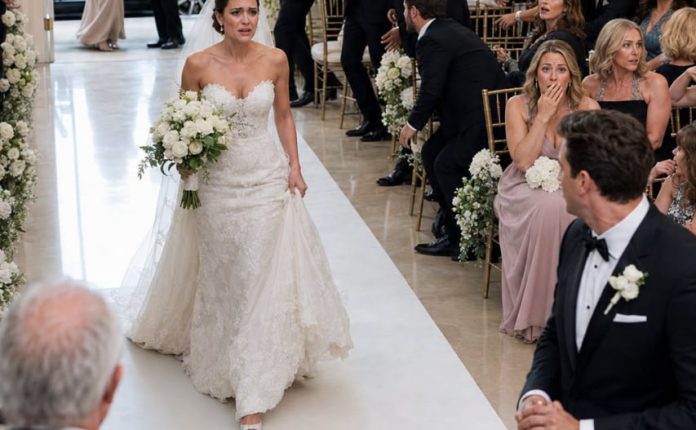
That night, Elodie came to my apartment. I nearly refused to let her inside, not because I blamed her for everything, but because I could not bear another Arden appearing at my door carrying explanations wrapped around self-interest.
Through the peephole, she looked younger than she had at her wedding, even though only twenty-four hours had passed. Her hair was pulled into a messy knot. Her makeup was gone. Her eyes were swollen. She held a flash drive in one hand.
“I know I don’t deserve to be here,” she said through the door. “But I have something you need.” I opened it.
Elodie stepped inside and immediately began crying. “I’m sorry. I should have stopped it. I knew Mom was planning something with the seating chart, but I thought it was just her being cruel.”
“I didn’t know about the money. I didn’t know about the condo. I didn’t know Bianca was being paid through your company.” I believed some of that. Not all of it.
Silence has layers. Some people stay silent because they truly know nothing. Others stay silent because knowing would require an action they are not prepared to take.
Elodie grew up inside Genevieve’s house, trained to survive by watching moods and avoiding explosions. It did not excuse her silence, but it explained its shape. I looked at the flash drive.
“What’s on it?” I asked. “The photographer’s raw files. Video too. Before the reception started, before guests arrived.”
She held it toward me with trembling fingers. “I asked for them this morning. I told the photographer I wanted behind-the-scenes footage. I didn’t tell Mom.”
I took the drive. Elodie wiped her face. “There’s a clip. Mom and Bianca at the head table. They moved the cards. Mom says…” She stopped.
“What does she say?” Elodie looked at me with obvious shame. “She says if you explode, Adrian looks like the victim. If you leave quietly, they can say you abandoned the marriage before checking the accounts.”
I closed my eyes. Shame works faster. Elodie sat at my kitchen island while I opened the files.
The video quality was sharp, and the sound was clearer than expected. The camera had been placed near the flowers while the photographer adjusted the lighting. Genevieve and Bianca entered the frame laughing.
Bianca held my place card between two fingers. “Do you think she’ll cry?” Genevieve smiled.
“If she cries, we call her unstable. If she screams, we call her abusive. If she leaves, we call her guilty. Any outcome works.”
Bianca slid her own card into my seat. “And if she stays?” Genevieve answered, “Then she learns her place.”
I stopped the video. Elodie covered her face. “I’m so sorry.” I looked at her. “Did Adrian know?” She nodded without raising her head.
“He told Mom it might be too much.” I asked, “He objected?” Elodie hesitated. “He said it could backfire.” Not because it was cruel. Because it could backfire.
I saved the file, created two copies, and sent one directly to Marisol. Then I turned back toward Elodie. “Why are you helping me?”
She lowered her hands. “Because yesterday was my wedding, and all I could think while Mom humiliated you was that one day she might teach my husband to do the same thing to me.”
“Or teach me to accept it. And I don’t want to become her.” That was the first answer I had heard from any Arden that sounded entirely honest.
I did not hug her. Not yet. But I made tea and allowed her to sit in my kitchen until midnight while she told me things she had never said aloud.
Graham had been borrowing against almost everything for years. Genevieve pressured Adrian to marry “up” after Bianca failed to bring in enough money. Bianca entered their lives first as a consultant, then a friend, then a permanent presence.
Genevieve believed my pride would make me leave before I investigated. Adrian once laughed and told his mother, “Isla would rather bleed quietly than admit she chose wrong.”
That sentence stayed with me—not because it was true, but because it had been true for far too long. The next morning, Marisol expanded the legal complaint.
The wedding video changed everything. It demonstrated premeditation. It supported claims that the humiliation was not simply personal cruelty but part of a financial strategy designed to destabilize me emotionally before asset negotiations.
Dorian Pike discovered more. Payments from Hart House to Ravel Creative Strategy had funded Bianca’s car, Genevieve’s private-club dues, interest on Graham’s loans, and even part of Elodie’s wedding expenses.
When Marisol told me, I had to sit down. “My money paid for the event where they humiliated me?” She answered, “Yes.”
I laughed, not because anything was funny, but because the alternative was breaking something expensive, and I owned everything in my office.
Bianca received her legal hold notice that afternoon. Two hours later, she called from a blocked number. “I think we should talk woman to woman.”
I stared at my phone, almost impressed by the audacity. “You mean thief to victim?” She exhaled sharply.
“Adrian told me your marriage was over.” I asked, “Did he tell my bank accounts too?” Bianca insisted she had provided legitimate consulting services.
“Then you’ll enjoy explaining the duplicate invoices.” Her tone changed. “I was not the mastermind.” I answered, “No. You were the invoice.” She disconnected.
Three days later, Bianca’s attorney contacted Marisol offering cooperation in exchange for reduced exposure. She had documents, emails, and voice recordings. According to her, Genevieve designed the structure while Adrian approved it.
She claimed Graham knew the projected collateral was fraudulent. She said Genevieve promised her a formal relationship with Adrian after I had been “financially neutralized.”
That phrase entered the file with all the others. Financially neutralized. Not divorced. Not separated. Not even ruined. Neutralized.
Sometimes language reveals exactly how much distance exists between a person’s face and their soul. Nine days after the wedding, the final settlement meeting took place in a windowless conference room inside Marisol’s firm.
There were no white roses, live musicians, champagne glasses, family crests, or carefully arranged chandeliers. Only fluorescent light, a long conference table, water pitchers, laptops, legal pads, evidence binders, and the constant low hum of air conditioning.
I preferred it. Beauty had been used too often to soften rot. Adrian arrived first in the same navy suit he wore whenever he wanted to look sincere.
It no longer worked. His skin looked gray. His eyes were hollow from lack of sleep, and his wedding ring was gone. Graham came next, shoulders collapsed, his remaining dignity leaking away like air from a punctured tire.
Genevieve entered last wearing dark sunglasses even though the room had no windows. She held her designer handbag tightly in both hands as if it could protect her.
Bianca did not attend. She had chosen survival and sent documents instead. Genevieve slowly removed her sunglasses and looked at me as though I remained the embarrassment.
“This entire situation is unnecessary and disrespectful to our family status.” Marisol did not bother looking up from her laptop.
“Mrs. Arden, your family status is not a legal defense.” Genevieve’s mouth tightened. Adrian leaned slightly toward me.
“Isla, before we begin, I want to say—” I cut him off. “No.” He stopped immediately.
“I am not here for your speech. I am here for signatures.” Marisol connected her laptop to the large screen.
The first slide appeared: RAVEL CREATIVE STRATEGY — PAYMENT HISTORY. Beneath it was a timeline of invoices, approvals, deposits, and transfers.
Then came the duplicate invoices. Travel receipts. Hotel charges. Bianca’s car lease, paid through something called a “brand mobility consultation.” Transfers from Bianca to Genevieve’s personal account labeled “G.A. arrangement.”
Then came payments from Genevieve to Graham’s lenders, loan applications listing my Toronto condominium as projected collateral, and a forged internal memorandum suggesting I had authorized “family asset integration.”
Graham groaned and covered his face with both hands. “Genevieve.” She snapped, “Do not start.” Marisol continued.
She played Adrian’s lobby call, Genevieve’s threat, and finally the wedding video. On the screen, Genevieve laughed beside my empty chair.
“If she screams, we call her abusive. If she leaves, we call her guilty. Any outcome works.” Nobody in the conference room moved.
Adrian closed his eyes. Genevieve stared at herself on the screen with an expression I had never seen before. It was not guilt. It was calculation suddenly interrupted by evidence.
Marisol paused the footage. “That recording creates considerable exposure for premeditated coercion, emotional distress claims, reputational harm, and financial pressure associated with marital asset manipulation.”
“Combined with the documented fraud, it becomes very persuasive.” Genevieve turned toward Adrian. “You said there were no cameras.”
Adrian stared at her. “That is what you’re upset about?” She snapped, “It was your sister’s wedding. Who records private family discussions?”
“Elodie’s photographer,” I said. “Apparently quite well.” Graham whispered, “We should sign.” Genevieve rounded on him.
“Don’t be weak.” Graham lifted his head. “Weak? You drained our accounts, involved our son, humiliated his wife publicly, and used stolen company money to pay for our daughter’s wedding.”
“I think weakness is the smallest word left for us.” The room changed. Graham had always been quiet, disappearing behind Genevieve’s volume.
Hearing him speak plainly felt almost unnatural. Genevieve stared at him as if he had slapped her. Adrian immediately tried redirecting the room toward emotion.
“Isla, please. I love you. I was lost. Bianca meant nothing. The money got out of control. My mother made everything worse, but you and I can still—”
“No,” I said again, more softly this time. “You do not love a woman when you let your mother seat your mistress beside you at a family table to break her.”
“You do not love a woman when you approve fraudulent invoices to finance your affair. You do not love a woman when you call her unstable for noticing theft.”
His face crumpled. “I made mistakes.” I shook my head. “No. You made choices and hoped I would mistake them for confusion.”
Marisol slid the agreement across the table. The terms were straightforward. Adrian would relinquish any claim against Hart House Interiors and affiliated properties.
He would sign a civil admission concerning unauthorized financial conduct. Diverted funds would be repaid through liquidation and structured restitution. Adrian, Genevieve, and Graham would cooperate fully with the forensic review.
Graham would resolve his private loans without any further reference to my assets. Genevieve would accept a no-contact clause and formally waive any real or implied claim to the Toronto condominium or other Hartley trust properties.
In exchange, I reserved the right to pursue criminal referral but agreed to delay formal submission while compliance remained satisfactory. Genevieve laughed.
“You expect me to sign away my dignity?” I looked directly at her. “You spent my money trying to steal my peace. Your dignity is not on the table.”
She refused for forty minutes. She called me vindictive, vulgar, common, cold, unnatural, and unforgiving. She said decent families handled matters privately.
Marisol reminded her that decent families generally did not use stolen company funds to finance mistresses. Graham signed first. His hand trembled.
Adrian signed next, crying silently. Genevieve resisted until Marisol calmly opened a folder labeled CRIMINAL REFERRAL DRAFT. Then she signed. The ink smeared because her hand was shaking.
As the meeting ended, Adrian stood beside the doorway wearing the expression of a man searching for one final unlocked entrance. “Isla,” he said, “I never actually wanted to hurt you.”
I picked up my handbag. “That may be the saddest thing you’ve said.” Hope immediately appeared in his eyes, as though sadness meant softness.
I finished the thought. “Because it means hurting me was simply an acceptable side effect.” Then I walked away before remorse could become another performance.