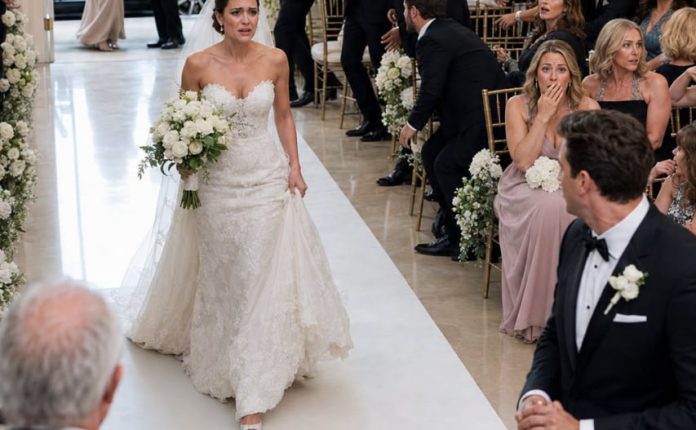
The first thing I noticed when I entered the ballroom was not the chandelier, the flowers, or even the bride in her pearl-covered gown turning nervously beside the dance floor. It was the woman sitting in my chair.
She laughed with her head tilted back, one hand resting lightly on my husband’s sleeve. Her red dress glowed like a warning beneath the warm lights of the Arden estate. My place card had been moved to a small table near the kitchen doors.

There, I had been positioned between a distant cousin who smelled of cigars and an elderly aunt who had once asked me whether “career women” ever learned how to be gentle. At the family table beside my husband sat Bianca Ravel—his mistress, his consultant, his late-night emergency.
She was the woman Adrian swore was only a business contact after I discovered hotel charges in Burlington, dinner receipts for two, and a photograph of her wearing the scarf I had purchased for him in Paris. My mother-in-law, Genevieve Arden, noticed the exact moment I understood.
She smiled before I could speak. That was the worst part. Not the insult itself, but the confidence behind it. Genevieve stood beside the table in a silver gown, diamonds arranged across her throat like tiny weapons, holding a glass of white wine.
“We gave your seat to Bianca,” she said, loudly enough for relatives to hear but softly enough to pretend the comment was private. “Unlike you, she knows how to make my son feel alive.”
The ballroom did not stop, but something inside it changed. Music continued playing. Forks struck plates. Someone laughed too loudly near the windows. My sister-in-law, Elodie Arden, the bride, froze halfway between guests with her bouquet still in one hand.
Her new husband looked confused and then frightened, as though he had just realized his wedding reception had become the stage for something far uglier than ordinary family tension. Adrian rose so abruptly that his chair struck the table.
“Isla,” he said, his face flushing. “Please. Let me explain.” There are moments when your body understands humiliation before your mind can name it. My hands turned cold. My throat tightened.
I could almost feel two hundred people measuring me, waiting to decide whether I would become entertainment. A foolish wife. A jealous wife. A dramatic woman ruining somebody else’s wedding because she could not control her emotions.
Genevieve wanted that. I saw it in the way she leaned slightly toward me, waiting for the explosion. Bianca wanted it too. She lifted her champagne glass with a delicate smile.
“Hello, Isla. We were wondering when you’d arrive.” I looked at Adrian. He was not looking at me with love. He was looking at me with fear—not fear because I was hurt, but fear that I might expose him before he could control the story.
That distinction cut deeper than the affair itself. For years, I told myself Adrian was weak under pressure rather than cruel. I believed he avoided conflict because his mother dominated the family, not because he benefited from my silence.
But standing between his wife and mistress, silently asking me to protect him from the consequences of what he had done, he revealed something I should have understood much sooner. Weakness can become cruelty when it repeatedly chooses the person causing harm.
Genevieve stepped closer. Her expensive, powdery perfume turned my stomach. “A smart wife,” she whispered, “knows how to keep her mouth shut when family reputation is at stake.”
I almost laughed. Family reputation. Inside the Arden family, those words had always operated like a curtain covering everything rotten underneath.
Graham Arden’s failed investments. Genevieve’s debts hidden behind charity luncheons. Adrian’s unexplained transfers from my company accounts. Bianca’s sudden promotion from unknown image consultant to “strategic branding partner” with invoices larger than the salaries of my senior designers.
Every time I questioned something, I was told I was tired, suspicious, too independent, too sharp, and insufficiently soft to understand old families. Whenever I defended myself, Genevieve called me vulgar.
Whenever I asked Adrian for financial clarity, he kissed my forehead and said, “Don’t let numbers make you cold.” So I did something none of them expected. I did not scream.
I did not cry, slap Adrian, throw a glass, or create the public breakdown Genevieve had prepared everyone to witness. I simply looked at her and said, “How kind of you to clarify the seating arrangement.”
Her smile faltered. Only slightly. Then I turned toward the gift table, and I could feel the entire room following me with its breath held.
Among the silver-wrapped boxes and crystal vases sat my gift to Elodie and her husband. Heavy cream paper. Wide blue ribbon. A handwritten card. For months, Genevieve had been telling relatives what she believed was inside.
According to her, I was transferring ownership of a luxury waterfront condominium in downtown Toronto, property belonging to my side of the family and purchased long before I married Adrian. Genevieve told everyone I was “finally learning to share.”
She told her friends the condominium would help “stabilize the younger generation.” What she did not know was that the box contained no deed. Not anymore. Adrian moved quickly once he realized where I was going.
He caught my arm beside the gift table, his fingers digging into my skin harder than he intended. “Isla, stop,” he hissed. “You cannot do this. Not here. Not at Elodie’s wedding.”
I looked down at his hand until he released me. “No, Adrian,” I said, my voice steady enough to surprise both of us. “You destroyed this long before I walked through those doors.”
His expression changed. “You’re overreacting.” I looked directly at him. “That word has saved you too many times.”
I picked up the box. It was heavy, but not with property documents. Its weight came from a past I was finally taking back: framed photographs, old family keys from my grandmother’s first apartment, and a letter written directly to Elodie.
The letter explained that the condominium would remain mine. Instead, I had created an education trust for her future children, protected in her name alone and inaccessible to every other Arden.
Inside the box was another symbolic item Genevieve would understand later: a photocopy of the original deed with NOT TRANSFERABLE stamped in red across every page.
I turned toward the ballroom doors. Behind me, Genevieve’s voice sharpened. “If you leave now, do not expect this family to welcome you back.”
I stopped and looked over my shoulder at the head table—my husband’s mistress occupying my chair, my mother-in-law standing like a queen inside a borrowed kingdom, and relatives who had watched years of humiliation while calling silence politeness.
“That is the first generous offer you’ve made all night.” Then I walked away. Behind me, the music stumbled before resuming with a weak, nervous rhythm.
Nobody followed immediately. That hurt less than I expected. Outside, beneath the long stone portico of the Arden estate, I heard only my own breathing, slow and controlled.
My phone began vibrating before I reached the driveway. Adrian. Again. Genevieve. Adrian. An unknown number. Probably Bianca. Then a message from Elodie appeared.
“I’m sorry. I’m so sorry. I didn’t know she moved your seat until tonight.” I stood beneath the cold night air holding the gift box and realized something almost peaceful.
This was not the night my marriage ended. It was only the night the Arden family finally performed its death publicly. At two that morning, after ignoring twenty-three calls, I sat alone at my kitchen island and opened my laptop.
I unlocked a hidden folder I had been building for fourteen months. It was named RECIPES because Adrian never cooked and would never open anything so ordinary.
Inside were photographs from hotels, bank statements, duplicate invoices, fragments of emails, wire transfers, private loan documents, screenshots, recorded voicemails, and the postnuptial agreement Adrian had signed without reading because he believed I loved him too much to protect myself.
I called my attorney, Marisol Keene, on her private line. She answered on the second ring and sounded fully awake. “Isla?”
“We begin tomorrow morning,” I said. There was a short pause before she exhaled. “Finally.”
By sunrise, Adrian had already transformed himself into three different men. At 6:12, he became the wounded husband. “Isla, you humiliated me in front of my entire family.”
At 6:37, he became the frightened son. “My mother pushed too hard. You know how she gets. Please don’t punish me for her behavior.” At 7:05, he became the romantic fraud I once mistook for tenderness.
“Bianca means nothing. I was confused. You are my wife. You are my home.” Then, at 7:42, he made the mistake that destroyed whatever mercy remained.
He sent a voice message saying, “Mom says if you apologize for causing tension at Elodie’s reception, we can all sit down like adults and fix this.”
I played it twice, not because I needed to hear it again, but because the absurdity deserved witnesses. Then I forwarded it to Marisol.
By nine, I sat inside her office on the thirty-second floor of a downtown tower holding a paper cup of coffee so bitter it felt medicinal.
Marisol Keene was not the kind of attorney who wasted words on outrage. She wore a charcoal suit, thin gold glasses, and the expression of a surgeon preparing to remove a tumor cleanly.
Spread across the conference table were the printed contents of my hidden folder. Seven binders. More than four hundred pages. Three flash drives. A timeline. A financial map. A list of possible legal claims.
Marisol studied the records for twenty minutes before speaking. “This is not infidelity.” I looked at her. “No?” She shook her head.
“Infidelity is the emotional cover. This is asset extraction.” The words settled across the room with the cold weight of accuracy.
Hart House Interiors had begun as a one-woman studio inside a rented office above a florist. Over twelve years, I built it into a luxury residential design firm with commercial contracts, real-estate partnerships, and a valuable portfolio of properties held through my family trust.
Adrian joined two years after our marriage, initially as a “temporary operations adviser” while recovering from a failed business venture. Later, he became director of partnerships because Genevieve complained that a husband should never be “made to feel ornamental.”
I gave him access gradually. He once complained it was too gradual. Now I understood it had been far too generous. Marisol highlighted one invoice.
“Ravel Creative Strategy. Bianca’s agency?” I nodded. “If you can call a rented desk and website template an agency.”
“Your husband approved payments totaling six hundred and forty-two thousand dollars over eighteen months.” My stomach tightened. I already knew the number was substantial, but hearing it spoken aloud stripped away every excuse.
Marisol turned another page. “Duplicate branding audits, event-positioning reports, image consultations, private travel reimbursement, hospitality research, vendor retainers. Many are identical except for the date.”
“She said she was helping us expand into hospitality design.” Marisol looked at me. “She was helping herself to your money.”
There was more. Betrayal, once allowed to grow beneath a polite marriage, rarely stays simple. Adrian routed company funds into inflated marketing contracts connected to Bianca.
Bianca transferred portions of those payments into a holding account controlled by Genevieve. Genevieve then used that money to service private loans taken out by Graham Arden, my father-in-law.
His quiet dignity suddenly looked less like nobility and more like financial paralysis. Several loans were secured using projected collateral from assets Adrian did not own—including the Toronto condominium Genevieve expected me to transfer at Elodie’s wedding.
Marisol pulled out a printed message. “She planned the seating arrangement to provoke you.” The message from Genevieve to Adrian had been written four days before the wedding.
Genevieve: Seat Bianca beside you. Put Isla near the service doors. If she makes a scene, we frame her as unstable before negotiations. If she leaves, even better. A silent exit reads like guilt.
Adrian: She won’t sign if she feels cornered.
Genevieve: Then make her feel ashamed, not cornered. Shame works faster.
I read those final three words repeatedly. Shame works faster. My hands began trembling. Marisol turned the page over so I no longer had to look.
“I should have left sooner,” I whispered. Marisol answered immediately. “No. You should have been treated better sooner.”
The simplicity of the sentence broke something open inside me. I had spent so long gathering evidence that I had forgotten I was allowed to grieve.
Marisol passed me tissues without comment and continued working while I pulled myself together. By noon, she filed an emergency injunction freezing shared accounts, restricting Adrian’s access to Hart House Interiors, and notifying my banks of suspected fraudulent activity.
By one, forensic accountant Dorian Pike began tracing money flowing between Hart House, Bianca’s agency, Genevieve’s accounts, and Graham’s lenders. By three, every company employee received a legal hold notice requiring preservation of emails, invoices, project records, and communications involving Ravel Creative Strategy.
At four, Adrian arrived at my office building. He never made it beyond security. I watched through the boardroom feed as he stood in the lobby with disheveled hair, a crooked tie, and none of the expensive ease usually carried in his posture.
He demanded to see me. Then he begged. Finally, he threatened the receptionist with “marital access,” a phrase so absurd that Marisol actually looked over her glasses.
Adrian called my private line. I put him on speaker. “Tell them to let me upstairs,” he said.
“No.” He replied, “I am your husband.” I looked at Marisol. “For now.” Silence followed.
“You’re blowing this out of proportion,” Adrian said, trying to recover his usual tone. “You walked out of my sister’s wedding because of a seating misunderstanding.”
“Was the seating misunderstanding before or after you paid your mistress with money stolen from my company?” His breathing changed.
Marisol quietly wrote something on a legal pad. Adrian lowered his voice. “Isla, listen. Bianca’s agency did provide services.”
“Did sleeping with you count as billable hours?” He made a wounded sound. “That is beneath you.”
“No, Adrian. What was beneath me was apologizing to your mother for noticing my own money disappearing.” He immediately shifted strategies.
“My mother got too involved. She is under pressure. My father’s loans have been difficult. I made mistakes trying to protect everyone.”
“You were not protecting everyone. You were feeding them.” Adrian whispered, “I love you.” I replied, “No. You love the life my work allowed you to perform.”
His voice broke. “Please don’t destroy my family.” I looked at the evidence covering the table and felt something inside me finally settle.
“I am not destroying your family, Adrian. I am removing the protection that allowed your family to destroy me.” That evening, Genevieve called.
The elegance had disappeared from her voice. What remained was thin, sharp rage. “You ungrateful little climber. After everything we allowed you to become.”
I almost smiled. “Genevieve, I built my company before I knew your son existed.” She snapped, “You married into a family with history.”
“Yes. Unfortunately, most of it appears to be financial fraud.” She inhaled sharply. “You think you’re clever.”
“No. I think I was patient.” Genevieve warned, “If you make this public, you will regret it.” I answered calmly.
“Genevieve, threats work best before the documents are filed.” For the first time since I had met her, she had no immediate response.