The woman who accused me of faking my pregnancy wore black silk to court, but she did not look like a grieving mother. She looked like a queen attending the punishment of a servant, perfectly composed while preparing to turn my grief, my marriage, and my unborn child into evidence against me.
Three weeks earlier, I had buried my husband beneath a gray February sky. I watched damp soil strike the casket of the only man who had ever made me feel chosen and tried to understand how a drunk driver, a rain-slick highway, and one late-night phone call could erase a life in less than a minute.
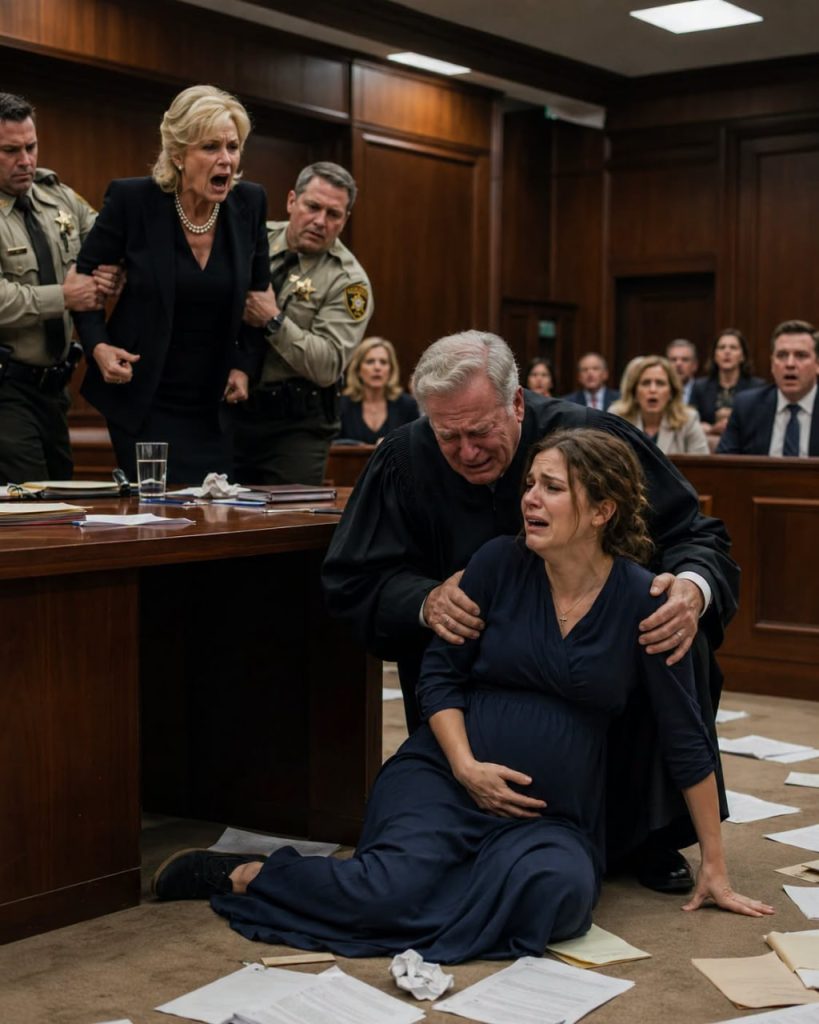
I should have been at home holding Gabriel’s sweater against my face, memorizing what remained of his scent before grief stole even that from me. Instead, I sat at the defendant’s table in a downtown courthouse with one hand resting protectively over my twenty-four-week pregnant belly.
Across the room, my mother-in-law was trying to convince a judge, a courtroom full of strangers, and perhaps even herself that the child inside me did not exist. The room smelled of disinfectant, old wood, and stale coffee, while fluorescent lights hummed overhead.
The benches behind us were crowded because inheritance disputes always attract people who claim to despise gossip while leaning forward to hear every word. Reporters occupied the back row, pens ready for the headline Beatrice Langham desperately wanted them to write: wealthy widow claims fake pregnancy to steal dead husband’s estate.
Beatrice sat across the aisle in a tailored black suit with a pearl brooch pinned at her collar. Her silver-blonde hair had been arranged into a smooth helmet, and her face held an expression of solemn disgust. She had not cried once at Gabriel’s funeral.
She stood beside his grave with gloved hands folded and corrected the priest’s pronunciation of our last name. Now her attorney, Malcolm Pierce, rose carrying a folder and wearing the smug confidence of a man who had learned how to translate cruelty into professional language.
“Your Honor,” he began, addressing the empty bench before the judge had even entered, “my client intends to present evidence that Mrs. Nora Langham has engaged in deliberate fraud against the estate of the late Gabriel Langham.”
He paused long enough for everyone to listen more closely. “We have serious reason to believe that the alleged pregnancy is fabricated.” A murmur moved through the courtroom like a cold draft.
My baby kicked. The movement was small but unmistakable, a fluttering pressure beneath my palm, as though my son had heard the accusation and answered for himself. My throat tightened immediately because I wanted Gabriel there.
I wanted his hand covering mine. I wanted his calm voice cutting through the room and his laugh afterward when he would tell me our child already had a temper. But Gabriel was gone. His side of the bed was cold.
His toothbrush still stood in the cup beside our bathroom sink because I had not found the strength to throw it away. His mother had waited exactly nine days after the funeral to file an emergency petition challenging my pregnancy and freezing his estate.
Malcolm continued. “We believe the defendant has used a prosthetic pregnancy device to manipulate the court and unlawfully position herself as guardian of a fabricated heir.” Whispers sharpened behind me.
My fingers tightened around my stomach. I was twenty-four weeks pregnant, exhausted, swollen, and still waking every night expecting Gabriel to walk through our bedroom door. My ankles hurt. My back ached. I cried without warning whenever I discovered his handwriting on grocery lists.
My body was performing the enormous work of building our child while my heart was learning how to survive without the man who should have been beside me. Now strangers stared at my belly as if it were an exhibit requiring inspection.
“It’s Gabriel’s baby,” I said quietly. Grief had roughened my voice until the words barely carried. Beatrice slowly turned her head toward me. Her eyes contained no sorrow. Only contempt.
“Do not say his name as if it still belongs to you,” she whispered. I stared at her. She leaned closer so only I could hear. “You were never his equal. You were a temporary embarrassment he dressed up as love.”
I swallowed hard. “He was my husband.” Beatrice answered, “He was my son. And you trapped him while he was alive. Now you parade around with that false belly, hoping we are too polite to call you what you are.”
A clerk shuffled papers nearby. The bailiff glanced toward us. Beatrice smiled faintly, knowing exactly how far she could go before anyone officially noticed. Then she lowered her voice even further.
“You have no money. No influence. No respectable family standing behind you. You are alone, Nora. Completely alone. And alone women lose.” That sentence hurt because part of it was true.
I was alone, though not because I had no living family. Pride, grief, and one unforgivable night had cut me off from the people who raised me almost ten years earlier.
My father, Thomas Ellery, had once been one of the most respected judges in the state. My mother died when I was seventeen, and afterward my father and I loved each other like wounded animals trapped in the same room—fiercely, clumsily, and with too many teeth.
When I met Gabriel, he was not yet the polished son of the Langham family. He spent weekends restoring old motorcycles behind his uncle’s garage, smelled of engine oil and cedar soap, and listened when I spoke as though my opinions carried genuine weight.
My father hated him almost immediately. Not because Gabriel was cruel or dangerous, but because he came from a family my father distrusted and because, at the time, Gabriel had walked away from the Langham fortune rather than work inside the family investment firm.
Dad called Gabriel reckless. I called him brave. The argument lasted months until one night it became a fracture. I packed a bag while my father stood at the bottom of the staircase in our old house.
“If you walk out with him,” he said, “do not come back expecting me to bless the wreckage.” I was twenty-two and in love. I heard only rejection, not whatever fear lived beneath it.
I left. For nine years, silence replaced family. I married Gabriel without my father there. We moved into a small house with blue shutters and built a quiet life together.
Gabriel tried repeatedly to convince me to write to Dad. He suggested it after our first anniversary, then after our fifth. When we discovered I was pregnant, he tried again.
“He may be stubborn,” Gabriel said, kissing my temple while I cried over the positive test, “but he is going to love this baby.” I promised maybe after the first ultrasound. Then maybe after Christmas. Then maybe after I found the right words.
I never found them. Gabriel died before I could tell my father he was going to become a grandfather. Then the bailiff’s voice cut through the courtroom. “Order in the court. All rise.”
Everyone stood. The side door opened, and the judge entered wearing a black robe with a file tucked beneath one arm. His hair was completely silver now. His shoulders looked slightly narrower than I remembered, and years had carved lines into his face.
But his eyes were the same—sharp, dark, steady, impossible to lie to. My breath vanished. The clerk announced, “All rise for the Honorable Judge Thomas Ellery.”
My father took the bench. For one moment, the entire courtroom blurred. I gripped the edge of the table because my son seemed to turn inside me at the exact second my past walked into the room wearing a judge’s robe.
Dad looked down at the file while the clerk began reading the case number. “Langham Estate versus Nora Mae Ellery Langham.” His hand stopped moving.
Slowly, he lifted his head. His eyes found mine. The courtroom became silent in a way that felt separate from law, procedure, and the spectators waiting to be entertained by my humiliation.
Recognition crossed his face like pain breaking through ice. Shock came first. Then disbelief. Then his gaze dropped to my stomach, and something changed so rapidly inside his expression that I had to look away.
Beatrice leaned toward Malcolm, apparently oblivious to the earthquake unfolding behind the bench. “Good,” she whispered, not quietly enough. “He looks strict. He will not tolerate her performance.”
My father heard her. His jaw tightened. Then the judge returned. Not the father. The judge. He adjusted his glasses, looked down at the file, and said in a voice that did not tremble, “Counsel may proceed.”
Malcolm Pierce began with theater. Men like him often do. He spoke of legacy, estates, deception, and the sacred duty of courts to protect families from opportunists.
He described me as “a woman of limited means” who had “strategically positioned herself” between the Langham fortune and its rightful beneficiaries. He implied I announced the pregnancy only after Gabriel’s death because no living husband remained to confirm or deny it.
He produced photographs of me wearing loose dresses and argued my body shape had changed too conveniently. He produced a receipt from an online costume store for a fake pregnancy belly, supposedly connected to an email address containing a variation of my name.
Then he produced an affidavit from a disgraced retired doctor claiming I had once been told I might struggle to conceive. Every sentence was designed to make my life resemble a calculated scheme.
My attorney, Elise Moreno, sat beside me with her jaw set. She was tired, brilliant, and had accepted my case after one of Gabriel’s old college friends called and begged her to help.
I could barely afford her, and she knew it. “We’ll worry about bills later,” she told me when we met. “Right now, we worry about keeping that woman away from your child.”
When Malcolm completed his opening statement, Elise stood. “Your Honor, my client has repeatedly offered to undergo examination by a court-appointed obstetrician.”
“She has provided prenatal records, ultrasound images, bloodwork, pharmacy receipts, appointment confirmations, and sworn statements from her treating physician. The plaintiff has refused every neutral medical confirmation while circulating defamatory claims to the press.”
Elise continued calmly. “We are prepared to prove not only that Mrs. Langham is pregnant, but that this petition was filed in bad faith to intimidate a grieving widow and control the unborn heir of Gabriel Langham.”
The word heir made Beatrice’s mouth tighten. That was what the fight was truly about. Not truth. Not grief. Not Gabriel. Control.
Gabriel had left the Langham trust years earlier, but after his father died, documents surfaced showing that he remained entitled to a private share of the family estate. If he had a child, that share would pass to the child.
Beatrice tolerated me while Gabriel lived because he loved me enough to maintain distance between us. Now he was dead, and she wanted to erase me before our son inherited anything she believed should remain under her command.
My father listened without interrupting. He rarely looked at me. Whenever he did, I felt ten years of silence pressing against my ribs.
I wondered whether he still hated me. I wondered whether he saw the twenty-two-year-old daughter who left or the widowed woman trembling before him with her dead husband’s child beneath her heart.
Then Malcolm called Beatrice to testify. She rose gracefully, smoothing her skirt before walking to the witness stand as though accepting an award.
Under questioning, Beatrice described herself as a devastated mother forced to defend Gabriel’s memory from exploitation. Her voice trembled beautifully when she described her son as “too trusting.”
She dabbed at her eyes with a handkerchief while claiming I had isolated Gabriel from his family. She said I denied her access to medical records because I had something to hide.
Then she claimed she had watched me at Gabriel’s funeral and noticed that I moved “too easily” for a woman six months pregnant. Too easily.
I almost laughed. At Gabriel’s funeral, I moved like someone walking underwater. I held my stomach with one hand and touched his casket with the other.
Before they lowered him, I kissed the wood and whispered, “I don’t know how to do this without you.” Beatrice stood ten feet away checking her phone.
Elise began her cross-examination with quiet precision. “Mrs. Langham, did your son know about the pregnancy before his death?” Beatrice’s eyes flicked toward me.
“So she claims.” Elise asked, “Did you read his last text messages to his wife?” Beatrice answered, “My son’s phone is part of the estate review.”
“Answer the question.” Beatrice looked irritated. “I read some messages.” Elise lifted a printed page.
“On January seventeenth, Gabriel texted Nora, ‘I heard his heartbeat in my dreams last night.’ On January eighteenth, he texted, ‘Mom can rage all she wants when she finds out. I choose you and our son.’ Were you aware of those messages?”
Beatrice’s expression hardened. “My son was manipulated.” Elise repeated, “Were you aware of those messages?” Beatrice finally said yes.
“And yet you filed a petition stating he could not confirm the pregnancy.” Beatrice answered coldly, “My son is dead.” Elise said, “But before he died, he confirmed it repeatedly in writing.”
Beatrice’s lips thinned. My father made a note. Malcolm shifted in his chair. Elise continued. “Did you contact media outlets before this hearing?”
“I made no official statement.” Elise replied, “That was not the question.” Beatrice admitted, “I may have spoken to family friends.”
“Family friends who happen to own news sites?” Beatrice’s eyes flashed. “People were concerned.” Elise asked, “About truth, or about pressure?” Malcolm objected.
My father sustained the objection, but his eyes remained fixed on Beatrice with a coldness I remembered from childhood. It was the look he gave witnesses who mistook polish for credibility.
Then came my medical records. My obstetrician, Dr. Priya Raman, testified by video from her clinic. She confirmed my pregnancy, gestational age, fetal heartbeat, and prenatal care.
She confirmed Gabriel had attended two appointments. She confirmed that extreme stress and public accusations could endanger both mother and child. Malcolm tried questioning whether the medical records could have been falsified.
Dr. Raman’s expression became the kind of calm that warns a foolish man he has selected the wrong woman to patronize. “Counsel, I have practiced obstetrics for twenty-one years.”
“I have delivered more than three thousand babies. Your suggestion that I cannot distinguish between a pregnant patient and a prosthetic device is both medically absurd and personally insulting.”
Several people in the gallery coughed to hide their reactions. My baby kicked again. I pressed my palm against the movement.
For the first time that day, my father’s composure nearly failed. His gaze followed the subtle movement beneath my dress. He looked away quickly, but not before I saw grief cross his face.
Not courtroom grief. Father grief. Grandfather grief. The grief of a man realizing he had already lost ten years and almost missed the next generation too.
Then Beatrice snapped. It began with a small, sharp sound in her throat. Dr. Raman had just confirmed that the baby was a boy when Beatrice stood abruptly.
“No,” she said. Malcolm touched her arm. “Mrs. Langham—” She repeated it louder. “No. This is disgusting.”
My father struck the gavel once. “Mrs. Langham, sit down.” She ignored him. “You are all fools. Every one of you. She has lied from the moment she walked into my son’s life.”
“Sit down,” my father said again, his voice colder. Beatrice turned toward me, and the hatred in her face no longer wore the protection of silk, pearls, or courtroom manners.
“You thought you could breed your way into my family.” Whispers erupted throughout the room. Elise moved closer to me while the bailiff stepped forward.
Beatrice pointed toward my stomach. “That is not Gabriel’s child.” My voice shook, but I answered, “It is. He loved him before he was born.”
Something inside her broke loose. “Don’t you dare speak for my son.” Then she moved.
She moved faster than anyone expected from a woman wearing heels. The bailiff was positioned on the opposite side of the aisle. Malcolm reached for her sleeve and missed.
Elise shoved back her chair. I tried to stand, but my body was too slow, too heavy with pregnancy and fear. Beatrice crossed the space between us.
“I will prove it,” she screamed. I wrapped both arms around my stomach. “Don’t touch my baby.”
She could not reach my dress because Elise stepped partly between us. So Beatrice lifted her leg. Her black heel flashed beneath the courtroom lights.
Then she kicked.