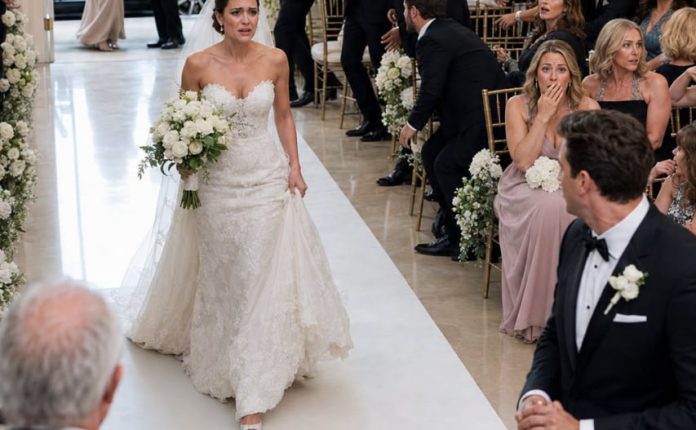
The footage did not show every word of the confrontation, but it clearly captured Bianca approaching me, raising her hand, and striking my face. It also showed Adrian remaining beside her and speaking while I held my pregnant stomach. After a media organization requested courthouse records, the video became public.
Within hours, it spread across local news outlets and business websites. Lumina Grid’s board released another statement announcing that Adrian Caldwell had been suspended from all executive duties pending investigation into misuse of corporate resources and conduct inconsistent with the company’s leadership standards.
Investors did not care only about the assault. They cared about undisclosed transactions, shell vendors, falsified documents, and possible misuse of corporate funds. Adrian’s carefully constructed image as the humane CEO had protected him while questions remained private. Once independent auditors entered the company, charisma became irrelevant.
Bianca was charged with misdemeanor assault. Her attorney initially claimed she acted in self-defense, but courtroom footage and witness statements contradicted her account. She eventually accepted responsibility in a plea agreement requiring probation, community service, and counseling. The criminal penalty was modest compared with the damage to her professional life.
Lumina Grid terminated Bianca after investigators discovered she had approved payments to Northgate Advisory without disclosing her family connection to its registered owner. The sapphire bracelet was recovered as disputed marital property. When Natalie asked whether I wanted it returned, I immediately said yes.
Not because it was valuable. My mother had worn that bracelet during every important event of my childhood. It belonged to a life Adrian had tried to rewrite. At the full emergency hearing, Judge Warren reviewed the financial findings, threatening messages, disputed agreement, and medical-insurance communications.
Adrian sat beside Graham Pike without the confidence he had carried into the first hearing. He continued denying that he forged my signature. Bianca, attempting to reduce her own exposure in the financial investigation, submitted a sworn statement explaining what happened on the date of the supposed occupancy agreement.
According to Bianca, Adrian logged into our home computer using my saved credentials while I was hospitalized. Bianca signed as witness because he told her the arrangement was routine. When asked whether she knew I had not consented, she admitted that she did.
Adrian’s attorney attempted to portray her as a vindictive former employee trying to save herself. Then Lumina Grid’s technology logs confirmed the login. The court invalidated the occupancy agreement and continued my exclusive use of the marital home throughout the remainder of my pregnancy and early postpartum period.
Adrian was ordered to restore medical coverage, provide temporary support, and preserve all remaining assets. Because Rose had not yet been born, permanent custody could not be decided. Judge Warren did, however, prohibit Adrian from attending the delivery unless I expressly requested his presence.
He was also ordered to communicate only through a monitored parenting application once the baby arrived. Outside the courtroom, Adrian approached Natalie and asked to speak with me privately. She refused. That evening, he sent a message through the approved legal channel.
Lydia, this has gone too far. Bianca made a mistake. The company is suffering. Our daughter will grow up knowing her mother destroyed her father’s life. I stared at the screen for several minutes before sending my response through Natalie.
Our daughter will grow up knowing that adults are responsible for their own decisions. I did not hear from Adrian directly again before the birth. Four weeks later, on a rainy January morning, my daughter entered the world. I named her Rose Benjamin Caldwell—Rose after our mother and Benjamin after the brother I thought I had lost.
Ben sat in the hospital waiting room and did not enter until I invited him. When he held Rose for the first time, his hands trembled. “She has Mom’s mouth,” he said. I looked at the tiny crease above her eyes and answered, “She has your serious forehead.”
“She is five hours old. She does not have a serious forehead.” I insisted that she absolutely did. We laughed quietly, and the sound felt unfamiliar. For years, laughter in my home had so often followed someone else’s embarrassment. This laughter asked nothing from anyone.
Adrian received formal notification of the birth through counsel. He sent flowers and immediately requested visitation. Natalie arranged a supervised hospital meeting with a social worker present. I expected anger when I saw him again. Instead, I felt distance.
He stood beside Rose’s bassinet for a long time before saying, “She looks like you.” I answered, “She looks like herself.” He asked whether he could hold her. The social worker looked toward me, and after several seconds, I nodded.
Adrian lifted our daughter carefully. For one moment, the image resembled a family photograph I had once imagined—a father holding his newborn child while her mother watched from a hospital bed. Then Adrian whispered to Rose, “Your mother has made everything very difficult.”
The social worker ended the visit immediately. Even beside a newborn, Adrian could not stop trying to recruit another person into his grievance. The divorce lasted fourteen months. Public stories made his downfall appear sudden, but legal accountability moved much more slowly than humiliation.
There were motions, disclosures, postponements, expert reports, authenticated records, disputed valuations, and endless distinctions between company losses and marital property. Adrian fought almost every request. He claimed Northgate Advisory had performed legitimate consulting services. Auditors found no employees, written reports, or evidence that meaningful services existed.
He said the apartment funded through Northgate had been reserved for visiting executives. Building footage showed him and Bianca living there. He claimed jewelry purchases were client gifts. Several pieces were recovered from Bianca’s home. Eventually, Lumina Grid’s board removed Adrian permanently as chief executive.
The company filed a civil action seeking repayment of misused funds. Adrian retained equity, but much of it became subject to claims and restrictions. Lumina Grid itself survived, and that mattered deeply to me because thousands of employees had never participated in our marriage or Adrian’s decisions.
I did not want them punished for what he had done. When reporters asked whether I hoped Lumina Grid would collapse, I refused to turn my divorce into a public revenge campaign. Privately, I hoped the company might eventually become what Adrian had only pretended it was.
The board appointed an interim CEO who cooperated with regulators, strengthened oversight, and separated charitable giving from publicity campaigns. Lumina Grid’s reputation gradually recovered. Adrian’s did not. He entered therapy only after a custody evaluator required it.
During early sessions, according to reports provided in our case, he focused almost entirely on the humiliation of losing his position. He described himself as the victim of a vindictive spouse, an unstable employee, and an overreaching media cycle. Months passed before he acknowledged using money and housing to control me.
The evaluator recommended supervised visitation with Rose. Adrian could earn expanded contact only by following rules, accepting responsibility, and refraining from speaking negatively about me. I agreed. Some people expected me to demand that he never see his daughter again.
I understood that impulse. There were nights when I watched Rose sleep and remembered his message about canceling my insurance. I imagined how easily his decisions could have harmed her before she was even born. But custody was not a reward for me or a punishment for Adrian.
It was a safety decision for Rose. If Adrian could become a safe parent under professional supervision, she had the right to know him. If he could not, she had the right to be protected. The final financial settlement awarded me my lawful share of the marital property.
It restored funds Adrian attempted to hide and established support for Rose. After the protected occupancy period ended, I sold the house. Adrian had used it as a symbol of my dependence, and I did not want to spend my recovery proving that I could remain inside something he had weaponized.
I bought a smaller home near Ben and his wife, Claire. It had yellow siding, a wide porch, and a maple tree in the backyard. There was no security desk, private elevator, or marble foyer. There was also nobody controlling whether I was permitted to walk through my own front door.
The first night, Rose slept in a bassinet beside my bed. I woke repeatedly, not because she cried, but because silence still felt suspicious. Court orders could change legal circumstances. They could not instantly teach my nervous system that peace no longer meant danger was merely gathering itself.
My therapist, Dr. Hannah Cole, explained it gently. “You spent years studying every change in his voice. Your body became responsible for predicting him.” I asked how I was supposed to stop. She told me not to chase the woman I had been before Adrian.
“You build safety through new experiences until your body learns the difference.” Recovery happened in ordinary moments: opening mail without expecting a hidden bill, buying groceries without wondering whether my card would suddenly decline, calling Ben without checking who could hear, and taking Rose to the doctor without carefully managing every word.
Another ordinary act mattered even more. I returned to work. Before marrying Adrian, I had coordinated public-building projects. I loved practical problems—how people moved through spaces, where daylight entered, and whether a design served a community instead of merely impressing investors.
I joined a small architectural firm specializing in shelters, clinics, and affordable housing. My first assignment involved converting an old hotel into transitional apartments for women and children. During a planning meeting, a consultant discussed secure entrances, private interview rooms, and protected storage for identification and medical documents.
I understood every requirement personally. I did not tell the team my entire story. I simply used what it had taught me. Ben and I rebuilt our relationship with equal caution because the courtroom reunion had not magically erased four years of silence.
There were missed birthdays, misunderstood messages, and wounds on both sides. Ben carried guilt because he had not found another way to reach me. I carried shame because I had believed Adrian’s version of him. We attended family therapy rather than pretending love alone would repair everything.
During one session, Ben admitted, “After the first year, I became angry. I thought you were choosing him over us.” I told him I believed he was punishing me for marrying someone he disliked. “I did dislike him,” Ben admitted.
“That made his lies easier to believe,” I answered. Ben nodded. “I should have separated my opinion of him from my relationship with you.” I admitted I should have questioned why every supposed message from him sounded unlike the brother I remembered.
We did not forgive each other through one perfect emotional conversation. We practiced becoming trustworthy again. Ben respected every legal boundary surrounding my case. He never discussed confidential proceedings with me, contacted Judge Warren, or attempted to influence anything involving Adrian.
When reporters discovered our relationship and suggested Ben had manipulated the court to protect his sister, the court released the transcript showing his immediate disclosure and recusal. He had done exactly what judicial ethics required. Privately, however, he gradually became my brother again.
He assembled Rose’s crib badly enough that Claire had to rebuild it. He delivered groceries every Sunday and claimed they were accidental over-purchases. He learned to warm bottles and discovered that expensive judicial robes provided absolutely no protection against infant spit-up.
One evening when Rose was six months old, Ben and I sat on my porch while she slept against his chest. “I keep thinking about the moment I saw you in court,” he said. I told him I kept trying not to think about it.
“I nearly forgot where I was,” he admitted. I laughed softly. “You looked as though you wanted to climb over the bench.” Ben said he had wanted to. I reminded him that doing so might have destroyed his career. “I know.”
“But you didn’t.” He shook his head. “No.” He looked down at Rose and said, “For years, I imagined finding you in some dramatic situation and rescuing you. Then the day came, and the most useful thing I could do was follow procedure.”
“That procedure protected me,” I told him. Ben said it felt inadequate. I disagreed. “You secured the room. You preserved what happened. Then you stepped aside so nobody could claim the outcome came from family influence.” He was quiet for several seconds.
“I wanted to be the person who saved you.” I looked at him and answered, “I needed you to be the person who believed me.” Ben nodded. That was the heart of everything. Rescue is often imagined as force—breaking down a door, fighting an abuser, carrying someone away.
In reality, protection may begin with one person asking a clear question and accepting the answer. Are you safe? No. For years, nobody had asked me that directly. Adrian asked whether I trusted him, whether I supported him, and whether I wanted to destroy our family.
Judge Warren had asked whether I was safe. The truthful answer changed my life. Two years after the courtroom assault, Rose took her first independent steps across the community center my architectural firm had helped redesign.
The building had once been a neglected motel beside the highway. Narrow rooms became small apartments. The old lobby became a bright childcare area, while a former banquet hall became space for legal clinics, financial counseling, and employment workshops. We named the building Rowan House.
It was not named specifically for Ben, despite what people sometimes assumed. Rowan had been our mother’s maiden name. At the opening ceremony, I stood near the back holding Rose’s hands while speakers discussed safety, housing, and dignity. Nobody mentioned Adrian.
His role in my story had become smaller. That did not mean he disappeared. He continued supervised visits and slowly demonstrated improvement. During the first year, he treated every session like an opportunity to prove that he was a good father.
He brought expensive toys, asked supervisors to document his affection, and became frustrated whenever Rose preferred familiar caregivers. Later, something shifted. He stopped performing for the reports. He learned her routines, brought simple books, and accepted when she did not want to be held.
In therapy, Adrian eventually admitted that much of his public generosity had been transactional. He wanted admiration, loyalty, and control in exchange for everything he gave. When Rose turned two, the evaluator recommended short unsupervised visits in public settings. I agreed under strict conditions.
People frequently asked whether I had forgiven Adrian. The question assumed forgiveness was a gate I either had to open or permanently lock. The truth was less dramatic. I did not trust him. I did not hate him. I no longer needed either emotion to organize every decision.
His access to Rose depended on his behavior rather than my anger. Bianca later sent me an apology through her attorney after completing probation. She wrote that envy and ambition had convinced her to see me as an obstacle instead of a person.
She admitted knowing that Adrian controlled my finances and acknowledged that wearing my mother’s sapphire bracelet to court had been intentionally cruel. She did not ask me to forgive her. I sent no response. An apology can be meaningful without creating a relationship.
The bracelet now belongs to Rose. I placed it inside a secure box with a letter explaining its history in language she can read when she is an adult. I refused to let one person’s cruelty become the bracelet’s only meaning. It had belonged to my mother first.
At Rowan House, Rose released my fingers and took three unsteady steps toward Ben. He crouched with his arms extended, but he did not move forward to catch her before she reached him. She fell onto her hands, laughed, and pulled herself upright again.
The room erupted in applause. Rose looked bewildered by the attention and then began clapping for herself. Tears rose in my eyes. Two years earlier, I had entered a courtroom believing my daughter would be born into instability, humiliation, and a family organized around control.
Now she was learning to walk through a building designed to give other families some of the safety I had once desperately needed. Ben lifted her into his arms and said, “You did it.” Rose pointed toward me and announced, “Mama.”
Ben smiled. “Yes. Mama did it too.” I looked around at the lawyers, counselors, architects, volunteers, and families who had transformed an abandoned building into something useful. No single person had saved me, and recognizing that mattered.
Tessa helped me retrieve my belongings. Natalie built the legal case. Judge Warren issued emergency orders. Medical staff protected my pregnancy. Ben believed me while respecting the limits of his authority. I finally told the truth. Each action became one piece of the bridge that carried Rose and me somewhere safer.
That was why Rowan House never presented survivors as helpless people waiting for heroes. Its programs gave them rooms, documents, financial knowledge, counseling, legal assistance, and choices. Safety was not something another person granted forever. It was something people learned, piece by piece, to build around themselves.
Looking back, I understand that abuse does not always enter a relationship through visible violence. Sometimes it arrives disguised as concern, protection, expertise, or love. It sounds like, “Let me handle the difficult decisions,” and gradually becomes, “You would have nothing without me.”
Adrian did not isolate me in a single day. He questioned my family’s motives, intercepted communication, and made every relationship outside our marriage feel disloyal. He persuaded me to leave my career and then used the resulting financial dependence as evidence that I had contributed nothing.
He provoked emotional reactions, removed their context, and presented those reactions as proof I was unstable. His public success made the private manipulation harder for people to recognize. Respectability can conceal cruelty, but it cannot transform cruelty into love.
The courtroom did not save me simply because my brother happened to be the first judge behind the bench. In fact, Ben’s most important decision was acknowledging the conflict, preserving my immediate safety and the evidence, and then stepping aside so an independent judge could make the legal decisions.
Protection became credible because compassion was accompanied by proper procedure. My recovery did not depend on destroying Adrian either. His removal from Lumina Grid, financial losses, damaged reputation, and restricted parenting time were consequences of his own choices, not achievements I needed to celebrate.
My real victory was rebuilding relationships, returning to meaningful work, raising Rose in a home where fear was no longer part of the daily routine, and learning that I could make decisions without first calculating another person’s reaction.
I did not deny my daughter the possibility of knowing her father simply to punish him. I required him to demonstrate safety, accountability, and consistency. Boundaries protected Rose without turning hatred into something she was expected to inherit from me.
I also learned that asking for protection is not weakness. Trusting the wrong person does not make someone foolish. Surviving does not require becoming colder, harder, or crueler than whoever caused the harm.
Sometimes courage begins with one truthful answer to one simple question.
“Are you safe?”
“No.”
The moment I finally spoke that answer—and somebody believed me—the story no longer belonged entirely to the man who had spent years creating the fear.
THE END!