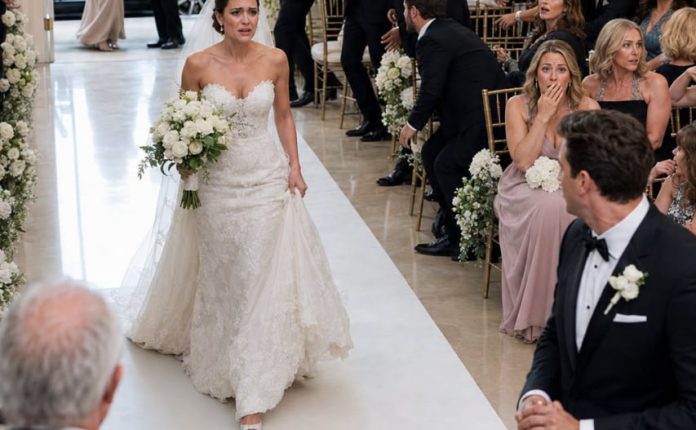
At eight months pregnant, I walked into family court expecting to lose my marriage, my home, and perhaps the last pieces of dignity my husband had not already taken from me. I did not expect his mistress to strike me twenty feet from the judge’s bench, or the judge to recognize me instantly.
I certainly did not expect the polished chief executive officer who had spent four years isolating me from everyone I loved to discover that the man seated above him—the man with authority to preserve evidence, summon courthouse security, and stop another lie entering the record—was the older brother my husband had convinced me to abandon.

The courthouse was colder than the December morning outside. Marble corridors carried the dull echoes of hurried shoes, murmured instructions, and names called by clerks who had already seen more broken families than they could remember. I moved slowly, one hand supporting my stomach and the other gripping a manila folder.
Inside were medical records, screenshots, unpaid bills, and messages I had repeatedly decided were not serious enough to show anyone. My daughter shifted beneath my ribs as I passed security. An officer noticed my discomfort and offered a chair, but I declined because sitting had become almost as difficult as standing.
I told myself I only needed to survive one hearing. I would sign whatever was reasonable, ask for enough support to rent somewhere safe, and leave before my husband found another way to convince me that survival itself was selfish. As I walked toward the courtroom, one word repeated inside my head: divorce.
Divorce, not betrayal. Divorce, not financial control. Divorce, not years of being told that every concern was evidence of instability. Divorce, not the night I slept inside a twenty-four-hour laundromat because my husband had changed the locks on our house and disabled my access to our bank card.
I had been married to Adrian Caldwell for six years. To the public, he was the founder and chief executive of Lumina Grid, a rapidly expanding energy-technology company celebrated for developing efficient power systems for hospitals and public buildings. Business magazines described him as disciplined, visionary, and emotionally intelligent.
He spoke at leadership conferences about creating humane workplaces. Every December, he donated to women’s shelters and made certain photographers were present when he delivered the checks. At home, however, humanity had gradually become an expense he could no longer justify whenever it interfered with his convenience, reputation, or control.
When the courtroom doors opened, Adrian entered beside his attorney, Graham Pike, a man known for representing wealthy clients through divorces that left their spouses too exhausted to continue fighting. Adrian wore a charcoal suit tailored so precisely that he looked as though he belonged to the architecture of the room itself.
His dark hair was perfectly combed, and his expression was relaxed, almost bored, as though he had arrived to approve a quarterly budget rather than legally dismantle the life we had built. On his arm was Bianca Shaw, the woman he had spent years insisting was only an executive colleague.
For three years, Adrian had introduced Bianca as Lumina Grid’s executive operations director. Later, she became his “strategic partner,” the phrase he used whenever I asked why she accompanied him to dinners, conferences, and private resort meetings. That morning, she made no attempt to disguise the reality of their relationship.
She wore a fitted cream dress beneath a pale coat and held Adrian’s arm with the easy possession of a woman who believed the legal paperwork was merely catching up with what had already happened privately. Around her wrist was a narrow sapphire bracelet that immediately stopped me where I stood.
The bracelet had belonged to my mother. After Mom died, I stored it inside a velvet box in our bedroom safe. Six months earlier, it disappeared. Adrian told me pregnancy had made me forgetful and insisted I must have misplaced it. Bianca saw me staring and slowly adjusted the bracelet until the sapphire caught the fluorescent light.
Adrian’s mouth curved into a smile. “You actually came,” he said. I reminded him that I had been ordered to appear. He looked toward my stomach and said, “I thought your condition might prevent you.” I answered, “My pregnancy is not a condition.” Bianca’s gaze dropped immediately.
“It certainly seems to have become your entire personality,” she said. I tightened my grip around the folder and tried to walk past them. Adrian leaned close enough that his words would not easily carry. “Sign the settlement. Take the temporary housing allowance and disappear. You should be grateful I am offering anything.”
“The house is jointly titled,” I answered. Adrian reminded me the company had paid for it. I said we purchased it during the marriage. His response came immediately: “You contributed nothing.” I reminded him I had left my job because he asked me to, but his carefully pleasant expression never changed.
“No one forced you to become dependent,” he said. My daughter kicked sharply, and I placed one hand over the movement while breathing through tightness spreading across my lower back. “I am asking for a fair division of marital property and support for your child.” Bianca laughed loudly enough that people turned.
“Your child?” she said. “You used that baby to trap him after you realized he was leaving.” I told her not to speak about my daughter. She smiled. “Why? Because the truth makes you emotional?” I stepped away, but Bianca deliberately moved into my path.
“You are embarrassing yourself,” she continued. “Adrian built something important. You sat at home, spent his money, and complained when he stopped pretending to be impressed.” I looked toward my husband, waiting for even the smallest indication that some boundary remained between cruelty and what he would permit.
Adrian smiled. That was when Bianca struck me. Her palm connected with my cheek before I understood she had lifted her hand. The impact turned my head and sent pain through my jaw. I stumbled sideways, reaching automatically for the edge of a table while my other hand covered my stomach.
The courtroom froze. A metallic taste spread across my tongue where my teeth had cut the inside of my lip. Adrian did not move toward me. Instead, he murmured, “Perhaps now you’ll stop making scenes.” Whispers erupted across the gallery while a clerk stood and the bailiff started toward us.
Bianca leaned closer, her perfume filling the space between us. “You should cry,” she whispered. “Pregnant women always look sympathetic when they cry.” I lifted my eyes toward the bench and saw that the judge had entered from chambers only moments earlier.
He stood behind his chair with one hand pressed against the stack of files before him. Judge Benjamin Rowan was known throughout the county for his measured temperament and strict adherence to procedure. Lawyers described him as patient but impossible to manipulate, and gray had begun appearing at his temples.
His face had changed during the four years since I had last seen him. His eyes had not. They were the same green-gray eyes I saw every morning in the mirror. My brother looked at the swelling mark on my face, then at my pregnant stomach, and finally back into my eyes.
His hand tightened around the bench until his knuckles whitened. “Lydia?” he said. My name was barely audible, but it was enough. Adrian’s smile disappeared. Benjamin was nine years older than I was and had spent most of my childhood behaving as though my safety were personally assigned to him.
After our father died, Ben attended parent-teacher meetings whenever our mother had to work. He taught me to drive in an old sedan with a broken radio, helped me apply to college, and answered late-night calls without making me feel foolish for needing him. Before my wedding, he asked me one final question.
“I’m not trying to interfere,” he had said. “I only want to know that you can disagree with Adrian and still feel safe.” I was offended by the question because Adrian had already spent months explaining that Ben disliked him simply because my brother was intimidated by successful men.
According to Adrian, Ben’s concern was not love but control. Every question my brother asked became evidence that he did not respect my adult choices. “He treats you like a child,” Adrian told me after our engagement dinner. “You have to choose whether you’re building a life with your husband or remaining your brother’s little sister.”
The isolation never happened through one dramatic argument. Adrian was far too intelligent for that. He scheduled holidays that conflicted with family gatherings, then acted hurt whenever I suggested changing them. He claimed Ben’s legal work made him cynical and repeatedly warned that listening to my brother would poison our marriage.
When Ben called, Adrian frequently said we were busy or told me my brother had spoken disrespectfully about him. Some messages never reached me at all. I learned much later that Adrian had blocked Ben’s number on one of my phones, deleted emails, and instructed our building staff not to admit him without permission.
At the time, I believed the silence meant my brother had chosen pride over reconciliation. Four years passed. During those years, Adrian gradually became the center of my financial, social, and emotional world. When I left my position as an architectural project coordinator, he promised it would only be temporary.
We had been trying for a child, and Adrian argued that the demands of his company required one of us to create stability at home. “You can always return after the baby,” he promised. The pregnancy did not come quickly. Instead, there were medical appointments, losses, and months when seeing a stroller hurt.
Through much of it, Adrian appeared supportive. He held my hand in clinics, ordered dinner when I was too exhausted to cook, and told friends we were facing everything together. Then Lumina Grid received its largest investment round, and the man I knew began changing in ways I kept explaining away.
He came home later, guarded his phone, and traveled more frequently with Bianca. He blamed the pressure of scaling the company. When I questioned him, he said fertility treatments had made me emotionally unstable. Gradually, he began recording our arguments, but he never recorded the way those arguments actually began.
He recorded me crying after he disappeared for two nights but not his refusal to answer my calls. He photographed a broken glass after I knocked it from the counter while he blocked the kitchen doorway, but not the twenty minutes he spent telling me no judge would believe a dependent wife over a respected CEO.
Every reaction became evidence. Every provocation disappeared. When I finally became pregnant, Adrian looked stunned rather than happy. He hugged me, but his body stayed rigid. Within a month, he moved into the guest room, claiming my sleep schedule interfered with work. Two months later, he suggested a “strategic separation.”
He was already living another life with Bianca. The first time I contacted Ben after years of silence, I did not leave a message. I heard his voice on the greeting, panicked, and disconnected. Adrian saw my brother’s number in the call history and immediately confronted me.
“Running back to your brother?” he asked. I told him the call was accidental. Adrian answered, “You know what he’ll do. He’ll turn this into a legal war and use your pregnancy to control everything.” The most painful truth was that part of me still believed him.
Isolation works because the person creating it does not need every lie to be convincing. He only needs enough lies to make outside help feel dangerous. Three weeks before the court hearing, Adrian changed our locks while I was attending a prenatal appointment, leaving my clothing, medical supplies, and identification documents inside.
He transferred five hundred dollars onto a prepaid card and messaged me that I should use it for temporary lodging. When I called police, Adrian produced a copy of a separation agreement I had never signed. The signature resembled mine closely enough that responding officers called it a civil dispute.
For eleven nights, I slept on borrowed couches. I filed emergency motions without understanding the procedures. Adrian’s attorneys claimed I voluntarily abandoned the home. The divorce hearing was rescheduled twice, and my legal-aid attorney received the final notice too late to rearrange another court appearance.
That was why I entered Ben’s courtroom alone. Neither of us knew he had been assigned to the emergency family calendar that morning. Cases rotated electronically, and a late rescheduling request from Adrian’s lawyers placed ours on his docket after the previously assigned judge became unavailable.
The moment Ben recognized me, he understood the conflict. He also understood that an assault had just occurred in front of witnesses. “Bailiff,” he said, his voice unsteady only for the first word, “secure the courtroom. No one leaves until identifying information and witness details have been collected.”
The heavy wooden doors closed. Adrian stood straighter and immediately attempted to regain control. “Your Honor, this is a straightforward dissolution matter. My wife is highly emotional, as you can see.” Ben turned toward him. “Do not characterize her medical condition or emotional state.”
Bianca rolled her eyes and claimed I had walked into her. Ben looked toward the clerk. “Let the record reflect that the court and multiple witnesses observed Ms. Shaw approach Mrs. Caldwell and strike her in the face.” Bianca’s confidence faltered as Adrian’s attorney rose and requested permission to approach.
“In a moment,” Ben answered. He looked toward me, and four silent years seemed to occupy the space between us. “Mrs. Caldwell, do you require medical assistance?” I told him I did not know. He asked about abdominal pain, dizziness, and contractions. I admitted my back had been tightening since I arrived.
Ben immediately instructed the clerk to call courthouse medical personnel. Adrian scoffed. “She does this whenever she wants attention.” My brother’s expression changed. “Mr. Caldwell, you will remain silent unless addressed.” Adrian began protesting that he could not be spoken to that way.
Ben answered evenly, “I have just watched your companion assault a pregnant litigant before the court convened. I may speak to you exactly as necessary to maintain order and preserve safety.” Bianca folded her arms and called the entire situation ridiculous.
Ben directed the bailiff to separate her from the parties, obtain her statement, and contact the courthouse deputy assigned to criminal intake. Bianca protested that he could not arrest her over a misunderstanding. Ben reminded her that he had ordered evidence preservation and an assessment, not an arrest.
She turned toward Adrian expecting support. For the first time, he looked uncertain. Ben inhaled slowly and then addressed the courtroom formally. “Before any substantive matter proceeds, I must disclose that Mrs. Caldwell is my younger sister. We have had no meaningful contact in approximately four years.”
He explained that he had no prior knowledge our case had been assigned to his calendar and therefore could not preside over the divorce, custody, or financial issues. Adrian’s attorney visibly relaxed and announced that the hearing would have to be postponed. Ben immediately corrected him.
“No. I will recuse from the underlying case. However, the assault occurred in my presence, and immediate safety concerns have been raised. I will preserve the record, request emergency review by the supervising family judge, and remain only until replacement judicial coverage arrives.”
Adrian smiled again, although far less confidently. “So you have no authority to issue anything against me.” Ben looked directly at him and answered, “I have authority to maintain order in this courtroom. Another judge will determine the emergency family orders.”
Then his voice sharpened slightly. “I strongly advise you not to mistake recusal for helplessness.”