Part 1: The Thanksgiving They Finally Remembered Me
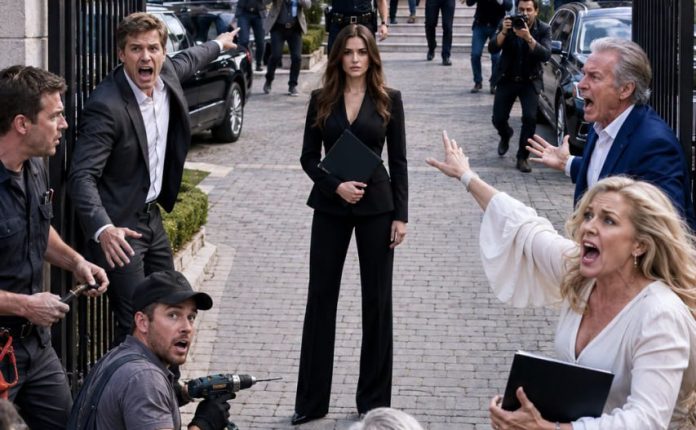
My name is Claire Whitmore. I was thirty, and on Thanksgiving morning, I watched my mother stand outside the iron gates of Ashcroft Manor holding a lease with my forged signature while a locksmith set a cordless drill on the hood of his van. “Open the gate,” she ordered through the intercom. “We have a legal right to enter.” Behind her, my father carried a leather portfolio under one arm while my younger brother, Ethan, grinned directly at the security camera.
Ethan had arrived in a rented moving truck packed with mattresses, coffee machines, folding tables, towels, lamps, and enough furniture to outfit a small hotel. He leaned closer to the camera and shouted, “We’re moving in, Claire. You can’t stop all of us.” They thought the ten-year lease in my mother’s hand gave them control of my home. They believed they could change the locks, convert bedrooms into guest suites, and open Ashcroft as a holiday inn before Christmas.
What they did not know was that I had seen the lease three days earlier. They also had no idea the manor was far from empty. Two sheriff’s deputies waited inside the dark library. Detective Maya Bennett stood behind the dining-room curtains. My attorney, Adrian Cole, had the real deed and purchase records spread across a side table, while investigative reporter Rachel Monroe reviewed fraudulent invoices, reservation receipts, and messages my family believed I would never discover.
I had not grown up imagining my parents would someday try to take my house. Their methods had always been quieter. Thanksgiving was their favorite day to remind me that I belonged only when I was useful. One year, Mom told me dinner had been moved to Friday because Dad had to work. On Thursday night, I saw photographs online of them carving turkey with Ethan and twenty guests. When I confronted her, she calmly said, “You’re so independent, Claire. We assumed you had plans.”
Another year, they claimed the rental house was too small for everyone. Two days later, Ethan posted a video showing three empty bedrooms. Independent was my mother’s favorite word whenever she wanted neglect to sound like praise. I built my career without their help. I studied architectural conservation and became a historic-property risk assessor, crawling through burned attics, inspecting damaged beams, and documenting old buildings before insurance companies approved expensive restoration work.
By twenty-nine, I was a regional director at a Boston firm. When the company was acquired, my employee shares were bought out. That money, together with years of savings and a preservation loan, allowed me to purchase Ashcroft Manor, an 1891 estate sitting on forty wooded acres. The property contained thirty-two rooms, a slate roof, a ruined conservatory, and a fire-damaged east wing. Most buyers saw a bottomless repair bill. I saw a wounded building that deserved another life.
I told my family almost nothing about the purchase. Whenever I succeeded, they treated my success like a shared bank account. Promotions became invitations to invest in Dad’s newest scheme. Bonuses became reasons I should pay Ethan’s debts. My expertise became free consulting. My time, money, and professional reputation were always described as “family resources.” I had learned that if I told them too much, they would eventually find a way to make whatever I had earned partly theirs.
Six months before I bought Ashcroft, my parents asked me to inspect an old warehouse they wanted to use for their struggling wedding business. I found dangerous electrical wiring, major water damage, unstable ceiling sections, and an expired occupancy permit. I told them plainly not to sign the lease. Dad accused me of sabotaging them and insisted I was exaggerating because I secretly wanted their business to fail. They signed anyway, ignoring every warning I had documented.
Three months later, part of the warehouse ceiling collapsed during a rehearsal dinner. Several guests were injured, lawsuits followed, and the venue shut down. My parents told relatives I had approved the building and later abandoned them. Then Dad demanded I sign a false statement supporting his insurance claim. I refused. After that, my Thanksgiving invitations disappeared entirely. Ashcroft became my distance from them. Not revenge. Distance. For the first time, I owned something they could not easily reach.
Then, three days before Thanksgiving, a locksmith called to confirm an appointment I had never scheduled. His name was Carl Jensen. He sounded uncertain and asked whether I still wanted every exterior lock replaced Thursday morning. I told him he had the wrong person. He emailed me the paperwork. At the bottom of a ten-year commercial lease was a signature that looked almost exactly like mine, except the lease was dated March 1, four months before I had even purchased Ashcroft Manor.
I stared at that date until the numbers stopped looking real. According to the document, I had leased Ashcroft to Whitmore Hospitality Group for ten years. I had not closed on the property until July 17. I searched the state business registry and discovered Whitmore Hospitality had been formed only six weeks earlier. My father was listed as manager, my mother as secretary, and Ethan as operations director. For several seconds, all I could do was laugh because my mind refused to process the scale of it.
Carl became more uncomfortable as we spoke. “Mrs. Whitmore told me you might object,” he admitted. I told him I was not Mrs. Whitmore and that my mother was not my authorized property manager. He paused, then explained that she had specifically requested every exterior lock be replaced while the owner was supposedly traveling in Europe. “I’m sitting inside the house,” I told him. Carl apologized repeatedly before revealing that they had also requested a master-key system for twenty-four guest rooms.
“Guest rooms?” I asked. Carl explained that my mother told him Ashcroft Manor was reopening as a boutique inn. My hand tightened around the phone. Ashcroft was residential property with very limited historic-event permissions. It was absolutely not licensed as a hotel. I told Carl to send me every document they had given him. Within minutes, twelve attachments arrived, including the fake lease, an owner-authorization form, room-numbering charts, floor plans, and a document titled ASHCROFT HOLIDAY INN—GRAND OPENING OPERATIONS.
They had planned everything. My bedroom was labeled Bridal Suite. My office had become Executive Suite 2. My restoration workshop was marked Laundry and Staff Storage. The library was labeled Cocktail Lounge, and the ballroom was scheduled for a “Thanksgiving Preview Event.” I stared at that phrase. The same holiday my family had repeatedly excluded me from was apparently going to become the day they moved into my house and publicly unveiled it as their newest family business.
My father had even assigned nightly prices. Standard rooms were listed at $495. Fireplace suites were $795. The bridal suite—my bedroom—was advertised at $1,250 per night. I called my attorney, Adrian Cole. He had handled Ashcroft’s purchase and understood its complicated title history. He answered on the second ring. “I have a strange question,” I said. “Can someone lease a property four months before I own it using my forged signature?” He stopped joking and told me to send everything immediately.
Twenty minutes later, Adrian called back. “This isn’t some ridiculous homemade lease,” he said. They had used a genuine commercial lease template, copied Ashcroft’s legal description, and reproduced my signature from somewhere. I knew exactly where. Months earlier, Dad had obtained a legitimate inspection form I had signed before the warehouse collapse. They had apparently copied my signature from that document. Adrian then pointed out something worse: the forged lease had supposedly been notarized.
The notary was Denise Rowland, my mother’s cousin. Denise had worked in real estate for years and knew exactly how notarization was supposed to work. Adrian told me I needed to call the police. For three seconds, I hesitated because the suspects were my parents and my brother. Then I looked again at the floor plan showing strangers sleeping in my bedroom. “I will,” I said. Detective Maya Bennett arrived that afternoon and examined everything at my dining-room table.
Maya was calm, precise, and completely unimpressed by family drama. She reviewed the lease, locksmith paperwork, corporate records, and dates. “Right now,” she explained, “we have suspected forgery, attempted fraud, possible conspiracy, and potentially identity-related offenses. But if they actually attempt entry using this document, their intent becomes much easier to establish.” I understood what she was saying without needing her to spell it out. “You want them to try,” I said quietly.
Maya answered, “I want you not to interfere with our investigation.” That was police language for something simple: do not warn them. Over the next twenty-four hours, we discovered how far the scheme had already gone. My family had created a professional website called Ashcroft Manor Inn. The photographs belonged to me. Some came from my private restoration account. Others had apparently been taken during the single afternoon in September when I foolishly allowed Mom and Dad to visit.
I remembered Mom wandering through the house with her phone raised, photographing bedrooms, windows, staircases, and fireplaces. I thought she was finally impressed by what I had accomplished. In reality, she had been gathering marketing material. The website described Ashcroft as “a historic Whitmore family estate lovingly restored across generations.” My family had contributed exactly zero dollars to the purchase or restoration, yet their surname was displayed everywhere as though the manor had belonged to them for generations.
The website advertised twenty-two guest rooms, holiday dinners, weekend wedding packages, corporate retreats, wine tastings, Christmas stays, and a New Year’s Eve gala. Worse, more than forty bookings had already been accepted. Nearly $68,000 in deposits had been collected from customers who believed they were reserving rooms in my home. My stomach turned when I realized those people believed they would soon be arriving at Ashcroft with suitcases, wedding dresses, children, and holiday plans.
Investigative reporter Rachel Monroe entered the story because one of those customers contacted her newspaper. Rachel worked for the Boston Ledger’s investigations desk and had previously reported on the warehouse collapse involving my parents. A bride whose December wedding had been canceled after that disaster discovered the new Ashcroft website and sent Rachel a tip. Rachel called me Tuesday evening and asked, “Are your parents opening a hotel in your house?” I almost laughed because hearing someone else say it sounded completely absurd.
Rachel arrived Wednesday morning carrying a folder that contained even more evidence than I had. There were advertisements, email campaigns, vendor agreements, wedding packages, a commercial-linen invoice, a champagne distributor contract, reservation confirmations, and projected booking revenue. My family was not merely preparing to commit fraud. They were already doing it. The only thing they lacked was physical control of the property, and Thanksgiving morning was apparently their planned takeover date.
“They need possession before the first guests arrive,” Rachel said. Adrian agreed. Once my family entered, changed locks, moved furniture inside, displayed a supposedly notarized lease, and claimed tenancy, they could create enough confusion for responding officers to initially view the matter as a civil dispute. Even a fraudulent tenancy claim could take time to unravel. They did not need the lease to survive forever. They only needed it to confuse everyone long enough to establish themselves inside the manor.
“They’re counting on hesitation,” Maya explained. “They want everyone uncertain long enough for them to establish control.” That sentence described not only their legal strategy but almost my entire childhood. My mother had always exploited hesitation. When I was seventeen, she emptied my college savings because Ethan needed a car. “You’ll get scholarships,” she told me. I did. Years later, she volunteered me to design a cousin’s restaurant renovation without asking. “Family helps family,” she said whenever I objected.
Dad relied on a different style. He simply behaved as though whatever he wanted had already been decided. Once, he arrived at my apartment accompanied by two contractors and announced that I would be cosigning a business loan. When I refused, he stopped speaking to me for four months. Ethan learned both methods perfectly. At twenty-seven, he had tried several careers, accumulated large debts, borrowed from nearly everyone we knew, and still believed his next opportunity would somehow make him wealthy.
Wednesday evening, Mom called. I let it go to voicemail. Her message sounded cheerful. “Hi, sweetheart. We thought we might finally do Thanksgiving together this year. Wouldn’t that be nice? Call me.” The timing was so transparent it almost impressed me. A few minutes later Ethan texted, Big family surprise Thursday. Don’t make plans. I showed Maya. She gave a humorless smile. “They think you don’t know.” I asked what we should do. “Let them keep thinking that,” she said.
That was how Thanksgiving at Ashcroft became something completely different from every Thanksgiving I had known. Instead of seasoning a turkey, I charged security cameras. Instead of setting a family table, I gave law enforcement access codes. Instead of wondering whether my parents would remember to invite me somewhere, I prepared for them to commit a crime on camera. For once, I knew exactly what my role was supposed to be. I was supposed to do absolutely nothing.
At 8:17 Thanksgiving morning, the first security alert sounded. Dad’s SUV pulled up outside the gates. Mom stepped out holding the lease. Two minutes later, Carl’s locksmith van appeared. At 8:24, Ethan’s rented moving truck turned into the lane. Then another vehicle arrived, followed by another. My stomach dropped. A catering van pulled up, followed by a florist and several cars carrying people dressed for Thanksgiving. Mom had invited guests because, of course, she needed an audience.
Through the intercom, her voice crackled. “Claire? Open the gate.” I stood inside the security room beside Maya, watching her on the monitor. “Don’t answer yet,” Maya said. Mom pressed the button again. “Claire, we know you’re home.” Dad stepped toward the camera and announced, “We have documentation.” Then Ethan leaned into view, smiling like he had already won. “We’re moving in, Claire. You can’t stop all of us.” His expression told me this was not desperation. They were enjoying themselves.
Taking Ashcroft was not only about money. It was also about defeating me. I was the daughter who had stopped paying for their problems, the sister who had finally refused to rescue Ethan, and the family member who had acquired something too large for them to casually demand. They wanted the manor because it was valuable, but they also wanted to prove that nothing I owned could truly belong only to me. My mother pressed the intercom again and slowly said, “Open. The. Gate.”
I said nothing. Five minutes passed. Then she turned toward Carl and said, “Do it.” Carl already knew about the police investigation and was cooperating. He approached the pedestrian gate while Mom impatiently pointed toward the larger vehicle gate. Carl explained that he needed to test the smaller lock first. He placed his drill against the cylinder housing. The sound carried across the cold morning. Inside Ashcroft, nobody spoke as the drill bit began cutting into the outer plate.
Rachel raised her camera. Adrian closed the folder containing my real deed. Maya touched the radio on her belt. The moment Carl’s drill broke the outer lock plate, she spoke one word. “Now.” Two sheriff’s vehicles emerged from behind the carriage house while another entered through the service road. My mother turned around. Her face changed instantly. For the first time that morning, all the confidence disappeared, and the forged lease in her hand suddenly looked exactly like what it was—a piece of paper that could not save her.