When my wife, Sarah, died during childbirth, people kept telling me that time would eventually soften the pain. They said grief changed shape and that one day I would remember her without feeling as if someone had reached into my chest and closed a fist around my heart. They told me I would learn to live again. I hated hearing it, not because they meant anything cruel, but because none of them understood what it felt like to leave a hospital carrying a newborn daughter while knowing her mother would never walk through our front door again.
Sarah had been thirty-one years old, healthy, excited, and terrified in all the normal ways first-time parents were terrified. We had painted the nursery together. She chose pale yellow walls because she said pink was too predictable, and there were little white clouds above the crib with a wooden moon hanging over the changing table. Sarah spent three evenings painting tiny stars around that moon, complaining that her back hurt while refusing to let me finish the job for her.
“This is my contribution,” she had said, laughing as she balanced on a small stool with one hand beneath her enormous belly. “You assembled everything else.” I remembered grabbing her gently around the waist and telling her to get down before she killed herself. For years afterward, I hated myself for remembering those exact words. Sarah went into labor two weeks later. At first everything seemed normal, and then suddenly it wasn’t. There was bleeding. Doctors came running. Machines began sounding alarms.
Someone told me to step away from the bed while Sarah squeezed my hand so hard her fingernails cut into my skin. I remember her looking directly at me—not at the nurses or doctors, but at me. She was frightened. “Daniel,” she whispered. Those were the last words she ever said. Our daughter survived, but Sarah didn’t. The doctors explained that there had been a catastrophic hemorrhage and that they had done everything they could. I heard almost none of their explanation.
All I understood was that my wife had been alive that morning and dead that evening, and somehow I was expected to walk out of the hospital and continue being a person. I named our daughter Arianna Sarah Mercer, Ari for short. Sarah had chosen the name Arianna months earlier and joked that our daughter would hate us if we made her write the whole thing on school papers. So Ari she became. For the first two years of her life, it was just the two of us—and, in a strange way, Sarah was still there too.
Her photographs were everywhere. There was one beside my bed from our honeymoon in Maine, another in the kitchen where she was holding a bowl of flour and pretending she had no idea how it had ended up covering her face, and one in Ari’s nursery showing Sarah at seven months pregnant, laughing with both hands resting over her stomach. I talked about Sarah constantly because I wanted Ari to know her mother had existed. More importantly, I wanted her to know that she had been wanted, loved, and dreamed about.
There were nights when Ari wouldn’t sleep unless I walked around the living room holding her against my chest. I would whisper stories about Sarah while Ari stared up at me with enormous brown eyes. “Your mommy loved strawberries. Your mommy couldn’t whistle. Your mommy danced terribly. Your mommy once drove twenty miles with a coffee cup sitting on the roof of her car.” I didn’t know whether a baby understood those stories. I told them anyway because they were all I had left to give her.
My parents helped whenever they could, and my sister, Megan, practically lived with us for the first three months. Eventually everyone returned to their own lives, and somehow I returned to mine too, if it could be called that. I went back to work. I learned how to pack a diaper bag with one hand while holding a crying baby with the other. I learned which grocery store stayed open late when Ari developed fevers at midnight, how to braid hair badly, and how little sleep a human being could survive on.
I also learned that a two-year-old could somehow survive on six blueberries and half a cracker while possessing enough energy to destroy an entire living room. What I didn’t learn was how to stop being lonely. I wasn’t looking for another wife. That part mattered. I wasn’t searching dating apps or asking friends to introduce me to women. Whenever someone suggested that I deserved happiness again, I changed the subject. Then, a few weeks before Ari’s second birthday, I walked into a children’s store downtown.
I was searching for a wooden play kitchen Sarah had once shown me online. The store was crowded, and Ari was tired and irritated because she had missed her nap. I stood in an aisle comparing two nearly identical toy kitchens while Ari sat in the shopping cart announcing loudly that she wanted cookies. That was when Claire approached us. She wore the store’s green apron over jeans and a white blouse. She had shoulder-length dark blond hair and a smile that felt immediately warm rather than practiced.
“Major negotiation happening here?” she asked. I turned toward her and said that apparently the other party’s demands included cookies. Claire crouched beside the cart and asked Ari what kind. Ari stopped complaining and stared at her before answering, “Chocolate.” Claire widened her eyes dramatically and told her that was a very serious cookie. Ari giggled. It surprised me enough that I smiled too. Ari had always been shy around strangers, particularly women she didn’t know well.
Yet within minutes she was showing Claire the stuffed rabbit she carried everywhere and explaining, in the fragmented language of a two-year-old, that the rabbit’s name was Captain Bun. Claire listened as though Ari were presenting something genuinely important. Eventually she helped me choose the toy kitchen, and when she discovered it was for Ari’s birthday, she found a roll of gold ribbon and tied an enormous bow around the box. “No charge,” she said. I thanked her and left.
That should have been the end of it. Three days later, Ari dropped Captain Bun somewhere downtown, and I retraced our route for almost an hour before remembering the children’s store. Claire was working again, and Captain Bun was sitting safely behind the counter. “You saved him,” I said. “Of course,” she replied. “He looked emotionally vulnerable.” I laughed. It was the first real laugh I could remember having with a stranger in years. We ended up talking for nearly twenty minutes.
Claire asked about Ari, then about me. Eventually she noticed the wedding ring I still wore on my left hand. Her smile changed—not disappearing, just becoming gentler. “I’m sorry,” she said quietly. Something about the way she said it made me answer honestly. “She died when Ari was born.” Claire didn’t offer one of the usual phrases about everything happening for a reason or Sarah being in a better place. She simply said, “That must have been incredibly hard.”
I nodded. “It still is.” Claire looked at Ari, who was sitting on the floor hugging Captain Bun. “I imagine some days are harder than others.” That sentence stayed with me. Before I left, Claire wrote her number on the back of the store receipt. “No pressure,” she said. “But if you ever want coffee with another adult, I’m reasonably good company.” I stared at the number for almost a week before finally texting her. Coffee became lunch, lunch became dinner, and dinner became walks in the park with Ari.
Claire never pushed, and that was one of the things I loved most about her. She never tried to replace Sarah—or at least that was what I believed then. When Claire first came to our house, she paused in front of Sarah’s photograph in the hallway. “She’s beautiful,” she said. I swallowed and answered, “She was.” Claire looked at me and said, “You don’t have to take these down because I’m here.” That sentence meant more to me than she could possibly have understood.
Over the next year, Claire slowly became part of our lives. She learned that Ari liked bananas sliced lengthwise instead of into circles, which songs calmed her after nightmares, that I forgot to buy laundry detergent until we were completely out, and that Sunday mornings belonged to pancakes. Ari adored her at first. That detail would haunt me later because for nearly eighteen months, I never saw anything that made me seriously question Claire’s affection for my daughter.
There were tiny moments I noticed, but I dismissed them. Ari sometimes became unusually quiet when Claire entered a room. She asked if she could sleep with me more often. Once she cried when I told her Claire would be picking her up from preschool. Children went through phases, I told myself. One afternoon, when Ari was three, she threw a tantrum because Claire packed her blue cup instead of her yellow one. Claire handled it patiently, or at least she seemed to.
Later that evening, Ari whispered, “Claire gets mad.” I remember kneeling in front of her and asking, “When?” Ari answered, “When you go.” I told her everybody got mad sometimes. She stared down at Captain Bun and whispered, “Different mad.” I should have asked more questions. Instead, I kissed her forehead and told her everything was okay. That memory would replay in my head hundreds of times after I finally learned what had been happening inside my home.
About six months before our wedding, Claire moved into the house. She transformed our daily routine almost immediately. Dinner appeared at reasonable times, appointments were remembered, bills were organized, and the refrigerator contained actual food instead of yogurt, leftovers, and juice boxes. I felt guilty about how relieved I was. Single parenthood had exhausted me in ways I didn’t know how to explain. Claire seemed to lift half the weight from my shoulders.
“You don’t have to do everything alone anymore,” she told me. I wanted to believe her, so I did. Three months later, I proposed. We married in a small ceremony in my parents’ backyard. Ari wore a yellow dress and carried daisies. Claire looked beautiful. During the vows, I cried partly because I loved the woman standing in front of me and partly because another woman should have been there. Grief is strange that way. Happiness and sorrow can occupy the same space.
After the ceremony, Claire held my face in her hands and whispered, “I’m going to take care of you.” At the time, those words felt like love. Weeks later, I would remember them differently. Our family dinner happened twenty-three days after the wedding. My parents came over around six, and Megan arrived a few minutes later carrying wine and a ridiculous houseplant she claimed was a traditional wedding gift, even though we all knew she had invented that tradition five minutes earlier.
Claire cooked roast chicken, potatoes, green beans, and homemade bread. The house smelled incredible, and my father kept joking that marrying Claire had dramatically improved my standard of living. Claire laughed. I did too. Ari was quieter than usual. She sat at the table pushing peas around her plate. Once, I noticed her staring at Claire. She wasn’t simply watching her. She was staring with an expression I couldn’t quite understand. I leaned closer and asked, “You okay, Bug?” Ari nodded.
After dinner, Claire brought out lemon cake, my mother’s favorite. Mom became emotional, which wasn’t unusual because she could cry during television commercials. But this time, she reached across the table and took Claire’s hand. “I hope you know how grateful we are,” she said. Claire smiled and told her she didn’t have to thank her. Mom insisted that she did because Daniel and Ari had gone through something no family should have to endure.
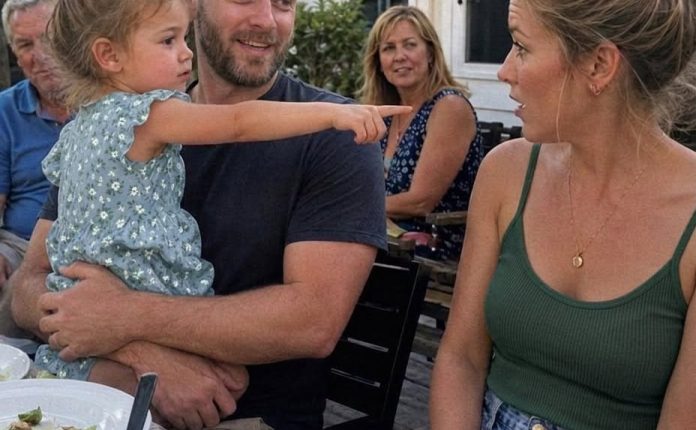
“She needed someone loving in her life,” Mom said. “We all worried about them for such a long time.” I felt embarrassed and touched at once. Claire squeezed my mother’s hand and answered, “You don’t have to worry anymore.” Before Mom could respond, Ari suddenly stood on the seat of her chair. Everyone looked at her. Her little face was completely serious. Then she raised one small finger and pointed directly across the table at Claire.
“She is a monster,” Ari said.
The room fell silent. My father slowly lowered his fork. Megan looked at me. Claire blinked. I gave a nervous laugh and said, “Ari.” Claire tried to smile and asked, “Am I a scary monster?” Ari didn’t laugh. I reached toward her and gently asked, “Sweetheart, why would you call Claire a monster?” Ari looked at me with wide, innocent eyes, almost confused that I didn’t already understand. Then she answered with one sentence that made my entire body go cold.
“Because monsters put sleepy sugar in people’s drinks.”
Everything inside me stopped. “What?” Ari pointed toward my coffee mug. “Like she puts in yours.” My mother whispered my name, but I barely heard her. I looked down at the mug beside my plate and then back toward Claire. Her face changed only slightly, but I saw it. Ari continued before anyone else could speak. “She does it when you’re not looking.” My mouth went dry. “What sleepy sugar?” I asked. Ari looked toward the kitchen.
“The white one,” she said. “The little bag.” Claire finally spoke. “Daniel, she’s four years old.” Her voice was calm. Too calm. I ignored her and asked Ari to show me. Claire pushed her chair back and said the situation was ridiculous. Ari froze the moment Claire raised her voice. I saw fear flash across my daughter’s face, and that was the instant something inside me shifted. It wasn’t only Ari’s words. My daughter was afraid of my new wife.
“Ari,” I said carefully, “you’re not in trouble.” She stared at Claire. Claire stared back. I stood and told Claire to stay where she was. Her face hardened. “Excuse me?” she asked. “Just stay here.” My father stood too. Claire looked around the table and said, “This is insane. We’re seriously letting a preschooler accuse me of poisoning someone?” Nobody had used the word poisoning. Not Ari. Not me. Not anyone. The fact that Claire said it made the room feel even colder.
Ari grabbed my hand and whispered, “Come.” She led me toward the kitchen. Behind us, chairs moved and Claire called my name, but I ignored her. Ari walked past the pantry and stopped beside a narrow cabinet near the refrigerator where we kept baking supplies. She pointed. “In there.” I opened it. There was flour, sugar, brown sugar, and cornstarch. Nothing unusual. “What am I looking for?” Ari crouched and pointed behind a bag of flour. I moved it.
There was a small plastic pouch hidden behind the bag. It was unmarked and filled with white powder. My stomach dropped. I picked it up just as Claire appeared in the doorway. My father stood behind her, while Megan and Mom watched from the dining room. I held up the bag and asked, “What is this?” Claire folded her arms. “Probably powdered sugar.” I asked why it was hidden. Claire said she hadn’t hidden it. Ari immediately said, “Yes, you did.”
Claire looked down at my daughter, and something about that look made me move Ari behind me. Claire exhaled sharply and told me to think for a second because Ari was four years old and had probably seen her measuring something while cooking. Then Ari tugged my shirt and said, “She puts it in the blue cup too.” I looked down at her. “What blue cup?” I asked. “The one by your bed,” she answered. That was the moment my face turned completely pale.
I knew exactly which cup she meant. For the previous month, I had been drinking water every night from a dark blue insulated tumbler Claire bought me. For that same month, strange things had been happening. I had been waking up exhausted—not normal tired, but drugged tired. There had been mornings when my alarm rang for twenty minutes without waking me. Once I slept through Ari crying after a nightmare, and Claire told me she had comforted her.
Twice I woke with headaches so severe I had to sit on the edge of the bed before standing. Another morning, I discovered a bruise on my shoulder and had no memory of getting it. I blamed stress, work, wedding planning, and everything except the woman sleeping beside me. Now, standing in my kitchen holding an unmarked bag of white powder, those memories came back at once. I looked directly at Claire and asked, “What have you been putting in my drinks?”
“Nothing,” she answered. I started to mention what Ari had said, but Claire snapped, “Ari is four!” Her voice rose sharply, and my daughter flinched. I saw it again, and this time Claire noticed me seeing it. She immediately softened her voice. “Daniel, please. I understand you’re protective of her, but children invent things.” I held the bag up and said, “She didn’t invent this. If it’s harmless, you won’t mind if we find out exactly what it is.”
Claire didn’t answer. My father pulled out his phone and said he was calling the police. Claire’s head snapped toward him. “No.” The word came too fast and too sharply. Dad stared at her. Claire quickly recovered and said calling police was unnecessary and would terrify Ari. My father’s thumb hovered over the screen as he answered, “If it’s powdered sugar, nobody has anything to worry about.” Claire stepped toward him and quietly said, “Please don’t.”
My heart began pounding. I told Dad to call. Claire suddenly moved toward the hallway. Megan stepped in front of her and asked where she was going. Claire said she needed air. Megan answered that she could get air later. Claire laughed without humor and called all of us unbelievable. She reached for her purse. I reached it first. “Daniel,” she warned. I picked it up and told her she could have it after the police came.
“You have no right to search my belongings,” Claire said. I told her I hadn’t said I would search the purse. The panic in her expression told me something anyway. She was afraid of what might be inside. My father called 911. Claire changed instantly. The loving woman I had married seemed to disappear. Her shoulders stiffened, her mouth tightened, and she looked at me with an expression I had never seen before. It wasn’t fear. It was calculation.
“You’re really doing this?” she asked. I looked down at my daughter hiding behind my leg and answered, “Yes.” Claire stared at me for several seconds before sitting down. Nobody spoke while we waited. I put the bag of white powder on the kitchen counter and kept Ari beside me. Eventually my mother took her into the living room and turned on cartoons. Claire said nothing. Neither did I. Two police officers arrived about twelve minutes later.
Officer Ramirez was a woman in her forties, and her partner, Officer Cole, looked younger. They separated us immediately. I explained Ari’s statement, the powder, the blue tumbler, and my recent fatigue. Ramirez asked whether I had consumed anything prepared by Claire that evening. I said coffee. Her expression sharpened. “Don’t drink anything else.” Another officer arrived, followed by paramedics, and suddenly my home became a scene from somebody else’s life.
They photographed the bag, collected my coffee mug, and took the blue tumbler from my bedroom. A paramedic checked my blood pressure and heart rate. Physically, I felt fine. Emotionally, I felt as if the floor beneath me had disappeared. Claire remained remarkably composed. She told police the substance was a nutritional supplement, which was different from her earlier claim that it might be powdered sugar. Officer Ramirez noticed the contradiction immediately.
“So which is it?” Ramirez asked. Claire hesitated and said she hadn’t been sure what I had found. Ramirez pointed out that Claire had seen the bag. Claire said it could have been either. When asked what supplement it supposedly contained, Claire answered, “Magnesium.” Ramirez asked why magnesium would be hidden behind flour. Claire insisted she hadn’t hidden it. Then Officer Cole returned from speaking with Ari and quietly said something to his partner.
Ramirez looked at Claire. “Ms. Mercer, we’d like you to stay here.” Claire crossed her arms. “I already am.” Officer Ramirez then turned toward me and asked to speak privately. We walked outside, where my porch light cast a yellow circle over the driveway. I suddenly remembered Sarah standing in that exact place years earlier while arguing with me about where to plant hydrangeas. The memory nearly broke me before Ramirez even began speaking.
“Your daughter told Officer Cole that your wife has given you what she calls sleepy sugar multiple times,” Ramirez said. I closed my eyes. She continued, explaining that Ari said Claire had told her never to tell me. My eyes opened. “What?” Ramirez said Ari had been told it was grown-up medicine and that I needed it because I couldn’t sleep. I tried to breathe. Then the officer hesitated and said there was something else Ari had mentioned.
My daughter had apparently woken up one night and found Claire inside my office. Ari described Claire opening a drawer and taking papers. My office contained bank records, tax documents, insurance policies, Sarah’s death certificate, Ari’s birth certificate, and my Social Security information. Suddenly, I felt physically sick. I told Ramirez I needed to go to the hospital. She agreed. My parents stayed with Ari while Megan drove me because officers didn’t want me behind the wheel.
At the emergency room, doctors took blood and urine samples. I sat beneath fluorescent lights with Megan beside me, and neither of us spoke for a long time. Finally, she said, “I never liked her.” I looked at her in disbelief. “Megan.” She immediately admitted it was a terrible time to say it but explained that she felt guilty because there had been things she noticed. My chest tightened as I asked what she meant.
“She asked me questions,” Megan said. “About your finances.” I turned toward her. She said Claire had asked whether Sarah had life insurance, whether the house was paid off, and whether I had changed my will after Sarah died. I couldn’t speak. Megan insisted Claire had framed everything as financial planning and said she wanted to make sure Ari would always be protected. At the time, Megan hadn’t thought it was sinister enough to warn me.
The doctor returned nearly two hours later with a serious expression. “We found zolpidem in your system,” she said. I stared at her and asked what that meant. She explained it was a prescription sleep medication. “I don’t take sleeping pills,” I said. The doctor understood. Based on the amount and the time I had consumed my coffee, she believed I had ingested the drug that evening. Megan covered her mouth with one hand while I sat there feeling numb.
I thought about the cake, the laughter, my mother thanking Claire for taking care of us, and the coffee Claire had placed beside me before dessert. The doctor continued talking about side effects, dangerous interactions, and monitoring, but I heard only fragments. I had been drugged. Not once, perhaps, but repeatedly. By my wife. When I returned home near midnight, Claire was gone. Police had taken her in for questioning, but Officer Ramirez remained at the house.
“We found prescription medication in her purse,” Ramirez told me. I asked if it was zolpidem. She nodded. The prescription wasn’t in Claire’s name. It belonged to a sixty-eight-year-old widower named Eric Dawson, someone I had never heard of. Police were already trying to determine who he was and why Claire possessed his medication. The next morning, I took Ari to my parents’ house because I didn’t want her in our home while investigators were still searching it.
I sat on the carpet with Ari while she played with wooden blocks. For nearly an hour, I didn’t question her because I wanted professionals to handle serious interviews and didn’t want to influence her memory. Eventually, Ari climbed into my lap and whispered, “Is the monster gone?” My throat tightened. I told her Claire wasn’t there right now and probably wouldn’t be coming back. Ari’s entire body relaxed against me. That tiny movement destroyed me.
“How long were you scared of her?” I asked gently. Ari held up three fingers, and I didn’t know whether she meant three days, weeks, or months. I asked why she hadn’t told me. Her answer came immediately. “She said you would go away.” I felt something inside me fracture. I asked exactly what Claire had said. Ari played with the sleeve of my shirt and whispered, “She said if I tell secrets, you sleep forever.” My hands began trembling.
I forced myself to keep my voice steady and asked, “Like Mommy?” Ari nodded. “She said Mommy sleeps forever.” I closed my eyes. There are moments when guilt becomes physical. It sits on your chest and makes breathing difficult. My daughter had been living in fear inside her own home while I had been planning a wedding. I had kissed Claire goodnight. I had thanked her for helping with Ari. I had left them alone together, completely unaware of what was happening.
Ari touched my face and asked, “Daddy sad?” I opened my eyes and told her Daddy was okay. She hugged me, and somehow that made everything worse. Over the next several days, the truth began emerging piece by piece, with each discovery more disturbing than the last. The medication belonged to Eric Dawson, a widower who had reported several prescription bottles missing months earlier. Detectives soon discovered Claire had previously worked as a part-time caregiver for Eric’s wife before she died.
Eric’s son remembered Claire very well. He told detectives she had become unusually close to his father shortly after his mother’s death. She brought meals, helped with errands, and organized his medication. Eventually, Eric’s son became suspicious after noticing unexplained withdrawals from his father’s bank account. When he confronted his father about Claire, she disappeared. No criminal charges had been filed because Eric refused to cooperate and insisted the withdrawals were loans.
But detectives found something even more troubling. Claire had used multiple surnames: Claire Dawson, Claire Willis, Claire Bennett, and now Claire Mercer. My wife’s legal name wasn’t even Claire. It was Melissa Jane Willis. Claire was her middle name, but she had built a convincing identity around it using altered documents. She had no major criminal convictions, only a scattered trail of relationships that never seemed serious enough to produce a clear record.
Those relationships often involved men who were older, widowed, newly divorced, or grieving. They were vulnerable men who had lost someone or were going through major upheaval. Men with young children rarely appeared in her history. I was the exception, or perhaps Ari was simply an obstacle Claire believed she could manage. Then detectives examined my financial records, and everything became terrifyingly clear.
Three months earlier, somebody had accessed my life-insurance account online. The beneficiary had originally been Ari, with my sister Megan designated as trustee until Ari turned twenty-five. The beneficiary had been changed to Claire. I hadn’t changed it. The insurance company showed electronic authorization, my login credentials, my home IP address, and a digital signature that appeared to be mine. I had no memory of making any change.
The account had been accessed at 1:14 in the morning. I checked my calendar and messages from that date. That night, I had texted Megan around 8:30 saying I felt unusually exhausted and was going to bed early. Claire had told me the following morning that I slept nearly eleven hours. Investigators found other documents too—a home-equity application saved on my computer, a partially completed power-of-attorney form, photographs of my passport, driver’s license, Sarah’s death certificate, and even Ari’s Social Security card.
Claire had taken pictures of everything. What I couldn’t understand was why she hadn’t simply stolen money and disappeared. Why marry me? The detective assigned to the case, Paul Brenner, explained that marriage gave access—to property, medical decisions, insurance, accounts, and credibility. I felt nauseous and asked whether he was saying Claire had planned to kill me. He carefully replied that the evidence suggested she was positioning herself to benefit significantly if something happened to me.
“If something happened?” I repeated. Brenner said they were investigating. I reminded him that I had a four-year-old daughter. If I died, Claire could have been left with Ari. “Potentially,” he said. The room seemed to tilt. That possibility was worse than anything else. Money could be replaced, houses could be sold, and documents could be restored, but Ari could have been left completely alone with the woman who had already terrorized her.
I stood so abruptly that my chair scraped across the floor. Brenner remained seated. I asked what would happen next, and he said they would keep building the case while Claire faced initial charges that might expand as investigators uncovered more evidence. Her attorney would argue for bail, but police could help me apply for a protective order covering both me and Ari. I laughed once, a broken sound. “I married her three weeks ago,” I said.
“I know,” Brenner answered. I told him I had stood in front of my family and promised to spend my life with her. She had helped my daughter carry flowers down the aisle. Brenner finally told me something I never forgot: people who manipulate others usually aren’t frightening all the time. If they were, nobody would let them close enough to do damage. Those words followed me home and stayed with me long after the investigation ended.