Part 2: The Lease That Could Not Possibly Exist
The deputies did not rush toward my family. Somehow, that made the moment even more frightening. They approached slowly while Mom stood beside the damaged gate holding the lease like a shield. “What is this?” she demanded. Deputy Harris instructed everyone to move away from the gate. Dad stepped forward immediately. “This is private property,” he said. Harris agreed calmly, then asked for documentation supporting their claimed right to enter.
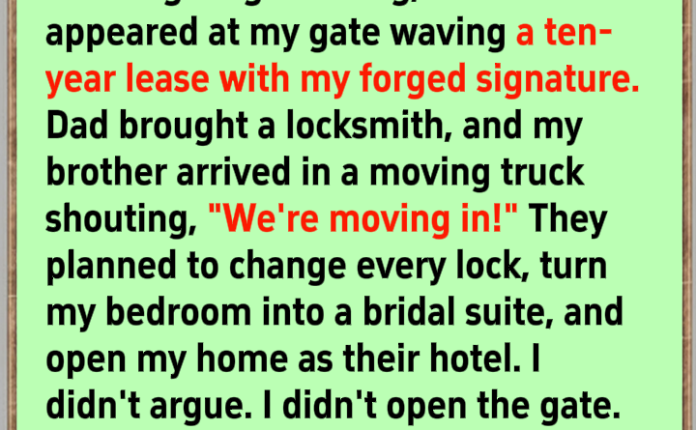
Mom practically shoved the lease toward him. “There. We are lawful tenants.” Deputy Harris glanced at the document while Dad smiled as though the matter had already been resolved. My father had spent years relying on confidence as evidence. If he spoke loudly enough, produced enough paperwork, and moved quickly enough, people often stopped questioning him. This time, however, the paperwork was precisely why the police were standing there.
Carl stepped away from his tools while Ethan climbed down from the moving truck. “What’s going on?” he demanded. Deputy Harris told him to stay where he was. Ethan laughed. “Come on. This is family stuff.” That sentence could have been the motto of my childhood. Money disappeared? Family stuff. Promises broken? Family stuff. Claire excluded? Family stuff. Apparently forged leases and attempted property takeovers belonged in the same category.
Mom pointed toward Ashcroft. “My daughter is having emotional difficulty accepting a business arrangement she signed months ago.” Maya looked at me inside the house. I almost laughed. Instead, I kept watching. Deputy Harris asked when the lease had been executed. “March first,” Mom answered immediately. Then he asked who owned Ashcroft on March first. That question created the first visible crack in her confidence.
Dad answered before she could. “Claire.” Harris shook his head. “No, she didn’t.” Dad’s jaw tightened. “There may have been a closing delay.” Mom quickly added that I had equitable possession beforehand. Adrian, listening inside, muttered that it was spectacular nonsense. Deputy Harris asked who notarized the document. Mom answered, “Denise Rowland,” and confirmed that I had supposedly been physically present before her. That lie mattered because Denise had already spoken with investigators.
Denise had admitted that I had never appeared before her. She claimed Mom assured her that my signature was authentic and that I had authorized everything remotely. That confession did not absolve Denise, but it destroyed my mother’s story. Deputy Harris nodded as though satisfied. For one brief moment, Mom relaxed. She thought she had successfully answered his questions. Then Detective Bennett stepped out of the manor and walked down the stone path toward the gate.
“Mrs. Whitmore?” Maya said. Mom answered yes. Maya introduced herself and calmly explained, “We spoke with Denise Rowland last night.” Dad went pale. Mom did not. She became furious. “Claire called the police on us?” Maya ignored the question and explained that official records showed I purchased Ashcroft on July 17. Dad snapped that the dispute was civil. Maya replied, “Forgery and attempted unlawful entry are not civil matters.”
Ethan began moving toward the truck. Deputy Harris immediately ordered him to stop. Ethan claimed he only wanted his phone, but Harris told him to remain where he was. For once, Ethan obeyed. Then Mom spotted Rachel standing on the front terrace. She recognized her instantly from the warehouse investigation. “What is she doing here?” Mom shouted. Rachel raised her press credentials. My mother turned toward the security camera and screamed my name.
“You brought reporters?” she demanded. I finally pressed the intercom button. “Yes.” Just one word. I had imagined this confrontation for two days. I had imagined yelling, accusations, and perhaps satisfaction. Instead, I felt strangely calm. Mom approached the speaker. “How dare you humiliate this family?” There it was. Not, How dare you accuse us? Not, The lease is real. Not, We can explain. Her greatest concern was humiliation.
“You brought a locksmith to my home,” I replied. “It’s our business property,” she insisted. “No.” “You signed the lease.” “No.” “You agreed to help us after the warehouse disaster.” “No.” Then Dad moved closer and said, “You owe us after what you did.” I stared at the monitor. What I had done, according to them, was warn them that their unsafe warehouse could hurt someone. The ceiling had collapsed exactly as I feared, yet somehow I remained the villain.
Dad accused me of destroying their company. I reminded him that I had warned them not to use the building. He claimed I had wanted them to fail and resented Ethan. Somehow, within minutes, a forged commercial lease had become another argument about my childhood. “I’m not discussing my childhood through an intercom,” I said. Mom demanded that I come outside. I refused. She turned toward Maya and said, “You see? She’s unstable.”
For most of my life, a statement like that would have worked—not necessarily on the police, but on me. I would have opened the gate to prove I was reasonable. I would have invited them inside, explained everything, negotiated, compromised, and probably apologized for making the situation uncomfortable. That morning, I stayed where I was. Maya requested identification and asked Dad to open the leather portfolio. He refused, claiming it contained privileged business documents.
Maya calmly informed him that investigators already had a warrant covering business records connected with the suspected fraudulent hospitality operation. Dad’s smile vanished. The warrant included the portfolio, the moving truck, and electronic devices associated with the attempted occupation. Inside the portfolio, police discovered vendor contracts, reservation deposits, insurance forms, guest lists, projected revenue, and an application for a commercial line of credit secured by Ashcroft’s expected hotel income.
My father had attempted to borrow against a business operating from property he did not own. Ethan’s phone contained even more damaging evidence. One message read, What if she refuses to leave? Mom answered, She won’t make a scene. Ethan asked about police, and Mom replied, Civil dispute. They won’t touch it. Another exchange discussed moving my belongings into the fire-damaged east wing “until Claire calms down.”
The phrase made my stomach twist. They had not planned to negotiate with me. They had planned to remove me from my own home and wait for me to “get over it.” That phrase had followed me my entire life. Lose your savings? Get over it. Miss Thanksgiving? Get over it. Pay Ethan’s debt? Get over it. Now they wanted me to get over losing Ashcroft too. For them, my ability to survive had become permission to keep taking.
Police opened the moving truck and found hotel linens, towels, bedside tables, coffee makers, lamps, small refrigerators, and boxes labeled ROOM 1 through ROOM 24. At the very back stood three enormous framed signs reading ASHCROFT MANOR INN. My name appeared nowhere. Their business name appeared everywhere. Dad watched officers remove the signs and called the search theft. Maya looked at him and asked, “You mean taking property that belongs to someone else?”
The catering company and florist were released after giving statements. They had been hired for an investor-preview Thanksgiving luncheon. Mom had invited prospective investors, business contacts, and two travel influencers Ethan hoped would promote the inn online. My family intended to unveil my home as their newest commercial venture while I was still living inside it. One guest openly asked an officer whether I even knew what was happening. Mom looked away.
Then the financial scheme began unraveling in public. One investor demanded $25,000 back. Another had put in $10,000. A third had provided equipment. Rachel started asking questions while police took statements. Suddenly the $68,000 in guest deposits represented only part of the damage. The amount involved was approaching six figures. My parents had not merely created fake hotel bookings. They had sold ownership interests in a business built around property they did not control.
Mom kept talking even after Dad and Ethan requested attorneys. She insisted I had promised use of Ashcroft and claimed I knew they desperately needed a replacement venue. When Maya asked whether I had explicitly agreed, Mom said, “She knew.” Maya answered, “That’s not what I asked.” Mom became angry and shouted that Maya did not understand our family. Maya’s response stayed with me. “I don’t need to.”
For years, every boundary I tried to set disappeared into family explanations. You don’t understand Mom. You know how Dad gets. Ethan is struggling. Family is complicated. Detective Bennett did not care. She only cared about facts. Who owned the house? I did. Did I sign the lease? No. Did they know that? Yes. Did they attempt to enter anyway? Yes. Reality became much clearer once someone refused to participate in all the excuses surrounding it.
At 10:06 a.m., police arrested Dad. At 10:11, Ethan. Mom was arrested seven minutes later. As Deputy Harris placed her hands behind her back, she looked toward the manor and shouted my name. “Tell them this is a misunderstanding!” she screamed. I stood behind the window without moving. For thirty years, I had been expected to rescue everyone from the consequences of their decisions. This time, I did absolutely nothing.
The moving truck was impounded. The fake lease went into an evidence bag. Carl’s drill remained on the gravel beside the scarred lock. By eleven, the driveway was nearly empty. Thanksgiving morning had started with my family trying to steal my home, and by noon I stood in the kitchen staring at a turkey I had completely forgotten to cook. Rachel found me there and asked whether I was okay. I laughed weakly. “No.” She nodded. “Good answer.”
I worried that my relatives would believe my parents’ version. Rachel reminded me that I had not forged the lease, taken reservation deposits, hired the locksmith, packed the truck, or invited investors to my property. “You didn’t set them up,” she said. “You simply stopped warning them before they showed you who they were.” Adrian entered carrying two bottles of wine and announced that everyone had reached the legal point in the day where felony paperwork should be replaced with dinner.
So my Thanksgiving dinner included my attorney, a detective, two deputies, a locksmith who felt terrible about nearly drilling my gate, and a reporter who had entered my life only forty-eight hours earlier. Carl raised his wineglass and said, “To locks that remain unchanged.” Everyone laughed, including me. Then my phone began ringing. Relatives demanded to know why my mother was in jail and why I had called police on Thanksgiving.
Messages poured in. What did you do? Your father says you promised them the manor. Ethan says you stole their business. Can’t you settle this privately? Family should not involve reporters. Not one person initially asked whether I was safe or why my family had arrived with a forged lease and a truck full of hotel furniture. Everyone wanted me to repair the embarrassment. I turned my phone off and finished dinner without waiting for anyone in my family to decide whether I deserved a seat.
Part 3: The Family Version of the Truth
By Friday morning, Rachel’s first article was online. Within hours, local television stations picked up the story. By evening, photographs of Ashcroft were everywhere. I hated seeing strangers discuss my home as though it were a television set. Some people sympathized with me, but others accused me of trapping my parents. One viral comment read, Imagine owning thirty-two rooms and refusing your own family one. It was astonishing how quickly theft became generosity when people disliked the victim.
Rachel’s follow-up article focused on dates rather than emotion. The lease was supposedly signed March 1. I bought Ashcroft on July 17. Whitmore Hospitality was formed months later. Bookings had been accepted without legal authorization. Dates were difficult to manipulate. My mother still tried. After her release pending arraignment, she appeared on a local television program wearing navy blue and looking exhausted but carefully composed.
She denied forging my signature and claimed I had verbally agreed to help rebuild the family business. When the interviewer asked why the lease predated my ownership, Mom blamed “confusion regarding closing dates.” Then she delivered the line she had clearly rehearsed. “Our daughter has struggled for years with feeling excluded from the family. We deeply regret that. But this is ultimately a painful family disagreement that has been sensationalized.”
She had transformed attempted property theft into my childhood insecurity. Dad refused interviews. Ethan gave too many. He posted a thirteen-minute video calling me vindictive, controlling, and emotionally unstable. He claimed I had promised him a management position at Ashcroft. I had never promised anything. Then he accidentally confirmed key details by saying they had spent months building the business and had investors, reservations, and contracts before I supposedly “changed my mind.”
Rachel saved the video before Ethan deleted it. So did the police. Adrian obtained emergency civil orders preventing my family from claiming any legal interest in Ashcroft. The fake hotel website was disabled, and every known customer received notice that the property was not operating as a hotel. I expected furious responses. Instead, people began sending me their stories and payment records.
One woman had paid a $6,000 wedding deposit. A family from Connecticut had paid $2,400 for Christmas rooms. A corporate group wired $12,000 for a January retreat. A retired couple had invested $20,000 because Dad claimed the manor had been “in the Whitmore family for decades.” My father had visited Ashcroft once. The scale of the deception kept growing, and almost every new victim brought another document that connected directly to my family.
Detective Bennett returned carrying a thick folder. One investor named Malcolm Pierce had contributed $50,000 in exchange for a promised twenty-percent ownership share in the hotel business. Dad had also provided Malcolm with documents showing supposed renovation contributions from our family. Some invoices carried the name Whitmore Heritage Assessment LLC, a fake company created to resemble my professional identity.
Those invoices claimed that I had contributed $185,000 in restoration work to Ashcroft as part of the family’s investment. My actual repairs were funded through my savings and preservation financing. My parents had photographed finished work, invented invoices, and used the value of my restoration to convince investors they had already poured substantial capital into the manor. They had turned my private investment into collateral for their fraudulent business.
The criminal investigation expanded. Denise’s notary commission was suspended pending review. Dad’s accounts were frozen. Ethan’s laptop contained booking spreadsheets extending nearly a year into the future. Mom’s emails included Valentine’s promotions, spring wedding packages, garden events, and summer retreats. They had not intended to occupy Ashcroft temporarily. They had built their entire future around taking mine.
My extended family reacted exactly as expected. Aunt Linda, Dad’s older sister, called and begged me to “drop the charges.” I explained that criminal prosecution was not mine to drop. She insisted Mom remembered the situation differently and described the lease date as a paperwork mistake. When I mentioned the forged signature, she said families forgive. I finally asked, “Why does forgiveness always mean I give them what they want?” She had no meaningful answer.
Then my maternal aunt Joanne contacted me and apologized. Mom had told everyone that I inherited Ashcroft and had offered it to the family after the warehouse disaster. Joanne discovered the truth only because Mom asked her to invest $30,000. Joanne refused unless she could speak with me directly. Mom claimed I was traveling, then abruptly stopped asking her for money. That conversation revealed another layer of manipulation.
My parents had deliberately told relatives that Ashcroft was inherited family property. That way, nobody would question why they had any claim to it. Suddenly, years of strange comments from relatives made sense. I had assumed people were confused. They were repeating lies they had been told. For the first time, I stopped trying to defend myself emotionally and instead sent everyone the same factual written statement.
I explained that I purchased Ashcroft independently, that no family member contributed to the purchase or restoration, that I never leased it to Whitmore Hospitality, and that the document used on Thanksgiving contained a signature I did not provide and a date preceding my ownership. Some relatives apologized. Others disappeared. A few continued defending my parents. I eventually understood that people determined to misunderstand me were not lacking information. They were defending a system.