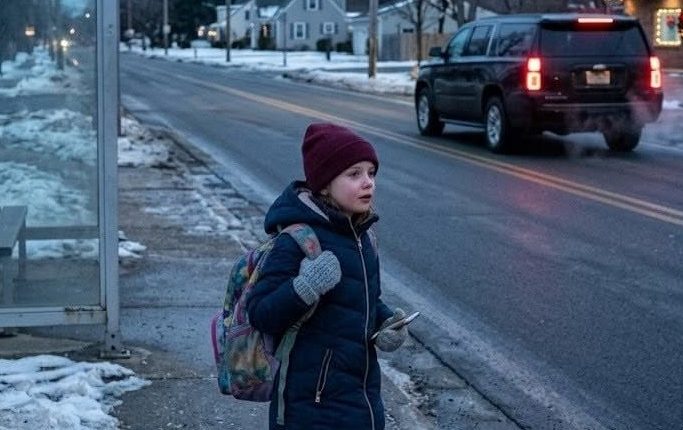
The first night after my husband’s funeral, his daughter stood beside my bed holding a stuffed rabbit by one ear.
She was five years old, small for her age, with pale brown hair that had escaped from the braid I had made that morning. She wore pink pajamas covered with silver stars. Her eyes were swollen from crying, although she had spent most of the day trying not to let anyone see.
“Can I sleep here?” she whispered.
I pulled back the blanket.
“Of course, Lily.”
She climbed in without another word, turned toward me, and pressed her face against my shoulder. For several minutes, she remained completely still.
Then her fingers closed around the sleeve of my nightgown.
“Are you going to leave me too?”
The question was so quiet that I nearly pretended I had not heard it.
Not because I did not want to answer, but because I knew whatever I said would become one of those promises a child carries for the rest of her life.
Her mother had left when she was eighteen months old.
Her father had died six days earlier.
And that afternoon, every blood relative who had stood near his casket had quietly found a reason why Lily could not come home with them.
I wrapped both arms around her.
“No,” I said. “I’m not going anywhere.”
“You promise?”
“I promise.”
She lifted her face to look at me.
“Even if I’m difficult?”
My heart broke at the word.
Five-year-old children were supposed to worry about monsters beneath their beds, not whether their grief made them too difficult to love.
“Even if you’re difficult,” I told her. “Even if you’re angry. Even if you cry. Even if you make mistakes. I’m staying.”
Her eyes closed, but her fingers remained tangled in my sleeve for the rest of the night.
That was how our new life began.
Not with legal documents, financial plans, or family support.
It began with a frightened little girl holding on to my sleeve, and with a promise I had no idea how I would keep.
My husband, Michael Harper, had been thirty-nine when his heart stopped in the parking lot of a grocery store.
There had been no long illness and no warning dramatic enough to prepare us. He had complained of exhaustion for several weeks, but Michael owned a small architectural consulting company and was always exhausted.
The morning he died, he kissed Lily on the forehead, drank half a cup of coffee, and reminded me that we needed milk.
“Anything else?” he asked from the doorway.
“Come home early,” I said.
He smiled.
“That, I can do.”
Those were the last words he ever spoke to me.
At eleven forty-three that morning, a stranger called from Michael’s phone. By noon, I was sitting beneath the white lights of a hospital consultation room while a doctor explained that the emergency team had done everything possible.
I remember watching the doctor’s mouth move.
I remember Lily’s drawing folded inside my purse.
I remember thinking that I had forgotten to ask Michael whether he wanted chicken or pasta for dinner.
Grief does strange things to the mind.
It gives ordinary details unbearable importance.
For three years, Michael and I had built a warm, imperfect marriage. We argued about laundry, laughed over terrible movies, forgot appointments, made plans, changed plans, and tried again.
Lily had been two when I met her.
The first time Michael brought her to the café where I worked, she hid behind his leg and stared at me as though I were an applicant for a very serious position.
“What’s your name?” I asked.
She held up two fingers.
“That’s how old she is,” Michael explained.
“I see. And is her name Two?”
Lily giggled.
That giggle was the beginning of everything.
I never tried to replace her mother. I did not ask her to call me Mom, although she sometimes did when she was sleepy or excited. Most of the time, she called me Nora.
I packed her lunches, attended preschool events, learned how to remove fruit juice from white fabric, and sat beside her bed when she had a fever. Michael and I married when Lily was four.
His family did not approve.
The Harpers lived forty minutes away in a gated neighborhood where the trees were trimmed into identical shapes and every driveway looked freshly washed.
Michael’s father, Charles, had inherited a manufacturing company and expanded it into a regional business. His mother, Margaret, served on charity boards, organized museum fundraisers, and remembered the names of important people while forgetting the names of servers.
They believed Michael had married beneath him.
They never said it directly.
People like Margaret Harper rarely said cruel things directly. She could turn an insult into a question and make you feel unreasonable for hearing it.
“Will you continue working at the café after the wedding?” she once asked me.
“Yes.”
“How modern. I suppose independence is important when people come from different backgrounds.”
At our wedding, she wore black.
Michael pretended not to notice.
His older sister, Vanessa, was more direct.
“You seem nice,” she told me at the reception. “But Michael has always had a habit of rescuing people.”
“I didn’t need rescuing.”
“Of course not,” she said, smiling.
Lily was treated differently.
Margaret displayed photographs of her in silver frames and introduced her as “our precious granddaughter,” but she seldom spent more than an hour alone with her.
Lily’s biological mother, Claire, had disappeared after months of instability and broken promises. She sent two birthday cards during Lily’s first five years, both several months late. Michael had eventually received full custody.
The Harpers blamed him for choosing Claire.
Then they blamed Lily for resembling her.
They loved the idea of a granddaughter much more than the living child.
At Michael’s funeral, Margaret wept loudly enough for three rows of mourners to hear.
She held Lily beside the casket and repeated, “My poor baby, my poor precious baby.”
But when the last guests had left and the funeral-home staff began collecting flower arrangements, I asked the question I had been dreading.
“What happens now?”
We were standing in a private room near the chapel. Charles was checking his phone. Vanessa was removing a black ribbon from her coat.
Margaret frowned.
“What do you mean?”
“With Lily.”
All three of them looked at me.
Michael’s attorney had not yet read the will. I was Lily’s stepmother, but I had never formally adopted her. Claire still existed somewhere, although no one had heard from her for nearly four years.
I had no guarantee that the law would allow Lily to remain with me.
“She needs stability,” I said. “She needs people who know her.”
Margaret glanced toward the hallway, where Lily was sitting with my friend Anna and coloring in a book someone had brought for her.
“This is hardly the appropriate moment,” she replied.
“I agree, but someone has to discuss it.”
Vanessa crossed her arms.
“I have two children already.”
“I’m not asking you to make a decision this second.”
“My house is full, Nora. My youngest is going through a difficult stage, and Lily has experienced…trauma.”
The way she said the word made it sound contagious.
Charles placed his phone in his pocket.
“Michael made his choices.”
“What does that mean?”
“He chose to separate himself from this family. He chose that woman as Lily’s mother. He chose to marry you. We warned him that irresponsible decisions have consequences.”
I stared at him.
“Your son died six days ago.”
“And we are grieving,” Margaret said. “Please do not make this uglier than it already is.”
“I’m trying to make sure his daughter has a home.”
“She has your home,” Vanessa replied.
I looked from one face to another.
“So you want her to stay with me?”
Margaret’s expression hardened.
“You have been acting as her mother for several years. Surely you are not planning to abandon her now.”
The accusation was so perfectly arranged that for a moment, I could not speak.
They were refusing to take Lily while making it sound as if I had suggested leaving her on a doorstep.
“I’m not abandoning her,” I said. “I’m asking whether any of you intend to help.”
“With what?” Charles asked.
“Everything.”
No one answered.
Three days later, Michael’s attorney, Samuel Reed, met with us in his office.
Michael’s will nominated me as Lily’s guardian. Samuel explained that the nomination carried significant weight, especially because I had been her primary maternal figure, but a family court would still need to approve the arrangement.
Michael left me our modest three-bedroom house, his personal belongings, and the balance of our joint accounts. His business assets were to be evaluated separately.
There was no mention of a large inheritance.
Charles leaned back in his chair.
“That is all?”
Samuel’s eyes shifted toward him.
“That is the portion of the estate relevant to today’s meeting.”
“Michael had interests in several projects.”
“Those matters are still being settled.”
Margaret looked at me.
“Did you know about this will?”
“I knew he had made one. I didn’t know the details.”
“Convenient.”
Samuel closed the folder in front of him.
“Mrs. Harper, your son prepared these documents before marrying Nora. He updated them twice after the marriage, most recently eleven months ago.”
Charles’s face changed slightly.
“Why?”
“You would have to ask Michael.”
“My son is dead.”
“Yes,” Samuel said quietly. “He is.”
Margaret refused to take the box of Lily’s possessions that had been left at her house.
Two weeks after the funeral, a delivery van arrived at my door.
The driver placed six black plastic bags on the porch.
Inside were Lily’s spare clothes, toys, framed photographs, rain boots, and a ceramic handprint she had made at age three.
Margaret had packed her granddaughter’s memories in trash bags.
A white envelope was taped to the top.
Nora,
Since Lily will apparently remain with you, these items should be returned. Please do not contact us until the legal matters have been resolved. This situation has been emotionally overwhelming for the family.
Margaret
Lily found me sitting on the floor beside the bags.
She picked up the ceramic handprint.
“Grandma doesn’t want this anymore?”
“She thought you should have it here.”
“Why did she put it in garbage bags?”
I looked at my husband’s child and discovered that adulthood sometimes means choosing the least damaging version of the truth.
“She probably used what she had.”
Lily nodded, but I could tell she did not believe me.
That night, she climbed into my bed again.
“Are you going to leave me too?”
“No.”
She asked the same question every night for nearly four months.
Sometimes she asked it after a good day. Sometimes after a tantrum. Sometimes after I corrected her behavior or told her she could not have dessert before dinner.
I began to understand that she was not asking where I planned to sleep.
She was asking whether love could survive disappointment.
Each night, I gave her the same answer.
“No, Lily. I’m staying.”
The court approved my temporary guardianship.
Claire did not respond to the notices sent to her last known addresses. The Harpers submitted a letter stating that they did not object to Lily remaining in my care.
The letter contained one sentence that I would remember nine years later:
Due to our ages, responsibilities, and existing family commitments, we are unable to assume guardianship or provide regular care for the child.
Not Lily.
The child.
Once the order became final, the Harpers disappeared.
They did not call on Lily’s sixth birthday.
Margaret sent a card at Christmas, signed only with her name. There was no gift and no message.
Vanessa unfollowed me online.
Charles’s assistant emailed once to ask when Michael’s remaining company files would be delivered.
I wanted to hate them.
For a while, I did.
But hatred requires energy, and raising a grieving child consumed everything I had.
Michael’s business had been successful on paper but unstable in reality. Several projects ended when he died, and two clients refused to pay outstanding invoices without lengthy negotiations. The final amount transferred to our household was enough to clear some debts and cover several months of expenses, not enough to create a new life of comfort.
I returned to work at the café.
My manager, Anna, adjusted my schedule so I could collect Lily from school. I worked early mornings, weekends, and occasional evening events.
I learned how to stretch soup across three dinners.
I learned which utility company allowed a five-day extension and which one did not.
I learned that children often choose the worst possible morning to announce they need a costume representing a historical figure.
Lily learned things too.
She learned to place her cereal bowl in the sink.
She learned that grief could arrive suddenly, even during cartoons.
She learned that her father’s favorite blue sweater still smelled like him for almost a year, until one day it did not.
On the anniversary of Michael’s death, we sat on the living-room floor and opened a box of photographs.
Lily touched one showing Michael carrying her on his shoulders.
“Do you think Daddy knew he was going to die?”
“No.”
“Would he have stayed if he could?”
“Yes.”
“How do you know?”
“Because he loved you more than anything.”
She was silent for a while.
“More than you?”
I smiled through the ache in my chest.
“In a different way.”
She considered this carefully.
“Did he love me the biggest?”
“The biggest,” I said.
For her seventh birthday, she asked for a cake shaped like the moon.
I had never made anything more complicated than cupcakes, but custom cakes cost more than I could afford. I stayed awake until two in the morning shaping gray icing into craters.
The finished cake looked less like the moon and more like a dented bowling ball.
Lily called it beautiful.
At eight, she joined a school choir but became frightened before the winter concert. I found her hiding inside a bathroom stall.
“What if I forget the words?” she asked.
“Then move your mouth and look confident.”
“What if everyone knows?”
“Most adults are too busy worrying about themselves to notice.”
She laughed and went onstage.
At nine, she stopped climbing into my bed every night.
The first evening she remained in her own room, I lay awake waiting for footsteps that did not come.
I should have felt relieved.
Instead, I cried quietly into my pillow because healing sometimes resembles another small goodbye.
She still came to me when thunderstorms shook the windows, when she had nightmares, or when a classmate mentioned fathers.
At ten, she asked whether I regretted keeping her.
We were washing dishes. I nearly dropped a glass.
“Where did that come from?”
A girl at school had told her that I could have had a different life if I had not been “stuck raising someone else’s kid.”
I dried my hands and sat beside her.
“You are not someone else’s kid.”
“But I’m not really yours.”
“Family is not only decided by biology.”
“Did you have to keep me?”
“No.”
That answer hurt her for exactly one second before I finished.
“I chose to.”
Her chin trembled.
“Every day?”
“Every single day.”
She leaned into me, taller now, her head reaching my shoulder.
“That means I choose you too,” she whispered.
When Lily was eleven, I applied to adopt her.
Samuel helped with the paperwork at a reduced fee. Claire’s parental rights had not been formally terminated, so the process required more notices, background checks, home visits, interviews, and delays.
Claire never appeared.
The Harpers were informed as extended relatives. They did not object.
The adoption became final on a rainy Thursday afternoon.
The judge asked Lily whether she understood what adoption meant.
“Yes,” she said. “It means Nora is legally my mom, even though she was already doing the job.”
The judge laughed.
I cried.
Outside the courthouse, Anna took our photograph beneath a dripping umbrella.
Lily held the adoption certificate inside a plastic folder. I bought two grocery-store cupcakes, and we ate them in the car because the rain was too heavy to drive.
It was one of the happiest days of my life.
I sent a copy of the order to Margaret.
The envelope was returned unopened.
For the next three years, our life became ordinary.
Ordinary was a blessing.
There were school projects, braces, forgotten lunches, friendship problems, permission slips, and debates about screen time. I moved from the café floor into bookkeeping and eventually began handling accounts for three small businesses.
We were never wealthy, but we became stable.
Lily developed Michael’s habit of sketching buildings on every available piece of paper. She drew libraries shaped like open books, schools with gardens on the roofs, and hospitals where every patient’s room had a large window.
At fourteen, she won a regional student design competition.
Her project was a community center for children who had lost a parent.
In the center of the model, she placed a circular room with soft chairs and shelves of stuffed animals.
“What’s that room?” I asked.
“The Staying Room.”
“What happens there?”
“Nothing. That’s the point. Someone just stays with you until you’re ready to leave.”
I had to turn away so she would not see me cry.
By then, I believed the worst was behind us.
I was wrong.