The first thing my mother said when I opened the door was not, “I’m sorry about your sister.”
It was, “Which bedroom are you putting us in?”
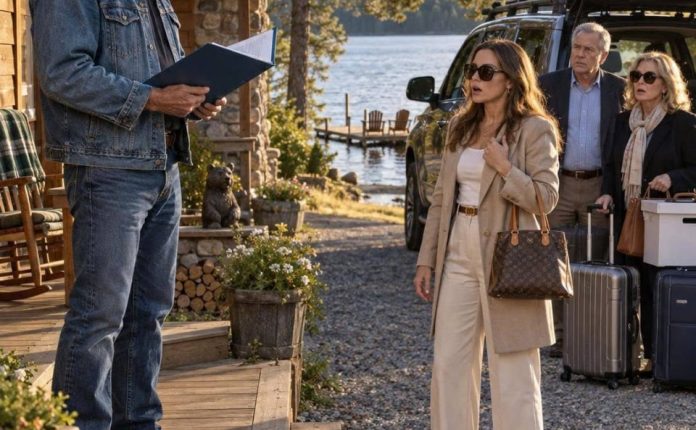
She stood on the porch of the lake house wearing a cream-colored coat that had never known rain, one gloved hand resting on the handle of an enormous rolling suitcase. My father waited behind her with two duffel bags at his feet. My older brother, Daniel, was unloading cardboard boxes from the back of his SUV, while his wife, Melissa, stood beside the passenger door studying the house as though she were already deciding which walls to repaint.
My younger brother, Owen, had brought his two teenage sons. They were carrying fishing rods.
For one strange moment, I wondered whether grief had finally broken something inside my mind.
The lake behind the house was gray beneath the November sky. Wind pushed small waves against the wooden dock, and the bare branches of the birch trees scraped softly across the roof. Three days earlier, I had buried my sister, Eleanor, beneath a maple tree in the cemetery outside town.
She had been fifty-one.
I had been the only member of our family standing beside her grave.
Now, the people who had not spoken to me in nine years were arranged across her porch with luggage, pillows, grocery bags, fishing equipment, and the comfortable expectation of guests arriving for a holiday.
I held the door halfway open.
“What are you doing here?”
My mother’s expression tightened.
“Don’t start, Claire.”
“Start what?”
“We have been driving since six this morning. Your father’s back is bothering him, and the boys need to use the bathroom.”
Daniel came up the porch steps carrying a box labeled KITCHEN in thick black marker.
“Move aside,” he said. “This is heavy.”
I did not move.
The cold wind lifted my hair and blew it across my face. I pushed it back slowly.
“Why did you bring boxes?”
Daniel gave a short laugh, the same laugh he used when we were children and I asked a question he thought was foolish.
“Because we’ll be staying for a while.”
“No, you won’t.”
The porch went silent.
Even the boys stopped whispering.
My father looked at me then. He had aged more than I expected. His hair had gone almost entirely white, and the skin beneath his eyes sagged in pale folds. But his voice was still the same measured voice that had ended arguments at the dinner table without ever raising its volume.
“Claire,” he said, “this is not the time for one of your scenes.”
One of your scenes.
Nine years disappeared.
I was thirty-eight again, standing in my parents’ dining room while my mother accused me of destroying the family. Daniel had been leaning against the mantel, arms crossed. Owen had stared at his plate. My father had told me that some accusations could never be taken back.
Eleanor had stood beside me.
Only Eleanor.
“I’m not making a scene,” I said. “I’m telling you that you cannot stay here.”
Melissa stepped forward.
“We understand that the house was technically left to you.”
“Technically?”
She glanced at my mother before continuing.
“But this has always been a family property. Eleanor would not have wanted you to keep everyone away.”
I looked through the open doorway behind me.
Eleanor’s boots were still lined neatly beside the mat. Her faded green scarf hung from a wooden peg. A blue ceramic mug waited beside the sink, stained with the last tea she had been too weak to finish.
They had not visited while she was dying.
Not once.
My mother lifted her chin.
“Are you going to make us have this conversation on the porch?”
“Yes.”
Her face changed. Not dramatically. My mother rarely allowed herself dramatic displays unless she controlled the room. But something in her eyes hardened.
“Fine,” she said. “We came because this situation affects all of us.”
“What situation?”
“The house.”
“My sister died.”
“We know that.”
“You didn’t come to the funeral.”
Daniel placed the kitchen box on the porch with a thud.
“We didn’t know about it until afterward.”
“You knew she was sick.”
“We knew she had cancer,” he replied. “We didn’t know she had deteriorated so quickly.”
“She was sick for almost two years.”
Owen finally spoke.
“She didn’t answer my messages.”
“You sent her three messages,” I said. “All during the final month of her life. The first asked whether she had updated her will. The second asked whether Dad’s fishing boat was still in the shed. The third asked if she planned to sell.”
His face turned red.
“You don’t know everything that happened.”
“No,” I said. “But I know exactly what didn’t happen. None of you came.”
My father’s jaw tightened.
“We had our reasons.”
“And now you have suitcases.”
The words landed harder than I expected.
My mother looked past me into the house.
“Eleanor was angry. She had always been stubborn. We believed she needed space.”
“She needed her family.”
“She had you.”
“Yes,” I said. “She did.”
A gust of wind swept across the porch. Somewhere near the dock, a loose metal chain knocked against a post.
My mother’s gloved fingers curled around the suitcase handle.
“Let us inside, Claire.”
“No.”
“We are your family.”
“You haven’t been my family for nine years.”
Her eyes flashed.
“That was your decision.”
Behind her, Daniel muttered something under his breath.
I looked at each of them—the mother who had erased me from family photographs, the father who had returned every birthday card unopened, the brothers who had told relatives I was unstable, and the in-laws who had learned to repeat the family version of my disgrace.
Then I looked at the boxes.
“What’s in those?”
Daniel shrugged.
“Things we’ll need.”
“You packed for more than a visit.”
Melissa answered before he could.
“Your mother thinks the house should be shared until the estate is settled.”
“The estate is settled.”
“That is not what we were told.”
“Who told you otherwise?”
No one answered.
My father stepped closer to the door.
“Eleanor was under medication when she changed her will. Daniel has spoken to an attorney.”
I felt something cold move through me that had nothing to do with the wind.
“Of course he has.”
“We are not trying to take anything from you,” my father continued. “We only want to make sure your sister’s actual intentions are respected.”
“My sister’s actual intention was to leave me this house.”
“She was vulnerable.”
“She was clear.”
“She was dying.”
“And you think dying made her stupid?”
My father recoiled slightly.
My mother pressed her lips together.
“This is exactly why we hoped to discuss the matter calmly.”
“You came with luggage.”
“We thought staying together would give us time to reconnect.”
I almost laughed.
Nine years of silence, and now that the roof behind me belonged to me, they had decided it was time to reconnect.
“No,” I said. “You thought arriving with your belongings would make it harder for me to turn you away.”
Daniel folded his arms.
“You can’t seriously be this selfish.”
That word almost opened me.
Selfish.
The word had followed me through childhood like a shadow. Selfish when I wanted privacy. Selfish when I refused to lend Daniel my car after he had wrecked his. Selfish when I moved two towns away. Selfish when I told the truth.
Eleanor had once told me that our family did not use words to describe reality. They used words to assign roles.
Daniel was responsible, even when he stole.
Owen was sensitive, even when he stayed silent.
I was selfish, especially when I said no.
I stepped outside and pulled the door shut behind me.
“Take your bags back to the cars.”
My mother stared at me.
“You are throwing your grieving parents into the cold?”
“You are not grieving. You are calculating.”
She slapped me.
The sound cracked across the porch.
For several seconds, nobody moved.
Her palm had struck the same side of my face she had hit nine years before, though the first time she used the back of her hand and knocked my glasses onto the dining-room floor.
Daniel looked away.
Owen studied the porch boards.
My father whispered, “Margaret.”
But he did not step between us.
He never had.
I touched my cheek. It burned beneath my fingers.
Then I opened the door, went inside, and locked it.
My mother began pounding before I had taken three steps.
“Claire!”
I did not answer.
“You open this door immediately!”
The pounding became louder.
“This is Eleanor’s home!”
I turned around and looked through the narrow glass panel beside the door.
“No,” I said, knowing she could see my mouth form the words. “It was Eleanor’s home.”
Then I closed the curtain.
They remained on the porch for almost twenty minutes.
My mother demanded.
Daniel threatened.
Melissa tried reason.
My father attempted dignity, speaking through the door about legal consequences and family respect.
Owen said almost nothing.
Eventually, the suitcases rolled back down the path. Car doors slammed. Engines started. Tires scattered gravel.
I stood in the hallway until the sound disappeared.
Then I slid down the wall, pressed my knees against my chest, and cried so hard that I could not breathe.
Not because my mother had struck me.
Not because they wanted the house.
I cried because some small, foolish part of me had believed they might have come because Eleanor was dead.
I had imagined regret bringing them to the lake.
I had imagined my father standing at the end of the dock, remembering how Eleanor used to swim before sunrise. I had imagined Daniel walking into the kitchen and seeing the height marks scratched into the doorframe from childhood summers. I had imagined my mother sitting in the window seat, touching the quilts Eleanor had sewn, finally understanding that her daughter had lived and suffered and died without her.
Instead, they had brought boxes labeled KITCHEN.
I stayed on the floor until the room grew dark.
When I finally stood, I saw an envelope resting on the small table near the stairs.
My name was written across it in Eleanor’s thin, slanted handwriting.
CLAIRE—AFTER THEY COME.
I stared at those words for a long time.
Then I began to shake.
There were twelve letters in total.
I found them exactly where Eleanor’s attorney, Mr. Hayes, said they would be: inside a metal cashbox beneath a loose floorboard in the upstairs bedroom we had shared as girls. The box also contained a small brass key, a stack of photographs tied with blue ribbon, copies of legal documents, and an old cassette recorder.
Eleanor had planned everything.
That realization hurt almost as much as losing her.
She had known they would come.
She had known they would not come for her.
I carried the box downstairs and placed it on the dining table. Outside, the lake had darkened into a flat sheet of black glass. I lit the fireplace, made tea I did not drink, and opened the first envelope.
Claire,
If you are reading this, our family has learned about the house. I wish I could promise you they will behave with kindness. You and I both know I cannot.
Do not let them stay, not even for one night. They will call it grief. They will call it reconciliation. They will call it fairness. What they mean is access.
I am sorry that even in death, I have left you with another fight.
But I did not leave you the house because I needed you to fight for property. I left it because you are the only person who ever understood what this place was.
The lake house had belonged to our grandmother, Ruth.
When I was a child, I believed every family had two versions: the public family and the real one. The public version of ours appeared in framed photographs wearing matching sweaters and pleasant smiles. My father ran a respected insurance office. My mother organized charity luncheons, school auctions, and church fundraisers. Daniel won trophies. Owen played the piano. Eleanor earned perfect grades.
I was the difficult daughter.
The real family was quieter.
My father controlled every dollar. My mother controlled every story. Daniel learned that charm could excuse cruelty. Owen learned that silence kept him safe. Eleanor learned to disappear into books.
I learned to notice things.
The lake house was the only place where our grandmother allowed truth to remain truth.
She never told me I was too sensitive. She never ordered Eleanor to stop crying. When Daniel mocked us, she made him apologize. When my mother criticized my body, Grandmother Ruth put down her fork and said, “Margaret, we do not teach girls to hate the bodies that carry them.”
Our mother did not speak to her for three months after that.
After Grandmother Ruth died, she left the lake house to Eleanor.
The family said it was because Eleanor was the oldest daughter. The truth was written in a letter Eleanor did not show me until years later.
You are the keeper, Ruth had written. Keep this place for whoever needs somewhere safe.
For years, Eleanor did.
She let Owen stay after he dropped out of college, though he later pretended he had taken a voluntary break. She gave Daniel money after his first business failed. She allowed our parents to spend every summer there without paying taxes, utilities, or repairs.
And when I arrived one stormy evening nine years ago with a split lip, two broken fingers, and no shoes, she opened the door before I could knock.
That was the night everything changed.
My husband, Peter, had hurt me before.
Never where people could easily see.
He squeezed my arm hard enough to bruise. He shoved me into walls and later apologized with flowers. He controlled the bank accounts, read my messages, criticized my clothes, and convinced me that exhaustion was evidence of instability.
My family loved him.
Peter helped my father with investments. He played golf with Daniel. He charmed my mother by praising her cooking and calling her “Mom.” When I tried to explain what was happening, I spoke carefully. Too carefully.
My mother said marriage required patience.
My father said Peter seemed stressed.
Daniel said I had always exaggerated.
Owen said he did not want to take sides.
Eleanor believed me before I finished the first sentence.
The stormy night I reached the lake house, Peter had thrown me down the basement stairs because I had changed the password on my email. He took my keys and phone, but while he slept, I climbed out through the laundry-room window and ran to a neighbor’s house.
Eleanor took photographs of my injuries.
She drove me to the hospital.
She sat beside me while I spoke to the police.
She called my parents because I begged her to. I still believed they would come once they understood.
They came the next afternoon.
So did Peter.
He arrived with red eyes, shaking hands, and an attorney.
My mother embraced him before she embraced me.
Peter told them I had attacked him with a lamp. He said I had been drinking. He showed them scratches on his neck—the scratches I made while he was choking me.
My father asked whether I had taken my medication.
I was not taking medication.
Daniel asked why Peter would invent such a story.
Owen stared at the floor.
Eleanor stood in front of my hospital bed and told them to leave.
My mother slapped me first.
Then she slapped Eleanor.
“You have always encouraged her,” she shouted. “You have always filled her head with poison.”
My father said that if I pursued criminal charges, I would destroy Peter’s career and humiliate the entire family.
I pursued them anyway.
Peter accepted a plea agreement. The sentence was shorter than it should have been. Our divorce took eighteen months. He fought over every chair, every plate, every dollar. My parents testified in support of him during a hearing about financial control.
Afterward, my mother sent one message.
Until you apologize for what you have done to this family, do not contact us again.
I did not apologize.
Neither did Eleanor.
That was the beginning of the nine years.
At first, I told myself the silence was temporary.
I mailed birthday cards. I sent Christmas gifts to my nephews. I called when my father had surgery. Every envelope came back unopened. Every call went unanswered.
Eleanor never asked me to keep trying.
She only said, “You are allowed to stop knocking on a locked door.”
Eventually, I did.
But she did not tell me everything she sacrificed by standing beside me.
The second letter was labeled THE LOAN.
Claire,
Daniel will claim I promised him the house. He is not entirely lying.