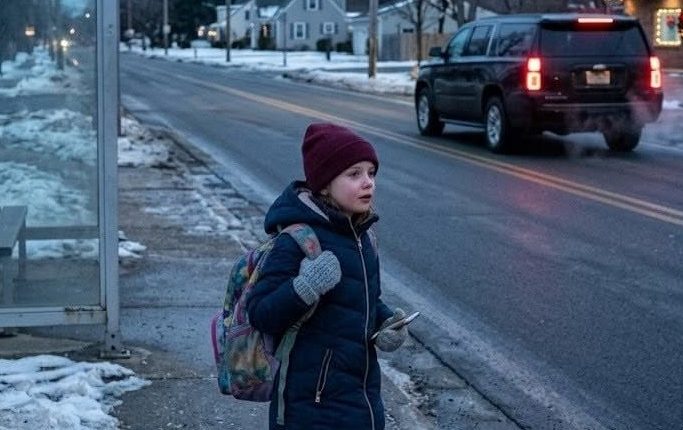
The boy appeared beside my desk eight minutes before the library closed, soaked to the skin and holding a red backpack against his chest as though it contained something alive.
“Mrs. Hart?”
I looked up from the computer.
Milo Bennett was seven years old, small for his age, with pale brown hair that never seemed to lie flat and serious gray eyes that belonged to someone much older.
He came to the library almost every afternoon.
He read books about dinosaurs, astronauts, tornadoes, and children who survived in forests. He never chose funny stories. He never used the computers to play games.
And he always left before sunset.
That evening, however, rain struck the tall windows like handfuls of gravel, and darkness had swallowed the street nearly an hour early.
“What is it, Milo?”
His fingers tightened around the straps of his backpack.
“Could you walk me home?”
I stared at him.
In eleven years of working at the Ashford Public Library, no child had ever asked me that question.
“Where is your mother?”
“At home.”
“Did she send you here?”
He lowered his eyes.
“No.”
I glanced toward the entrance. My coworker, Janet, was turning the sign from OPEN to CLOSED while muttering about flooded roads.
“Milo, does your mother know you’re still here?”
He hesitated for so long that the answer became obvious.
“I think so,” he finally whispered.
“You think so?”
“She knows I come here.”
That was not the same thing.
I stepped around the desk and crouched so we were closer to eye level.
“Why can’t your mother pick you up?”
“She doesn’t have a car.”
“Can she call someone?”
“Our phone doesn’t work.”
A cold uneasiness moved through me.
Outside, thunder rolled across the town. Milo flinched, then pretended he had not.
“Is there another adult at home?”
“My sister.”
“How old is your sister?”
“Four.”
I stood slowly.
“That isn’t what I meant.”
“I know.”
Janet approached with her umbrella and handbag.
“Everything okay?”
“Milo needs help getting home.”
Janet looked from him to me.
“I can call the police department. They’ll send someone.”
“No!”
Milo’s shout echoed through the empty library.
He stepped backward, hitting the edge of a display table. Several bookmarks fluttered to the carpet.
“No police,” he said, his voice shaking. “I don’t need police. I just need someone to walk beside me.”
Janet raised her eyebrows.
I knew what she was thinking. We were both mandatory reporters. We had received training about neglected children, abuse, hunger, unexplained bruises, and children who were terrified of uniforms.
But training manuals were clean and orderly.
Real fear was not.
Real fear was a seven-year-old boy standing in wet sneakers, trying desperately not to cry.
“How far do you live?” I asked.
“Four blocks.”
Janet touched my arm.
“Evelyn, we should call someone.”
“I’ll walk him.”
“Are you sure?”
“I’m sure.”
Milo’s shoulders dropped with relief, but only slightly.
Janet waited while I gathered my coat and locked the front desk drawers. Before leaving, I slipped two packets of crackers and an apple from the staff-room basket into my pocket.
I told myself they were for the walk.
I already knew they were not.
The rain had weakened to a steady drizzle when Milo and I stepped outside. Streetlights reflected in the water running along the curb. My umbrella was wide enough for both of us, but Milo stayed near the edge, allowing rain to strike one shoulder.
“Come closer,” I told him.
“I’m okay.”
“You’re getting wet.”
“I was already wet.”
There was no complaint in his voice. It was merely a fact.
We walked past the pharmacy, the closed bakery, and the old courthouse with its white columns shining in the rain.
Milo did not speak.
I had known quiet children before, but his silence felt constructed, as though he had carefully stacked invisible bricks between himself and the world.
“How long were you at the library today?” I asked.
“Since lunchtime.”
“Did you go to school?”
He kicked a pebble toward the gutter.
“No.”
“Are you sick?”
“No.”
“Is your sister sick?”
“No.”
“Then why didn’t you go?”
He watched the pebble disappear into the rushing water.
“I missed the bus.”
“Could your mother take you?”
“No.”
“Because she doesn’t have a car?”
He nodded.
There was something practiced about the answer.
“Did you eat lunch?”
“Yes.”
“What did you have?”
He took too long again.
“Food.”
Despite my worry, I almost smiled.
“What kind of food?”
“Regular food.”
“Milo.”
He looked at me then, and the expression in his eyes erased my smile.
“Please don’t ask so many questions.”
I stopped walking.
We stood beneath a flickering streetlight while rain tapped against the umbrella.
“I’m not trying to get you in trouble.”
“I know.”
“Then why are you afraid to answer me?”
“I’m not afraid.”
“You shouted when Janet mentioned the police.”
“Because police ask more questions.”
“And what happens after they ask questions?”
His mouth tightened.
“They take things.”
“What things?”
“Kids.”
The answer was so quiet I almost missed it.
A car passed, spraying water from its tires. I guided Milo farther from the curb.
“Has someone told you that?”
“My dad.”
“Where is your father?”
“He doesn’t live with us anymore.”
“Does he visit?”
“No.”
“Do you know where he is?”
Milo shook his head.
I studied his face, wondering whether I had ever seen his father around town. I remembered his mother vaguely—a thin woman with dark hair who had signed him up for a library card the previous autumn.
She had seemed tired but attentive. She had knelt beside Milo and helped him print his name carefully on the form.
Leah Bennett.
I remembered because she had thanked me three times for waiving the fee on a damaged book Milo had accidentally dropped in the bath.
She had not seemed neglectful.
Then again, people carried entire disasters behind ordinary faces.
We turned onto Walnut Street, where the houses grew smaller and the sidewalks cracked beneath leaning maple trees.
Milo pointed ahead.
“That building.”
It was a three-story brick apartment house with sagging balconies and a broken light above the entrance. Rainwater dripped from a rusted gutter. Two black trash bags had split near the steps.
Milo stopped at the gate.
“Mrs. Hart?”
“Yes?”
“I have one condition.”
The word sounded strange coming from a child.
“What condition?”
He looked up at me.
“You have to promise you won’t come inside.”
I glanced at the dark building.
“I can walk you to your apartment.”
“No. You have to stop at the door.”
“Why?”
“And if you hear my sister crying, you still can’t come in.”
The air seemed to leave my lungs.
“Milo, why would your sister be crying?”
“She cries sometimes.”
“Is your mother with her?”
He stared at the wet pavement.
“Milo.”
“You have to promise.”
“I cannot promise that.”
His head jerked up.
“Then I’ll go alone.”
He stepped through the gate, but I caught his backpack.
“Wait.”
“Let go!”
“I’m not hurting you.”
“You said you’d walk me home!”
“I did walk you home.”
“Then go!”
He pulled harder, panic spreading across his face.
“Why can’t I come inside?”
“Because you’ll see.”
“See what?”
He bit his lower lip so hard it turned white.
Then, from somewhere inside the building, a child screamed.
It was not the cry of a child throwing a tantrum.
It was a terrified, desperate shriek.
“Milo!”
A little girl’s voice echoed down the stairwell.
“Milo, come back!”
He tore free from my hand and ran toward the entrance.
I followed.
He tried to slam the building door behind him, but I caught it with my shoulder.
“You promised!” he shouted.
“No, Milo. I told you I couldn’t.”
He raced up the stairs. I followed him to the second floor, where he fumbled with a key outside apartment 2C.
The door opened before he could use it.
A barefoot little girl stood there wearing purple pajama bottoms and a yellow sweater several sizes too large. Her dark hair hung in tangled curls around her face.
Tears and mucus shone beneath her nose.
“You were gone forever,” she sobbed.
“I came back, Rosie.”
“You said five minutes.”
“I know.”
“You said count to sixty lots of times.”
“I know. I’m sorry.”
She threw her arms around him.
Milo hugged her with one arm while trying to push the door closed with the other.
I placed my hand against it.
“Hello, Rosie.”
The girl froze.
Her eyes widened.
“Is that the lady?” she whispered.
Milo’s face went pale.
“What lady?” I asked.
“The lady who takes us away.”
“No,” Milo said quickly. “She’s from the library.”
Rosie clung to him.
“You said nobody could know.”
“I didn’t tell her.”
“I heard you crying,” I said.
“She got scared of the thunder,” Milo replied.
I looked past them into the apartment.
No lights were on. A battery-powered camping lantern glowed on the floor. Blankets had been arranged around it like the walls of a small fort.
Two bowls sat on the carpet. One contained dry cereal. The other was empty.
A sour smell drifted from the kitchen.
“Where is your mother?” I asked.
Milo stood straighter.
“She’s working.”
“What kind of work?”
“Cleaning.”
“When will she be home?”
“Soon.”
Rosie began crying again.
“No, she won’t.”
“Be quiet,” Milo hissed.
“She didn’t come yesterday.”
“She’s coming.”
“Or the day before.”
“I said be quiet!”
Rosie hid her face against his wet coat.
I entered the apartment.
Milo did not stop me this time.
He simply watched, his expression changing from fear to defeat.
The living room was cold. An electric heater stood unplugged beside the wall. Several unopened envelopes lay on a table, including a red notice from the power company.
The refrigerator light did not turn on when I opened it.
Inside were half a carton of milk, a jar of mustard, three soft carrots, and a plastic container that smelled spoiled.
“How long has the electricity been off?” I asked.
Milo shrugged.
“How long?”
“Two days.”
“And your mother has been gone how long?”
“She’s working.”
“Milo.”
“Since Monday,” Rosie whispered.
It was Thursday.
I leaned against the kitchen counter.
For three days, a seven-year-old had been caring for a four-year-old in a cold apartment without power.
“What have you been eating?”
“Cereal,” Milo said.
“What else?”
“Crackers.”
“Anything else?”
He looked toward the window.
“We had bread. But the green parts got too big.”
I closed my eyes.
On the counter sat a small plastic knife and a peanut butter jar scraped almost clean. Beside them was a sheet of paper filled with Milo’s uneven handwriting.
MONDAY
CEREAL
ROSIE BATH
MOM COMING HOME
TUESDAY
LIBRARY
GET WATER
MOM COMING HOME
WEDNESDAY
ROSIE COUGH
NO LIGHT
MOM COMING HOME
THURSDAY
FIND HELP BUT NOT POLICE
My throat tightened.
“You went to the library to find help?”
Milo’s eyes filled with tears.
“Just for walking.”
“Why didn’t you tell me your mother was missing?”
“Because Dad said if people found out Mom left us alone, they’d split us up. He said nobody wants two kids together because Rosie cries and I ask too many questions.”
Rosie pressed her cheek against his shoulder.
“Milo doesn’t ask too many.”
“I know,” I said.
He shook his head fiercely.
“You don’t know. You don’t know anything.”
“You’re right. I don’t know everything. But I know you cannot stay here alone.”
“We’re not alone. We have each other.”
“You are children.”
“I can make cereal.”
“That does not make you an adult.”
“I know how to lock the door. I know Rosie’s medicine is in the bathroom. I know she needs two puffs when she coughs bad. I know not to use the stove.”
His voice rose with every sentence.
“I know how to fill the bathtub before the water stops. I know how to make her stop crying. I know how to check the window for Mom. I know everything!”
Then his voice broke.
“I know everything Mom said to do.”
He covered his face with both hands.
Rosie began patting his back.
“It’s okay,” she whispered. “You did good.”
Those three words nearly shattered me.
You did good.
The little girl was comforting the boy who had become her parent.
I crossed the room and knelt in front of them.
“Milo, look at me.”
He would not.
“You have done more than anyone should ever expect from a seven-year-old.”
He wiped his face with his sleeve.
“But you need an adult now.”
“No police.”
“I need to call someone who can help us find your mother.”
“They’ll take Rosie.”
“I will do everything I can to keep you together.”
“You can’t promise.”
“No,” I admitted. “I can’t promise that.”
His expression hardened.
“Then you’re lying like everybody else.”
The words struck harder than he could have known.
Eleven years earlier, my son had asked me a question from the back seat of our car.
“Are we almost there, Mom?”
“Yes,” I had said while glancing at my phone. “Two more minutes.”
We never arrived.
A truck ran a red light. I survived with a broken collarbone and nineteen stitches.
My nine-year-old son, Caleb, died before the ambulance reached the hospital.
For years, I had replayed the lie I had told him.
Two more minutes.
As though mothers controlled distance, time, traffic lights, and death.
After Caleb died, people often said I should be grateful for the years I had been given.
They said I would heal.
They said I could have another child.
They said God had a plan.
I learned to distrust promises offered by people who did not have to live inside their consequences.
So I did not promise Milo that everything would be fine.
I told him the only truth I had.
“I don’t know what will happen next. But I will not leave until you and Rosie are safe.”
He lowered his hands.
“You’ll stay?”
“Yes.”
“Even if people come?”
“Yes.”
“Even if they get mad?”
“Yes.”
“Even if I get mad?”
“Especially then.”
He studied my face.
Then he nodded once.
I called emergency services.
While we waited, I used the flashlight on my phone to examine Rosie’s cough medicine. The inhaler was nearly empty, but she was breathing comfortably.
I gave both children the crackers and apple from my pocket. Milo divided everything exactly in half, although Rosie ate her portion quickly and stared at his.
Without a word, he gave her half of what remained.
I pretended not to notice the way his own stomach growled.
Paramedics arrived first, followed by a police officer and a social worker named Nina Alvarez.
The moment Milo saw the uniform, he grabbed Rosie and backed into a corner.
“You said you wouldn’t let them split us up!”
“I said I would stay.”
“You lied!”
“I am still here.”
Officer Grant stopped near the doorway and removed his hat.
“Hello, Milo. Hello, Rosie.”
Neither child answered.
“I’m not here to take anybody anywhere,” he continued. “I’m here to help find your mom.”
“She’s working,” Milo insisted.
“Do you know where?”
Milo shook his head.
Nina crouched several feet away.
“Can I sit here?”
Milo shrugged.
She sat on the floor without moving closer.
“I brought sandwiches.”
Rosie peeked at the paper bag in her hand.
“What kind?”
“Turkey, cheese, and one peanut butter and jelly.”
“I like jelly.”
“I was hoping somebody did.”
Nina placed the bag on the floor and gently slid it toward them.
Rosie looked at Milo for permission.
He nodded.
While they ate, the paramedics checked them for dehydration and other problems. Milo tolerated the examination with clenched fists. Rosie talked continuously once she discovered that one paramedic had a dog named Pickles.
Officer Grant took Leah Bennett’s photograph and information.
“What was she wearing when you last saw her?” he asked.
“Black pants,” Milo said. “Blue shirt. Her cleaning shirt.”
“Did she leave on foot?”
“She takes the number six bus.”
“What time?”
“At five thirty.”
“Did she say where she was working?”
“The Meridian Hotel.”
Officer Grant stepped into the hallway to make calls.
The Meridian was a large hotel near the interstate. Surely someone there would know Leah.
Surely this could be explained.
A double shift.
A broken phone.
A misunderstanding.
But when Officer Grant returned, the worry in his face had deepened.
“The hotel says she didn’t show up Monday night.”
Milo stopped chewing.
“They’re wrong.”
“Her supervisor says she called earlier that afternoon and asked for extra hours, but she never arrived.”
“She went there.”
“Do you know whether she stopped anywhere first?”
Milo shook his head.
“Think carefully.”
“She said she had to get medicine.”
“For herself?”
“For Rosie.”
Officer Grant called the pharmacies in town.
The third pharmacy confirmed that Leah had picked up an inhaler shortly after five on Monday evening.
Security footage showed her leaving alone.
After that, she seemed to have vanished.
Nina explained that Milo and Rosie needed to spend the night somewhere with heat, food, and electricity.
“Together?” Milo asked.
“Yes,” she said. “Together.”
“Where?”
“We have an emergency foster family about twenty minutes away.”
“No.”
“The Parkers have cared for brothers and sisters before.”
“No strangers.”
“I understand you’re frightened.”
“You don’t understand anything!”
He turned to me.
“We can stay with Mrs. Hart.”
The room became silent.
Nina looked at me.
Milo seemed to interpret my hesitation as rejection.
“You said you wouldn’t leave.”
“I won’t,” I answered.
“Then we can go to your house.”
“Milo, it isn’t that simple.”
“Why?”
Because my house had been preserved like a tomb.
Because Caleb’s blue bicycle helmet still sat on a shelf in the garage.
Because the height marks on the kitchen doorway ended at four feet three inches.
Because I had spent eleven years ensuring that no child ever slept beneath my roof again.
Because caring for children meant loving something death could take.
I looked at Rosie, who was clutching the remains of her sandwich.
Then I looked at Milo.
“I am not an approved foster parent,” I said. “They cannot send you home with someone they have not checked.”
His face closed.
“But I can follow you to the Parkers’ house and stay until you feel safe.”
“You’ll really come?”
“Yes.”
Nina explained that she needed to ask me some questions first. She checked my identification and contacted her supervisor.
An hour later, I followed her county vehicle through the rain.
The Parkers lived in a yellow house with a porch swing and two carved pumpkins near the steps. They were a married couple in their sixties who had fostered children for nearly twenty years.
Mrs. Parker greeted Milo and Rosie without trying to hug them.
She showed them a bedroom with twin beds and allowed Milo to check the closet, windows, and space beneath each bed.
Mr. Parker made hot chocolate.
Milo refused to remove his backpack.
Rosie chose the bed near the wall.
When she began to fall asleep, Milo sat beside her, still wearing his wet shoes.
“You should change,” I told him.
“I’m not sleeping.”
“You need rest.”
“I have to watch Rosie.”
“The Parkers will watch both of you.”
“They don’t know her.”
“You can tell them what she needs.”
“What if Mom comes home?”
“Officer Grant will tell us.”
“What if she goes to the apartment and we’re gone?”
“He left a note and his phone number.”
“What if she thinks I left her?”
My chest ached.
“She will know you kept Rosie safe.”
“What if she’s mad because I told?”
“No good mother would be angry that you asked for help.”
His eyes fixed on mine.
“You don’t know my mom.”
“No,” I said. “But I remember how she helped you write your name on your library card. I remember how she looked at you when you spelled Bennett correctly.”
He lowered his gaze.
“She’s a good mom.”
“I believe you.”
“She gets tired.”
“All parents get tired.”
“She cries in the bathroom because she thinks we can’t hear.”
I sat beside him.
“Being sad does not make someone bad.”
“Dad said she was useless.”
“Your father was wrong.”
“He said she couldn’t take care of us.”
“Milo, your mother may need help. Needing help does not mean she does not love you.”
He considered this.
“Do you need help?”
The question startled me.
“Yes.”
“Who helps you?”
For eleven years, I had avoided that question.
“My sister calls me every Sunday.”
“That’s not the same.”
“No,” I admitted.
“Maybe you should ask someone.”
“Maybe I should.”
He studied me for another moment, then finally removed his shoes.
I stayed until both children were asleep.
When I returned home after midnight, the silence felt different.
Usually, I welcomed it.
That night, it accused me.
I stood in my kitchen looking at the faint pencil marks beside the doorway.
AGE 6—FIRST DAY OF SCHOOL.
AGE 7—CHRISTMAS.
AGE 8—ALMOST AS TALL AS MOM.
AGE 9—Caleb had written this one himself.
A few months later, he was gone.
I pressed my forehead against the wall.
“I broke his trust,” I whispered.
But beneath that thought was another.
I had saved him.
The next morning, I called the library and told Janet I would not be coming in.
Then I called Nina.
There was still no sign of Leah.
Police had checked hospitals under her name, the bus station, local shelters, and the hotel. Her bank account had not been used since Monday afternoon.
“What happens now?” I asked.
“We continue searching,” Nina said. “The children remain with the Parkers.”
“Can I visit?”
“You’re not a relative.”
“I know.”
“They asked for you.”
The words warmed something inside me that I immediately tried to suppress.
“I can approve a supervised visit this afternoon,” she continued. “We also need someone to gather clothing from the apartment. Milo wants you to do it.”
I met Officer Grant at Walnut Street.
In daylight, the apartment looked even more desperate. The furniture was secondhand but carefully maintained. Children’s drawings covered the refrigerator. A vase contained paper flowers made from grocery advertisements.
In Leah’s bedroom, bills were stacked neatly beside a notebook.
I should not have read it.
But on the open page, she had written:
Rent—$780
Power—$164
Rosie medicine—$89
Bus pass—$42
Food—whatever remains
At the bottom, she had added:
Call legal aid about Travis.
Do not let him find new address.
Milo needs shoes.
Keep going.
A photograph stood beside the notebook.
Leah sat on a park bench between Milo and Rosie. All three were laughing. Milo’s front teeth were missing. Rosie had cake frosting on her nose.
Behind the photograph was a folded court document.
It was a protective order against Travis Bennett, the children’s father.
The order described threats, broken furniture, financial control, and an incident in which Travis had shoved Leah while she was holding Rosie.
The final page noted that Travis’s whereabouts were unknown.
I showed the document to Officer Grant.
His expression changed.
“We need to find him.”
“You think he took her?”
“I don’t know.”
He photographed the papers and contacted the detective assigned to Leah’s disappearance.
In Milo’s room, I packed shirts, trousers, socks, and the stuffed green dinosaur resting on his pillow.
Inside his desk drawer, I found a birthday card addressed to his mother.
The front showed a cartoon bear holding flowers.
Inside, Milo had written:
Dear Mom,
You are not useless. You make good pancakes and you know all the bus numbers. When I grow up I will buy you a house with lights that never turn off.
Love, Milo
I sat on the edge of his bed and cried.
Not the restrained tears I had learned to permit myself on Caleb’s birthday.
These were ugly, gasping tears that bent me forward until my chest hurt.
Officer Grant appeared in the doorway.
“You okay?”
“No.”
He waited.
“I had a son.”
He looked at the toy dinosaur in my hands.
“What happened?”
“He died.”
“I’m sorry.”
“I stopped being a mother that day.”
Officer Grant leaned against the doorframe.
“I don’t think that’s something you can stop being.”
I looked at him.
“I think it becomes something else. But it doesn’t stop.”
That afternoon, Milo was sitting on the Parkers’ porch when I arrived.
He ran toward my car, then stopped himself and walked the rest of the way.
“Did you find her?”
“Not yet.”
His disappointment was immediate.
“But the police are still looking.”
“You brought my backpack?”
“It’s in the car.”
“I already have my backpack.”
“The blue one with your school things.”
“Oh.”
“I also brought your dinosaur.”
“I don’t need him.”
“Rosie might.”
He nodded, accepting this excuse.
Inside, Rosie was wearing a dress belonging to one of the Parkers’ grandchildren. She showed me every room in the house and informed me that Mr. Parker’s pancakes were “nearly good.”
Milo remained near the window.
At five thirty—the time Leah usually left for work—he became restless.
At six, he refused dinner.
At seven, the phone rang.
Mrs. Parker answered.
Her face changed as she listened.
Then she covered the receiver.
“It’s Nina.”
I stood quickly.
Mrs. Parker handed me the phone.
“We found someone who may be Leah,” Nina said.
My knees weakened.
“Is she alive?”
“Yes.”
The children were watching me.
I turned away.
“Where?”
“Saint Matthew’s Hospital in Bellwood, about forty miles away.”
“Why didn’t they find her before?”