The moment the black SUVs stopped outside Waverly Diner, my boss forgot how loudly he had humiliated me. Two men in dark suits entered first, scanning every booth, every doorway, every frightened face. Then a tall man stepped between them, pale with exhaustion and carrying a photograph of the little girl I had been feeding in secret. His eyes moved across the crowded room until they found me. “I’m looking for the person who helped my daughter,” he said. Behind me, Rick’s breath caught. In my apron pocket, the child’s crumpled note felt heavier than stone, because the last sentence did not ask to be rescued from hunger. It asked me not to send her home.
Part 1: The Girl in the Yellow Jacket
Rick’s voice sliced through the breakfast rush like a plate thrown across the room.
“You know she can’t pay, yet you keep serving her anyway?”
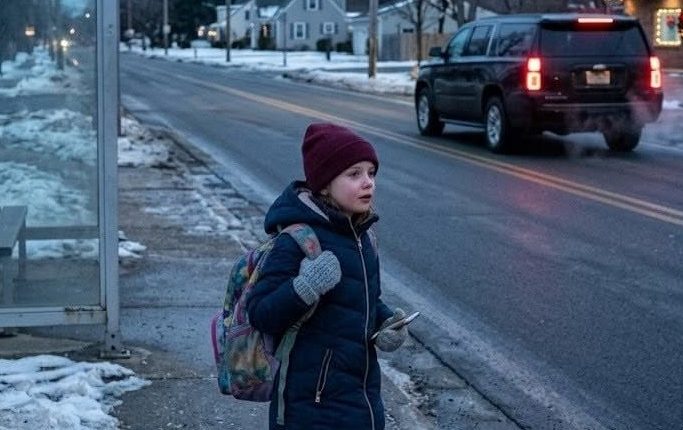
Every fork in Waverly Diner stopped halfway to someone’s mouth. Thirty faces turned toward me, then toward the little girl in the far corner booth, swallowed by a yellow jacket two sizes too large for her narrow shoulders.
His finger jabbed toward my chest. “Do you want your wages docked, Lena?”
The girl lowered her eyes to the egg sandwich I had placed in front of her. She was ten, maybe younger, with a backpack pressed against her body as if it were the only thing keeping her safe.
I felt heat rise into my face, but I kept my voice quiet. “I paid for it.”
Rick Barlow laughed without humor. He was a thick-necked man who wore his manager’s keys like military medals. “That isn’t the point.”
“What is the point?” I asked.
“The point is that this is a business, not a shelter.”
A few customers looked down at their plates. Others watched with the helpless curiosity people reserve for accidents that have not yet become their responsibility.
The girl’s fingers trembled around the sandwich. She had come in four times in two weeks, always between seven and eight, always alone, and always claiming she was waiting for someone.
The first time, she had ordered hot water and counted coins beneath the table. I had added toast and said the kitchen had made too much.
The second time, I had brought oatmeal. The third time, soup in a paper cup. That morning, she looked so faint that I had paid for eggs, bread, and milk before Rick could notice.
“Eat while it’s warm,” I told her.
Rick stepped closer. “I’m talking to you.”
“And I’m listening.”
“No, you’re performing.” His voice rose. “You like making everyone think you’re some kind of saint.”
That accusation hurt more than I expected. I did not help the girl because I thought I was good. I helped because I remembered exactly what hunger did to a child’s dignity.
When I was twelve, my mother and I had lived for three months on rice, canned beans, and whatever she could bring home from the motel where she cleaned rooms.
One winter morning, a waitress had slipped me pancakes and whispered, “Nobody should have to earn breakfast.”
I never learned her last name. I never forgot her face.
The girl looked up at me now. Her eyes were gray-green and far too watchful. “I can give it back,” she whispered.
“No,” I said. “You can’t.”
Rick grabbed the edge of the plate.
I put my hand over his wrist before he could take it. The diner went completely silent.
“Let go,” he said.
“Let her finish.”
His face darkened. “Office. Now.”
“I’m not leaving her while you’re standing over her like this.”
A chair scraped near the counter. Darnell, our cook, leaned through the service window. “She paid for the meal, Rick. Leave it alone.”
Rick glanced around and saw that several customers were no longer looking away. His humiliation sharpened into anger.
“Fine,” he said. “You want to make a scene? You’re fired.”
Someone gasped. My stomach dropped, but I untied my apron before he could see my hands shake.
The girl slid out of the booth. “No. Please. She didn’t do anything.”
I crouched so we were eye level. “This isn’t your fault.”
“Why did you help me?” she asked, almost angrily, as though kindness were another trap she had not learned to avoid.
“Because you were hungry.”
Outside, tires hissed against the wet street. A dark sedan slowed in front of the diner.
The girl saw it through the window. Every trace of color vanished from her face.
“He found me,” she breathed.
Before I could ask who, she ran through the side door and disappeared into the alley.
I followed, but the alley was empty except for rain, a yellow mitten near the trash bins, and the fading sound of an engine turning the corner.
When I returned to the booth, I found a folded napkin beneath her untouched glass of milk. On it, in cramped handwriting, were ten words that changed everything:
“Please don’t let my father send me back to that house.”
Part 2: The Man Who Came Looking
My hands shook so badly that the napkin crackled between my fingers.
Rick reached for it. “Give me that.” I pulled it away. “No.”
“This has gone far enough. I don’t want police, reporters, or rich people’s lawyers crawling through my diner because you decided to collect strays.”
Darnell came out of the kitchen, wiping his hands on a towel. “A child is missing, Rick. Your breakfast rush can survive the inconvenience.”
I called 911 before Rick could stop me.
Two officers arrived within minutes, followed by a detective named Priya Shah, who listened without interrupting while I described the girl, the sedan, and the yellow jacket.
“Did she give you a name?” Detective Shah asked. “Emma,” I said. “At least, that’s what she told me.”
The detective exchanged a look with one of the officers and opened a photograph on her phone. The same gray-green eyes stared back at me. The same small mouth. The same yellow jacket.
“Her name is Sophie Mercer,” Detective Shah said. “She has been missing for nine days.”
A murmur moved through the diner.
Rick straightened his shirt and lowered his voice. “Of course. Sophie. I knew I recognized her.” I stared at him. “You never said that.”
“I was trying not to frighten her,” he replied smoothly. Darnell gave a disgusted laugh. “You tried to take away her breakfast.”
Detective Shah ignored them. “Sophie’s father has offered a substantial reward, but that is not why this matters. She may be in immediate danger.”
“Her father?” I asked, touching the note in my pocket. “Gabriel Mercer. Mercer Hotels, Mercer Foundation, half the renovated blocks downtown. He has been searching across three states.”
Rick’s expression changed so quickly it was almost frightening. Ten minutes earlier, the girl had been a nuisance. Now she had become an opportunity.
He pulled out a chair for Detective Shah. “Anything you need. Waverly Diner has always supported families.”
Darnell muttered something in Spanish that made one of the officers hide a smile.
A customer near the window said, “Those black cars are back.”
The first two men entered in dark suits, alert but restrained. Behind them came a tall man in a charcoal overcoat, his face drawn with exhaustion. He did not look like the polished billionaire from magazine covers. He looked like a father who had forgotten how to sleep.
He held a printed photograph of Sophie against his chest.
“I’m Gabriel Mercer,” he said. “Which one of you has been feeding my daughter?”
Rick stepped forward immediately. “Mr. Mercer, I’m Rick Barlow, manager and community partner here. We’ve taken excellent care of her.”
I heard Darnell inhale sharply. Gabriel’s gaze moved past Rick and settled on me, perhaps because I was still holding the yellow mitten.
“I did,” I said. “I fed her.”
Rick turned. “Lena, don’t exaggerate. This was a team effort.”
I took the napkin from my pocket and handed it to Gabriel.
He read the first line. Then the second. His shoulders seemed to fold inward.
“She thinks I would send her back?” His voice was barely audible.
“I don’t know what she thinks,” I said. “But she was terrified of that car.”
Gabriel looked at Detective Shah. “Sophie had been staying at our Hawthorne house with my fiancée and her staff while I handled an acquisition in Singapore.”
“For how long?” I asked. “Seven weeks.”
“She came here hungry four times in two weeks,” I said. “Whatever you believed was happening in that house, it wasn’t care.”
Pain crossed his face, but he did not defend himself. “You’re right.”
Rick cleared his throat. “There is still the matter of unpaid meals and employee theft. I have records, Mr. Mercer. Considerable losses.”
Gabriel looked at him as if he had only just noticed he was in the room. “How much?”
Rick named a figure nearly twenty times the cost of the food.
Darnell slammed a stack of receipts onto the counter. “Lena paid every cent. Rick knows it.”
One of Gabriel’s security men, Marcus Reed, stepped toward the office. “We also need your exterior camera footage.”
Rick’s eyes shifted. “The system automatically deleted it.”
Marcus held up a tablet. “No, it didn’t. We recovered the cloud backup, and the person watching Sophie in the alley was driving a car registered to your fiancée, Mr. Mercer.”
Part 3: What the Camera Remembered
Gabriel went still. “Celeste told me that car was being serviced.”
Marcus turned the tablet so Detective Shah could see. The footage showed Sophie leaving the diner three mornings earlier. Across the street, a black sedan waited with its lights off. A man sat behind the wheel, watching her through a camera with a long lens.
When the image sharpened, Gabriel whispered, “Martin Vale.”
“Who is he?” I asked.
“My fiancée’s driver,” Gabriel said. “Or he was. Celeste told me he resigned last month.”
Detective Shah made a call, requesting the vehicle’s current location. Rick hovered near the counter, suddenly quiet. I noticed that he kept looking toward the office door, as though there were something else on the recordings he did not want anyone to see.
Gabriel turned to me. “Did Sophie ever mention Hawthorne House? A room? A person? Anything that seemed unimportant?”
I closed my eyes and replayed every broken conversation. She had never answered direct questions. Instead, she talked about small things: train whistles, blue birds painted on a wall, a place where the heat came through cracked windows, and a woman who counted every bite she ate.
“She said blue birds don’t freeze,” I remembered.
Detective Shah frowned. “What does that mean?”
“There’s an old mural near the abandoned Waverly freight station,” Darnell said. “Blue swallows across the brick wall. Homeless people sometimes sleep in the maintenance sheds behind it.”
I remembered Sophie staring at the bus map above the diner counter. She had asked which routes ran all night and whether the river froze completely in winter. I had answered without understanding that she was not making conversation. She had been building an escape plan one harmless question at a time.
Gabriel was already moving toward the door.
Detective Shah stopped him. “You are not leading this search. My officers are.”
Gabriel’s security detail looked ready to argue, but the detective did not blink. “Your fear does not make you useful,” she told him. “Follow instructions, or you stay here.”
For perhaps the first time in years, Gabriel Mercer accepted that money and authority could not place him at the center of a crisis. He nodded once.
“I’m going.”
“So am I,” I said.
Rick scoffed. “You don’t work here anymore, Lena. Don’t involve yourself in something dangerous just because a billionaire is watching.”
I picked up my coat. “For once, Rick, this has nothing to do with you.”
The freight station stood three blocks from the river, fenced off after a warehouse fire years earlier. Rain had turned the service road to mud. Officers spread out while Marcus and Gabriel checked the sheds.
Inside the first maintenance room, we found a nest of flattened cardboard, a child’s water bottle, and a diner napkin folded around half a biscuit. Sophie had slept there at least once. The sight of that biscuit hurt more than the expensive missing-person posters pasted across the city.
Gabriel picked up the water bottle and recognized a faded sticker from Sophie’s school.
“I approved a two-million-dollar renovation for this station,” he said. “I never imagined my daughter hiding in it.”
“Buildings are easier to inspect than people,” I said.
I found Sophie’s backpack beneath a rusted bench. Inside were two library books, a cracked phone with no battery, three granola-bar wrappers, and a photograph of a smiling woman kneeling beside Sophie in a garden.
Gabriel took the photograph with trembling fingers. “Her mother. Isabel.”
He told me Isabel had grown up poor and distrusted grand gestures. On their first anniversary, while Gabriel had reserved an entire rooftop restaurant, she had taken him instead to a soup kitchen and made him wash dishes.
“She said love was what you did when no one applauded,” he murmured.
The memory seemed to shame him more deeply than any accusation I could have made.
On the back, in Sophie’s handwriting, were the words, “Mom said find the place where winter smells like oranges.”
Gabriel stared at the message, and something like dread entered his eyes. “There’s only one place she could mean.”
Before he could explain, my phone rang from an unknown number. When I answered, I heard Sophie breathing.
“Lena?” she whispered.
“I’m here.”
Her voice broke. “She found me.”
Then a woman said calmly in the background, “Tell your little waitress goodbye,” and the line went dead.