Part 6: The Price of the Truth
Detective Price’s body had been buried for thirty-nine years.
His car had been destroyed after the investigation, but photographs from the accident remained in county archives. A modern forensic engineer reviewed them and found evidence that the rear brake line had been cut.
The pattern matched the damage to Peter Hale’s car.
Martin had killed the only detective who believed me.
Prosecutors added another murder charge.
When the news became public, people who had avoided me for decades began calling.
Former neighbors apologized.
Retired officers admitted the original investigation had focused too heavily on me.
Newspapers printed photographs of Laura, Emily and Noah beneath headlines about “the Mercer family conspiracy.”
I hated those headlines.
To the public, our tragedy was a mystery finally solved.
To me, it was forty Christmas mornings, two empty bedrooms and a daughter whose voice I could hear only through a cassette.
Emily’s funeral was held beneath a clear September sky.
Samuel stood beside me at the grave.
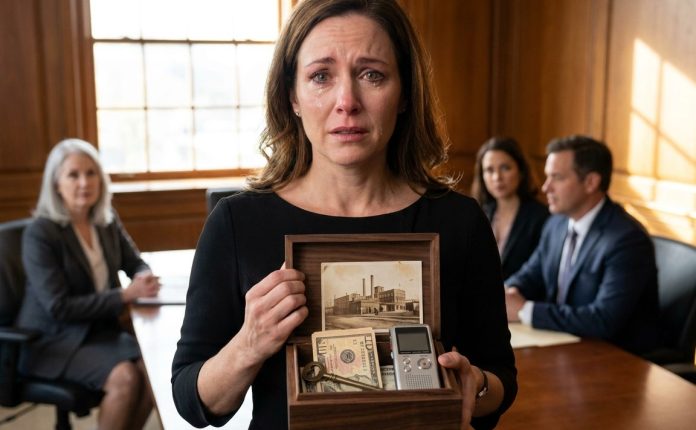
Only twelve people attended: hospice workers, two women from Emily’s sewing circle, Samuel’s clinic staff and a few people who had known her as Mara Vale.
I spoke last.
“My daughter was eight years old when she was taught that love was dangerous,” I said. “She spent the rest of her life protecting people from threats that lived mostly in the voice of one man. Some will ask why she did not come home sooner. I will not ask that question. A frightened child does not become unafraid simply because her body grows older.”
Samuel lowered his head.
“I lost forty years with Emily. But I will not let those missing years become the only truth about her. She was talented. She was loyal. She was brave long before she believed it.”
After the service, Helen gave me a final envelope.
“Emily asked me to give you this only after she was buried.”
Inside was a handwritten letter.
Dad,
When you read this, I hope Noah is beside you.
The box in my mattress contains the ugliest parts of our family, but I do not want ugliness to be my last gift.
There is another box beneath the loose floorboard under my sewing table.
That one is for both of you.
We returned to the apartment and lifted the floorboard.
The second box contained dozens of small objects: ticket stubs, drawings, birthday cards she had made but never sent, and photographs taken from a distance.
There was one of me leaving church.
One of Samuel outside his clinic.
One of the old house at Christmas, glowing with lights.
At the bottom were two quilts.
One was covered in fabric dinosaurs.
The other was made from pieces of Laura’s old dresses.
A note was pinned to them.
For the father who waited and the brother who survived.
Samuel held the dinosaur quilt against his face.
For the first time, he called me Dad.
It was a whisper.
But I heard forty lost years inside it.
Martin’s trial began in February.
Grace testified for three days. She admitted everything: the forged records, Laura’s disappearance, Emily’s confinement and the intercepted letters.
Martin’s lawyers portrayed her as an accomplice seeking mercy.
Then Emily’s recordings were played.
The courtroom heard an eight-year-old child begging her brother not to cry while their mother confronted a murderer downstairs.
We heard Laura say my name.
We heard the strike.
We heard the fuel.
Martin stared straight ahead.
He was convicted of murdering Laura, Peter Hale and Detective Price. He was also convicted of kidnapping, fraud, conspiracy and attempted murder connected to Samuel’s hit-and-run.
Because of his age, every sentence was effectively a life sentence.
Before sentencing, the judge allowed victims’ statements.
I stood across from my brother.
“For forty years, I thought the worst thing you took from me was time,” I said. “But time was only the container. You took my children’s trust in their own memories. You turned love into evidence of danger. You made a frightened woman believe that confession was impossible and a frightened child believe that silence could keep her brother alive.”
Martin watched without blinking.
“I used to wonder whether I could forgive you. I no longer ask. Forgiveness is not a door you are entitled to have opened.”
Samuel spoke after me.
He described growing up believing his father was a murderer and his mother had died calling another man’s name.
Then he placed the DNA report on the table.
“You told me blood made me yours,” he said. “But blood did not sit beside my bed when I could not breathe. Blood did not search for me. Blood did not keep my room waiting for forty years.”
He looked toward me.
“My father is Daniel Mercer.”
Martin’s face changed.
For the first time, he looked defeated.
Six months after the trial, the state granted Grace a reduced sentence because of her testimony and age. She moved into a secure medical facility.
I visited her once.
“Did Laura love me?” I asked.
Grace closed her eyes.
“Yes.”
“That isn’t the same as being faithful.”
“No.”
“Or honest.”
“No.”
“Why did she choose Martin?”
“She was afraid of being ordinary,” Grace said. “Martin made secrecy feel like importance. By the time she understood the difference, people were dead.”
I appreciated the answer because it did not excuse Laura.
She had betrayed me.
She forged invoices, continued an affair and took our children away.
Martin manipulated her, but he did not invent every weakness he used.
I could mourn her murder without pretending she had been innocent.
Before I left, Grace took my hand.
“Laura wrote something on the night before the fire. Martin thought he destroyed it, but I kept a copy.”
She gave me a single folded page.
Daniel,
I do not ask you to forgive me. I ask you to believe that when I finally understood what I had done, I chose to come home.
If I fail, tell Emily that fear is not the same thing as truth.
Tell Noah that fatherhood is not decided by blood.
And tell them both that the safest place they ever knew was real.
It was you.
I read the letter in my car.
At the bottom, written in a different ink, Grace had added a sentence in 1987.
Martin saw me copy this. If I speak, he says Noah will disappear forever.
That evening, I called Samuel.
“I found another letter from your mother.”
“I’ll come over.”
“There’s something else.”
“What?”
I stared through the windshield.
For forty years, I had believed the conspiracy ended with my brother and Grace.
But Grace’s notation raised another question.
Martin had been in police custody for the hit-and-run when Emily’s apartment was searched.
Yet the hospice nurse had told me that someone entered Emily’s room the night before her death—a man claiming to be her attorney.
The visitor log listed no name.
Inside Laura’s copied letter, Grace had written one final line beneath the fold.
Martin did not act alone at the cottage. The man who carried the fuel was the same officer who closed your children’s case.
Part 7: The Last Name in the Box
The officer who officially closed the disappearance investigation in 1992 was Lieutenant Raymond Cole.
He had replaced Detective Price after the crash.
Cole told me there was no evidence of foul play. He advised me to “accept that Laura chose a new life.”
He retired in 2004 with full honors.
At eighty-six, he lived in a private nursing residence twenty minutes from Emily’s apartment.
Investigators reviewed Martin’s financial records and found payments to Cole stretching from 1987 to 2005. The transfers were disguised as consulting fees through a security company.
Cole had altered the cottage fire report, removed Emily and Noah’s names from regional missing-child notices, and ensured that no connection was made between Laura Mercer and the dead woman identified as Lauren Reed.
He had also provided Martin with updates whenever I found a promising lead.
That was how Martin always reached witnesses before I did.
That was how he knew Emily had found me at the diner.
Cole had followed her from a records office after she requested the original missing-person file.
When detectives confronted him, he claimed dementia.
Medical evaluations showed mild cognitive decline, but not enough to prevent questioning.
Samuel and I watched through a one-way window as Cole was interviewed.
At first, he denied knowing Martin.
Then investigators showed him the bank transfers.
Cole sighed.
“You don’t understand what things were like then.”
“What were they like?” the detective asked.
“Messy. The wife left willingly. The husband looked guilty. The brother had influence.”
“You helped conceal a murder.”
“I never saw anyone killed.”
“Were you at the Blackwater cottage?”
Cole stared at the table.
“Martin called me after Laura threatened him. He said she was hysterical and had attacked him.”
“What did you see when you arrived?”
“Smoke.”
“And Laura?”
“On the floor.”
“Alive?”
Cole swallowed.
“Yes.”
My fingers curled against the window frame.
“What did Martin ask you to do?”
“Bring fuel from the shed.”
“Why?”
“He said the cottage needed to burn completely or Daniel would destroy all of us.”
“Did you pour it?”
“No.”
“Who did?”
“Martin.”
“What did you do?”
Cole’s voice dropped.
“I carried the container inside.”
“And the children?”
“I saw the girl on the porch roof. Martin told me he would handle her.”
“Did you see Noah?”
“Martin brought him to the car.”
“Why didn’t you save Laura?”
Cole closed his eyes.
“She looked at me.”
The room became silent.
“She was conscious,” he continued. “She said Daniel’s name. Martin told me that if she lived, my payments and the Hale investigation would come out. I walked outside.”
“You left her to burn.”
“Yes.”
Cole was charged as an accessory to murder, conspiracy and obstruction.
He also admitted visiting Emily at the hospice.
Martin had instructed him years earlier to monitor her. When news of her illness reached him, Cole went to discover what evidence she possessed.
“Did you harm her?” investigators asked.
“No. She was already dying. She looked at me and said, ‘My father is coming.’”
“Did you find the box?”
“I searched the drawers. Not the mattress.”
“What did she say before you left?”
Cole looked toward the observation window, almost as though he knew I was there.
“She said we had mistaken her silence for surrender.”
Emily had waited until she knew death was near before giving the hospice my name. She understood Martin might watch me if she contacted me earlier.
She hid the evidence inside the mattress because Cole had searched her apartment before.
The box that made my blood run cold had also protected the truth long enough for me to find it.
Cole pleaded guilty.
No trial could return Laura, Emily, Peter Hale or Detective Price, but the guilty plea filled the last deliberate gap in the story.
For the first time in four decades, there was no unknown figure waiting behind the next lie.
Samuel began visiting every Sunday.
At first, our conversations were cautious. We discussed safe subjects—his clinic, the weather, repairs needed around the house.
Then memories began returning.
He remembered the red wagon I pulled through the neighborhood.
He remembered hiding crackers beneath his pillow.
He remembered Emily singing to him when thunderstorms shook the windows.
One afternoon, we opened the attic.
Forty wrapped Christmas presents sat inside plastic storage containers. The paper had yellowed. The ribbons had flattened.
Samuel picked up the first box bearing his name.
“You bought these every year?”
“Yes.”
“What did you think would happen?”
“I thought you might come home.”
He opened the box.
Inside was a child’s train set.
We laughed and cried at the absurdity of a forty-five-year-old veterinarian holding a toy intended for a six-year-old.
We opened every present.
Some were childish. Later gifts included books, watches, college dictionaries, kitchen appliances and blank photo albums.
The final present, purchased the previous Christmas, contained two house keys.
Samuel held them up.
“What are these?”
“One for you. One for Emily.”
He closed his hand around both.
“We’ll keep hers.”
We transformed Emily’s bedroom into a sewing room but left several of her childhood belongings in place. Samuel took the dinosaur quilt home.
I kept Laura’s quilt folded in a cedar chest.
I did not display photographs of Laura as though nothing had happened. Neither did I destroy them.
She had been my wife.
She had betrayed me.
She had tried to return.
She had died protecting our children.
All those truths were allowed to exist together.
Samuel and I established the Emily Mercer Foundation for adults who had been abducted or separated from family as children. It funded DNA testing, counseling and record searches.
On the first anniversary of Emily’s death, we held a small gathering at the foundation’s office.
A photograph of her hung near the entrance. Not the childhood photograph from the missing-person posters, but one Helen had found on Emily’s hospice identification card.
She was smiling slightly.
She looked tired but unafraid.
After the guests left, Samuel and I drove to Miller’s Pond.
I had promised to take Emily and Noah there the weekend after their trip.
Forty-one years late, I carried a picnic basket to the water.
Samuel placed Emily’s baby tooth beneath a maple tree. I placed one of her handmade birthday cards beside it.
We sat on the shore until sunset.
“Do you think she knew we would find each other?” Samuel asked.
“Yes.”
“How can you be sure?”
“Because she put both our names on the second box.”
Samuel skipped a stone across the pond.
“I spent my whole life thinking the wrong man was my father.”
“You were a child. Then you were protecting the life you understood.”
“I wish I had believed you sooner.”
“I wish I had noticed Laura was frightened that last morning.”
“We could do this forever.”
“Do what?”
“Choose a moment and imagine we could have changed everything.”
He was right.
Regret had kept me alive during the search, but it could not teach us how to live after being found.
Samuel reached into his pocket and handed me a small object.
Captain Bite.
“You should keep him,” I said.
“No. He waited here with you.”
I turned the scratched dinosaur over in my hands.
“What about your house?”
Samuel smiled.
“I bought another one.”
We sat there as the final sunlight spread across the water, warm and bright.
For forty years, I had thought finding my children would restore the family I lost.
It did not.
Emily was gone. Laura was gone. Noah was now Samuel, a man with his own history, grief and loyalties.
We could not return to the morning before the trip.
We could not become untouched by betrayal.
What we could do was tell the truth without letting it become another prison.
As darkness approached, Samuel stood and offered me his hand.
“Ready to go home, Dad?”
I looked once more at the water.
Then I took my son’s hand.
“Yes,” I said. “Let’s go home.”