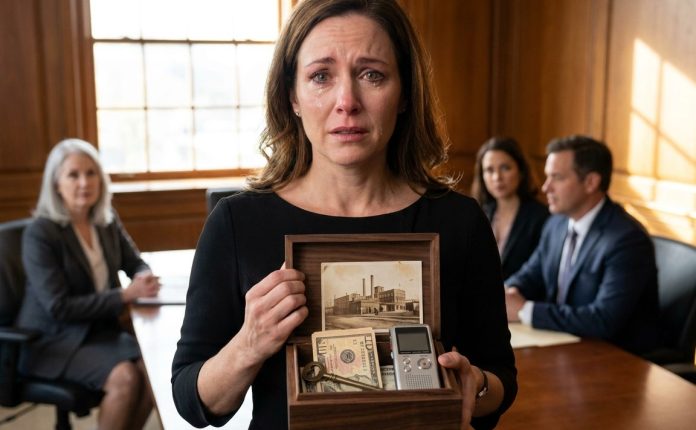
At eight months pregnant, I stood barefoot on the sidewalk while my mother-in-law ordered movers to carry my hospital bag, baby clothes, and late father’s rocking chair out of the apartment. “My family pays $9,800 a month for this place,” Vivian announced loudly enough for the neighbors to hear. “You don’t get to live like a Mercer after trapping my son.” My husband was unreachable, my ankles were swollen, and rain was beginning to stain the cardboard boxes around me. Then the building manager rushed through the lobby holding a folder of payment records. He looked at Vivian, then at the locksmith changing my front door, and said, “Ma’am, you need to stop. You have no idea whose money has been paying for this home.”
Part 1: The Woman at My Door
The first thing my mother-in-law removed from my home was the cradle.
It was not an expensive cradle. It had no designer label, no automated rocking mechanism, and no polished brass plaque bearing the Mercer family name. My father had built it before cancer weakened his hands. He had used maple from the old tree behind the house where I grew up and carved small stars into the headboard.
He died three months before my wedding.
When I became pregnant, I brought the cradle out of storage, sanded it carefully, and placed it beside the window in the nursery.
Vivian Mercer hated it immediately.
“It looks rustic,” she had said during her first inspection of the nursery. “The designer ordered a proper bassinet from Milan.”
“It was made by my father.”
“Yes, Nora, you’ve mentioned that.”
She said it while checking her phone, as though my father’s existence were an inconvenience she had already acknowledged once.
That Tuesday afternoon, two movers carried the cradle past me while I stood in the entryway of our apartment, one hand pressed beneath my stomach.
“Please be careful with that,” I told them. “It’s fragile.”
One mover slowed. He was young, with nervous eyes and rainwater darkening the shoulders of his uniform.
“Where do you want it, ma’am?”
“She doesn’t want it anywhere,” Vivian answered. “It’s being removed.”
I turned toward her.
She stood inside my living room wearing a cream wool coat and pearl earrings, perfectly dressed despite the September rain. Beside her was a locksmith kneeling at the front door. Another man was taping a cardboard box marked NORA—PERSONAL.
“Removed where?” I asked.
Vivian folded her arms. “Wherever you’re going.”
I stared at her for several seconds, waiting for the joke, the explanation, or even the usual polished cruelty followed by a smile.
None came.
“What are you talking about?”
“I’m talking about the end of this arrangement.”
“What arrangement?”
“The one in which you enjoy the Mercer lifestyle while my son destroys himself trying to satisfy you.”
My baby shifted hard beneath my ribs. I breathed through the pressure.
“Caleb is in Chicago. Have you spoken to him?”
“I’ve been speaking to him for three years. He may not always realize what he’s saying, but a mother understands.”
That answer frightened me more than shouting would have.
Caleb had flown to Chicago two days earlier for meetings with investors. His company, Northline Robotics, had been struggling through a difficult funding round. For weeks he had slept badly, eaten little, and taken phone calls in the bathroom because he believed whispered conversations were somehow less alarming.
We had argued the night before he left.
He wanted to use more of our savings to keep Northline operating. I refused until he showed me complete financial statements.
“It isn’t that I don’t trust you,” I had told him.
“That’s exactly what it is.”
“I’m asking for transparency.”
“You’re asking me to prove I’m not a failure.”
I had reached for him, but he stepped away.
The next morning, he kissed my forehead and promised we would talk when he returned.
Now his mother was emptying our apartment.
“Vivian,” I said, lowering my voice, “you cannot come into my home and remove my belongings.”
“This is not your home.”
“My name is on the lease.”
“As an occupant. The Mercer family guarantees the lease and pays every dollar of the rent.”
“That is not true.”
Her expression hardened.
“I have personally authorized $9,800 every month for nineteen months.”
Behind her, the mover carrying my father’s cradle shifted uncomfortably.
“Put it down,” I told him.
Vivian turned. “Take it to the truck.”
“Put it down.”
The sharpness in my voice made everyone stop.
I walked forward, but a sudden tightening gripped my abdomen. It was stronger than the practice contractions I had experienced during the previous week. I steadied myself against a chair.
The nervous mover set the cradle down.
“Ma’am, are you okay?”
“I’m fine.”
Vivian watched me with narrowed eyes.
“You always know how to create a scene.”
“I am thirty-four weeks pregnant.”
“And my son is nearly bankrupt.”
I looked at her.
“What did you say?”
“Caleb came to me yesterday.”
“He was already in Chicago yesterday.”
“He called me. He finally admitted what this marriage has cost him.”
My mouth went dry.
“What did he admit?”
“That Northline is out of money. That he has borrowed against his future distributions. That he has spent years maintaining an apartment, vacations, private medical care and every other luxury you demanded.”
I almost laughed, not because it was funny, but because the accusation was so disconnected from reality.
Our last vacation had been a three-day trip to Maine eighteen months earlier. My prenatal care was covered by my insurance. I bought most of the baby clothes myself, many secondhand. Caleb had wanted the apartment because it was close to his office and large enough to entertain investors.
“I never demanded this apartment.”
“He would never have chosen it alone.”
“He chose it before I even saw it.”
“You expect me to believe that?”
“I expect you to stop touching my property.”
Vivian stepped closer.
“Do you know what Caleb was like before he met you? Ambitious. Disciplined. Certain of himself. Now he apologizes constantly. He worries about disappointing you. He works until dawn while you sit here arranging a nursery he cannot afford.”
I felt each word strike a place that was already bruised.
Not because she was right, but because I knew Caleb had been unraveling. I had watched him conceal fear behind optimism and shame behind irritation. I had tried to support him without rescuing him. I had believed we were still partners.
But he had called his mother.
What exactly had he told her?
“Call him,” I said.
“I don’t need his permission to protect him.”
“You need his permission to end his marriage.”
“This is not about the marriage. This is about removing you from a property my family funds.”
She nodded toward the locksmith.
“Finish changing the lock.”
I took out my phone and called Caleb.
The call went directly to voicemail.
I tried again.
Voicemail.
I sent a message.
Your mother is here with movers. Call me immediately.
The message showed as delivered but unread.
Vivian began directing the movers again.
They carried out boxes of maternity clothes, books, toiletries and framed photographs. I stood in the center of the living room feeling as though I were watching strangers dismantle someone else’s life.
When one of them reached for a wooden box on the mantel, I moved between them.
“Not that.”
Inside were my father’s letters, his watch and the small recording device containing the last voicemail he ever left me.
The mover looked toward Vivian.
“Take her personal items,” she said.
“No.”
“Nora, don’t make this harder.”
“You brought strangers into my home while I was alone and pregnant. There is no version of this that becomes easy.”
For the first time, uncertainty passed across her face.
Then the elevator opened.
Leah Ortiz, my closest friend, stepped into the hallway carrying two paper bags from the bakery downstairs.
She saw the movers, the locksmith and me standing in the doorway.
“What happened?”
“Vivian is evicting me.”
Leah set the bags down.
“You’re doing what?”
Vivian gave her a dismissive glance. “This is a family matter.”
“It became a public matter when you put Nora’s underwear in a box on the sidewalk.”
Leah walked toward me.
“Are you having contractions?”
“I think they’re just from stress.”
“How far apart?”
“I don’t know.”
Leah turned to Vivian.
“Everybody stops moving until I check her.”
“You have no authority here,” Vivian said.
“Neither do you.”
Vivian’s cheeks flushed.
The building’s assistant manager appeared at the far end of the hallway. Behind him came Mr. Ellis, the senior property manager, a gray-haired man who had always greeted me by name and asked about the baby.
He was holding a folder.
“Mrs. Mercer,” he called.
Vivian turned with visible relief.
“Mr. Ellis, good. Please explain to Miss Bell that the Mercer family guarantees this lease.”
Mr. Ellis glanced at the locksmith.
“Why is that man changing the lock?”
“I am removing an unauthorized occupant.”
“She is not unauthorized.”
“I was assured that my name as guarantor gives me control of the residence.”
“It does not.”
Vivian’s expression sharpened.
“My family pays the rent.”
Mr. Ellis opened the folder.
“No, ma’am.”
Vivian stared at him.
He removed a printed ledger and held it toward her.
“The security deposit, first month’s rent and every monthly payment since the lease began came from Bell and Finch Holdings.”
The hallway became silent.
Vivian looked from the ledger to me.
“What is Bell and Finch Holdings?”
I placed a protective hand over my stomach.
“It’s my company.”
Her lips parted.
Mr. Ellis looked toward the belongings stacked by the elevator.
“Mrs. Mercer, Ms. Bell has paid $186,200 in rent, not including the deposit. You have never paid this building a cent.”
Then he turned the page.
“And according to the lease, she is the primary tenant. Your son is listed as her spouse, and you are only the guarantor.”
Vivian’s face lost its color.
The locksmith slowly removed his tools from the door.
But Mr. Ellis was not finished.
“There is another problem,” he said. “Someone has been submitting duplicate proof-of-payment letters under the Mercer family name.”
I looked at Vivian.
Vivian looked at me.
And for the first time, we both understood that someone had been lying to us.
Part 2: Two Payments for One Home
Leah took me to her apartment before the rain became heavy.
I did not want to leave my own home, but I could no longer bear the sight of my belongings piled beside the elevator. Mr. Ellis had stopped the lock change and ordered the movers to return everything, yet the apartment felt contaminated by what had happened.
Every room carried evidence that Vivian had walked through it and decided what parts of my life deserved to remain.
Leah lived ten minutes away in a modest two-bedroom apartment above a bookstore. She placed me on her sofa, brought me water, and called my obstetrician.
The contractions were irregular. The nurse advised rest, hydration and immediate evaluation if they became stronger, closer together or accompanied by bleeding.
“I’m staying with you,” Leah said after ending the call.
“You have work.”
“I own the bakery. I can tell my employees that my best friend was nearly evicted by a woman dressed like a luxury snowstorm.”
Despite everything, I laughed.
Then I began crying so suddenly that I could not breathe.
Leah sat beside me.
“I’m sorry,” I whispered.
“For what?”
“I don’t know.”
“That means you have nothing to apologize for.”
I covered my face.
“I kept thinking Caleb would call. Even while they were carrying out the cradle, I kept thinking the elevator would open and he would walk out.”
“Maybe he doesn’t know.”
“He called her yesterday.”
“That doesn’t mean he told her to do this.”
“No, but it means he told her something.”
My phone lay on the coffee table.
There were still no messages from him.
Mr. Ellis had sent copies of the payment ledger and lease. I opened the documents again, although I already knew what they contained.
Bell and Finch Holdings had paid $9,800 on the first business day of every month. I had personally authorized each transfer.
Bell and Finch was the company I created after selling my product-design studio four years earlier. The name came from my father, Thomas Bell, and his favorite bird, the finch that nested outside his workshop every spring.
Caleb knew about the company.
He knew I had sold my studio and retained several patents that generated licensing income. He did not know the exact amount held by Bell and Finch because we had agreed before marriage to keep premarital assets separate. My attorney had advised it. Caleb had said he understood.
After we chose the apartment, Caleb confessed that Northline’s cash flow was worse than he had admitted. He said his mother had offered to guarantee the lease but had attached conditions to paying the rent.
“She’ll treat the place as hers,” he told me. “She’ll choose the furniture, demand a key and remind us every month that we owe her.”
“So we pay it ourselves.”
“I can’t cover half right now.”
“I can.”
His face had tightened.
“I don’t want to live off you.”
“You wouldn’t be living off me. We’re having a child. We need a home.”
“What happens when we argue? Do you remind me that you pay for the roof?”
“No.”
“What happens when your friends ask?”
“I tell them we pay our rent, because we do.”
After several days, we reached an agreement. Bell and Finch would pay the full rent temporarily. Caleb would contribute when Northline stabilized. Vivian would remain the guarantor because the building required additional security from business-owner tenants whose income varied.
Caleb asked me not to tell Vivian.
“She already thinks you’re controlling me,” I said.
“She thinks everyone controls me except her.”
“That is not a reason to lie.”
“I’m not asking you to lie. I’m asking you not to discuss our finances with my mother.”
I had accepted that distinction because I wanted peace.
Now I saw how easily silence had become deception.
At six in the evening, Caleb finally called.
His face appeared on the screen from a hotel room. He looked exhausted, his tie loosened and his eyes bloodshot.
“Nora, I just saw your messages.”
“Your mother tried to throw me out.”
He closed his eyes.
“I know.”
The answer struck harder than I expected.
“You know?”
“She called after it started.”
“And you didn’t call me?”
“I was in a meeting. My phone was with my assistant.”
“You knew she was removing me from our home.”
“I told her not to do anything until I returned.”
“She did it anyway.”
“I’m sorry.”
“That’s all?”
“What do you want me to say?”
“The truth.”
He rubbed his forehead.
“Nora, I’m trying to get on the last flight home.”
“Why does your mother believe she pays the rent?”
He looked away from the screen.
“Caleb.”
“She sends money every month.”
“To whom?”
His silence answered before he did.
“To me.”
My fingers tightened around the phone.
“How much?”
He did not speak.
“Is it $9,800?”
“Yes.”
Leah, who had been standing in the kitchen, slowly turned toward me.
I lowered my voice.
“Your mother sends you $9,800 every month for rent.”
“Yes.”
“And Bell and Finch sends the landlord $9,800 every month.”
“Yes.”
“What have you been doing with her money?”
Caleb sat on the edge of the hotel bed.
“Northline needed cash.”
The room seemed to tilt.
“For how long?”
“Nora—”
“How long?”
“Most of the lease.”
Nineteen months.
Vivian had sent him approximately $186,200, believing it paid for our apartment. He had accepted it while knowing my company paid the landlord.
“You stole from her.”
“I borrowed it.”
“Did she know?”
“She knew Northline was struggling.”
“That is not what I asked.”
“No.”
I stood, and another contraction tightened across my abdomen.
Leah moved closer, but I raised my hand.
“Did you create the duplicate payment letters?”
Caleb looked confused.
“What duplicate letters?”
“Mr. Ellis said someone submitted proof-of-payment letters under the Mercer family name.”
“I sent statements to my mother’s office showing that the rent had been paid.”
“Whose statements?”
“I made summaries.”
“You made them look as if her money went to the landlord.”
“I needed time.”
“To do what?”
“Close the funding round. Once the investment came through, I was going to repay everything.”
“And if it didn’t?”
“It will.”
“You used my rent payments to support a lie.”
“I used my mother’s housing allowance to protect the company.”
“You used both of us.”
His face changed.
“That’s unfair.”
“Your mother emptied my nursery because she believed I was wasting money she gave us. You allowed her to believe that.”
“I never thought she would do this.”
“You knew what she thought of me.”
“I thought I could handle her.”
“You couldn’t even tell her the truth.”
He stood abruptly.
“I was ashamed, Nora. Is that what you want to hear? I was ashamed that my wife was paying nearly ten thousand dollars a month while my company was failing. I was ashamed that my mother still believed she had to rescue me. I thought I could turn one lie into a temporary bridge and fix everything before either of you knew.”
“You let her call me a parasite.”
“I never called you that.”
“You didn’t have to.”
My voice broke.
“You built the stage and let her perform.”
Caleb’s eyes filled with tears.
“I love you.”
“Love without honesty is just another method of control.”
He flinched.
I ended the call.
Leah took the phone from my hand before I dropped it.
For several minutes, neither of us spoke.
Then she asked, “Do you have access to the accounts for Northline?”
“No.”
“Does he have access to Bell and Finch?”
“He shouldn’t.”
The word should hung between us.
I opened my laptop.
Bell and Finch’s main accounts appeared normal. The rent transfers were correct. My investment portfolio remained intact. I checked my credit reports, then the accounts connected to my name.
At first, nothing looked unusual.
Then I saw a recent inquiry from Commonwealth Industrial Bank.
I had never applied for credit there.
Leah leaned over my shoulder.
“What is that?”
“I don’t know.”
I searched my email and found nothing. Then I checked the secure document portal used by my attorney.
A new file had been uploaded three weeks earlier.
PERSONAL GUARANTY—NORTHLINE ROBOTICS CREDIT FACILITY.
My name appeared beneath Caleb’s.
The listed guarantee was for $600,000.
At the bottom of the final page was a digital signature that looked exactly like mine.
Except I had never signed it.
I stared at the screen until the words blurred.
Leah whispered, “Nora, call your lawyer.”
Before I could reach for my phone, an email notification appeared.
The subject line read:
NOTICE OF DEFAULT AND INTENT TO COLLECT FROM GUARANTORS.
And the first sentence informed me that the bank intended to freeze assets held in my name within five business days.
Part 3: The Price of His Shame
My attorney, Daniel Cho, answered on the second ring.
I had known Daniel since I sold my design studio. He was careful, patient and almost impossible to surprise. After I explained the eviction, the duplicate rent payments and the forged guarantee, he remained silent long enough to frighten me.
“Send me everything,” he said.
“I already forwarded the documents.”
“Do not contact the bank yourself.”
“They’re threatening to freeze my assets.”
“They cannot legally collect against a fraudulent guarantee, but we need to move quickly. Did Caleb ever have access to your digital signature certificate?”
“No.”
“Did you share passwords?”
“Not intentionally.”
“That is not the same answer.”
I thought about our apartment. The desk we shared. The folder where I kept emergency instructions in case something happened during childbirth. Caleb knew where I stored passwords to utility accounts, insurance policies and the home alarm.
My secure document portal had a separate password.
But two months earlier, I had asked Caleb to print an insurance form while I was at a prenatal appointment.
The portal used two-factor authentication. I had read the code to him over the phone.
My stomach turned.
“He may have accessed it once.”
“Change every password now. I’ll contact the bank’s fraud department and arrange an emergency conference tomorrow.”
“He’s flying home tonight.”
“Do not meet with him alone.”
“He’s my husband.”
“He is also the person whose company benefited from a document bearing your unauthorized signature.”
The sentence was cold, but I needed its coldness.
After the call, Leah helped me change passwords while I rested on the sofa.
At nine thirty, someone knocked.
Leah checked through the peephole.
“It’s Vivian.”
“I don’t want to see her.”
“I can make her leave.”
Another knock sounded.
Then Vivian’s voice came through the door.
“Nora, I know you’re inside.”
Leah looked at me.
“Your choice.”
Part of me wanted Vivian gone. Another part wanted her to see the proof before Caleb could reshape the story.
“Let her in.”
Vivian entered without her coat. Rain had flattened her hair, and for once she wore no lipstick. She carried the payment ledger Mr. Ellis had given her.
“I spoke to my accountant,” she said.
I remained seated.
“Congratulations.”
Her jaw tightened.
“He confirmed the monthly transfers to Caleb.”
“Transfers you believed were rent.”
“Yes.”
“Why did you come here?”
“To understand.”
“You had nineteen months to ask questions.”
“I had no reason to suspect my son.”
“But plenty of reasons to suspect me.”
She looked down at the ledger.
“I made a terrible mistake today.”
“A mistake is sending the wrong invitation. You removed a pregnant woman’s belongings from her home.”
Her eyes flickered.
“I was angry.”
“So was I. I didn’t throw you into the rain.”
Leah stayed near the kitchen, arms folded.
Vivian took a breath.
“What did Caleb tell you?”
I turned the laptop toward her.
“He admitted he used the money you sent for Northline.”
Vivian stared at the screen.
“All of it?”
“Most of it.”
Her face hardened with each line she read.
“That cannot be right.”
“Why?”
“Because I gave Northline additional money.”
I sat straighter.
“How much?”
“Two hundred and fifty thousand dollars last winter.”
Leah let out a quiet breath.
Vivian continued.
“He said it was a temporary bridge until the next investment round.”
“Apparently every lie is temporary until someone discovers it.”
“He showed me contracts.”
“Did your accountant verify them?”
“He said there was no need.”
“Caleb said?”
“My son has never stolen from me.”
“He accepted $9,800 every month for a bill he knew I was paying.”
“That does not mean—”
“I also found this.”
I opened the guarantee.
Vivian read the first page. Then the signature page.
“What is this?”
“A six-hundred-thousand-dollar personal guarantee for Northline.”
“Why are you showing me?”
“Because I didn’t sign it.”
The color drained from her face.
“You’re saying Caleb forged your signature?”
“I’m saying someone did.”
“Caleb would never—”
The apartment door opened behind her.
Caleb stood in the hallway with a suitcase.
For several seconds, no one moved.
He looked first at me, then at his mother, then at the laptop.
“You found the guarantee,” he said.
Vivian turned slowly.
“You knew about this?”
Caleb closed the door.
“Nora, let me explain.”
“That sentence is becoming meaningless.”
He left his suitcase beside the wall.
“I didn’t forge it myself.”
“Who did?”
“Our finance director uploaded the documents.”
“With my signature?”
“I gave him a copy.”
Vivian crossed the room and slapped him.
The sound stunned all of us.
Caleb touched his cheek.
“You stole from me,” she whispered.
“I was going to repay you.”
“You falsified rent records.”
“I needed operating capital.”
“You used your wife’s name on a bank guarantee.”
“The investment was supposed to close.”
“Stop saying that!” I shouted.
My abdomen tightened again.
This time the pain wrapped around my back.
Leah noticed immediately.
“Sit down.”
“I am sitting.”
“No, you’re leaning forward. Breathe.”
Caleb stepped toward me.
“Are you having contractions?”
“Don’t touch me.”
He stopped.
Vivian stared at her son as if seeing a stranger.
“How much debt does Northline have?”
Caleb did not answer.
“How much?”
“One point four million, including vendor obligations.”
Vivian gripped the back of a chair.
“And the investment?”
“The lead investor withdrew this morning.”
The room fell silent.
That was why he had called Vivian. Not to confess the truth, but to ask for more money.
“Did you tell your mother I caused the company’s problems?” I asked.
“No.”
“What did you tell her?”
“That I couldn’t maintain everything anymore.”
“What does everything mean?”
“The apartment. The baby expenses. The company. All of it.”
“So you allowed her to decide I was the burden.”
“I was panicking.”
“You were protecting yourself.”
“I was trying to protect our future.”
I stood despite Leah’s warning.
“You forged my name to protect our future?”
“I thought the guarantee would never be called.”
“You risked everything my father left me.”
“It wasn’t like that.”
“You accessed my private accounts. You made your mother believe she was paying for our home. You stood by while she treated me like a thief because you were too ashamed to admit that your wife was supporting you.”
Caleb’s face crumpled.
“I didn’t want anyone to know I needed you.”
The words entered the room like poison.
Not that he loved me.
Not that he trusted me.
He needed me, and he had hated me for witnessing it.
Vivian lowered herself into a chair.
“How much has Nora paid?”
I answered without looking away from Caleb.
“One hundred eighty-six thousand two hundred dollars in rent. Plus the deposit.”
Vivian closed her eyes.
“And I gave you the same amount.”
“Approximately.”
“In addition to the quarter-million-dollar bridge loan.”
“Yes.”
Her voice became very quiet.
“What did you do with all of it?”
“Payroll. Components. Lease obligations. Legal expenses.”
“Where are the financial reports?”
“At the office.”
“I want them.”
Caleb looked toward me.
“Nora, I know I have no right to ask, but please don’t report the signature yet. Give me forty-eight hours. I can negotiate with the bank.”
“My attorney is already contacting them.”
Fear flashed across his face.
“You called Daniel?”
“You used my name on a six-hundred-thousand-dollar guarantee.”
“If the bank believes fraud occurred, they’ll refer it to law enforcement.”
“You should have considered that.”
“My employees will lose everything.”
“You made that choice, not me.”
He stepped closer.
“Our daughter will grow up with her father facing criminal charges.”
The sentence was designed to reach the part of me most vulnerable to fear.
It worked.
I hated him for knowing it would.
Before I could answer, a hot pressure moved low through my body.
Then warmth spread down my legs.
Leah looked at the floor.
Her face changed.
“Nora,” she said carefully, “you’re bleeding.”
Caleb reached for me.
A wave of pain bent me forward, stealing my breath.
Somewhere nearby, Vivian screamed for an ambulance.
As Leah lowered me onto the sofa, I looked at Caleb and saw terror replace every argument he had prepared.
Then another contraction tore through me, and the last thing I heard before the room blurred was the emergency dispatcher asking whether the baby was still moving.