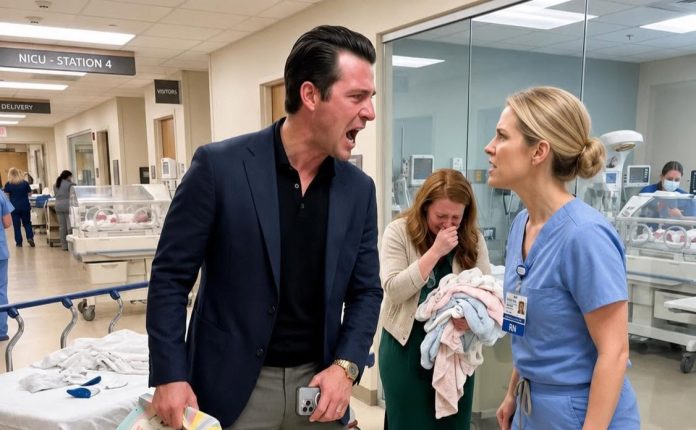
My husband threw my hospital bag onto the floor while I was eight months pregnant and struggling through contractions. He called me “dead weight,” ordered me out of the house, and told me never to return. The following afternoon, he entered my hospital room with another woman on his arm and a wedding ring sparkling on her finger. They expected tears. They expected me to beg. Instead, a three-star Army general walked through the door, addressed me as Colonel Anna Whitmore, and delivered orders placing me in command of one of the most sensitive operations in the country. But my rank was not the secret that destroyed my husband. The real shock was the twenty-million-dollar inheritance he had unknowingly surrendered—and the evidence proving he had committed crimes to steal it.
Part 1: The Night He Threw Me Out
My name is Anna Whitmore, and the night my marriage collapsed began with a contraction so sharp that I nearly dropped a glass onto the kitchen floor.
I caught myself against the counter, closed my eyes, and breathed through the pressure twisting across my abdomen. The digital clock above the stove read 9:42 p.m. Rain struck the windows in sudden waves, rattling the old frames of the house Mark and I had shared for nearly six years.
“Mark,” I called.
There was no answer.
The television continued playing in the living room. I could hear laughter from some late-night comedy show, followed by the faint tapping of his phone.
“Mark, please.”
He appeared in the doorway several seconds later, wearing a gray T-shirt and holding a glass of whiskey. He looked irritated rather than worried.
“What now?”
I stared at him.
For a moment, I wondered whether I had imagined his tone. This was the man who had once waited outside a military medical clinic for four hours because I had sprained my wrist during training. He had held my hand through the first ultrasound and cried when the technician showed us our daughter’s heartbeat.
But that version of Mark had been disappearing for months.
“I think labor is starting,” I said. “The contractions are getting stronger. Dr. Reynolds told us to go to the hospital immediately if this happened.”
Mark glanced at the clock.
“I’m busy.”
I initially thought he was joking.
“Busy doing what?”
“I’m dealing with something important.”
Another contraction tightened around my body. I placed both hands on the counter and bent forward as far as my swollen abdomen allowed.
“Please get the hospital bag.”
Instead of moving, he took a drink.
“Can you stop making everything a crisis?”
I turned toward him slowly.
“I am in labor.”
“You’ve been saying you feel uncomfortable for weeks.”
“This isn’t discomfort.”
He rolled his eyes.
That expression hurt more than the contraction. It reduced my fear, our child and everything I had endured to an inconvenience.
My pregnancy had never been easy. I had suffered from high blood pressure, severe swelling and recurring pain along my lower back. My military physicians had repeatedly warned me to avoid unnecessary stress.
Stress, however, had become the atmosphere of our home.
Three months earlier, my grandfather, Charles Whitmore, had died at the age of ninety-one. He had raised me after my parents were killed in an automobile accident when I was eleven. He taught me how to ride a bicycle, attended my commissioning ceremony and mailed handwritten letters to every base where I served.
I knew he had been financially comfortable, but I had never known the full extent of his wealth.
Two weeks after his funeral, his attorney informed me that my grandfather had established a family trust worth twenty million dollars. I was the sole beneficiary.
The transfer came with confidentiality requirements. Several assets were tied to a defense technology company that held government contracts. Until ownership reviews, security assessments and tax filings were completed, I was legally prohibited from discussing the trust with anyone who had not received clearance.
That included Mark.
I had hated keeping the truth from him, but the military legal office had been explicit.
“You may tell your spouse when authorization is issued,” the attorney had said. “Not before.”
I expected the restriction to last only a few weeks.
Instead, the process continued through the final months of my pregnancy and overlapped with preparations for a classified assignment. Mark believed I worked in an administrative role for the Department of Defense. He knew I was an Army officer, but I had always minimized my responsibilities because he disliked discussions about rank, deployments or the years of work that had built my career.
He had never attended one of my promotion ceremonies.
He had never asked to see my medals.
When military colleagues called me “Colonel,” he claimed they were being overly formal.
I allowed him to believe what made him comfortable.
That was my mistake.
Over the previous two months, Mark had begun coming home after midnight. He missed medical appointments, ignored calls and guarded his phone as though it contained classified intelligence.
Whenever I questioned him, his answers were the same.
“I’m under pressure.”
“I need space.”
“Stop making everything about the baby.”
I told myself he was frightened by impending fatherhood. I convinced myself that his software consulting business was struggling and that he was ashamed to tell me.
I kept swallowing my suspicions because I believed our family was worth saving.
I was wrong.
At 9:47 p.m., another contraction struck.
“Mark,” I whispered. “I need you.”
His face hardened.
“No, Anna. You need everyone. All the time.”
“What are you talking about?”
“I’m talking about the fact that I’m done carrying you.”
I stared at him in disbelief.
“I have served this family and this country for years. I have paid most of the mortgage. I supported your business when you had no clients.”
“There it is,” he snapped. “Your service. Your sacrifice. Your money. You always find a way to remind me that you think you’re better than everyone.”
“I never said that.”
“You didn’t have to.”
He placed the whiskey glass on the counter so hard that liquid spilled over the rim.
“You disappear for weeks and refuse to explain where you are. You come home exhausted. You hide documents. You take calls in another room. Then you expect me to sit around waiting for whatever scraps of attention you decide to give me.”
“My assignments are classified. You knew that when you married me.”
“I married a woman, not a government machine.”
His words landed with frightening calmness.
I looked at the man standing across from me and finally understood that he had rehearsed this speech. He had been waiting for the opportunity to say it.
Perhaps he had even been waiting for me to become physically vulnerable enough that I could not fight back.
“Please,” I said, trying to steady my voice. “Whatever is wrong between us can wait. Our daughter may be coming early.”
He laughed once, without humor.
“Always the dramatic officer.”
He walked into the hallway, opened the closet and pulled out the blue hospital bag I had packed weeks earlier.
For one desperate second, I thought he had changed his mind.
Then he threw it across the floor.
Clothes, baby blankets and toiletries spilled onto the hardwood.
“Get out.”
My chest tightened.
“What?”
“You heard me.”
“I’m having contractions.”
“That’s not my problem.”
“I can barely bend over.”
“Then call one of the soldiers who worships you.”
His cruelty stunned me into silence.
I studied his face, searching for regret, hesitation or even shame.
There was nothing.
Only impatience.
My hands shook as I collected my phone from the kitchen counter. I could not reach the items scattered across the floor, so I left most of them where they had fallen.
I called our elderly neighbor, Mrs. Elena Rivera.
She answered immediately.
“Anna? Is everything all right?”
“I need help.”
My voice broke on the final word.
Mrs. Rivera arrived within minutes, still wearing her slippers beneath a long raincoat. At seventy-four, she was barely five feet tall, but she entered my house with the authority of a commanding officer.
“What happened?”
“I’m in labor,” I said. “I need to get to the medical center.”
Her eyes moved toward Mark.
“You are her husband.”
Mark leaned against the wall.
“Not for much longer.”
Mrs. Rivera stared at him as though she had encountered something rotten.
Then she placed one arm around my waist and helped me toward the door.
At the threshold, I turned back.
Mark stood beside the scattered baby clothes, looking relieved to see me leave.
“Mark,” I said. “This is your daughter too.”
His mouth curved into a smug smile.
“Don’t bother coming back.”
Those words followed me through the rain, into Mrs. Rivera’s car and all the way to the military medical center.
The nurses placed me in a wheelchair before I could cross the entrance. My blood pressure was dangerously high, and our daughter’s heartbeat showed signs of distress.
For the next twelve hours, doctors worked to slow the labor long enough to stabilize us.
Mrs. Rivera remained beside me until a nurse convinced her to rest.
Mark never called.
No text.
No voicemail.
Not one question asking whether our baby was alive.
At 1:18 the following afternoon, after a long and frightening labor, I gave birth to a premature but healthy daughter.
I named her Grace.
She weighed five pounds, three ounces and had a furious little cry that made every nurse in the room laugh with relief.
When they placed her against my chest, I wept.
“I’m sorry,” I whispered to her. “I’m sorry you entered the world this way.”
Grace wrapped her tiny fingers around mine.
For several minutes, nothing else mattered.
Then, shortly before four o’clock, my hospital room door opened.
Mark walked in wearing a navy suit.
He had shaved, styled his hair and put on the expensive watch I had purchased for our fifth anniversary.
Beside him stood a beautifully dressed blonde woman in a cream-colored coat.
I recognized her immediately.
Lieutenant Colonel Claire Bennett.
My executive officer.
Claire had worked beside me for nearly eighteen months. She had attended classified briefings, coordinated my travel and once sat at my kitchen table during a holiday dinner.
Now her hand rested possessively on Mark’s arm.
A diamond ring sparkled on her finger.
Claire glanced at Grace in the bassinet and then looked at me with a small, victorious smile.
“Looks like you lost,” she said.
Mark folded his arms.
“I’ve moved on.”
My exhaustion disappeared beneath a wave of cold clarity.
“How long?”
Mark shrugged.
“Long enough to know what I should have had from the beginning.”
Claire lifted her hand deliberately, allowing the diamond to catch the afternoon light.
“We didn’t want you hearing it from someone else,” she said.
“You came into my hospital room to show me an engagement ring?”
Mark smiled.
“You always needed to be the important one, Anna. I thought you should see what it looks like when someone finally chooses Claire.”
Before I could answer, someone knocked.
The door opened before Mark could turn.
Every nurse in the room straightened.
Lieutenant General Samuel Grant entered in full uniform, followed by two senior officers and a military attorney.
Mark’s confident smile vanished.
General Grant stopped beside my bed.
Despite the difference in our ranks, he raised his hand in a formal salute.
“Colonel Anna Whitmore,” he said, “Headquarters instructed me to personally deliver your promotion orders and authorize your appointment to a new classified command.”
He placed a sealed envelope in my hands.
“Congratulations, Brigadier General Whitmore.”
The room became completely silent.
Claire’s face lost all color.
She immediately released Mark’s arm and stood at attention.
“Sir.”
General Grant looked at her ring and then at Mark.
“You know these people?” Mark asked weakly.
Claire swallowed.
“Lieutenant General Grant is the deputy commander of Army Cyber Command.”
Mark stared at me.
General Grant’s expression hardened as he looked between us.
“And Colonel Bennett,” he said, “is General Whitmore’s executive officer. At least, she was until fifteen minutes ago.”
Mark’s face went white.
In one devastating moment, the woman he had thrown out while she was giving birth stopped being the helpless wife he thought he could replace.
But as the military attorney stepped forward and closed the hospital-room door, I realized the general had not come only to deliver my promotion.
He had come because someone had used Claire’s credentials to access my sealed personnel files.
And the security logs led directly to Mark.
Part 2: The Salute That Changed Everything
General Grant asked the nurses to move Grace’s bassinet closer to my bed before requesting privacy.
A nurse looked at me for permission. I nodded.
Mark immediately protested.
“I’m her husband. You can’t remove me.”
The military attorney, Major Evelyn Shaw, faced him.
“This is a secure military matter. Unless General Whitmore requests your presence, you must leave.”
Mark looked toward me.
For years, I had rescued him from uncomfortable situations. I had rewritten his business proposals, made excuses for his missed payments and defended him when friends noticed how dismissively he treated me.
This time, I said nothing.
Claire stood rigidly near the wall. Her engagement ring no longer looked triumphant. It looked like evidence.
Mark lowered his voice.
“Anna, tell them I can stay.”
I held Grace against my chest.
“Leave.”
The single word seemed to shock him more than my promotion.
“You’re letting them treat me like a criminal?”
“I am asking you to leave my hospital room.”
“This is my child.”
“You did not care whether she survived twelve hours ago.”
His face reddened.
“That’s not what happened.”
Mrs. Rivera, who had just returned carrying a small bag of baby clothes, stopped in the doorway.
“It is exactly what happened,” she said.
Mark glared at her.
“You need to stay out of my marriage.”
Mrs. Rivera placed the clothes on a chair.
“You threw a woman in labor into a thunderstorm. Your marriage ended before my car reached the hospital.”
Major Shaw signaled toward the door.
“Mr. Whitmore.”
Mark pointed at me.
“This conversation isn’t over.”
“No,” I said. “It is only beginning.”
He left with two security officers standing behind him.
Claire remained.
General Grant waited until the door closed.
“Colonel Bennett, surrender your identification card, government phone and access token.”
Claire’s lips parted.
“Sir, I can explain.”
“You will have that opportunity during the formal investigation.”
She slowly removed the identification card from her wallet and placed it in Major Shaw’s hand. Then she surrendered her phone and the small encrypted access device attached to her keychain.
General Grant turned toward me.
“I apologize for discussing this now. Under ordinary circumstances, we would have waited until you were medically stable.”
“What happened?”
“Three weeks ago, someone used Colonel Bennett’s access credentials to search restricted personnel systems for information connected to you.”
Claire looked at me.
“I didn’t—”
General Grant raised one hand.
“Do not speak until addressed.”
He continued.
“The user attempted to access your deployment history, financial disclosure forms, clearance review and the classified addendum associated with the Whitmore family trust.”
My heart began pounding.
“Were they successful?”
“Partially. The system blocked the most sensitive material, but several personnel records were opened.”
“Where did the login originate?”
General Grant looked toward the closed door.
“Your home network.”
Claire shut her eyes.
I felt as though the room had tilted.
“Mark used her credentials?”
“That is one possibility,” Major Shaw said. “Another is that Colonel Bennett accessed the records while she was inside your residence.”
Claire’s voice trembled.
“He told me he needed proof.”
“Proof of what?” I asked.
“That you were hiding money. He found a letter from a trust attorney. He said you were planning to leave him and take everything.”
“You gave him access to a military system?”
“I logged in. I only intended to show him that your travel orders were legitimate.”
“Why were you in my house?”
Claire looked down.
I already knew the answer.
“How long have you been sleeping with my husband?”
“Anna—”
“Address her as General Whitmore,” General Grant said.
Claire flinched.
“General Whitmore, Mark and I became close while you were away.”
“That is not an answer.”
“Five months.”
Five months.
While I attended security briefings, prepared for childbirth and worried that my marriage was collapsing because Mark felt neglected, my executive officer had been entering my home and sleeping in my bed.
My hand tightened around the hospital blanket.
“Did you know I was pregnant?”
“Yes.”
“Did you know Mark and I were married?”
“Yes.”
“Did you know using military credentials for a personal search was illegal?”
Claire’s eyes filled with tears.
“Yes.”
Her honesty did not soften the betrayal.
General Grant explained that counterintelligence personnel had been monitoring the unauthorized searches. The timing of the access, combined with the confidential trust transfer and my pending command assignment, triggered an automatic security review.
My promotion ceremony had been scheduled for the following week. When the investigation escalated and doctors reported my emergency admission, General Grant decided to deliver the orders personally.
“I did not anticipate finding Colonel Bennett here,” he said.
“Neither did I.”
Major Shaw placed a folder on the tray beside my bed.
“This contains temporary protective measures. Your access credentials have been changed, your residence is being treated as a potentially compromised location, and security personnel will retrieve government property from the house.”
Mark had never known that a secured communication device was installed inside a locked cabinet in my home office.
If Claire had helped him enter that cabinet, the consequences could be catastrophic.
“Was classified information removed?” I asked.
“We do not know yet.”
Claire shook her head.
“Mark never touched the cabinet.”
General Grant turned toward her.
“How would you know?”
“I was there whenever he searched.”
“Whenever?” Major Shaw repeated. “There was more than one search?”
Claire realized her mistake.
The room went still.
“How many times?” I asked.
She began crying.
“Four.”
General Grant’s voice became dangerously quiet.
“You stated during your initial interview that the credentials had been used once without your permission.”
“I panicked.”
“You submitted a false statement during a security investigation?”
Claire covered her mouth with one hand.
I felt no satisfaction watching her unravel. I only felt grief.
Claire had been more than a subordinate. I had recommended her for advancement. When her mother underwent cancer treatment, I approved a flexible schedule and personally covered several of her responsibilities.
She had repaid me by carrying my husband’s ring into my hospital room.
“What was Mark looking for?” I asked.
“He believed your grandfather left you money.”
“How much did he think?”
“He found part of an old email mentioning a family trust. He guessed it might be two hundred thousand dollars.”
Mark had discarded me without knowing whether the inheritance was two hundred thousand or twenty million.
Claire continued.
“He said the money should belong to both of you. He wanted to know when it would become available.”
“And you helped him search.”
“I thought he deserved the truth.”
“You thought my husband deserved classified financial information more than your oath deserved loyalty?”
Claire looked away.
General Grant instructed the security officers outside to escort her to an administrative holding area.
Before leaving, Claire turned toward me.
“I know you hate me.”
“Hate would require energy I need for my daughter.”
“Mark told me you didn’t love him. He said your marriage had been over for years.”
“Then why did you need to come here and prove that you had won?”
She had no answer.
The officers took her away.
General Grant remained for another twenty minutes. He congratulated me again, promised that the promotion could remain confidential until I was ready and assured me that my command appointment would be protected during maternity leave.
Before departing, he looked at Grace.
“She entered the world during a difficult battle.”
“She did.”
“She looks like she intends to win the next one.”
For the first time that afternoon, I smiled.
After the officers left, Mrs. Rivera helped me dress Grace in a pale yellow sleeper.
“You have been hiding many surprises,” she said.
“I was not permitted to discuss the trust.”
“I am not talking about the money. I am talking about becoming a general.”
“I wanted a normal home.”
Mrs. Rivera touched my shoulder.
“A home is not normal when you must become smaller to keep someone comfortable.”
Her words remained with me.
That evening, Mark called eleven times.
I did not answer.
He sent apologies, accusations and threats in rapid succession.
Please let me explain.
Claire lied to me.
You humiliated me in front of everyone.
We need to discuss our finances.
You cannot keep my daughter from me.
By midnight, the tone changed again.
I know about the trust, Anna.
Half of it is legally mine.
My phone rang once more.
This time, the caller was not Mark.
It was my grandfather’s attorney, Jonathan Hale.
“Anna,” he said, “I was informed about the security breach. I need to ask you a very important question.”
“What is it?”
“Did you authorize Mark to borrow money against your house?”
“No.”
There was a long silence.
“Then we have a serious problem.”
“How serious?”
“Six weeks ago, your husband obtained a four-million-dollar business loan using a deed bearing your signature.”
My blood ran cold.
“I never signed anything.”
“I know,” Jonathan said. “Because the signature was dated on a day when you were deployed outside the United States.”
Part 3: The Four-Million-Dollar Forgery
Jonathan Hale arrived at the hospital the next morning carrying two leather briefcases and an expression I had seen only once before—at my grandfather’s funeral.
He was a tall, silver-haired attorney who had represented the Whitmore family for more than thirty years. He did not waste words.
After confirming that the door was closed, he placed several documents in front of me.
The first was a property deed.
The second was a personal guaranty.
The third was an application for a four-million-dollar commercial loan issued to Mark’s company, Whitmore Strategic Solutions.
Despite the name, I had never owned any part of the business.
Mark had added “Whitmore” without asking me because he believed my family name sounded prestigious.
At the bottom of each document was a signature resembling mine.
It was an impressive forgery.
But it was not perfect.
I formed the letter A in my surname with a narrow loop. The forged version contained the wide, decorative stroke Mark had seen me use on holiday cards.
“He practiced,” I said.
Jonathan nodded.
“The lender believed the house belonged jointly to you and Mark. He presented a deed suggesting that ownership had been transferred into a marital holding company.”
“The house was never his.”
“No. Your grandfather purchased it through the family trust before your marriage and granted you permanent residential rights. Mark was permitted to live there as your spouse, but he never acquired ownership.”
I remembered the night Mark accused me of constantly reminding him that I paid the mortgage. In reality, there was no traditional mortgage. I transferred a monthly amount to the trust for maintenance, taxes and improvements.
Mark knew the arrangement.
He simply assumed no one else would investigate it.
“What did he do with four million dollars?”
“Approximately one million was transferred into his company. Eight hundred thousand covered prior business debts. Several hundred thousand went into investment accounts. The remainder is difficult to trace.”
“The ring?”
Jonathan’s expression tightened.
“A jeweler confirmed that Mark purchased a one-hundred-and-eighty-thousand-dollar diamond six days ago.”
I looked toward Grace sleeping in the bassinet.
While I had been comparing prices on cribs and wondering whether we could afford extended childcare, my husband had used stolen money to purchase his mistress a diamond.
“Can the lender take the house?”
“No. The deed is fraudulent. The trust will defend the property. But the bank will pursue Mark once it learns the collateral does not exist.”
“Has he made payments?”
“Only one. He used funds from the loan itself.”
That meant his business was not merely struggling.
It was collapsing.
Mark had built the appearance of success using borrowed money and my forged signature.
Jonathan opened the second briefcase.
“There is another matter.”
I almost laughed.
“Of course there is.”
“Your grandfather’s estate documents were mailed to your residence before the confidentiality restrictions were finalized. One envelope was opened and resealed.”
“Mark.”
“We believe so. The enclosed letter did not reveal the amount of your inheritance, but it referenced the Whitmore Defense Technology Trust.”
“That explains why he searched my personnel file.”
“Yes.”
Jonathan removed a printed email.
“This message was recovered from Mark’s business account under an emergency preservation request. He wrote it to his financial adviser.”
I read the words slowly.
My wife is receiving money from her grandfather. I do not know the amount yet, but it should be enough to solve the liquidity problem. I need options for securing my share before she transfers or hides the assets.
The email had been sent seven weeks earlier.
Before he threw me out.
Before Claire’s engagement ring.
Before our daughter was born.
Mark had been planning to claim my inheritance while pretending our marriage was merely going through a difficult period.
“He knew enough to understand there was money,” I said.
“But not enough to understand its structure,” Jonathan replied. “The twenty million dollars is held in an irrevocable trust. It is separate property. Mark has no ownership interest.”
“What if we had remained married?”
“You could have chosen to use distributions for your family, but he could not compel the trust to give him anything.”
“And now?”
“Now the trustees will prohibit any distribution that could benefit him while the fraud investigation continues.”
A strange calm settled over me.
Mark believed throwing me out had placed him in control.
Instead, his actions had created a precise legal record showing when our relationship ended, why I left and how he treated me before he knew the value of my inheritance.
His cruelty had protected me from his greed.
Mrs. Rivera arrived around noon with soup and a knitted blanket. Jonathan departed to meet investigators from the bank and the military legal office.
Less than an hour later, Mark appeared again.
This time, hospital security stopped him outside my room.
I could hear his voice through the door.
“I am her husband!”
A security officer answered calmly.
“General Whitmore has declined your visit.”
“You cannot stop me from seeing my child.”
“You may address custody through the appropriate court.”
Mark began pounding on the door.
“Anna! Open this door!”
Grace startled and began crying.
Something inside me changed at that sound.
I had tolerated Mark’s anger when it was directed at me. I had minimized it, excused it and hidden it.
But he had frightened my daughter.
I pressed the call button.
“Please remove him from the floor.”
The pounding stopped after security escorted him away.
He left a voicemail minutes later.
“You are making a terrible mistake. Claire told me about the investigation, but she is trying to save herself. She used my computer. I had nothing to do with those searches. And that loan was for our future. I signed your name because I knew you would support me if you understood the opportunity.”
I replayed the final sentence twice.
He had admitted the forgery.
Jonathan instructed me to save the message.
Later that afternoon, a family-law attorney named Rebecca Sloan visited the hospital. She was recommended by Major Shaw and had represented several high-ranking military officers in complicated divorces.
Rebecca wore a burgundy suit and carried a tablet filled with documents.
“Your husband filed for divorce at eight-thirty this morning,” she said.
I was surprised by how little the news hurt.
“What is he asking for?”
“The house, temporary control of all marital accounts, spousal support and joint custody of your daughter.”
“He abandoned us while I was in labor.”
“He described the situation differently. According to his petition, you voluntarily left the residence after becoming verbally aggressive. He claims he did not know you were in active labor.”
“Mrs. Rivera witnessed everything.”
“That will help. The medical records will also establish the timing.”
“What about Claire?”
“His petition does not mention her.”
“Of course not.”
Rebecca scrolled through another page.
“He alleges that your military assignments caused the breakdown of the marriage. He also claims you concealed significant marital assets.”
“The trust is not marital property.”
“I agree. His attorney may not understand that yet.”
“When will he learn?”
Rebecca gave me the first genuinely satisfying smile I had seen in days.
“At tomorrow’s emergency custody hearing.”
I signed the necessary documents from my hospital bed.
We requested temporary sole custody, exclusive possession of the house, a protective order preventing Mark from accessing my financial records and an injunction freezing accounts connected to the fraudulent loan.
The next morning, I attended the hearing remotely.
Mark appeared in the courtroom wearing a dark suit, with Claire seated behind him.
Seeing them together confirmed that the hospital performance had not been impulsive. They had expected me to break down, surrender the house and negotiate from fear.
Mark’s attorney argued that he was a stable businessman whose wife frequently disappeared on unexplained government assignments.
Rebecca presented my promotion orders, medical records, Mrs. Rivera’s statement and security footage showing Mark attempting to force his way into the maternity ward.
The judge’s expression grew colder with every document.
Then Rebecca introduced the forged deed.
Mark’s attorney requested a recess.
The request was denied.
Judge Helen Morris granted me temporary sole physical custody, ordered Mark to remain five hundred feet away from me and Grace, froze the disputed financial accounts and prohibited him from entering the house.
Mark stood abruptly.
“She cannot do this! That house is mine!”
Judge Morris looked over her glasses.
“The evidence currently before this court indicates that the house belongs to a trust and that you attempted to use it as collateral without authorization.”
Mark pointed at the screen displaying my face.
“She hid twenty million dollars from me!”
The courtroom went silent.
He had learned the amount.
Claire must have told him after investigators questioned her.
Judge Morris’s gaze sharpened.
“Mr. Whitmore, sit down.”
Mark did not move.
“That money belongs to our marriage.”
“No,” Jonathan Hale said from beside Rebecca. “It does not.”
Mark stared at him.
Jonathan continued.
“The trust was created before the marriage, funded entirely by Charles Whitmore and restricted for General Whitmore and her descendants. Mr. Whitmore is neither a beneficiary nor an authorized recipient.”
Mark’s confidence finally cracked.
“How much do I get?”
“Nothing,” Jonathan said.
The judge called a recess while Mark’s attorney tried to control him.
Before the video connection ended, I saw Claire whisper something into Mark’s ear.
He turned toward the camera.
The hatred in his expression was unmistakable.
After the hearing, Rebecca told me the result was stronger than we had expected.
But Jonathan remained troubled.
“There is one more document we need to discuss,” he said.
He placed a beneficiary-change form on the hospital tray.
It concerned a three-million-dollar life insurance policy issued through a private military association.
The form removed my grandfather’s trust as secondary beneficiary and replaced it with Mark.
My signature had been forged again.
The effective date was only nine days earlier.
“Why would he change my life insurance now?” I asked.
Jonathan looked toward Major Shaw.
She answered carefully.
“Because according to your original deployment schedule, you were supposed to leave for a high-risk assignment next week.”