PART 1 — THE FIVE WORDS
I was burned across most of my body after saving my little sister from a house fire when she was ten.
Years later, I came to her wedding in a wheelchair, and she whispered, “Go sit in the back. You’re ruining my perfect wedding.”
Then the groom’s mother stood up and said five words that froze everyone.
“She saved your life, Emily.”
The church in Charleston, South Carolina, went completely silent.
A moment earlier, the organist had been playing a soft version of “Ave Maria.” Guests had been turning in their seats, adjusting silk dresses and straightening expensive ties. The photographer had been moving carefully along the aisle, searching for beautiful angles.
Now no one moved.
My sister, Emily Whitmore, remained bent beside my wheelchair, one hand hovering near my shoulder as though she had been interrupted in the middle of an affectionate greeting.
Her smile did not disappear immediately.
It cracked.
Only slightly.
Then she straightened.
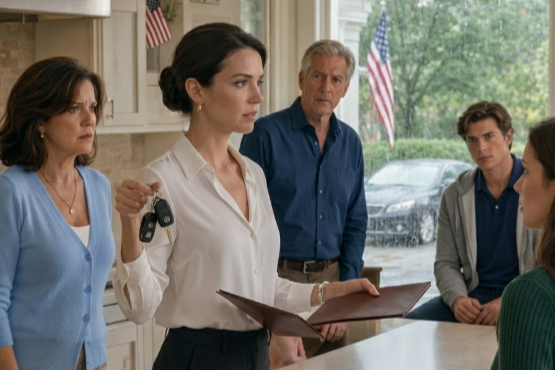
Margaret Callahan, the groom’s mother, stood in the front row wearing a deep green silk dress. She was tall and silver-haired, with the kind of posture that made people instinctively lower their voices around her.
Her son, Daniel, waited near the altar in a black tuxedo.
He looked from his mother to Emily.
“What does that mean?” he asked.
Emily’s fingers tightened around her bouquet.
“Nothing. Margaret misunderstood.”
Margaret did not look at her.
She looked at me.
“Claire,” she said, her voice quieter now. “Is your sister asking you to move?”
Every face in the church seemed to turn toward me.
I felt the old heat rise beneath my collar.
Not from the scars.
From being seen.
There were two kinds of staring I had learned to recognize after the fire.
The first was curiosity.
People wondered what had happened to me. They looked at the shiny ridges across my cheek, the tight skin along my neck, and the fingers that no longer bent properly. They tried to imagine the accident.
The second kind was pity.
I hated that more.
But what filled the church now was neither curiosity nor pity.
It was expectation.
Everyone was waiting for me to decide whether Emily’s wedding would continue.
I looked toward our parents.
Mom’s eyes were fixed on the floor.
Dad sat beside her, his jaw rigid.
Neither of them spoke.
That hurt more than Emily’s whisper.
They had heard her.
They had watched her ask me to hide.
And once again, they had decided that silence was the safest way to protect their favorite daughter.
“I’m fine where I am,” I said.
My voice came out steady.
Emily gave a small laugh.
“See? Claire is fine. This is just a seating issue.”
“No,” Margaret replied. “It is not.”
Emily’s expression hardened.
“Margaret, with respect, this is my wedding.”
“And that is your sister.”
“I know who she is.”
“Do you?”
Daniel stepped down from the altar.
“Mom, what are you talking about?”
Margaret finally turned toward him.
“When your father was a firefighter, he responded to a house fire on Tradd Street nineteen years ago.”
My breath caught.
The fire had happened on Tradd Street.
Our childhood home had been a narrow yellow house with dark green shutters and a magnolia tree near the porch. For years after it burned, I could not look at yellow houses without smelling smoke.
Margaret continued.
“Your father found two girls near the second-floor landing. The younger one was wrapped beneath the older one’s body.”
Daniel looked at me.
Margaret’s voice trembled for the first time.
“The older girl had gone back inside after escaping. She shielded her sister from falling debris and carried her toward the stairs.”
Emily’s face had gone white.
Daniel stared at her.
“You told me Claire started the fire.”
A murmur moved through the church.
I felt as if the floor had dropped beneath my wheelchair.
“What?” I whispered.
Daniel looked horrified.
“She told me you were playing with candles. She said you panicked, knocked one over, and then tried to rescue her because the fire was your fault.”
I turned toward Emily.
She did not deny it.
My stomach tightened.
All those years of watching her avoid discussing the fire.
All those times she changed the subject when someone called me brave.
All those family photographs in which she positioned me at the edge.
She had not simply been ashamed of my scars.
She had rewritten how I got them.
“Emily,” Dad said.
It was the first word he had spoken.
She spun toward him.
“Don’t.”
Daniel’s face hardened.
“Was that a lie?”
Emily looked around the church.
Two hundred guests watched her.
Her bridesmaids stood frozen near the altar.
The photographer had lowered his camera, but the small red light near the top was still on.
“Can we not do this right now?” she said.
Daniel’s voice became very quiet.
“Was it a lie?”
Emily’s eyes filled with tears.
“I was ten.”
“That does not answer the question.”
“I don’t remember everything clearly.”
“I do,” I said.
The words escaped before I could stop them.
Emily looked at me.
For nineteen years, I had protected her from the details.
I never described the way she screamed beneath the collapsed curtain.
I never told her how hard she fought me when I tried to cover her face with my shirt.
I never told her that part of the ceiling fell across my back while I was dragging her into the hallway.
I never told her I thought I would die before reaching the stairs.
She had been ten.
I wanted her to grow up without carrying my pain.
Apparently, she had used that mercy to build a lie.
“I was downstairs when the fire started,” I said. “You were asleep.”
Emily shook her head.
“Claire, please.”
“I smelled smoke. I ran outside. Mom and Dad were already on the lawn.”
Mom began crying.
“I heard you screaming from your room,” I continued. “Dad tried to go inside, but part of the ceiling collapsed near the entrance. The fire department had not arrived.”
Daniel’s eyes moved toward my father.
“You went back in?” he asked me.
“Yes.”
Margaret closed her eyes.
She had heard the story before.
Perhaps from her husband.
Perhaps many times.
“I found Emily trapped behind part of the curtain rod. Her blanket had caught fire. I put it out with my hands.”
I looked down at the ivory gloves.
Beneath them, two fingers on my left hand were partially fused. My right palm was covered with thick grafted skin.
Emily’s tears spilled over.
“You don’t have to say all this.”
“You told your fiancé I caused the fire.”
“I didn’t want him to think—”
She stopped.
“To think what?” Daniel asked.
Emily looked at my face.
The answer was there.
She did not want him to know she owed her life to the scarred woman in the wheelchair.
She wanted my body to be a mistake.
Not evidence of her debt.
“I didn’t want the fire to become part of our story,” she whispered.
Daniel stepped back from her.
“It already was.”
The organist removed her hands from the keys.
Father Michael, who had been waiting near the altar, closed the ceremonial book.
Emily turned toward Margaret.
“You had no right to do this.”
Margaret’s expression did not change.
“I watched you humiliate the woman who saved you.”
“You don’t know our family.”
“No,” Margaret said. “But my husband knew what she did.”
She reached inside her small evening bag and removed a folded piece of paper.
“I recognized Claire from the burn-center article Daniel showed me last month.”
I stared at her.
“What article?”
Margaret unfolded the page.
It was a photocopy of a newspaper story published after the fire.
The headline read:
TEENAGER RISKS LIFE TO SAVE SISTER FROM CHARLESTON BLAZE
Below it was a photograph of me at sixteen, lying in a hospital bed with bandages covering most of my body.
I had never seen the article.
Margaret looked at my parents.
“Thomas kept this for years. He said Claire was the bravest person he had ever carried out of a burning house.”
My mother made a broken sound.
Daniel looked at Emily.
“You knew my father was one of the firefighters.”
She shook her head.
“I didn’t.”
“You knew Claire saved you.”
“I was a child.”
“You are twenty-two now.”
Emily’s bouquet trembled.
“Are you ending our wedding over something I said when I was scared?”
“You said it last year,” Daniel replied. “You said it when I asked about the photographs of your sister.”
The church seemed to become even quieter.
“She told me Claire did not like being photographed,” he continued. “She said the scars came from Claire’s own carelessness. She said Claire used the accident to make the family feel guilty.”
I could not look away from Emily.
She had not lied once.
She had built an entire version of me.
Daniel loosened his tie.
“Why did you invite her?”
Emily’s mouth opened.
Mom answered.
“Because people would ask questions if Claire wasn’t here.”
That confession was somehow worse than everything else.
I had been invited not because I was loved.
I had been invited because my absence would look bad.
Emily covered her face.
“Mom!”
But Mom was crying too hard to stop.
“I told you this was wrong,” she said. “I told you not to move her.”
“No, you didn’t,” I said.
Mom looked at me.
“You stood beside me this morning while Emily approved the seating chart. You watched her move my chair from the family section.”
“I thought it was easier.”
“For whom?”
She had no answer.
Daniel turned to Father Michael.
“I need a moment.”
Then he walked away from the altar.
Emily reached for him.
“Daniel, don’t.”
He pulled his arm away.
“I don’t know who I’m standing beside.”
Her face collapsed.
Guests began whispering.
One of the bridesmaids started crying.
Dad rose abruptly.
“This ceremony is paused,” he announced. “Everyone should remain seated.”
Margaret looked at him.
“No one here is under your command.”
Dad stared at her.
Margaret turned toward me.
“Claire, would you like to leave?”
For the first time that day, someone asked what I wanted.
I placed my gloved hands on the wheels.
“Yes,” I said. “I would.”
Margaret stepped into the aisle.
Without touching my chair, she asked, “May I help?”
I nodded.
As she guided me toward the church doors, I heard Emily behind us.
“Claire, wait.”
I did not turn around.
For nineteen years, I had gone back for her.
That day, I kept moving forward.
PART 2 — THE FIREFIGHTER’S LETTER
The courtyard behind the church was quiet except for the sound of a fountain.
Margaret pushed my wheelchair beneath the shade of an oak tree, then sat on a stone bench across from me.
Inside, the wedding guests remained trapped between curiosity and embarrassment.
Outside, the air smelled like rain.
“I’m sorry,” Margaret said.
“You didn’t do anything.”
“I disrupted a wedding.”
“You interrupted something that should not have continued.”
She looked toward the church doors.
“My son has loved Emily for three years.”
“I know.”
Daniel and Emily had met during college in North Carolina. He worked in commercial real estate. She was a wedding photographer with a carefully managed social-media page filled with soft colors, luxury venues, and captions about authentic love.
She rarely posted family photographs.
When she did, I was usually absent.
“I did not intend to expose everything in front of the guests,” Margaret said. “But when I heard what she said to you, I saw my husband’s face.”
Her husband, Thomas Callahan, had died five years earlier from pancreatic cancer.
I remembered his name.
Not from the night of the fire.
From the hospital.
There had been a firefighter who visited me twice during my first month in the burn unit. I was heavily medicated and could barely speak, but I remembered a broad-shouldered man with tired blue eyes.
He brought me a stuffed Dalmatian.
I had named it Ember.
“Thomas came to the hospital,” I said.
Margaret smiled sadly.
“He talked about you for the rest of his life.”
I stared at her.
“Why?”
“Because he believed you should not have survived.”
The bluntness of the words did not offend me.
Doctors had said the same thing.
More than seventy percent of my body had suffered burns. My lungs had been damaged by smoke inhalation. I underwent dozens of surgeries, skin grafts, and painful rehabilitation sessions.
For nearly a year, my parents were told to prepare for every possible outcome.
Margaret reached into her bag again.
“There is something else.”
She handed me a sealed envelope.
My name was written across the front in block letters.
CLAIRE WHITMORE
The handwriting looked old.
“This was in Thomas’s fire-service box,” she said. “I found it after he died.”
My hands were not flexible enough to open envelopes easily, so Margaret waited until I nodded, then carefully tore the edge.
Inside was a two-page letter.
Dear Claire,
You may not remember me. My name is Thomas Callahan. I was one of the firefighters who responded to your home on the night of March 17.
I carried you from the second floor.
I have spent twenty-three years in the fire service. I have seen courage in many forms. What you did for your sister was not carelessness, panic, or foolishness. You made a choice no child should ever have been forced to make.
The letter continued.
Thomas described finding me curled around Emily near the landing.
He wrote that the fire had already moved through the hallway and that my back had taken the worst of the heat because I had covered her with my body.
He also wrote something I did not know.
The smoke alarms had not sounded.
Investigators discovered their batteries had been removed.
I stopped reading.
“Did you know this?” I asked.
Margaret shook her head.
“Not until I found the letter.”
I looked at the next paragraph.
The fire did not begin with candles.
It began in the kitchen.
A dish towel had been left near a burner. The alarm on the first floor contained no battery. The alarm upstairs had been disconnected.
My fingers tightened around the paper.
For nineteen years, my parents had described the fire as an electrical accident.
Whenever I asked about the investigation, Dad said the records had been lost.
I continued reading.
Thomas wrote that he had wanted to tell me the truth when I was older, but my father asked the department not to discuss the findings with me while I recovered.
The final paragraph was underlined.
You did not cause what happened. You carried another person through something the adults around you failed to prevent. Never let anyone use your scars to make you feel responsible for their shame.
I read the sentence again.
And again.
Margaret watched me.
“Why didn’t he send it?”
“I don’t know. The envelope was never stamped. He may have worried it would interfere with the investigation or your family.”
I folded the paper carefully.
“Did Daniel know about the article?”
“He saw your name on the guest list and asked why he had never met you. Emily gave him the explanation about the candle.”
Margaret’s jaw tightened.
“He mentioned it to me because he felt uncomfortable inviting someone with a difficult relationship to the wedding. When he said your full name, I remembered it from Thomas’s newspaper clipping.”
“You didn’t confront Emily?”
“I asked questions. She became defensive. Then Daniel told me you had been in a wheelchair since the fire.”
My wheelchair was not caused by paralysis.
Years of surgeries had left severe contractures in my legs and hips. I could stand briefly with support, but walking more than a few steps caused intense pain.
“I searched the old newspaper archives,” Margaret continued. “The article confirmed Thomas’s version.”
I looked toward the church.
“Daniel believed her.”
“He trusted the woman he planned to marry.”
“That was reasonable.”
“Trust becomes dangerous when someone uses it to erase another person.”
The church door opened.
Daniel stepped into the courtyard.
His face looked drained.
“Claire,” he said.
Margaret stood.
“I’ll give you privacy.”
“No,” I replied. “You can stay.”
Daniel nodded.
He stopped several feet from my chair.
“I’m sorry.”
“You didn’t know.”
“I should have questioned it.”
“You had no reason to believe your fiancée would lie about something like that.”
He looked toward the envelope in my lap.
“My mother told me about the letter.”
“Did Emily explain why she lied?”
Daniel’s eyes darkened.
“She said she wanted a life that was not defined by tragedy.”
I felt something inside me settle.
Emily had spent years believing the fire belonged to her.
The trauma.
The attention.
The right to move on.
My scars were acceptable only when they supported her survival story.
The moment they complicated the image she wanted, I became a problem.
“What happens now?” I asked.
“I postponed the ceremony.”
“Postponed?”
“I haven’t decided anything permanently.”
That answer was fair.
He had loved her for years.
One revelation, even a terrible one, did not instantly erase attachment.
“You don’t owe me a canceled wedding,” I said.
“This is not about what I owe you.”
“Then what is it about?”
“Whether I can marry someone who looked at your injuries and chose to invent a version that protected her image.”
He glanced toward the church.
“She also admitted she asked the photographer to avoid including you in wide shots.”
I looked down.
I had wondered why the photographer kept moving whenever my chair entered the frame.
Daniel’s mouth tightened.
“She told him you did not want to be photographed.”
A bitter laugh escaped me.
“I’m beginning to understand how convenient I have been.”
The church door opened again.
My father stepped outside.
“Claire, your mother needs you.”
I looked at him.
“Why?”
“She is having a panic attack.”
“Then call a doctor.”
His expression hardened.
“This is not the time for resentment.”
“No. It is exactly the time.”
Daniel moved slightly closer, not between us, but near enough that Dad noticed.
Dad looked at Margaret.
“You should never have interfered.”
Margaret’s voice became cold.
“My husband carried your daughters out of a burning house after you removed the smoke-alarm batteries.”
Dad’s face changed.
Daniel stared at him.
“What?”
Dad looked at the letter.
“That report was inconclusive.”
“It was not,” Margaret said.
“You don’t know what happened.”
“Thomas did.”
My father’s voice rose.
“I removed one battery because the alarm kept chirping.”
“And the upstairs alarm?” I asked.
He looked away.
Mom had complained for weeks that the alarm went off whenever she burned toast.
Dad disconnected it.
I remembered now.
The white plastic cover sitting on the kitchen counter.
The batteries beside the coffee maker.
I had seen them that afternoon.
Then my parents had spent nineteen years calling the fire an accident no one could have prevented.
Dad lowered his voice.
“You were fifteen. You were not supposed to go back inside.”
“Emily was ten.”
“The firefighters were coming.”
“She would have died.”
“You don’t know that.”
Margaret answered.
“Thomas did.”
Dad turned toward me.
“Are you going to let strangers tear this family apart?”
The words almost made me smile.
The fire had torn our house apart.
Silence had torn the family apart.
The strangers were simply naming the damage.
“You let Emily tell people I caused the fire,” I said.
His eyes shifted.
“You knew?”
“She was ashamed.”
“Of me?”
“Of what happened.”
“You allowed her to make me responsible.”
“We thought it would help her cope.”
There it was.
The family rule.
Emily’s pain required protection.
Mine required endurance.
“What helped me cope?” I asked.
Dad opened his mouth.
Nothing came out.
The church bells began ringing the hour.
No wedding followed.
PART 3 — THE MONEY BEHIND THE PERFECT WEDDING
By late afternoon, the church had emptied.
The guests received a carefully worded message saying the ceremony had been postponed because of a private family matter.
No new date was announced.
I returned to my apartment with Margaret’s letter folded inside my purse.
My apartment was on the first floor of a restored brick building near the medical district. I had chosen it because the doorways were wide and the bathroom had been renovated for wheelchair access.
My parents called it temporary.
I had lived there for six years.
They continued to speak as though I would eventually move back into their house and become dependent again.
The truth was the opposite.
I worked remotely as a medical claims analyst for a hospital network. The job was not glamorous, but it was stable, and I was good at it.
I paid my own rent.
I managed my medical care.
I scheduled transportation when I could not drive.
I had built a quiet life around what my body could do rather than what people believed it should do.
The following morning, someone knocked on my door.
It was Emily.
She was no longer wearing the wedding gown.
She had on leggings, an oversized sweater, and dark glasses.
I considered pretending I was not home.
Then she spoke through the door.
“I know you’re there.”
I opened it but did not invite her inside.
She removed the glasses.
Her eyes were swollen.
“Daniel left.”
“For how long?”
“He checked into a hotel.”
“I’m sorry.”
She stared at me.
“Are you?”
“Yes.”
“You hated the wedding.”
“I did not hate your wedding.”
“You think I don’t deserve him.”
“I never said that.”
“You didn’t have to.”
I looked at her.
“You came here to blame me.”
“I came to ask you to talk to him.”
“No.”
The answer surprised both of us.
Emily’s voice cracked.
“He respects you now.”
“Now?”
She closed her eyes.
“That came out wrong.”
“It came out honestly.”
She pressed both hands against her temples.
“I need you to explain that I was ten when the fire happened. That I have trauma. That I panicked.”
“You told him the lie last year.”
“I started telling it when I was young.”
“And continued because it was useful.”
Her eyes filled.
“You don’t understand what it was like growing up as the girl you saved.”
I stared at her.
“No. Tell me.”
“Everyone looked at me like I owed you my life.”
“You did not owe me your life.”
“That is easy for you to say.”
“I am the one who nearly died.”
“And I was the one who had to live knowing it!”
Her voice echoed through the hallway.
A neighbor’s door opened slightly, then closed.
Emily lowered her voice.
“At school, people called me the fire girl. At every family event, someone told the story. They praised you and looked at me like I was a burden.”
“So you made me the villain.”
“I wanted one thing that was mine.”
“Your wedding was yours.”
“Not with you in the front row.”
The sentence landed between us.
She covered her mouth immediately.
But it was too late.
“That is why you asked me to move,” I said.
“The photographer said the first rows would be visible during the ceremony.”
“And my scars did not match your colors.”
“That is not what I meant.”
“It is exactly what you meant.”
She began crying.
I felt no satisfaction.
Only exhaustion.
“You need to leave.”
“Claire, please. Daniel’s family has already paid deposits. The reception venue is holding everything for forty-eight hours.”
“I cannot fix your relationship.”
“You can tell him I am not a monster.”
“I don’t think you are a monster.”
Hope flickered across her face.
“I think you are a person who has spent years making cruel choices to avoid feeling guilty.”
The hope disappeared.
“Talk to him.”
“No.”
Her expression sharpened.
“After everything Mom and Dad did for you—”
I almost laughed.
“For me?”
“They spent years taking care of you.”
“They were my parents.”
“They gave up their lives.”
“So did I.”
“You always do that.”
“Do what?”
“Make everything about what you lost.”
I closed the door.
Her hand struck it from the other side.
“Claire!”
I locked it.
An hour later, Daniel called.
I almost ignored the number, but I answered.
“I’m sorry to bother you,” he said. “I need to ask something.”
“If it is about Emily, I can’t tell you whether to marry her.”
“It is about the wedding.”
I waited.
“Did you contribute money?”
My pulse changed.
“Why?”
“Emily said your parents paid for most of it. But the venue invoices list a transfer from an account with your name.”
I gripped the phone.
“What account?”
He read the last four digits.
I knew them.
The account had been created after the fire.
At first, it held donations from the community. Then an insurance settlement was added when investigators determined the alarms had failed and the electrical system contained code violations.
My parents called it the Claire Medical Trust.
They told me the money had been exhausted before I turned eighteen.
“How much?” I asked.
“The venue received thirty-two thousand dollars.”
My mouth went dry.
“From that account?”
“Yes.”
“There should not be any money left.”
Daniel was silent.
Then he said, “The florist, photographer, and bridal salon were also paid from it.”
I closed my eyes.
The perfect wedding had cost more than eighty thousand dollars.
I had assumed Daniel’s family was paying.
Apparently, a large portion came from money raised for my recovery.
“I need to call you back.”
I phoned my bank.
The trust was not held there.
I called the attorney whose name appeared on an old medical document.
He had retired.
His former partner agreed to search archived records.
Two hours later, she called.
The original settlement had been just over six hundred thousand dollars.
I could not speak.
My parents told me it had been less than one hundred thousand.
After medical expenses and legal fees, approximately three hundred eighty thousand dollars had remained in a protected trust.
The terms allowed withdrawals for my medical care, education, housing, and adaptive needs.
When I turned twenty-five, control should have transferred to me.
I was twenty-nine.
“I never received notice,” I said.
The attorney sounded concerned.
“Your father submitted annual statements indicating continued incapacity.”
“What kind of incapacity?”
“That you could not independently manage finances.”
I looked around my apartment.
At the laptop where I reviewed hospital accounts.
At the folders containing my tax records.
At the rent I paid every month.
“He said I was mentally incompetent?”
“He submitted physician letters.”
“From whom?”
She gave me the name.
Dr. Alan Reed.
He had been my pediatric rehabilitation specialist.
He retired when I was twenty-one.
The letters had been dated after his retirement.
“Can you send copies?”
“Yes.”
When they arrived, I knew immediately that the signature was wrong.
Dr. Reed signed his name with a long loop beneath the R.
These letters contained a short, uneven mark.
My father had forged medical documents to keep control of my trust.
And he had used the money to pay for Emily’s wedding.
I called Dad.
He answered on the second ring.
“What did you tell Daniel?” he demanded.
“How much money is left in my trust?”
Silence.
Then, “We need to discuss this in person.”
“How much?”
“Claire—”
“How much did you spend on Emily’s wedding?”
“It was family money.”
“No. It was compensation for my injuries.”
“We used some of it for your care.”
“You told me it was gone.”
“You don’t understand how expensive those years were.”
“I have the statements.”
That was a bluff.
I did not yet have every statement.
It worked.
Dad began breathing heavily.
“Your mother and I sacrificed everything.”
“Then why did you need to forge a doctor’s signature?”
He hung up.
Ten minutes later, Mom called.
Her voice shook.
“You are misunderstanding the trust.”
“Did you know Dad filed documents saying I was mentally incompetent?”
“We needed to maintain control.”
“Why?”
“You make emotional decisions.”
“I work in financial analysis.”
“You are vulnerable.”
“To whom?”
She started crying.
“We were afraid someone would take advantage of you.”
Someone had.
My own parents.
“Did you know the wedding was paid from my trust?”
“It was a loan.”
“Did Emily know?”
Mom went silent.
That answer hurt more than I expected.
“She knew.”
“She has always planned to repay it.”
“With what?”
“Her business.”
Emily’s photography business barely covered its expenses.
“How much money is left?”
Mom whispered, “About forty thousand.”
Out of nearly four hundred thousand dollars.
“What else did you spend it on?”
“Your father will explain.”
“No. You will.”
The list came slowly.
A new roof on their house.
Emily’s college tuition.
A failed restaurant investment for Dad’s brother.
Two family vacations I did not attend because travel was “too difficult” for me.
A down payment on Emily’s condominium.
And now the wedding.
My scars had financed the perfect life from which my family kept trying to hide me.