PART 1 — THE EMPTY SEATS
My parents skipped my graduation because, in my father’s words, it was “a loser’s parade.”
He said it at breakfast while buttering toast, as casually as if he were commenting on the weather.
“Valedictorian or not, Emma, it’s still just a bunch of kids in gowns pretending life owes them something,” Dad said.
Mom didn’t look up from her phone.
“Your brother’s semifinal game is at six,” she added. “Scouts might be there.”
My brother, Tyler, smirked from across the table, spinning his car keys around one finger.
“No offense, Em. Basketball actually matters.”
I looked down at the untouched cereal in front of me.
For four years, I had maintained the highest grade-point average in my class. I had tutored freshmen in math, captained the debate team, volunteered at the community food pantry, worked twenty hours a week at the public library, and slept an average of five hours a night.
Three months earlier, I had been named valedictorian.
The school had sent my parents a formal invitation. Principal Harris had personally called Mom to tell her I would be delivering the graduation address.
The blue envelope was still stuck to the refrigerator beneath one of Tyler’s basketball schedules.
Tyler had failed algebra twice and had been benched for most of the previous season after missing practices. But he was six-foot-four and could dunk, so my parents treated him like a stock they expected to explode in value.
His games were family events.
My achievements were background noise.
“Scouts came to my academic competition too,” I said quietly.
Dad took a bite of toast.
“For what? To watch people answer trivia questions?”
“It was the state debate final.”
“Same difference.”
Mom finally put down her phone and sighed.
“Emma, please don’t turn this into one of your emotional scenes. Tyler’s team could make the championship. You already know you’re graduating. What exactly are we supposed to watch?”
I stared at her.
“My speech.”
“You can record it.”
“The school is recording it.”
“There you go,” Dad said. “Problem solved.”
Something inside me went very still.
I had spent weeks imagining them in the bleachers.
I pictured Mom holding flowers. I pictured Dad pretending not to cry. I pictured Tyler making fun of my cap but secretly cheering when my name was announced.
I had even reserved four seats in the section marked FAMILIES OF HONOR STUDENTS.
One for each of them.
And one for Grandma Rose, who had died when I was fourteen.
Grandma had been the only person in our family who never made me feel ridiculous for wanting more.
She had taught me to read before kindergarten, saved newspaper articles about college scholarships, and kept every certificate I ever received in a green wooden box.
The last thing she said to me before she died was, “Don’t let anyone convince you that being overlooked means you are ordinary.”
That morning, I finally understood why she had said it.
I stood, carried my cereal to the sink, and poured it down the drain.
Dad glanced at the clock.
“You need a ride?”
For one hopeful second, I thought he had changed his mind.
Then he added, “We’re leaving for Tyler’s game at four, so you’d better be ready before then.”
“My graduation starts at five.”
He shrugged.
“Call Nina.”
So I did.
My best friend pulled into our driveway at four fifteen in her mother’s old minivan. A cardboard sign reading CONGRATULATIONS, EMMA! had been taped crookedly to the passenger door.
Nina jumped out holding a bouquet made of grocery-store daisies and blue ribbon.
“You look amazing,” she said.
I didn’t.
My gown had wrinkles because Mom had forgotten to pick it up from the cleaners. My hair was pinned with clips I had bought at a drugstore. The only jewelry I wore was Grandma Rose’s small silver pendant.
But when Nina hugged me, I almost believed her.
Behind us, Tyler came outside carrying his gym bag.
Mom followed with a cooler full of drinks and snacks.
She had painted Tyler’s jersey number on both cheeks.
Dad wore the team’s red baseball cap.
Mom glanced at my gown.
“Try not to trip onstage.”
Then she turned to Tyler.
“Did you remember your ankle brace? Your father packed the protein bars.”
They got into Dad’s SUV.
No photograph.
No hug.
No “congratulations.”
Tyler rolled down his window as they backed out.
“Don’t bore everyone to death with your speech.”
Then they drove away.
Nina stood beside me, staring after them.
“Your family is unbelievable.”
I tightened my fingers around the bouquet.
“Let’s go.”
The football field at Lakeside High looked almost magical beneath the warm evening lights.
Families crowded the bleachers with flowers, balloons, cameras, and handmade signs. Parents called their children’s names across the field. Younger siblings ran along the fence. Teachers hurried around adjusting collars and straightening caps.
I sat in the front row with the other honor students.
Behind us, the reserved section filled quickly.
Every seat filled except four.
Mine.
I told myself not to look.
I looked anyway.
The empty chairs seemed brighter than everything else.
When Principal Harris approached the podium, the crowd quieted.
He welcomed the families, congratulated the class, and spoke about resilience.
Then he adjusted his glasses.
“It is my privilege to introduce this year’s valedictorian, a student whose intellect is matched only by her compassion and determination. Emma Whitaker.”
The applause began politely.
Then my teachers stood.
Nina stood with her phone raised.
Members of the debate team began cheering.
The applause grew until it rolled across the field.
I walked toward the podium with my printed speech folded in my shaking hands.
For one second, I considered reading the safe version.
It was filled with familiar words about perseverance, friendship, gratitude, and bright futures.
No one would have blamed me for reading it.
No one would have known it was a lie.
Then I looked at the four empty seats.
I folded the pages in half and placed them beneath the microphone.
“My name is Emma Whitaker,” I began, “and tonight, I want to thank the people who showed up.”
A hush moved across the field.
I thanked Mrs. Alvarez, my English teacher, who kept granola bars and crackers in her desk because she knew I sometimes skipped lunch to save money.
I thanked Mr. Coleman, the librarian, who let me stay after closing when my house was too noisy to study.
I thanked Principal Harris for submitting scholarship recommendations when no one at home remembered the deadlines.
I thanked Nina, who recorded every debate tournament because she understood that sometimes a shaky phone video was the only proof I had that something important had happened.
Then I paused.
My hands had stopped trembling.
“And I want to thank the people who didn’t show up,” I said.
Somewhere in the bleachers, a baby cried.
“Because absence teaches too. It teaches you that applause may come from strangers before it comes from home. It teaches you to stop measuring your worth by how loudly certain people celebrate you.”
More phones rose.
“It teaches you that love without attention is only a word. That being related to someone does not automatically make them your supporter. And that sometimes the people who fail to see your value are not evidence that you have none. They are evidence that some people can stand beside something extraordinary and still choose not to look.”
My voice cracked then, but I kept going.
“To anyone graduating tonight with an empty seat in the audience, this moment still belongs to you.”
The first person to stand was Mrs. Alvarez.
Then Mr. Coleman.
Then Nina’s mother.
Within seconds, hundreds of people were on their feet.
The sound hit me like a wave.
I gripped the podium, blinking through tears.
“Build a life with people who show up,” I finished. “And become the kind of person who shows up for others.”
When I stepped away, the applause continued.
Principal Harris hugged me.
My teachers surrounded me.
Students I barely knew touched my shoulder as I returned to my seat.
I was still trying to breathe when I noticed the man waiting near the stairs beside the stage.
He was tall, probably in his early fifties, dressed in a charcoal suit despite the heat. Silver streaked the hair above his temples. In one hand, he held a bouquet of white roses.
I recognized him immediately.
Everyone did.
Daniel Pierce had founded Pierce Technologies before creating the Pierce Foundation, one of the most competitive scholarship organizations in the country.
Six months earlier, I had applied for its national leadership scholarship.
Three video interviews followed.
Daniel had attended the final one himself.
I had assumed it was because I was one of ten finalists.
Now he was standing at my high school graduation.
“Emma,” he said softly when I approached him. “You were extraordinary.”
“Mr. Pierce?”
He offered me the roses.
“These are for you.”
Cameras flashed around us.
“You came here for the scholarship?”
“I came here for you.”
There was something in his expression I couldn’t understand.
Pride.
Sadness.
And something that looked almost like recognition.
Before I could ask, Principal Harris called me back for the official class photograph.
Daniel stepped aside.
“We’ll speak soon,” he said.
Nina posted a ninety-second clip of my speech at eight twelve that evening.
By nine, it had more than two hundred thousand views.
By ten thirty, several major creators had reposted it.
At eleven, #EmmaWhitaker was the number-one trending topic on TikTok.
My parents came home at eleven seventeen.
Tyler entered first, limping and furious. His team had lost by fourteen points. The scouts had left before halftime.
Dad tossed his keys onto the counter while Mom complained about the referees.
They hadn’t called me once.
I was sitting on the living room couch with Nina and her mother when Tyler noticed my face on the television.
“What is this?” he asked.
Nina’s mother had connected her phone to the screen.
“Emma’s speech,” she said.
Mom forced a smile.
“Oh. Did someone record it?”
Nina looked at her.
“About four million people have watched it.”
Dad stopped removing his jacket.
“What?”
Nina restarted the video.
My voice filled the room.
My parents watched themselves become the unnamed villains in a story everyone seemed to understand.
Mom’s cheeks slowly lost their color.
Tyler’s smirk disappeared.
Dad crossed his arms, but when the video reached the end, the camera widened.
Daniel Pierce walked into the frame and handed me the white roses.
Mom’s breath caught.
Dad leaned toward the television.
His face went gray.
“Wait,” he whispered. “Is that Daniel Pierce?”
Mom grabbed the back of a dining chair.
For the first time that night, someone in my family looked afraid.
PART 2 — THE NAME THEY NEVER EXPECTED TO HEAR
Dad turned toward me.
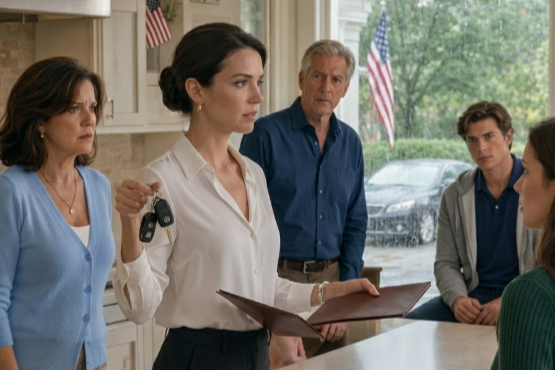
“What was Daniel Pierce doing at your graduation?”
It wasn’t curiosity in his voice.
It was panic.
“I won one of his foundation’s scholarships.”
“You never told us that.”
“I did. Three times.”
Mom stared at the frozen image on the television.
Daniel stood beside me with one hand extended toward the bouquet, his eyes fixed on my face.
“Which scholarship?” she asked.
“The Pierce National Leadership Award.”
Nina’s mother let out a quiet gasp.
Even Tyler looked impressed.
The scholarship covered four years of tuition, housing, books, and research expenses at any accredited university in the country.
It also included a paid summer fellowship at the Pierce Foundation.
Dad’s jaw tightened.
“That man doesn’t give anything away without wanting something in return.”
“You know him?” I asked.
He ignored the question.
“You are not to speak to him again.”
Nina looked at me.
Mom stepped toward Dad.
“Robert, maybe we should discuss this privately.”
“No. She needs to understand.”
He pointed at the television.
“Daniel Pierce is manipulative. He destroys families. Whatever he offered you, reject it.”
I laughed once in disbelief.
“You skipped my graduation. You didn’t know I applied for the scholarship. You didn’t know I was a finalist. Now you’re ordering me to reject it because you suddenly care about protecting me?”
“This is bigger than your graduation.”
“It was pretty big to me.”
Dad’s expression hardened.
“Do not use that tone.”
Nina stood.
“I think we should leave.”
“No,” I said.
For the first time in my life, I didn’t want witnesses to disappear.
I looked at Mom.
“How do you know Daniel Pierce?”
She opened her mouth, but Dad answered.
“We worked together years ago.”
Daniel’s public biography said he had founded Pierce Technologies in his parents’ garage when he was twenty-six.
Dad had spent years claiming he built his career through sales and consulting.
He had never mentioned Pierce Technologies.
“What kind of work?” I asked.
“None of your business.”
“It became my business when you told me to reject a full scholarship.”
Tyler dropped into an armchair, still wearing half of his basketball uniform.
“Was he your boss or something?”
Dad gave him a sharp look.
“Stay out of this.”
My phone vibrated on the coffee table.
An unfamiliar number had sent me a message.
Congratulations again, Emma. I hope I did not make tonight more complicated for you. When you are ready, there is something important I need to explain. —Daniel Pierce
Mom saw the name on the screen.
She crossed the room faster than I had ever seen her move and reached for the phone.
I grabbed it first.
“Give me that,” she said.
“No.”
“Emma, please.”
Her eyes filled with tears.
Not proud tears.
Terrified ones.
“Why is he texting you?” Dad demanded.
“He said there’s something he needs to explain.”
“You will block him.”
“I’m eighteen.”
“As long as you live in this house—”
“I won’t be living here much longer.”
The words came out before I had planned them.
Everyone went silent.
Dad’s face changed.
Not sadness.
Control slipping.
“You think a viral video and a rich man’s attention make you independent?”
“No. The scholarship does.”
He stepped closer.
“You have no idea what kind of man he is.”
“Then tell me.”
Dad said nothing.
Mom lowered herself into the chair Tyler had vacated.
Nina’s mother quietly took Nina’s hand.
I looked at Mom.
“Did you date him?”
Tyler made a choking sound.
Dad’s head snapped toward her.
Mom covered her mouth.
That was enough.
The room seemed to tilt.
“How long?” I asked.
“Emma,” she whispered.
“How long did you know him?”
She looked at Dad as though she needed permission to answer.
That hurt almost more than the silence.
“Before I met your father,” she said finally.
Dad’s hands curled into fists.
“I am her father.”
No one had said otherwise.
But the force with which he insisted made the air leave my lungs.
I looked from him to Mom.
Then back at the frozen image on the television.
Daniel’s silver-streaked hair.
The slight cleft in his chin.
The gray-green eyes I had always been told came from Grandma Rose, even though hers had been dark brown.
My fingers went cold.
“How long before you met Dad?”
Mom began crying.
“Please don’t do this tonight.”
“Tonight is the first time any of you have paid attention to something involving me.”
Dad slammed his palm against the television stand.
Nina flinched.
“That is enough. Daniel Pierce is not your father.”
I had not asked the question.
But he had answered it.
I picked up my phone.
Dad stepped between me and the doorway.
“You’re not going anywhere.”
“I didn’t say I was.”
“You are not meeting him.”
“Move.”
His face was inches from mine.
For years, I had learned to retreat when his voice changed.
I knew the warning signs: the rigid jaw, the lowered volume, the way he planted his feet as if the house itself belonged more to him than anyone else.
This time, Nina’s mother moved beside me.
“Robert,” she said evenly, “step away from her.”
He stared at her.
Then at the phone cameras still visible through our front window. People had begun gathering outside after recognizing the house from Nina’s earlier posts.
Dad stepped back.
I walked upstairs and locked my bedroom door.
At midnight, I replied to Daniel.
I’m ready.
He asked to meet the following morning at a café near the public library.
I didn’t sleep.
At two, I heard my parents arguing in their bedroom.
“You told me he would never come back,” Dad hissed.
“I didn’t know he would see her.”
“She applied to his foundation. How did you not know?”
“She doesn’t tell us anything anymore.”
I covered my mouth to stop myself from laughing.
At three fifteen, Tyler knocked softly.
I waited before opening the door.
He stood in the hallway wearing sweatpants, his hair still damp from the shower.
For once, he didn’t look arrogant.
“Is Daniel Pierce really your dad?”
“I don’t know.”
“Dad says he isn’t.”
“Dad also said my graduation didn’t matter.”
Tyler looked at the floor.
“I didn’t know your scholarship covered everything.”
“You never asked.”
He nodded slowly.
“I was a jerk today.”
“You’re a jerk most days.”
“I know.”
It was the closest thing to an apology he had ever given me.
He leaned against the doorframe.
“Mom’s crying. Dad keeps saying Pierce is trying to take something from him.”
“What could Daniel possibly take?”
Tyler looked back toward our parents’ room.
“You.”
The answer stayed with me until morning.
At eight thirty, I left the house carrying the white roses.
Dad had removed the battery from my car sometime during the night.
Nina was waiting at the end of the street.
Daniel Pierce sat at a table near the back of the café.
No assistants.
No cameras.
No security team.
Just a man with two untouched cups of coffee and a worn leather folder resting between his hands.
When he saw me, he stood.
“Thank you for coming.”
I sat across from him.
“Are you my father?”
Daniel closed his eyes for one brief moment.
Then he opened the folder.
“I don’t know with scientific certainty,” he said. “But I believe there is a very strong possibility.”
He slid an old photograph across the table.
My mother was twenty years younger, standing beside Daniel in front of a small lake cabin.
She was wearing a white summer dress.
Daniel had one arm around her waist.
On her left hand was an engagement ring.
PART 3 — THE LETTERS IN THE LEATHER FOLDER
I stared at the photograph until the faces blurred.
My mother looked happy.
Not the polite, performative happiness she used in family photographs.
She was laughing with her head tilted toward Daniel, and he was looking at her like the rest of the world had disappeared.
“When was this taken?” I asked.
“Three months before you were conceived.”
My chest tightened.
“You were engaged?”
“Yes.”
“What happened?”
Daniel turned his coffee cup slowly between his hands.
“I was working for my father’s company. Your mother and I planned to marry that autumn. Then I was offered a six-month engineering assignment in Singapore. It was important for my career, but I didn’t want to leave her.”
He looked at the photograph.
“Laura encouraged me to go. We were supposed to marry when I returned.”
“My mother said you abandoned her.”
Pain crossed his face.
“She may believe that.”
He removed a bundle of envelopes from the folder.
Some were yellowed at the edges. Each had my mother’s maiden name written across the front.
Laura Bennett.
Several were marked RETURN TO SENDER.
“I wrote every week,” he said. “At first she answered. Then her letters suddenly stopped.”
He handed me one of the envelopes.
The address was Grandma Rose’s old house.
“Why were they returned?”
“I was told Laura had moved.”
“She lived there until she married Dad.”
Daniel nodded.
“That is what I later discovered.”
The café noises seemed very far away.
“What did Dad have to do with this?”
“Robert worked in the mailroom at my father’s company. He knew both of us. He also knew when I would be overseas.”
My stomach twisted.
Daniel continued carefully.
“Before I left, Robert had been trying to get closer to your mother. She made it clear she wasn’t interested. After I went abroad, he began visiting your grandmother’s house. He told Laura he had information about me.”
“What information?”
“That I was seeing someone else in Singapore. That I had decided marriage would damage my career. That I had instructed him to retrieve the engagement ring.”
I shook my head.
“My mother believed him?”
“He brought her a letter.”
Daniel removed a photocopy from the folder.
The signature at the bottom looked like his.
The language was cold.
I have realized that our relationship was based more on youthful sentiment than a sustainable future. I cannot allow guilt to interfere with the life I am building.
“It was forged,” Daniel said. “The original was typed on a machine from the company’s administrative office. Robert had access.”
“Why didn’t you call her?”
“I did. Her number was disconnected. This was before social media made finding people easy. I sent telegrams. I contacted friends. Eventually, I received a letter that appeared to come from Laura.”
He slid another page toward me.
I read it twice.
Daniel,
Do not contact me again. I have moved on. The child I was carrying was not yours, and I am marrying his father. Whatever we had is over.
Laura
My hands began shaking.
“You knew she was pregnant?”
“Not until that letter.”
“And you believed her?”
“I believed the child was not mine. I did not believe the rest.”
“Why didn’t you come home?”
“I did. Two weeks later.”
He leaned back.
“Your mother was gone from your grandmother’s house. Robert met me outside. He said Laura had married him and wanted nothing to do with me. Then he showed me a photograph of their courthouse wedding.”
Mom and Dad had married five months before I was born.
I had always been told I arrived prematurely.
According to my birth certificate, I weighed eight pounds, six ounces.
Not exactly premature.
“I tried to see her,” Daniel continued. “Your grandmother threatened to call the police. She said my family had already caused enough damage.”
“Grandma knew?”
“I don’t know what she knew. She may have believed Robert’s version.”
Grandma Rose had never spoken warmly about Dad, but I had assumed it was ordinary tension between a mother and son-in-law.
Daniel pulled another photograph from the folder.
It showed a woman with silver-streaked hair, gray-green eyes, and a familiar half smile.
“My mother,” he said.
I looked at the photograph and felt as if I were looking at an older version of myself.
“The resemblance is what first made me question everything.”
“You saw my scholarship application.”
“Yes.”
The application required a personal essay and a short introductory video.
In mine, I had spoken about growing up in a family that valued athletic achievement more than academic achievement.
I had also listed my mother’s maiden name on the financial documents.
“Your application reached the semifinal committee without my involvement,” Daniel explained. “When I reviewed the finalists, I recognized your surname and your mother’s name.”
“But Whitaker is Dad’s name.”
“Your middle name is Rose. You mentioned your grandmother, Rose Bennett, in your essay.”
He smiled sadly.
“She used to make terrible peach pie.”
I almost laughed.
Grandma’s peach pie had been legendary in our family for all the wrong reasons.
“You knew her?”
“For years.”
A server approached, but neither of us ordered food.
“Why didn’t you tell me during the interviews?” I asked.
“Because I had no right to disrupt your life based on suspicion. I also did not want the scholarship decision contaminated by a personal connection. I removed myself from the final vote.”
“Did I actually win?”
“You received nine of nine independent votes.”
That mattered more than I wanted to admit.
“You came to the graduation because you thought I might be your daughter.”
“I came because no one from your family had responded to the foundation’s invitation.”
“What invitation?”
“We sent a formal notice explaining that you would receive the award onstage after graduation. Your father replied that the family would not be attending.”
Dad had not merely forgotten.
He had known.
“Can I see the reply?”
Daniel turned the folder toward me.
The email had come from Dad’s address.
Emma’s graduation is a minor local event. We have a more important family obligation that evening. Please mail any award materials directly.
My eyes burned.
Daniel waited without touching me.
It was such a small act of respect that I almost broke.
“Why did you stand beside me?” I asked.
“Because after hearing your speech, I could not let you walk off that stage believing no one was waiting.”
I pressed my knuckles against my mouth.
For eighteen years, Dad had watched me collect certificates alone. He had complained about driving to academic competitions. He had mocked every ambition that did not involve money, sports, or popularity.
Now I wondered whether he had always known exactly whose child I might be.
“What happens now?” I asked.
“Nothing you do not choose.”
Daniel took a card from the folder.
“A laboratory can conduct a legally documented DNA test. I have already submitted my sample, but yours will only be collected with your written consent.”
“You came prepared.”
“I have spent eighteen years unprepared.”
He looked down at his hands.
“I need to say something clearly. A test may prove I am your biological father. That would not entitle me to a relationship with you. I did not raise you. I was not there for your first day of school, your birthdays, your illnesses, or the nights you studied alone.”
“You didn’t know.”
“No. But you would still be allowed to feel abandoned.”
No adult in my family had ever given me permission to feel anything inconvenient.
“What about the scholarship?”
“It remains yours regardless of the test.”
“And if the test is negative?”
“I will still be proud to have selected you.”
I signed the consent form.
The laboratory collected the sample that afternoon.
Results would take several days.
When I returned home, Dad was waiting in the driveway.
He held the green wooden box that had belonged to Grandma Rose.
My certificates were scattered across the pavement.
“You went to see him,” he said.
I looked at the papers beneath his shoes.
“What did you do?”
“You think these make you special?”
He kicked one certificate aside.
“You think a speech makes you better than this family?”
I bent to gather the papers.
Dad grabbed my arm.
“I’m talking to you.”
A car door slammed.
Daniel crossed the street toward us.
He had followed at a distance because Nina had been worried about what my father might do.
Dad released me immediately.
The two men stood ten feet apart.
Eighteen years of hatred seemed to pass between them without a word.
Finally, Daniel looked down at the certificates.
“You’re still destroying her achievements, Robert?”
Dad’s face twisted.
“She is my daughter.”
Daniel’s voice remained calm.
“Then why have you spent her entire life punishing her for possibly being mine?”