Part 1 At my husband’s funeral, I expected tears.
I expected flowers, hymns, whispered condolences, and the heavy silence that follows a life ending after forty-six years of marriage.
What I did not expect was to see her sitting in the front row.
She wore a black dress, red lipstick, and a small pearl necklace I recognized immediately.
Because I had bought that necklace for my husband’s office Christmas party twelve years ago.
My daughter Claire gripped my arm so tightly it hurt.
“Mom,” she whispered, “who is that woman?”
I did not answer.
I already knew.
Her name was Vivian.
I had seen it once on my husband Arthur’s phone, years before, attached to a message that said, I miss you already.
When I asked him about it, he told me she was a client. He looked me straight in the eyes and lied so gently that I almost thanked him for it.
Now Arthur was lying in a polished wooden casket at the front of St. Matthew’s Church, and Vivian sat three seats away from me as if she belonged there.
My son Daniel stood up.
“I’ll ask her to move,” he said.
“No,” I whispered.
My whole body was shaking, but I would not give that woman the satisfaction of seeing me break.
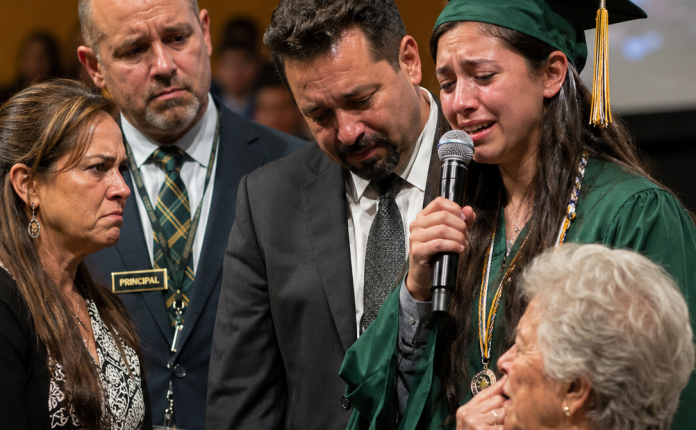
The priest stepped to the pulpit with a sealed envelope in his hand.
“Before Arthur passed,” he said, “he left me a letter to read today. He said it must be read before the eulogy, with everyone present.”
Vivian lowered her eyes.
My heart stopped.
Then Father Michael opened the letter and read my husband’s final words aloud.
“My dearest Eleanor,” the priest began.
The church became so quiet I could hear someone crying in the back pew.
“If you are hearing this, it means I was not brave enough to say these words while I was alive.”
My hands went cold.
Claire started crying beside me. Daniel’s jaw tightened.
Father Michael continued.
“I betrayed you. Not once. Not by accident. I made choices that hurt the woman who gave me the best years of her life.”
A gasp moved through the church.
Vivian’s face turned pale.
I stared at Arthur’s casket.
For years, I had wondered whether I was foolish, suspicious, jealous, or simply old enough to be ignored. Now the truth sat in front of everyone, dressed in black.
Then the priest read the next line.
“But Eleanor, the woman sitting in the front row is not here because I loved her more.”
Vivian lifted her head sharply.
“She is here because she has carried a lie that belongs to me. And today, I am asking her to return what she took from our family.”
My breath caught.
Return what?
Father Michael paused, looked toward Vivian, and unfolded the second page.
Part 2 The church seemed to shrink around me.
Every face turned toward Vivian.
She sat frozen, one gloved hand pressed against the small purse in her lap. The confidence she had carried into the church—the lifted chin, the perfect lipstick, the quiet claim of importance—began to crumble.
Father Michael cleared his throat and continued reading.
“Eleanor, there are things I hid because I was ashamed. There are things I excused because I was selfish. And there are things I allowed because I was a coward. Vivian did not steal my love from you. I gave away what was never mine to give. But she did take something else.”
My son Daniel whispered, “What is he talking about?”
I did not know.
My husband had been many things. Charming. Stubborn. Generous when watched. Secretive when cornered. He could make a room laugh in ten seconds and make me doubt my own memory in five.
But this was different.
Father Michael read slowly now, as though every word had weight.
“Twelve years ago, I began moving money from our family savings into a private account. I told myself it was temporary. I told myself I deserved freedom. I told myself Eleanor would never miss what she did not know existed.”
A low murmur filled the church.
My face burned.
Money.
I thought of the years I had clipped coupons after Arthur told me retirement would be tighter than expected. The winter I delayed replacing the furnace because he said we had to be careful. The vacation to Maine I canceled because he sighed over bills at the kitchen table.
All those small sacrifices came back to me at once.
Father Michael continued.
“Vivian knew where the money came from. She allowed me to pay for her apartment, her car, her jewelry, and her travel. She knew I was married. She knew I had children. She knew my wife trusted me.”
Vivian stood suddenly.
“That is not fair,” she said.
Her voice echoed through the church.
Father Michael stopped reading.
Every head turned.
Vivian’s face was flushed now, not with grief but anger.
“He told me he was unhappy,” she said. “He told me the marriage was over in every way but paper.”
My daughter Claire rose halfway from her seat.
“My mother cared for him through cancer,” she said. “She slept in a chair beside his hospital bed for three months.”
Vivian looked at me then.
For the first time, really looked.
I do not know what she expected to see. A bitter old woman, perhaps. A defeated widow. Someone small enough to step over.
Part 3 But I had buried too much by then to be small.
I stood.
“Sit down,” I said quietly.
Vivian blinked.
“I have a right to defend myself.”
“No,” I said. “You had years to defend what was right. Today, you can sit down and hear the rest.”
The church remained silent.
Slowly, Vivian sat.
My knees trembled beneath my black dress, but I stayed standing for one second longer than necessary. Then I lowered myself back into the pew.
Father Michael glanced at me, asking permission with his eyes.
I nodded.
He continued.
“I have arranged for my attorney, Mr. Samuel Price, to contact you after the service. He has records of the account, transfers, gifts, and property purchased with marital funds. I have signed a sworn statement acknowledging what I did. Eleanor, I cannot undo my betrayal. But I can stop one final injustice.”
My hand flew to my mouth.
Daniel leaned forward, stunned.
Father Michael read the next line.
“The lake house in Vermont is yours.”
Vivian gasped.
I looked at her.
The lake house.
Arthur had once told me about a “client retreat” in Vermont. He said the firm used it for business meetings. I never questioned him. Why would I? Back then, I still believed marriage was a room where both people kept the lights on.
Father Michael’s voice softened.
“I bought it with money that belonged to our marriage. I put it in Vivian’s name to hide it. She knows this. My attorney has the documents proving the transfer was fraudulent. I have instructed him to recover it for you or force its sale, with proceeds returned to your estate.”
Vivian looked as though the floor had disappeared beneath her.
“You can’t do that,” she whispered.
Father Michael did not answer her. He kept reading.
“To my children, Claire and Daniel, I owe an apology I do not deserve to have accepted. You saw less than you suspected but more than I wanted you to know. If you are angry with me, you should be. If you are ashamed of me, I earned it. But do not let my sins become your mother’s burden.”
Claire sobbed openly now.
Daniel reached across me and took her hand.
I stared at the casket.
Arthur’s face was hidden by the closed lid. I had chosen that. Near the end, illness had made him look like a stranger wearing my husband’s bones. I wanted to remember his strong hands, his thick gray hair, his laugh that could fill our old kitchen.
But as the letter continued, I realized I had been mourning two men.
The one I loved.
And the one who had lied to me.
“Eleanor,” Father Michael read, “you may wonder why I asked Vivian to attend today. It was not to humiliate you. God knows I have done enough of that. I asked her here because, for too long, I allowed truth to hide in private rooms. I wanted everyone who heard me praised as a good husband to first hear that I was not always one.”
A few people shifted uncomfortably.
Arthur had been admired in our town. He coached Little League. He donated to church repairs. He remembered birthdays. He helped neighbors carry groceries and always tipped waitresses too much.
People like simple stories.
Good man. Loving husband. Respected father.
But life is not simple, and neither are people.
Father Michael’s voice grew heavy.
“I loved you, Eleanor. Badly at times. Selfishly at times. In ways that do not deserve to be called love without confession. But I loved you. You were my home, even when I was foolish enough to wander.”
That sentence broke something in me.
Not because it excused him.
It did not.
But because part of me had waited years to hear him admit that he had wandered.
I had not imagined the perfume on his scarf. I had not imagined the late meetings, the guarded phone calls, the sudden withdrawals, the emotional distance he blamed on stress.
I had not been crazy.
I had been married to a man who wanted both comfort and escape.
Father Michael reached the final paragraph.
“I ask only this: do not bury your dignity with me. Wear the black dress, accept the condolences, then go home and live. Take the money. Take the house. Take back your name from the shadow I put it in. Forgive me only if forgiveness frees you. If anger is what keeps you standing for now, then stand.”
The priest’s voice cracked.
“Your undeserving husband, Arthur.”
He folded the letter.
No one moved.
The silence after those words felt bigger than the church itself.
Then Vivian stood again.
This time, she did not look angry.
She looked frightened.
“This is between me and Arthur,” she said.
Daniel rose so quickly the pew creaked.
“No,” he said. “It became between you and our family when you sat in the front row wearing my mother’s pearls.”
Vivian touched the necklace.
Her fingers froze.
I looked at it more closely.
Not the necklace from the Christmas party.
My necklace.
The one Arthur told me had been misplaced during our move ten years ago.
I laughed once.
It was not a happy sound.
Vivian’s hand dropped.
Claire wiped her tears. “Take it off.”
Vivian’s mouth tightened. “This was a gift.”
“So was my mother’s trust,” Daniel said. “Apparently Arthur gave away both.”
The church murmured again.
Father Michael stepped down from the pulpit.
“Vivian,” he said gently, “perhaps it would be best if you returned the necklace now.”
She looked around.
There was no sympathy waiting for her.
Slowly, with shaking hands, she unclasped the pearls and placed them on the edge of the front pew.
But she did not apologize.
Some people cannot apologize because apology would require them to see the full size of what they have done.
She walked out of the church alone.
The heavy wooden doors closed behind her.
And only then did the service continue.
Father Michael gave the eulogy, but it was not the one I expected. He did not pretend Arthur was perfect. He spoke of a man who did good things and terrible things. A man who loved his family and wounded them. A man who confessed too late, but confessed.
I sat through it with dry eyes.
At the cemetery, people approached me carefully.
Some whispered, “I’m so sorry.”
Others said nothing and simply squeezed my hand.
One woman from church, Martha Ellison, leaned close and said, “You carried yourself like a queen.”
I almost smiled.
Queens, I thought, probably did not feel like their insides had been scraped hollow.
After the burial, we returned to my house.
Arthur’s favorite lemon cake sat untouched on the dining table. Claire had ordered sandwiches. Daniel made coffee. People came and went in soft waves, bringing casseroles, flowers, stories, and awkward silence.
Everyone wanted to know what to say to a widow who had just heard her husband confess adultery from beyond the grave.
There is no proper casserole for that.
By late afternoon, the house emptied.
Only Claire, Daniel, and I remained.
Claire sat beside me on the sofa, still holding a tissue.
“Mom,” she said, “how long did you know?”
I looked toward the window.
Outside, the maple tree Arthur planted when Daniel was born moved gently in the wind.
“I suspected for years.”
Daniel swore under his breath.
“Why didn’t you tell us?”
“Because you were his children,” I said. “And because I was ashamed.”
Claire took my hand.
“You didn’t do anything wrong.”
I knew that.
But knowing a thing in your mind and feeling it in your bones are not the same.
“When a husband strays,” I said, “people look at the wife and wonder what she lacked. Was she too cold? Too old? Too ordinary? Too tired? I did not want to become a question people whispered over coffee.”
Daniel knelt in front of me.
“Mom, listen to me. Dad’s choices were Dad’s choices.”
My son’s face blurred through my tears.
“He was not only bad,” I whispered.
“No,” Daniel said. “But he was not only good either.”
That truth settled over us.
For years, I had protected Arthur’s image because I thought love required it. Even in my own mind, I polished the good memories and locked the ugly ones away. But that day, the lock broke.
I remembered the first time I met him at a church picnic. I had dropped a paper plate of potato salad, and he had pretended to trip so I would not be embarrassed alone.
I remembered him carrying Claire through a snowstorm when she had a fever and our car would not start.
I remembered dancing with him barefoot in our kitchen.
I also remembered him coming home smelling of a perfume I did not own.
I remembered him turning his phone face down.
I remembered him telling me I was imagining things.
All of it was true.
That was the hardest part.
A week after the funeral, Arthur’s attorney, Samuel Price, came to the house.
He was a serious man with round glasses and a leather briefcase. He sat at my kitchen table and laid out documents as carefully as a surgeon laying out instruments.
There had been an account.
There had been transfers.
There had been the lake house.
There had been jewelry, vacations, furniture, and payments made over more than a decade.
The total amount made my hands go numb.
“I don’t understand,” I said. “He told me we had to be careful.”
Mr. Price’s eyes softened.
“Mrs. Bennett, your husband maintained two financial lives.”
Two financial lives.
One where I skipped dental work because insurance did not cover enough.
One where Vivian had a lake house.
Claire, who had insisted on being present, stood abruptly and walked to the sink. Her shoulders shook.
Daniel stared at the table, his face dark with anger.
Mr. Price continued.
“Arthur signed a sworn affidavit before his death. It gives us strong grounds to pursue recovery of assets. Vivian may contest it, but the documentation is substantial.”
“Will there be court?” I asked.
“Possibly. But she may settle to avoid public proceedings.”
Public.
The word no longer frightened me the way it once had.
My humiliation had already sat in the front row of a packed church.
“What do you recommend?” Daniel asked.
Mr. Price looked at me, not my son.
That mattered.
“I recommend Mrs. Bennett decide what outcome allows her to move forward.”
For the first time in a long time, a man at my kitchen table did not speak around me.
I looked at the documents.
Part of me wanted to burn them.
Part of me wanted to call Vivian and ask how she slept in a house bought with my grocery money, my delayed repairs, my canceled trips, my trust.
But beneath the anger was something steadier.
Dignity.
“I want back what is legally mine,” I said. “Not because I want revenge. Because I will not help hide what he did.”
Mr. Price nodded.
“Then we proceed.”
Vivian did not go quietly.
At first, she claimed Arthur had given her gifts freely. Then she claimed she knew nothing about the source of the money. Then, through her attorney, she offered to return some jewelry if I agreed not to pursue the lake house.
I refused.
Three months later, she settled.
The lake house was sold. Funds were returned. The private account was closed. Several pieces of jewelry came back to me in velvet boxes.
Among them was my pearl necklace.
I held it in my hands one evening at my bedroom mirror.
For years, I had thought of those pearls as lost.
Now they were back, but they felt different. Heavier.
Claire said I should sell them.
Daniel said I should throw them into the river.
But one Saturday morning, I took them to a jeweler downtown.
“I want these remade,” I told him.
The jeweler, a kind older man named Mr. Levine, examined them.
“They’re beautiful pearls.”
“They have an ugly history.”
He looked up.
“Then we’ll give them a better one.”
He turned the necklace into three bracelets.
One for me.
One for Claire.
One for my granddaughter, Emily.
When I gave Claire hers, she cried.
“I don’t know if I can wear it,” she said.
“You don’t have to,” I told her. “But I want you to know something beautiful can survive being handled badly.”
She put it on.
So did I.
Life after that did not become easy, but it became honest.
People in town talked, of course. Some with pity, some with judgment, some with the secret excitement people get when respectable families crack open in public.
For a while, I avoided the grocery store on busy days.
Then one morning, I woke up angry at myself.
I had done nothing wrong, yet I was the one hiding.
So I put on a red blouse, fastened my pearl bracelet, and went to the market at noon.
Martha Ellison found me near the apples.
“Eleanor,” she said softly, “how are you?”
I looked her in the eye.
“Widowed. Betrayed. Better dressed than expected.”
She stared at me, then burst out laughing.
So did I.
That was the first real laugh after the funeral.
It felt strange, almost disloyal. Then it felt wonderful.
In the months that followed, I began going places Arthur never liked. A watercolor class. A women’s book club. A weekend trip with Claire to the coast. I bought new curtains for the bedroom and painted the kitchen yellow, which Arthur had always said was “too cheerful.”
Too cheerful became exactly what I wanted.
One afternoon, Father Michael came by for tea.
He looked nervous.
“I have wondered if I did the right thing,” he admitted.
“Reading the letter?”
“Yes.”
I poured his tea.
“You read what Arthur asked you to read.”
“That does not always mean it was merciful.”
I thought about that.
Mercy is a complicated word. People often use it when they want women to swallow the truth quietly so everyone else can feel comfortable.
“It was painful,” I said. “But pain and harm are not always the same thing. The lie was harming me long before the truth hurt me.”
Father Michael bowed his head.
“I am sorry for your suffering.”
“So am I,” I said. “But I am not sorry I know.”
He nodded.
Before he left, he handed me a small envelope.
“This was separate from the funeral letter. Arthur asked me to give it to you only if you wanted it. If not, I can destroy it.”
I stared at the envelope.
My name was on it.
Eleanor.
Not my dearest Eleanor.
Just Eleanor.
“Do you know what it says?” I asked.
“No.”
I almost told him to burn it.
But curiosity, grief, and unfinished love are stubborn things.
I took it.
That night, I sat at the kitchen table with the envelope in front of me for nearly an hour.
Then I opened it.
Eleanor,
I have no right to ask for your understanding. I do not ask for it. I only want to leave you one truth I should have said long ago.
Vivian made me feel young. You made me feel known.
I was foolish enough to chase the easier feeling.
Being known is harder. It means someone sees your weakness, your vanity, your fear, your smallness. You saw mine, even when I denied it. Instead of becoming better, I ran toward someone who only saw the version I performed.
That was not love. It was escape.
You were my wife. My witness. My truest friend. And I failed you.
I am sorry.
Arthur.
I read the letter once.
Then I folded it and placed it in the drawer beside the old recipe cards.
I did not cry.
Perhaps I had cried enough.
A year passed.
On the anniversary of Arthur’s death, I drove to the cemetery alone.
I brought no roses. He had always bought roses when he wanted forgiveness, and I had grown tired of them.
Instead, I brought a small bundle of wildflowers from my garden.
I stood before his grave and looked at his name carved into stone.
Arthur James Bennett
Beloved Husband, Father, and Friend
Beloved.
The word hurt less than it once had.
“I don’t know exactly what you were,” I said aloud.
A breeze moved through the grass.
“You were my husband. You were my betrayer. You were the father of my children. You were the boy from the church picnic. You were the man who lied. You were the man who confessed too late.”
I placed the flowers down.
“I will not spend the rest of my life making you one thing so I can understand you.”
A bird called from the fence.
“And I will not spend the rest of my life being only the woman you hurt.”
That was the real goodbye.
Not the funeral. Not the burial. Not the letter.
That moment.
When I stopped asking his memory for permission to live.
The following Sunday, I hosted dinner.
Claire came with her husband. Daniel came with his children. My granddaughter Emily helped me set the table and noticed my bracelet.
“Grandma, is that new?”
I touched the pearls.
“New enough.”
“It’s pretty.”
“Yes,” I said. “It came from something painful.”
She looked confused in the way only children can, so I smiled.
“One day I’ll explain.”
During dinner, Daniel raised his glass.
“To Mom,” he said.
I laughed. “What did I do?”
Claire looked at me with tears in her eyes.
“You stayed standing.”
Everyone lifted their glasses.
I thought of myself in the church that day, trembling in black, watching Vivian remove my pearls.
I had not felt strong.
I had felt old, embarrassed, furious, heartbroken, and exposed.
But perhaps strength is not always a grand feeling.
Perhaps sometimes strength is simply not leaving the room when the truth enters.
That night, after everyone went home, I stood in front of my mirror.
The pearl bracelet glowed softly against my wrist.
Arthur had taken many things from me.
Trust. Years of peace. Money. The comfort of an uncomplicated memory.
But he had not taken everything.
He had not taken my children.
He had not taken my name.
He had not taken my ability to begin again at seventy.
At my husband’s funeral, his mistress sat in the front row.
She thought her presence would prove she had mattered.
But then the priest read Arthur’s final letter.
And in front of everyone, the truth finally changed seats.
It moved away from shame.
It moved away from secrecy.
It came and sat beside me.
And for the first time in years, I did not feel like the woman who had been replaced.
I felt like the woman who had survived.