The thunder of the twenty-one-gun salute faded into the valleys of Ashwood Hills as Mr. Barnaby adjusted his spectacles and finally spoke my name.
I stood by the tall window of the library and watched the honor guard fold the flag with the silent precision of men who understood that ceremony was a duty of the soul.
The rhythm of their movements reminded me of the last morning I spent with my grandfather in the sunroom of this very house.
We had been sitting with cups of coffee that had long since turned cold while he spoke about the hidden gears of the world.
“The people who do the quiet work are rarely the ones that history chooses to remember,” he had said while looking directly into my eyes.
He paused for a moment before adding that those quiet individuals are always the ones that history absolutely requires to function.
He looked at me with a specific intensity that he never used with my brother or my parents as if he were waiting for a dormant part of my spirit to finally wake up.
My grandfather was General Alistair Rhodes, a man who had commanded armies across three decades of conflicts that were too sensitive for the public to ever discuss.
I had seen the medals that hung in velvet cases on his office walls, but I also knew there were other honors kept in a locked safe that represented service beyond the reach of standard recognition.
He had been the steady North Star of our family for my entire life, yet we all circled him like planets around a sun whose true core remained a mystery.
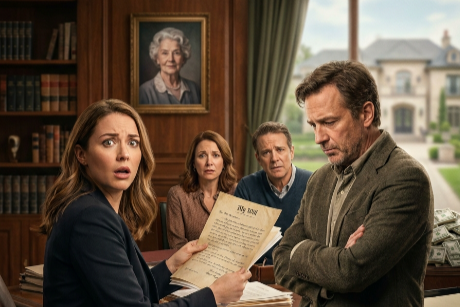
Now that he was gone, we were gathered in the wood-paneled study to hear how his legacy would be divided among the living.
Mr. Barnaby cleared his throat and announced that my grandfather had left me nothing but a single cream-colored envelope.
My father, Lawrence, shifted in his leather chair and allowed a small, satisfied smile to tug at the corners of his mouth.
He sat next to my mother, Penelope, with the posture of a man who had just won a high-stakes wager he had been playing for years.
“It seems the General had a very clear understanding of your contribution to this family,” Lawrence whispered while he adjusted his expensive silk tie.
When the lawyer announced that my parents would inherit the main estate and the bulk of the investment accounts, the hunger in their eyes became impossible to hide.
My brother, Timothy, leaned back and began tapping a rhythm on his knee as he likely calculated the value of the vintage car collection he had just been granted.
My grandmother sat in the corner holding the folded flag against her chest, and she refused to look at any of us as the greed filled the room.
Lawrence leaned toward me and remarked that an envelope was a fitting gift for someone who had never quite grasped the importance of the family name.
“Do not mistake a piece of paper for a sign of affection, Josephine,” he said with a voice that was designed to cut through my composure.
I held the envelope tightly and kept my chin level because Alistair had always told me that a soldier never shows her flank to an enemy.
I waited until I was alone in the hallway to break the wax seal and discover what my grandfather had deemed more important than gold.
Inside the envelope sat a single sheet of heavy stationery and a plane ticket that was scheduled for the following morning.
The letter read that I had served quietly just as he once did, and it claimed that the time had come for me to know the full truth of our history.
“Report to London immediately because duty does not end just because the uniform has been placed in a closet,” the note concluded.
It was signed only with his initials, A.R., which was the mark he used for documents that carried the weight of life and death.
The ticket was for a flight from Philadelphia to London Gatwick, and it was a one-way passage that suggested a long journey ahead.
Lawrence found me on the stone porch later that evening while he swirled a glass of aged bourbon in his hand.
“Are you actually going to follow the instructions of a dead man who left you nothing but a cheap flight?” he asked with a mocking laugh.
I told him that I intended to leave at dawn because I still respected the orders of my commander even if my father did not.
He took a slow sip of his drink and observed that London was a very expensive city for someone without a proper inheritance.
“Do not call us when your bank account reaches zero because we are busy managing the actual responsibilities of this estate,” Lawrence warned me.
I looked at him and replied that he would not hear from me again until I had found exactly what I was looking for.
I walked past him into the house to pack my Navy discharge papers and my dress uniform along with the letter that felt like a burning coal in my pocket.
When I landed at Gatwick the next afternoon, a driver was waiting near the terminal with a sign that bore my name in elegant calligraphy.
He was dressed in a formal black suit with a silver pin on his lapel that featured a crest I did not immediately recognize.
“Is this transport related to the Crown?” I asked as I gestured toward the polished car waiting at the curb.
The driver did not speak but instead produced an identification card embossed with gold leaf that confirmed his status as a royal servant.
I followed him to a black Bentley that had no traditional license plate but instead displayed a small, regal crown.
As we drove through the heart of London, I watched the ancient stone buildings and the grey waters of the Thames slide past the window.
The city felt like a living monument to a history that was far older and deeper than anything I had experienced in Pennsylvania.
I asked the driver if he knew why my grandfather had sent me here, and he glanced at me through the rearview mirror with a neutral expression.
“General Rhodes was a man of exceptional discretion, and such men are held in very high regard within these specific circles,” he answered.
His tone was that of a man giving a classified briefing, and I knew better than to push for information that was not yet mine to hold.
We arrived at a side entrance of Buckingham Palace where a man in a sharp grey suit was waiting under the stone archway.
“I am Sir Alaric Pemberton, and it is a distinct honor to finally meet the granddaughter of the man who saved my life,” he said as he extended his hand.
He walked with the same rigid uprightness that Alistair had maintained until his final days, the hallmark of a life spent in the service of others.
He led me through a maze of gilded corridors and explained that my grandfather had led a secret joint operation during the height of the Cold War.
“Your grandfather prevented a catastrophe that would have altered the course of Western civilization,” Sir Alaric whispered as we passed a row of portraits.
He told me that very few people knew the operation ever occurred, and even fewer understood the personal sacrifices the General had made to ensure its success.
I asked why there was no record of this in any of the military history books I had studied during my time in the Navy.