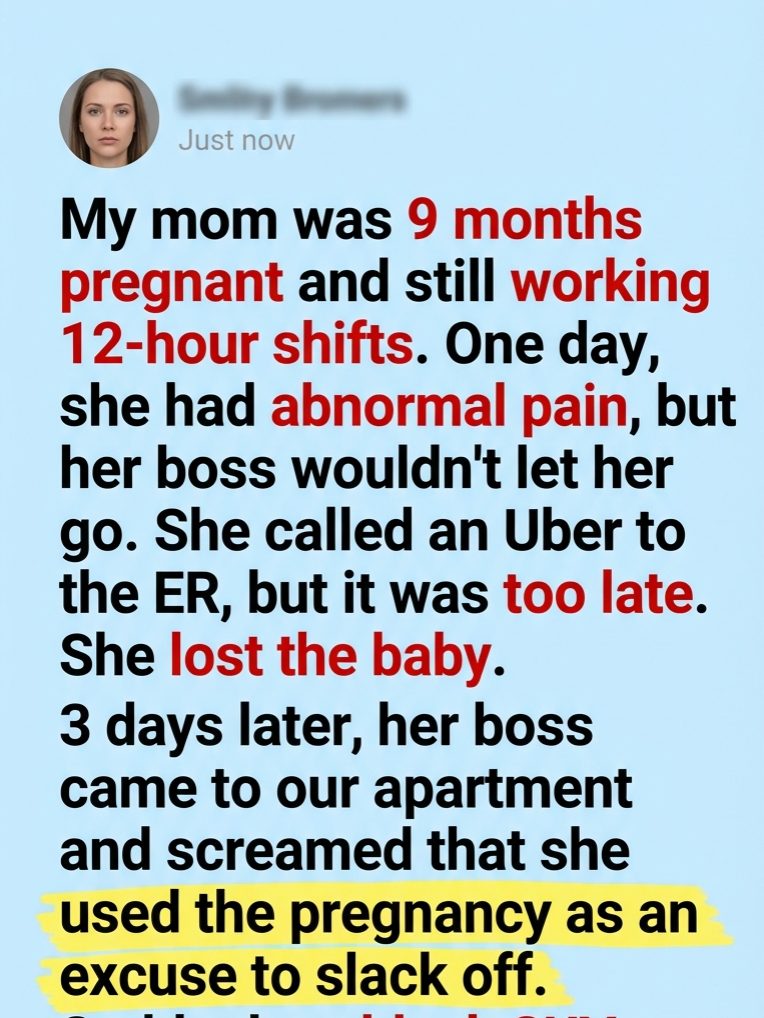
My mom was nine months pregnant and still pulling twelve-hour shifts at the warehouse because we were one missed paycheck away from being on the street. That was the simple math of our lives back then: rent due, fridge half-empty, no cushion. She kept a little notebook in her purse where she wrote down every dollar, every shift, every hope that the next week would be easier. It never was.
That afternoon, the air inside the warehouse felt heavier than usual—dusty, loud, the kind of place where time dragged and your body forgot what comfort felt like. Around noon, Mom felt the first sharp pain. Not the rolling ache everyone warned her about, but something localized and stabbing, like a needle pressed into one spot and held there. She tried to breathe through it. She tried to tell herself it was nothing. She tried to keep moving.

When the pain came again, stronger, she walked to her floor supervisor. She didn’t cry. She didn’t dramatize. She just said, “I think something’s wrong. I need to go get checked.”
He didn’t look up from his clipboard. He said if she left before the truck was loaded, she was “voluntarily resigning.” Those were his words. Flat. Final. He added that everyone was tired and everyone had aches, and if he let her go, he’d have to let everyone go.
Mom stood there for a second, one hand on her belly, the other gripping the edge of the desk. Then she nodded. She went back to her station.
For two more hours she worked, terrified. Every step sent lightning through her side. She counted boxes instead of minutes. She thought about the baby’s room we hadn’t finished. She thought about the stroller a neighbor had promised to give us. She thought about rent. Mostly, she thought about not making a scene.
When she finally collapsed, it wasn’t dramatic. She just went down like her body had quietly decided it couldn’t do this anymore. Someone shouted. Someone else called for help. She waved them off and pulled out her phone with shaking hands, because she knew better than to wait for permission. She called an Uber to the ER.

By the time they saw her, it was too late.
She lost the baby.
The hospital room was white and still and unbearably quiet. I remember the way Mom stared at the wall, like if she looked anywhere else the truth might break loose and flood the room. She kept apologizing—to me, to the nurses, to no one in particular. I didn’t know how to tell her that none of this was her fault when the world had just taught us how cruel it could be.
Three days later, while we were still moving through the apartment like ghosts, there was a knock at the door. It was the supervisor. He didn’t come inside. He didn’t lower his voice. He started screaming through the screen door about how Mom hadn’t turned in her badge and was “holding up the off-boarding process.” He called her lazy. He said she used the pregnancy as an excuse to slack off. His words cut deeper than anything I’d heard before, because they were so confident, so practiced, like he’d said them a hundred times to other people.
Mom stood there shaking, her arms wrapped around herself, as if she could hold everything together by force.
Then a black SUV pulled up.
We thought it meant more trouble. We thought it meant lawyers or security or some official way of telling us we were done.

Instead, a man stepped out, walked straight up, grabbed the supervisor by the shoulder, and hauled him back like he was removing a stain. He told him to leave. Not loudly. Not angrily. Just with a finality that made the yelling stop instantly.
Then he turned to my mom.
His voice went soft, like he was afraid to crack her. He said he’d found out what happened an hour ago. He said the supervisor was fired, effective immediately. He said he was personally hand-delivering her bereavement pay and a formal apology from the company.
He sat on our porch steps for an hour. He asked if she’d eaten. He wrote down a lawyer’s number. He kept saying, “No job is worth a life,” and, “I failed you by letting that man run my floor, and I’m going to make it right.”
Before he left, he told us he’d pay for the funeral out of his own pocket.
I don’t think that erased the loss. Nothing could. But it changed something else. It reminded us that even after the worst day of your life, someone might still show up, take responsibility, and choose to be human.
Note: This story is a work of fiction inspired by real events. Names, characters, and details have been altered. Any resemblance is coincidental. The author and publisher disclaim accuracy, liability, and responsibility for interpretations or reliance. All images are for illustration purposes only.