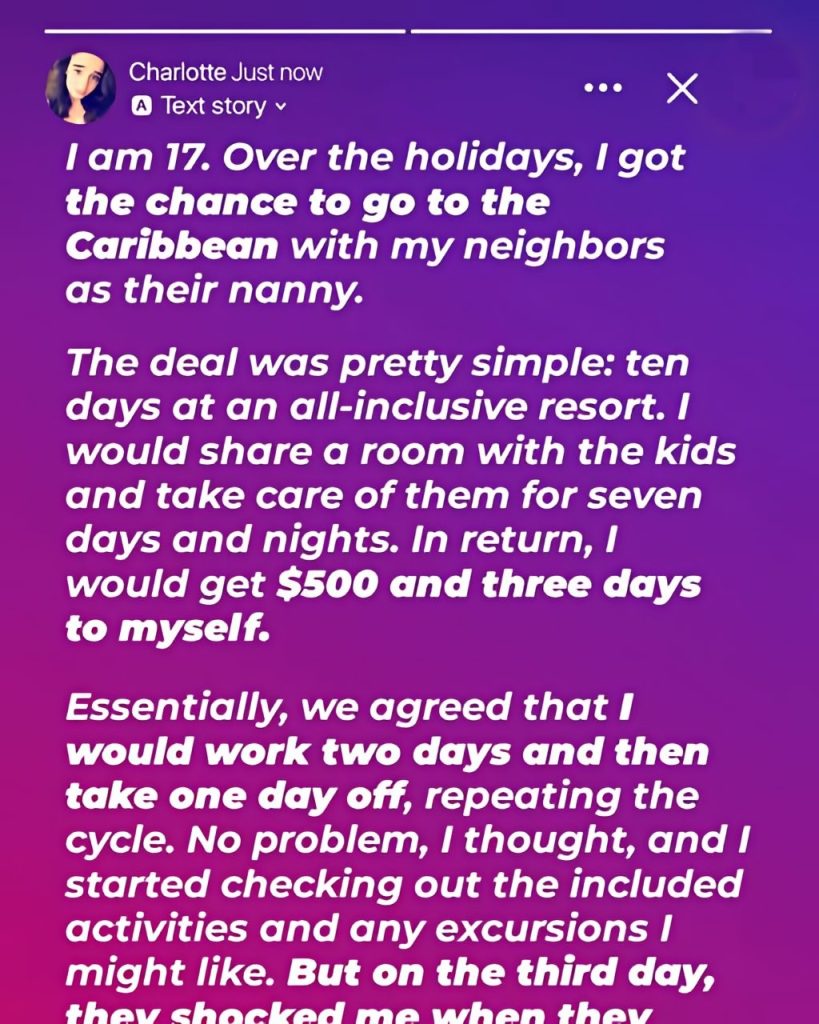
I am 17. Over the holidays, I got the chance to go to the Caribbean with my neighbors as their nanny. The deal was pretty simple: ten days at an all-inclusive resort. I would share a room with the kids and take care of them for seven days and nights. In return, I would get $500 and three days to myself. Essentially, we agreed that I would work two days and then take one day off, repeating the cycle. No problem, I thought, and I started checking out the included activities and any excursions I might like. But on the third day, they shocked me when they announced that their “couples-only” luxury excursion was non-refundable and that I would be required to work through my promised day off without any additional compensation or rest.
The sun was just beginning to peek over the turquoise horizon of the Saint Kitts coastline when Greg and Sarah Miller knocked on the connecting door of our suite. I was already awake, having spent half the night soothing their three-year-old, Leo, who was struggling with the heat and the unfamiliarity of a hotel crib. My eyes were puffy, and my back ached from the narrow cot I had been assigned. This was supposed to be my first day of freedom—the day I had planned to take a guided nature walk and finally read the book I’d packed.
“Change of plans, Charlotte,” Sarah said, her voice bright and brittle, totally ignoring the exhaustion written across my face. She was already dressed in a vibrant silk cover-up, her oversized sunglasses perched on her head like a crown of entitlement. “The resort offered us a private yacht tour for today, and it’s adults only. You’ll need to stay with Leo and Mia. Since we’re paying for your room and board, we figured you wouldn’t mind helping out a bit extra. We’ll be back after sunset dinner.”
I stood there, clutching a lukewarm juice box, my heart sinking into my stomach. “But Sarah, we had a contract. My parents and I sat down with you guys and wrote it out. Today was my day off.”
Greg stepped forward, checking his gold watch. He was a man who prided himself on his “negotiating skills,” which usually just meant bullying people who couldn’t fight back. “Contracts are fluid, kid. This is the real world. You’re getting a free trip to paradise. Think of this as paying your dues. We’ll talk about your ‘off time’ later in the week if the kids are well-behaved.”
Before I could find the words to protest—words that felt heavy and stuck in my seventeen-year-old throat—they were gone. The door clicked shut, leaving me standing in a room that smelled of sunblock and unwashed clothes, responsible for a fussy toddler and a six-year-old girl who was already demanding pancakes.
To those of you who have lived long lives, who remember the value of a person’s word and the weight of a handshake, you know that this wasn’t just a “change of plans.” It was a betrayal of character. My father, a man who worked forty years in the local mill, always told me, “Charlotte, a person with no integrity is just a house with no foundation. It might look pretty on the outside, but it’ll crush you the first time the wind blows.” The Millers were a house of cards, and I was being asked to be the soil they stood on.
The day was grueling. The Caribbean sun, while beautiful, is unforgiving when you are chasing two children around a crowded pool deck. By noon, I was dizzy. I had been so busy making sure the kids ate their fruit and stayed hydrated that I hadn’t even had a chance to grab a sandwich for myself. I sat on the edge of a lounge chair, Mia splashing in the shallow end and Leo finally napping in the shade of a large umbrella. I felt a single, hot tear roll down my cheek. I wasn’t crying because of the work; I was crying because I felt invisible. I was a person to my parents, a student to my teachers, but here, in this expensive resort, I was just a utility.
That was when I felt a presence beside me. It wasn’t the sharp, acidic scent of Sarah’s perfume, but the gentle, comforting aroma of lavender and old-fashioned peppermints.
“You look like you’re carrying the weight of the whole island on those young shoulders, dear,” a voice said. It was soft, gravelly, and full of a warmth I hadn’t felt since leaving home.
I looked up to see an elderly couple. The man was tall and lean, wearing a crisp linen shirt and a straw hat that had seen many summers. The woman had hair as white as the surf and eyes that sparkled with a sharp, observant intelligence. They looked like the kind of people who had seen a thousand sunsets and understood the stories behind each one.
“I’m fine,” I stammered, quickly wiping my face. “Just… it’s a long day.”
The woman sat down on the chair next to mine, her movements slow but full of grace. “I’m Evelyn, and this is Arthur. We’ve been watching you since yesterday, Charlotte. We saw you up at 2:00 AM walking that little one in the hallway. And we saw your ’employers’ leave this morning on that yacht. Arthur, didn’t you say they looked like they didn’t have a care in the world?”
Arthur nodded, leaning on a silver-topped cane. “Indeed. They looked like people who forget that the help is still a human being. Why are you out here alone on your day off, child?”
Something about the way Arthur said “child”—not as a term of belittlement, but as a term of protection—made the dam break. I told them everything. I told them about the $500, the shared room, the lack of sleep, and the broken promise. I told them I felt trapped because the Millers had my return flight information and I didn’t want to cause trouble for my parents back home.
Evelyn and Arthur listened with a stillness that only comes with age. They didn’t interrupt with “advice” or platitudes. They simply sat with me in the heat. When I finished, Arthur looked out at the ocean, his jaw set in a firm line.
“In my day,” Arthur began, his voice gaining a resonance that suggested he was a man used to being heard, “a man’s word was his bond. If you broke a contract with a worker, you weren’t just a bad businessman; you were a man without honor. These people aren’t your neighbors, Charlotte. They are parasites.”
Evelyn reached over and patted my hand. Her skin was like fine parchment, but her grip was steady. “You are learning a hard lesson very early, honey. You are learning that some people think their money buys them the right to be cruel. But Arthur and I? We believe that wealth is meant to be a shield for the vulnerable, not a sword to keep them down.”
They didn’t just offer sympathy. They acted. Evelyn stayed with me by the pool, helping me watch Mia and even entertaining Leo with a story about a magical sea turtle when he woke up. Arthur, meanwhile, disappeared for an hour. When he returned, he was holding a small, elegant envelope and wearing a very satisfied smile.
“I had a chat with the resort manager,” Arthur said, winking at me. “He happens to be the son of an old business associate of mine. It turns out the Millers have been quite vocal about their ‘importance’ since they arrived. The manager was more than happy to facilitate a small correction in the universe’s balance.”
That evening, when Greg and Sarah returned, they were sunburnt, slightly tipsy, and looking for a way to complain about the yacht’s caviar. They walked toward our poolside table, ready to order me to take the kids up to bed so they could enjoy a cocktail.
But Arthur and Evelyn were still there, sitting with me. The setting sun cast long, golden shadows across the deck, making the older couple look like a pair of ancient monarchs.
“Who are you?” Greg asked, his voice sharp and defensive.
Arthur stood up, his height far exceeding Greg’s. “My name is Arthur Sterling. And you, I believe, are the man who thinks a seventeen-year-old girl is a piece of luggage he can move around at his whim.”
Sarah bristled, her face turning a shade of red that had nothing to do with the sun. “This is a private matter. Charlotte is our nanny. She’s here on our dime.”
“Actually,” Evelyn said, standing up to join her husband, “she is here as a human being with rights. We’ve had a long talk with the management, Sarah. It seems there was a minor ‘clerical error’ regarding your suite. Since you’ve been using the nanny’s room as a nursery and forcing her to sleep on a cot in violation of the resort’s fire and safety capacity codes, the manager has decided to move Charlotte.”
Greg laughed, but it was a hollow, nervous sound. “Move her? To where? She doesn’t have the money for a room here.”
“She does now,” Arthur said, handing me the envelope he had been carrying. “Charlotte, this is the key to the Garden Villa on the north side of the property. It’s been paid for in full for the remainder of the trip. The resort has also agreed to provide a professional, certified childcare service for Leo and Mia starting tomorrow morning, which will be billed directly to your account, Greg, as a penalty for the safety violations.”
The silence that followed was the most meaningful sound I have ever heard. I looked at the Millers. For the first time, they looked small. Their silk clothes and gold watches didn’t make them look powerful; they looked like children who had been caught stealing from the cookie jar. Greg opened his mouth to shout, but Arthur stepped into his personal space, his eyes cold and unyielding.
“I was a judge for thirty years, son,” Arthur whispered, though the words carried across the quiet deck. “I know a shark when I see one. You can either accept this arrangement quietly, or we can spend the next few days Discussing labor laws and the legalities of taking a minor across international lines under false pretenses. What’s it going to be?”
Sarah grabbed Greg’s arm, her arrogance completely evaporated. They slunk away toward the elevators, leaving the kids with us for the final hour.
The rest of the trip was a dream I never could have imagined. I had my own villa with a private plunge pool. Every morning, I would meet Arthur and Evelyn for breakfast. They told me stories about their youth—about the hard years after the war, the way they built their company through honesty and late nights, and the importance of never letting anyone dim your light.
They didn’t treat me like a “poor girl” who needed a handout. They treated me like a young woman who needed an example. They showed me that getting old doesn’t mean becoming cynical; it means becoming a lighthouse for those still navigating the fog.
To the older generation reading this, you might think your stories don’t matter anymore. You might think the world has moved on to its gadgets and its fast-paced “fluid” contracts. But let me tell you, as a seventeen-year-old who was drowning in that world: your wisdom is the only thing that can save us. We need your voice to remind us what honor looks like. We need your strength to show us how to stand our ground.
On the last day of the trip, I sat on the beach with Arthur and Evelyn. I tried to thank them again for the villa, for the $500 they had secretly replaced (and doubled) when the Millers tried to withhold my pay, but Arthur just waved his hand.
“Don’t thank us for doing what is right, Charlotte,” he said, looking at the horizon. “Thank yourself for having the courage to tell the truth. Most people your age would have just kept their heads down and let those people break their spirit. You spoke up. That’s the first step to becoming someone who can change things.”
Evelyn leaned over and kissed my cheek. “Go home, finish school, and remember us when you’re building your own life. Remember that the only person you ever truly have to answer to is the one you see in the mirror every morning.”
I flew home the next day. I didn’t sit with the Millers. I sat in a different section of the plane, a seat Evelyn had arranged. When I got home and my parents asked how the trip was, I didn’t tell them about the fancy resort first. I told them about two people who wore linen and carried canes, and how they taught me that a person’s worth isn’t measured by the islands they visit, but by the promises they keep.
I am twenty-five now. I graduated college and started a career in child advocacy. Every time I find myself in a difficult negotiation, every time I see someone trying to take advantage of someone smaller, I feel the weight of that silver-topped cane in my mind. I hear the gravelly voice of a man who knew the law but loved justice more.
To all the grandfathers and grandmothers out there: keep being lighthouses. Keep sitting on those benches and watching the world. You might think you’re just resting, but you are actually the guardians of our collective soul. You are the ones who can look at a 17-year-old girl and see the woman she is struggling to become. You are the ones who can turn a “long day” into a life-changing epiphany.
The Millers eventually moved away, their “fluid” lifestyle leading them to a series of legal and social collapses that my father predicted all along. I don’t feel anger toward them anymore. I feel pity. They moved through paradise but never saw the beauty, because they were too busy trying to own it.
But me? I saw the beauty. I saw it in the white hair of an old woman and the steady hand of an old man. I saw it in the realization that even in the middle of the Caribbean, the most precious thing you can find is a stranger who treats you like family.
The sunset is beautiful this evening, and as I sit on my own porch, I realize that life is indeed a series of cycles. We are young, we struggle, we learn, and if we are lucky, we grow old enough to help someone else through their own “third day.” I am Charlotte, and I am finally, truly, free. The ocean is vast, but the foundation is solid. And that, dear friends, is the most meaningful story I have ever had the privilege to live. God bless the elders who watch overhead, and may we all find the courage to be the light in someone else’s storm. Welcome to the shore.