I caught my dog hiding something—and it changed everything I thought I knew.
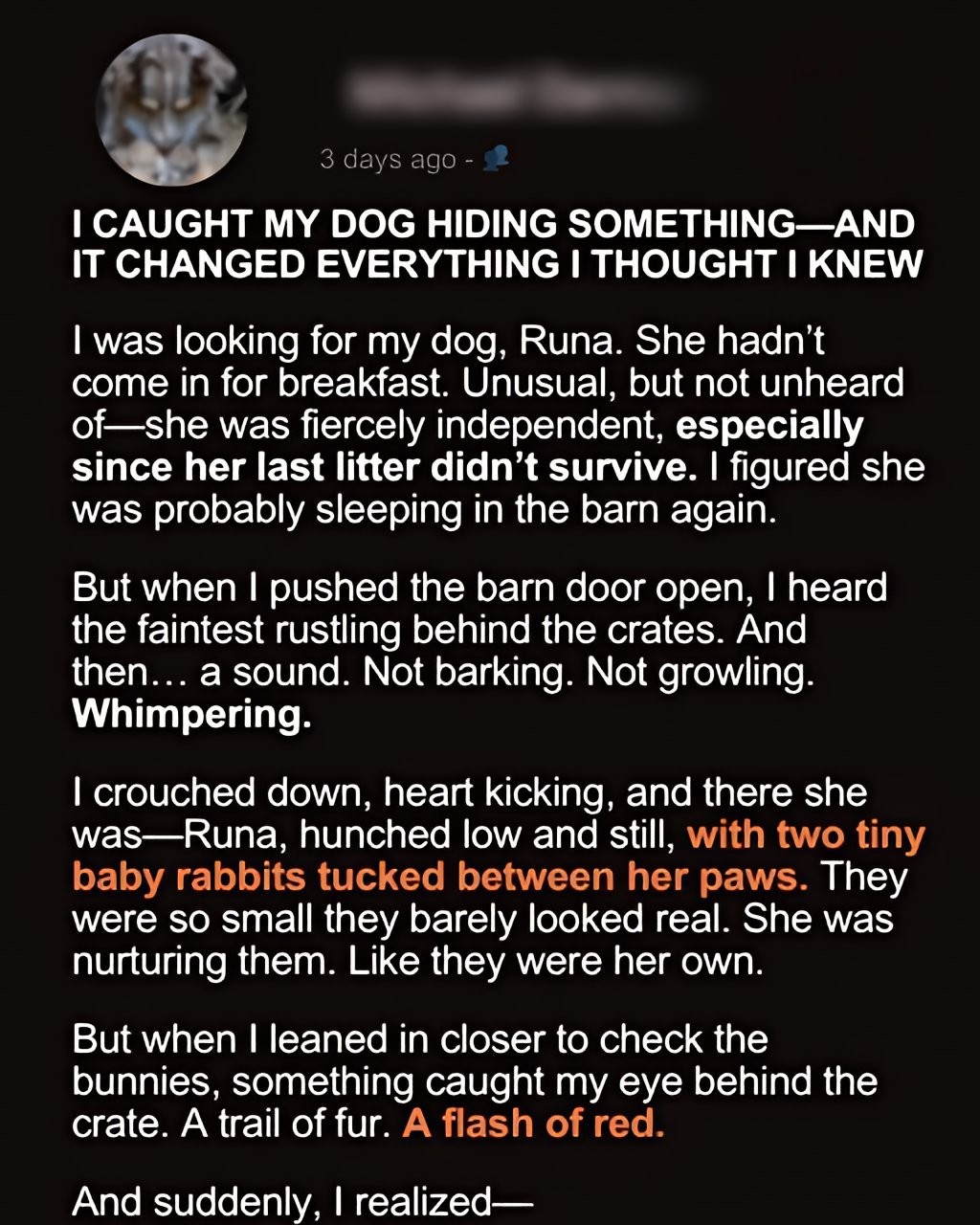
I was looking for my dog, Runa. She hadn’t come in for breakfast. Unusual, but not unheard of—she was fiercely independent, especially since her last litter didn’t survive. I figured she was probably sleeping in the barn again.
But when I pushed the barn door open, I heard the faintest rustling behind the crates. And then… a sound. Not barking. Not growling. Whimpering.
I crouched down, heart kicking, and there she was—Runa, hunched low and still, with two tiny baby rabbits tucked between her paws. They were so small they barely looked real. She was nurturing them. Like they were her own.
But when I leaned in closer to check the bunnies, something caught my eye behind the crate. A trail of fur. A flash of red.
And suddenly, I realized—the red wasn’t just a color. It was the coat of a young vixen, a fox that lay dead and broken just a few feet away in the shadows. Runa hadn’t just found these bunnies; she had fought for them.
The Shadow of Loss
To understand why this moment shattered me, you have to understand Runa’s history. Runa is a three-year-old Anatolian Shepherd mix, a breed designed for one thing: protection. On our small farm in the Pacific Northwest, she was the primary line of defense against coyotes, cougars, and the ever-opportunistic foxes.
Six months ago, Runa had her first litter. We were excited, prepared for a pack of fluffy protectors. But nature can be cruel in ways that defy explanation. A rare infection swept through the pups within forty-eight hours. Despite the vet’s best efforts and Runa’s desperate, frantic licking, we lost all six of them.
Runa changed that day. The light went out of her eyes. She became a ghost on the property, patrolling the perimeter with a grim, joyless intensity. She stopped playing. She stopped seeking affection. She would spend hours staring at the empty patch of dirt where the whelping box had once sat. Her maternal instinct had been primed for an explosion of life, only to be met with a crushing silence. We were worried she would never come back to us.
The Battle in the Barn
As I knelt in the dust of the barn, the puzzle pieces began to click together. The “trail of fur” was a mix of grey-white rabbit fur and the coarse, fiery orange of the fox.
The night before, a storm had rolled through, the kind that sends predators looking for easy shelter. A mother rabbit must have nested near the barn, and the fox had found her. I saw the remains of the mother rabbit further back in the shadows—a grim reminder of the circle of life.
But Runa had intervened.
Runa, who had been unable to save her own flesh and blood, had heard the screams of these tiny, helpless kits. Her protective instinct—warped and sharpened by her recent grief—had snapped. She hadn’t seen prey. She had seen “The Children.”
The fox, likely confused by a livestock guardian dog defending wild rabbits, hadn’t stood a chance. Runa’s ears were notched with fresh blood, and her shoulder bore a shallow rake from the vixen’s claws. She had put her life on the line for two creatures that, under any other circumstances, she might have ignored or even hunted herself.
An Interspecies Sanctuary
Runa looked up at me, her golden eyes wary. She didn’t growl, but she shifted her weight, pulling the two kits deeper into the warmth of her belly fur. They were “pinkies”—barely a week old, their eyes still sealed shut, their ears folded flat against their heads. They were nursing on her, or trying to, and Runa was softly nuzzling them with a tenderness that brought tears to my eyes.
“It’s okay, girl,” I whispered, reaching out to touch her blood-stained ear. “You did good. You saved them.”
She let out a long, shuddering sigh and rested her chin on the dusty floor. The kits, sensing the change in tension, began to squirm, their tiny mouths searching for milk that wasn’t there.
I knew then that I couldn’t just leave them there. Domestic dogs can sometimes produce “phantom” milk during a false pregnancy or after a loss, but it wouldn’t be enough to sustain wild cottontails. If I wanted Runa’s “puppies” to live, I was going to have to become a co-parent.
The Mental Load of Survival
The next seventy-two hours were a blur of biological research and frantic care. I learned about the delicate pH balance of rabbit milk, the necessity of keeping them warm but not hot, and the terrifyingly high mortality rate of orphaned wild rabbits.
I set up a small nesting box inside the barn—I didn’t want to move them to the house and break Runa’s heart again. Every two hours, I would walk out to the barn with a tiny syringe of specialized formula.
Runa never left their side. She watched every feeding with a hawk-like focus. When I was done, she would immediately take over, grooming them with long, sweeping licks to stimulate their digestion—a task usually performed by a mother rabbit.
This was the “Mental Load” of the farm, but it felt different. For months, the farm had felt like a place of chores and tragedy. Now, it felt like a mission. Runa was no longer the “broken dog”; she was a mother with a job to do. Her depression had vanished, replaced by a fierce, maternal purpose.
The Science of “Pseudocyesis” and Empathy
I spoke to our vet, Dr. Aris, about what was happening. He explained that Runa was likely experiencing a form of pseudocyesis—a phantom pregnancy or a prolonged hormonal state triggered by her loss. Her body was physically convinced she had babies, and the presence of the orphaned rabbits had provided the “target” for those hormones.
But beyond the biology, Dr. Aris noted something more profound. “Anatolian Shepherds are bred to identify ‘their’ flock,” he said. “Usually, it’s sheep or goats. But grief can expand those boundaries. She’s decided those rabbits are her flock. She’s not just a mother to them; she’s their army.”
This interspecies nurturing isn’t unheard of in the animal kingdom, but witnessing it in the aftermath of Runa’s personal tragedy felt like a miracle. It was a reminder that empathy isn’t a uniquely human trait. Runa understood vulnerability. She understood what it felt like to have something small and precious in need of a protector.
The Growing Pains
As the weeks passed, the kits—now named Pip and Squeak—began to thrive. Their eyes opened, revealing bright, inquisitive beads. Their ears perked up, and they began to “binky”—that joyful, twisting hop that rabbits do when they are happy.
The sight was surreal. A 100-pound guard dog, capable of snapping a coyote’s neck, would lie perfectly still in the grass while two half-pound fluff-balls used her head as a trampoline. Runa seemed to find it hilarious. She would “play-bow” at them, her tail thumping the ground like a drum, being careful to never move too fast or too hard.
The neighbors thought I was crazy. “You’re letting a predator raise prey,” they’d say. “One day her instinct will kick in and she’ll eat them.”
But they didn’t see what I saw. I saw a dog who had been given a second chance to be a mother. I saw a dog who walked with her head held high again. The “instinct” they were worried about—the urge to kill—had been entirely supplanted by the urge to preserve.
The Hardest Lesson: Letting Go
The goal of wildlife rehabilitation is always the same: release. As the bunnies grew larger and started eating the clover and dandelion greens I brought them, I knew the day was coming. They were wild animals. They weren’t meant to live in a barn behind a crate for the rest of their lives.
Runa seemed to sense it, too. As Pip and Squeak became more independent, venturing further from the barn, Runa’s protection became less about “cuddling” and more about “patrolling.” She would sit on the hill, watching them forage, her ears swiveling at every rustle in the woods.
On a warm evening in late July, I opened the barn door and watched the two rabbits hop out into the tall grass of the meadow. They stopped for a moment, looking back at the large, tan shape of the dog who had saved their lives.
Runa didn’t follow them. She stood at the edge of the porch, her tail wagging slowly.
“They’re ready, Runa,” I said, putting my hand on her collar.
She let out a short, sharp bark—not a warning, but a send-off. The rabbits disappeared into the brush, two flashes of brown against the green.
The Aftermath: A Healed Heart
Runa didn’t fall back into her depression after the rabbits left. The “hole” in her heart had been patched. She had successfully raised a “litter” to adulthood. She had done the work she was born to do, and the universe had allowed her to finish the job this time.
She came back into the house that night for the first time in months. She walked straight to her old bed in the living room, circled three times, and fell into a deep, peaceful sleep.
The “flash of red” in the barn that morning had been a sign of death, but it had led to the most vibrant display of life I had ever seen. It taught me that grief doesn’t have to be a dead end. Sometimes, it’s just a detour that leads you to someone else’s rescue.
Final Reflection
We often think of our pets as simple creatures—food, walk, sleep. But Runa proved that their emotional lives are as complex and layered as our own. They feel the weight of their failures and the joy of their successes.
To anyone who is currently in their own “barn corner,” hiding from the world because of a loss that feels too heavy to carry: look around. There might be something tiny, something “unreal,” and something completely different from you that needs your strength.
Runa saved those rabbits, but in the end, it was the rabbits who saved Runa.
The trail of fur is gone now, washed away by the rains of autumn. But if you walk out to the meadow at dusk, you’ll sometimes see two large cottontails grazing near the fence line. They don’t run when the big tan dog walks by. And Runa? She just watches them for a moment, her tail giving a single, knowing thump, before she continues her patrol of the land she finally feels whole enough to protect.