Grandma wore her navy church cardigan to Aunt June’s house.
I picked her up an hour early because she disliked arriving breathless and hated being treated as cargo.
She carried the biscuit tin on her lap.
“You don’t have to bring the originals,” I said.
“I know.”
Her thumbs rested against the lid.
“I’m bringing them because I want them here.”
I helped her up June’s steps.
Inside, the living room smelled of furniture polish and coffee that had been brewing too long.
June had arranged chairs in a loose circle.
Mom sat beside Doug.
Bennett stood near the fireplace, checking his phone.
Claire occupied a chair beside her father.
She did not look at Bennett when he approached her.
Leanne sat next to me with a thin folder.
My mother noticed her immediately.
“This was supposed to be family.”
“It concerns my identity and my tax records,” I said. “She’s here with me.”
Mom glanced toward Graham.
“You brought someone too.”
“My counsel is advising me separately,” he said. “I came to answer questions about my company.”
June offered coffee.
Nobody accepted.
I helped Grandma settle into the chair closest to the window.
Mom leaned forward.
“Mother, this must be exhausting for you.”
“No,” Grandma said. “Not knowing was exhausting.”
Mom sat back.
June clasped her hands.
“I think we all want this resolved without more hurt.”
Leanne spoke calmly.
“Then we need to distinguish facts from assumptions. No one is being asked to sign anything today.”
Mom’s mouth tightened.
Graham placed a folder on the coffee table.
He explained when the supplier record had been created, whose name appeared on it, and where the payments had been directed.
He did not dramatize the amount.
He did not call my mother names.
The pages did enough.
Doug looked at the payment instructions.
“I thought it was Marilyn’s side work.”
Mom turned toward him.
“It was.”
“Then why wasn’t it in your name?” I asked.
“She handled the making,” Mom said, pointing toward me. “I handled the rest.”
“I helped Grandma finish blankets you described as donations.”
“Some were.”
“Which ones?”
Mom looked at Graham.
“You’re allowing her to interrogate me.”
He folded his hands.
“I’d like the answer too.”
She began explaining that handmade goods were difficult to price.
Time, transport, materials, dealing with customers.
Some of that would have been reasonable in an honest business.
I let her finish.
Then I asked, “When did I agree to it?”
“You understood.”
“When?”
“We discussed things over the years.”
“Show us one message.”
Mom looked toward June, expecting relief.
June stared at the folder.
Grandma opened the biscuit tin.
The small click of the lid drew everyone’s attention.
“These are the yarn receipts,” she said.
I arranged several on the table with her permission.
Beside them, Graham placed the corresponding invoice dates.
The company had paid for one blanket Grandma remembered as a gift for a family whose home burned.
Another was supposedly going to a woman recovering from surgery.
Mom had received money for both.
Grandma listened as Graham read the descriptions.
Then she turned toward my mother.
“Were there families?”
Mom’s answer came too quickly.
“Mother, you helped people. Contractors are people.”
“That isn’t what I asked.”
For a moment, nobody moved.
Grandma sat with her palms open on her knees.
I remembered those hands guiding mine when I was seven, showing me how to loosen a stitch without unraveling everything beneath it.
Mom looked away first.
“There were gifts,” she said.
“Were there families who needed the blankets?”
“I may have simplified the arrangement.”
Grandma closed the tin.
“I could have understood selling them.”
Her voice remained level.
“I did not need you to invent people for me to care about.”
Doug rubbed his forehead.
He had signed bank documents and enjoyed household income without asking where the supplier name came from.
The subsequent review would determine what he knew and when.
In that room, he could not turn the joint account into somebody else’s fact.
“I didn’t know you used Tessa’s number,” he said.
Mom ignored him.
I took out the copy of the tax form.
“This signature isn’t mine.”
She gave a short, disbelieving laugh.
“You’re making a family arrangement sound sinister.”
Leanne asked, “Did Tessa sign it?”
Mom looked at her.
“That’s a legal question.”
“It’s a factual question.”
“I filled out paperwork.”
“Did she sign it?”
My mother’s face changed.
She understood now that her usual abundance of words would not carry her past a simple question.
“No,” she said.
Bennett looked down.
I thought I would feel triumph.
Instead, I felt cold.
There had been a moment, years earlier, when my mother sat with a form and chose to write my name.
She had known the difference then.
She knew it now.
“Why?” I asked.
“We were all trying to manage after everything our family went through.”
“Our father died eighteen years ago.”
“Don’t speak to me like I’ve done nothing for you.”
I pressed my feet into the rug.
She had raised us.
She had worked.
She had sometimes been funny, sometimes generous, occasionally tender in ways that made her cruelty harder to name.
None of those facts signed the form for me.
“I didn’t receive the money,” I said. “But the income was reported under my name.”
“It can be corrected.”
“Then you should have corrected it when I called.”
“I was trying.”
“You asked me to sign permission that didn’t exist.”
June looked up.
“What permission?”
Leanne produced the message Mom sent after visiting my cottage.
I explained the proposed document.
Mom began to speak, but Graham interrupted.
“The investigation is already underway. A later statement cannot replace what happened.”
My mother turned to Bennett.
“You see what she’s doing.”
For years, that would have been enough.
He would have looked at me and said my name in a warning tone.
This time, Claire spoke before he could.
“Bennett, tell them about your email.”
He looked at her.
“Not here.”
“Here is where everyone is being asked to believe your mother.”
He stared at the fireplace.
Claire set a printed copy on the table.
Mom reached toward it, then stopped.
Bennett read his own response.
His shoulders lowered.
“I was trying to keep the wedding from falling apart.”
“You asked her what to say,” Claire said.
“I didn’t mean I’d lie.”
“You told me afterward that Tess misunderstood you.”
He opened his mouth.
Claire waited.
The silence gave him more opportunity than any interruption could have.
Finally, he said, “I knew it looked bad.”
I looked at him.
“You knew my name was on a form.”
“Yes.”
“You knew I was asking questions.”
“Yes.”
“And you wanted a story that would make me stop.”
His eyes filled.
I did not look away, though part of me wanted to spare him.
“Yes,” he said.
Claire took a breath.
“I postponed the wedding because I needed to know whether you would tell the truth without being cornered.”
“Claire.”
“You had several chances.”
“We can work through this.”
“I asked you what happened. You chose to manage me.”
He stepped closer.
She did not move.
“This isn’t a decision I’m making because your mother is under investigation,” she said. “I’m making it because you asked me to build a marriage on an explanation you knew wasn’t honest.”
She removed her engagement ring.
She held it for a moment, turning it once between her fingers.
Then she placed it on the table beside the email.
Nobody spoke.
Bennett sat down.
Mom made a sound of outrage.
“You’re ending an engagement over paperwork?”
Claire looked at her.
“I’m ending it over what happened when the paperwork became inconvenient.”
Graham stayed seated.
He let his daughter speak for herself.
That was almost as striking to me as the ring.
The meeting ended without reconciliation.
Mom left first.
Doug followed several minutes later, after asking Graham for the accountant’s contact information.
Bennett remained near the fireplace.
June began stacking cups that nobody had used.
She stopped when she reached my chair.
“I laughed,” she said.
I looked up.
“At the shower. I knew you’d worked on it. I laughed anyway.”
“Yes.”
“I’m sorry.”
She did not add that she had been uncomfortable.
She did not ask me to understand.
I nodded.
It was the first apology that did not come with a job attached.
Outside, Bennett caught up with me while I helped Grandma into the truck.
“Can we talk?”
I shut her door gently.
“You can send what you need to say.”
“Tess, you’re my sister.”
“I know.”
“I panicked.”
“You had time to stop.”
He leaned against the truck, then stepped away when I looked at his hand on the paint.
“I don’t know how to fix it.”
“Start by giving a truthful statement. Don’t make me the reason you do it.”
I climbed into the driver’s seat.
Grandma waited until we reached the road.
“Did you want him to follow us?”
I swallowed.
“Yes.”
“Would it have helped?”
“Not today.”
She laid her hand over mine for a moment.
We drove home with the windows partly open.
The weeks afterward were less dramatic than the shower and harder to live through.
I sent documents.
I answered questions.
I worked.
Leanne helped me dispute the income attributed to me, establish that I had not authorized the supplier arrangement, and document the misuse of my identifying information.
The company corrected the reports its accountant determined were wrong.
The tax matter still took months.
An official envelope could make my stomach tighten long after I understood what was inside it.
I kept a folder by the kitchen door.
Opening mail became something I did seated, with a pen nearby.
Graham’s company examined every payment connected to the supplier record.
The review separated delivered blankets from fabricated or inflated charges, and it identified failures in the approval process.
Marilyn lost her position.
The company stopped letting the same employee create a supplier, enter its invoices, and prepare its payments without independent review.
Claire insisted that vendor ownership information be checked rather than merely filed.
Those changes did not restore the years.
They did make it harder for the same thing to happen again.
Word spread through the family without my arranging an audience.
The canceled wedding required an explanation.
Mom’s departure from Whitmore Lumber required another.
For a while, she supplied both.
Then people began receiving questions from investigators, and the explanations became difficult to maintain.
Relatives who had accepted her version called me.
Some apologized.
Some wanted details because scandal entertained them.
I learned the difference.
“I’m not discussing the investigation,” became a sentence I could say without decorating it.
Claire returned wedding gifts.
She kept the blanket.
We met at Grandma’s house one afternoon while she was sorting boxes from the home she and Bennett had planned to share.
She brought the blue, cream, and green blanket folded in a clean tote.
“I wanted to ask something,” she said.
Grandma touched the top layer.
“Ask.”
“Would you mind if I kept using it?”
Grandma laughed softly.
“What else is a blanket for?”
Claire’s face loosened.
I had not realized she expected permission to keep something made for a future that no longer existed.
“I chose those colors because you liked them,” I told her. “They still belong to you.”
She took it home to her own apartment.
For a while, she slept badly.
So did I.
Our friendship did not consist of pretending we had become better people because terrible things happened.
Sometimes we talked about the case.
Sometimes she told me about a delivery truck breaking down outside Glasgow.
Sometimes I described a horse that had decided my tool bucket contained something edible.
Ordinary subjects gave us places to rest.
Grandma’s part of the financial loss needed its own attention.
She had supplied work and received only small reimbursements under false explanations.
An attorney helped her document that separately.
Graham offered payment for the identifiable blankets the company still had, based on an independent valuation of the work.
He did not call it charity.
He called it an unpaid obligation.
Grandma made him explain the figures.
Then she accepted the agreement after her own adviser reviewed it.
She bought a better reading lamp, though it could not restore her sight.
She paid for help with her garden.
Mostly, she liked knowing the work had been named correctly.
One afternoon, I found her turning a new yarn label between her fingers.
“You going back into business?” I asked.
“I was never in business.”
She smiled.
“But I might consider it, if somebody asks honestly.”
Bennett gave a statement after the meeting.
He admitted seeing the form before the shower.
He provided the messages he exchanged with Mom after her access was suspended.
He also acknowledged that money Mom contributed to the wedding had come from her joint household account, although he said he had not known its source at the time.
The financial review traced what it could.
The authorities determined what could be proved.
I did not attend every meeting or demand to hear every interview.
My life was already full of things I had to carry.
Months later, Marilyn entered a guilty plea to charges arising from the diverted payments and misuse of my identity.
The eventual sentence included supervised probation and a restitution order.
The process was neither quick nor satisfying in the way people expected when they asked whether justice had been done.
Some money was recovered.
Some would take years to repay.
The order did not make Grandma younger.
It did not return the hours I spent reading notices at midnight.
But the official record no longer treated my mother’s story as mine.
That mattered.
Before sentencing, she sent me a letter.
She wrote about raising twins after losing a husband.
She wrote about keeping our family comfortable.
She wrote that things had become larger than she intended.
Only near the end did she mention the form.
I read it with Leanne.
Then I wrote a short response.
I acknowledged what she had done for us when we were children.
I also stated what she had done to me as an adult.
I did not offer forgiveness to improve the appearance of the record.
I did not promise permanent estrangement because I was angry that morning.
I told her I would decide future contact on my own terms, without family intermediaries.
For a time, there was no contact.
That was quieter than I expected.
I had imagined distance as an argument that continued from separate rooms.
Instead, I sometimes finished a workday and realized I had not spent any of it anticipating her judgment.
My truck still had too many miles.
My cottage still had the sticking window.
Neither seemed like evidence against me anymore.
Bennett began sending letters rather than calling.
The first was full of explanations.
I put it away.
The second described the diner conversation accurately, including the sentence about thinking I would start a fight.
He wrote that he had made my likely anger more important than the reason for it.
I read that one twice.
Eventually, we met for breakfast.
He came without a prepared speech.
He asked about my work.
When I answered, he listened.
We did not become close again over pancakes.
Trust returned, if at all, in smaller units.
A question answered honestly.
A family request declined without making me responsible.
An apology that survived my refusal to say everything was fine.
Claire did not resume the engagement.
Bennett eventually stopped treating that as a punishment she might withdraw.
He moved into a smaller place.
He paid back money where he could.
Those were his choices to make.
I no longer managed the meaning of them for him.
The following winter, Claire invited Grandma and me to dinner.
Snow had settled along the edges of her balcony.
The apartment smelled of onions softening in butter.
She had bought a Dutch oven herself.
When she lifted the lid, steam clouded her glasses.
Grandma laughed at the sound of her trying to wipe them with an elbow.
After dinner, we sat on the couch.
Claire spread the wedding blanket over Grandma’s knees, then across mine.
The seams lay flat.
Two hundred squares.
The corner with the red heart rested near my hand.
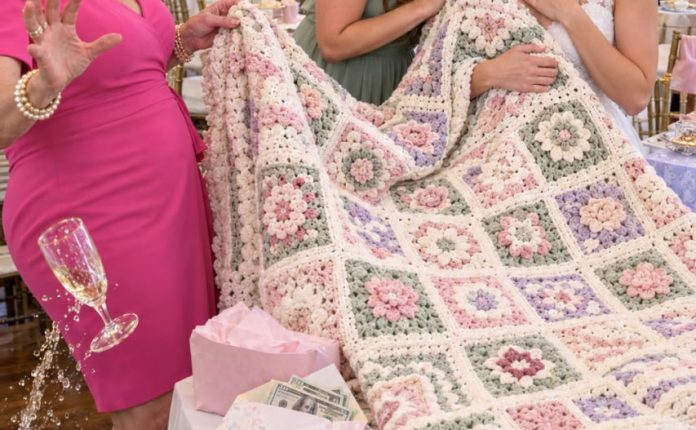
I rubbed it between my thumb and forefinger, remembering the way it had dragged against the table leg at the shower.
For months, that corner had carried the whole scene back to me.
The laughter.
My brother’s turned face.
My mother’s glass breaking.
Now it warmed three people who had chosen to sit together.
Grandma asked whether the soup needed more salt.
Claire said she had been afraid to add too much.
I told her it was good.
We stayed there talking until the snow began again.
The blanket did exactly what I had spent one hundred hours making it to do.
END PART 3