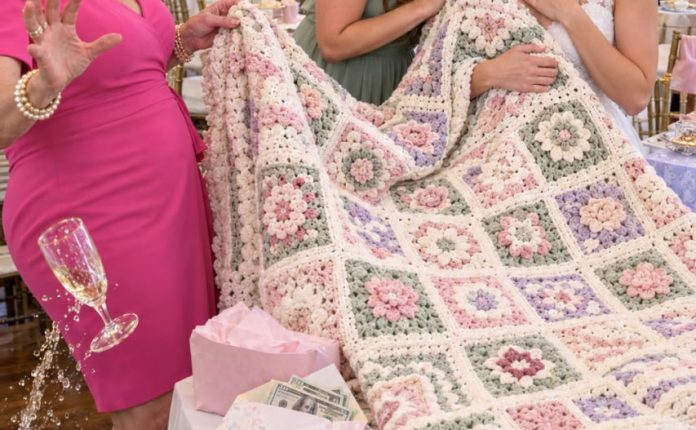
My mother lifted the corner with Grandma’s red heart, and I saw the yarn stretch between her fingers. Then my twin brother laughed.
“Was there nothing you could afford on the registry?” Mom asked.
Behind her, the gift table shone with silver paper and thick satin ribbon. Someone had brought the expensive Dutch oven. Someone else had bought a mixer so large its box occupied an entire chair.
My blanket rested between them.
Two hundred squares. One hundred hours of work.
I had counted because Claire once asked how long something like that took, and I wanted to give her a real answer.
“Mom,” she said, then corrected herself. “Marilyn. I asked Tess about that blanket.”
My mother smiled at her.
“Of course you did, sweetheart. You’re gracious.”
Aunt June made a small sound beside the punch bowl. She always laughed a moment late, as if she hoped the right response would become obvious before she committed herself.
Bennett leaned against the kitchen doorway.
“You could’ve sent money, Tess.”
He held a beer against his chest. His watch caught the light when he moved.
Three weeks until his wedding. Twenty-nine years of being my brother.
He still looked away whenever looking directly at me might cost him something.
Mom shook the blanket once.
“Shoeing horses can’t be easy money. Doug and I will put cash in your name. Nobody needs to know.”
Several relatives were already looking at me with the gentle embarrassment people reserve for somebody who has misunderstood the occasion.
I could have explained my savings.
I could have told them the yarn cost more than my weekly groceries.
Instead, I watched the corner fall.
It brushed the table leg, then rested against a polished shoe.
That square had taken Grandma Nora two afternoons.
At eighty-six, she could distinguish light from shadow, but she could no longer read a pattern. She counted under her breath and felt each stitch before making the next.
When she finished, she held the square against her cheek.
“Put this where they’ll find it,” she told me.
She had sewn a little red heart into every blanket she made for as long as I could remember.
I bent and picked up the corner.
The room grew quieter, perhaps because nobody knew whether I was about to cry.
I folded the blanket along its seams, turning Grandma’s heart toward the top.
Claire reached for it before I asked.
“Thank you,” she said.
Her voice was low and plain. No performance.
I leaned close enough that she could hear me without forcing me to address the room.
“Ask your father who’s received payment for blankets since 2019. It wasn’t me.”
Her hands tightened beneath the folded weight.
Behind her, Aunt June poured lemonade past the rim of a glass.
Bennett stopped moving.
My mother’s champagne flute slipped from her hand.
The sound was surprisingly small at first: a hard click, then the scattering rush of broken crystal.
Nobody reached for a broom.
“What did you say?” Mom asked.
Claire looked at her.
I said, “Something her father can answer.”
My mother stepped over the glass and took my elbow.
She smiled toward the guests while steering me through the front door.
“Excuse us. Tess gets overwhelmed in a crowd.”
On the porch, she shut the door carefully.
Then she turned.
“What have you done?”
Her fingers pressed into the soft place above my elbow. I could smell her perfume beneath the warm scent of wet grass.
“Asked a question.”
“At your brother’s shower.”
“You brought the conversation to my finances.”
“That was a joke.”
I looked at her hand.
She released me, but only because she realized I was looking.
For twenty-four days, an IRS notice had been folded inside my glove compartment.
It concerned contract income reported by Whitmore Lumber and Supply for the previous year: $41,580.
My name appeared beneath the company’s.
So did my tax identification information.
There was one difficulty.
I had never worked for Whitmore Lumber.
I trimmed hooves, fitted shoes, managed sore feet, and spent a considerable part of every week convincing large animals to trust me with their balance.
I did not supply lumber companies with contract services.
I had never invoiced Graham Whitmore. I had never received a payment from him.
My mother worked in his accounts office.
That was why I called her when the notice arrived.
She answered while I was sitting at my kitchen table, still wearing the sweatshirt I used for early appointments.
“Whitmore sends paperwork to half the county,” she said. “Probably someone entered a number wrong.”
“Mine?”
“Those things happen.”
She offered to take the notice into work.
Something in her eagerness made me stop.
“I’ll make a copy.”
“Bring the original. Copies get misplaced.”
I put the original in my truck.
The next morning, I called my tax preparer, who told me to gather records and keep everything.
I had done that much.
What I had not done was decide what the notice meant.
A mistake remained possible.
So did something I did not yet have a name for.
On the porch, Mom glanced through the window.
“You’re angry because people didn’t praise the blanket.”
“I’m trying to find out why your employer thinks it paid me.”
Her expression went still.
Only for a moment.
Then she sighed as though I had asked the same foolish question for the tenth time.
“I said I’d handle that.”
“You haven’t told me what happened.”
“Because there’s nothing to tell.”
A car moved slowly along the road beyond the yard. I watched it until it disappeared behind the hedge.
“Come back inside,” she said. “Tell Claire you were confused.”
“I’m leaving.”
“Bennett will remember this.”
“So will I.”
I walked down the porch steps.
My truck waited beneath a maple tree halfway along the driveway. I climbed inside and sat with both hands resting on the steering wheel.
I had intended to drive away.
Instead, I waited until my breathing stopped sounding like something I was trying to conceal.
The gift bag lay beside me, flattened now. I had bought it because the blanket deserved clean wrapping, even if it did not arrive in a store’s box.
Through the front window, I could see Mom moving between guests.
She knew how to restart a room.
A bright comment. A hand on somebody’s shoulder. A suggestion that everyone needed cake.
I had grown up watching her do it.
Our father died when Bennett and I were eleven. Doug came into our lives four years later, bringing a quieter manner and a habit of agreeing with whichever version of events Mom had already established.
Bennett became the child with promise.
I became the child with practical hands.
Neither description was wrong.
What hurt was how quickly one became an investment and the other became a service.
When Bennett needed help moving, I brought the truck.
When Grandma’s porch steps weakened, I replaced the boards.
When Mom wanted something collected, repaired, carried, or quietly paid for, she called me.
At family dinners, she asked Bennett about his career.
Then she asked whether I still smelled horses when I got home.
I had learned to answer briefly.
Claire was different from the beginning.
At their engagement party in January, she asked me how I knew whether a horse was uncomfortable.
Not whether I made enough money.
Not whether I had considered another career.
She listened while I explained how a small change in posture could tell you more than a dramatic movement.
Later, I sat on her father’s leather couch with a plate of shrimp balanced on my knees.
A burgundy blanket lay behind my shoulder.
My thumb found a red heart in the corner.
I recognized Grandma’s stitches immediately.
The border was mine. I remembered undoing part of it because the first row pulled too tightly.
I assumed Mom had bought it from Grandma as a gift for her employer.
There was nothing strange about that explanation.
At least, there had not seemed to be.
After the tax notice arrived, I asked Grandma about her blankets.
She mentioned a project Mom managed.
Something for families.
She was vague because she had never handled the deliveries.
I asked Mom about the burgundy throw.
She said Graham liked handmade things and sometimes bought pieces from local craftspeople.
Then she changed the subject to wedding seating.
I searched my own messages that evening.
In 2019, Mom had asked whether I could help Grandma finish some blankets before Christmas.
The message called them donations.
In later years, she used phrases like community gifts and families who need something warm.
I found photographs too.
Blue blankets stacked on Grandma’s dining table.
A cream one draped over my chair while I joined its final edge.
The burgundy throw, unmistakable even in the poor light of my kitchen.
I did not yet have proof of anything beyond work performed and explanations given.
But the dates formed a line.
That was what I had been counting backward.
Forty minutes after I left the house, Claire appeared at the top of the driveway.
She carried the blanket against her chest.
I unlocked the passenger door.
She climbed in, settled the blanket across her lap, and looked through the windshield.
Neither of us spoke immediately.
“You didn’t leave?” she asked.
“Not yet.”
“Good.”
From the house came laughter, followed by the shutting of a door.
Claire watched the porch.
“Tell me exactly what you meant.”
I opened the glove compartment.
The registration slipped forward against the sheath of my hoof knife.
I handed her the notice from beneath it.
She read the first paragraph, then the amount.
Her face changed less than I expected.
She looked like someone finding an error in a machine that could injure people if she ignored it.
“That’s Dad’s company number,” she said.
“I checked it against the website.”
“Have you ever done anything for him?”
“Never.”
“Given Mom your tax information?”
“My mother has had my Social Security number since I was born.”
Claire nodded slowly.
She turned the page over as though an explanation might be printed on the back.
“There’s a blanket like this on Dad’s couch.”
“I saw it in January.”
“He buys them for contractors. Christmas gifts. Sometimes for clients when a big job finishes.”
“How long?”
“I remember them before I started working there full time.”
“2019?”
“That sounds right.”
She ran a finger along Grandma’s heart.
“He says a local woman makes them.”
“Grandma believes she’s making them for families who need help.”
Claire looked at me.
I let her absorb that without improving it into an accusation.
She had recently become operations manager at Whitmore Lumber. Graham was preparing her to take more responsibility as he stepped back from daily decisions.
She knew schedules, purchase orders, delivery routes.
She had never needed to inspect a blanket supplier.
“I can look at the records,” she said.
“Look before you decide what you believe.”
“You think I wouldn’t?”
“I think you’re supposed to marry my brother.”
She lowered her eyes to the blanket.
“That doesn’t make this disappear.”
We agreed to meet her father at seven on Monday.
Before she got out, I asked whether she would tell him why.
“I’ll tell him we need to review a vendor,” she said. “He’ll hear the rest from you.”
“Keep the blanket.”
She looked almost offended.
“I was going to.”
After she returned to the house, I drove home.
My cottage had two rooms and a kitchen with a window that stuck whenever it rained.
I made toast because cooking required more attention than I had left.
Then I laid the photographs and printed messages across the table.
At ten, Bennett called.
I watched his name until the screen went dark.
His message arrived a minute later.
Mom says you’re having a hard time. Please don’t make Claire part of it.
I read that twice.
There was no question about what had happened.
No mention of the glass.
No acknowledgment that he had laughed.
I put the phone facedown and turned off the lamp.
On Sunday, I visited Grandma.
Her kitchen smelled of tea and the lemon soap she had used since I was a child.
She sat near the window with a basket of yarn beside her chair.
“You gave it to Claire?”
“Yes.”
“Did she like it?”
“She held it like she did.”
Grandma smiled.
I sat across from her and asked about Mom’s project.
“What does she tell you when she takes the blankets?”
“That somebody needs one.”
“Who?”
“She doesn’t usually say.”
“Does she pay you?”
“For yarn. Sometimes more than the yarn costs. I tell her she doesn’t have to.”
I pressed my palms against my knees.
“How often?”
“Oh, honey. You’d have to ask her. I kept the wrappers for colors, but I didn’t keep business books.”
She heard something in my silence.
“Tessa.”
“I got a tax notice.”
I explained carefully, without naming a crime or asking her to guess.
Grandma reached across the table until she found my wrist.
“Your mother said your hands were good enough to help,” she said. “She ought to have said whose work she was taking.”
“I don’t know the whole of it.”
“Then find it.”
Her grip tightened.
“Find it before somebody explains it away.”
Monday morning, the lumber yard was already awake when I arrived.
Forklifts moved between stacks wrapped in plastic. A delivery driver stood beside his cab, drinking coffee from a paper cup.
Graham’s office sat behind the counter area.
Claire met me outside it.
“Dad’s waiting.”
He stood when I entered.
At sixty-one, Graham had the broad shoulders of someone who had spent much of his life carrying things before he began paying other people to carry them.
His boots left dust beneath his desk.
“Claire says we have a records problem.”
I placed the notice in front of him.
He moved his coffee aside.
The room smelled of pine and something burnt in the pot.
He read the notice once.
Then again.
“Did you authorize anyone to supply us under your name?”
“No.”
“Did you complete a tax form?”
“No.”
“Have you been paid for these blankets?”
“Not by you. Not by anybody.”
He looked toward Claire.
“Get Martin.”
Martin, the IT manager, arrived with a laptop and an expression that suggested he knew Graham did not summon him before breakfast for minor inconveniences.
Graham gave short instructions.
Preserve the accounting records.
Prevent changes to the vendor file.
Suspend Marilyn’s access while they reviewed the problem.
He did not call her.
That was the moment I began to believe somebody might take this seriously.
Before I left, Graham asked me to write a statement of what I knew and provide copies of the photographs.
He also told me the company would bring in its outside accountant and counsel.
“Don’t rely on our people to represent you,” he said. “Get someone of your own.”
I had a gelding waiting outside Franklin.
By eight forty-three, I was holding its hoof between my knees when my phone began vibrating.
Mom.
Then Mom again.
The horse shifted. I set his foot down and waited.
Fourteen calls before lunch.
I answered none.
At four seventeen, Claire sent a message.
They had located the vendor file. There was a bank account attached, and she wanted me at Graham’s house that evening.
She would not write the account holder’s name.
I sat on the running board, staring at the screen.
Then another message arrived.
Bennett called. He asked who showed you the paperwork.
The dust on my boots had dried into pale lines.
I had spent the day trying to understand what my mother had done.
Now I had to understand why my brother knew there was paperwork to be shown.
I called Claire.
“Save everything,” I said.
“We have.”
END PART 1