Graham’s burgundy blanket was still on the couch when I arrived that evening.
I stopped in the doorway.
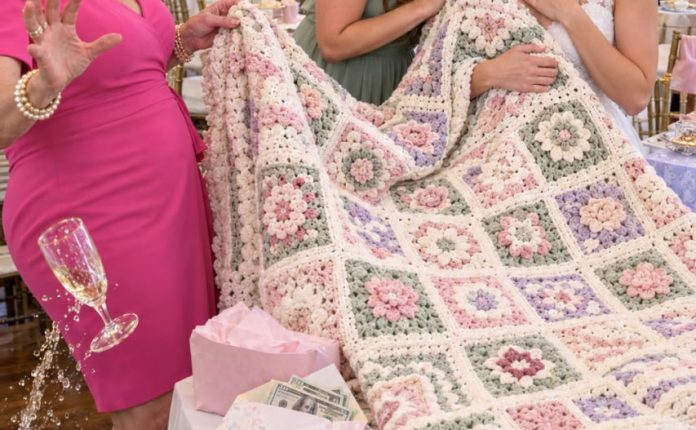
The border curled slightly where I had joined it years earlier. I could remember the feel of that yarn, rougher than the cream wool I used for Claire’s gift.
Graham followed my gaze.
“That’s one of yours?”
“Grandma’s. I finished the edge.”
He lifted it from the couch and carried it into the dining room.
Claire had cleared the table.
A folder lay beside her laptop. Three glasses of water stood on coasters, untouched.
I sat where I could see the back door.
It was an old habit from working around animals: know how to leave before you need to.
Graham sat opposite me.
“The payments went to an account your mother supplied.”
I kept my hands beneath the table.
“In my name?”
“The supplier record is in your name. The account confirmation we located names Marilyn and Douglas Hale.”
Mom and Doug.
Their joint account.
Claire slid a printed page toward me.
It showed the last digits of the account, the bank name, and the payment instructions saved with the vendor record.
Graham explained that their regular system had not automatically compared the supplier’s name with the receiving account’s ownership.
They had requested further confirmation through their accountant and bank.
“We have enough to stop paying,” he said. “We don’t have every answer yet.”
I appreciated that distinction.
I had heard enough people sound certain when certainty served them.
Claire opened the folder.
“The supplier was added in November 2019.”
There was my name, with an added trade description beneath it.
Tessa Hale — Custom Textile Services.
I read it three times.
I had never called myself that.
“The tax form has your number,” Claire said. “And a signature.”
She placed a second page beside the first.
The handwriting resembled mine if somebody remembered it rather than knew it.
The first letter leaned the wrong way.
My actual signature joined the last two letters of my surname. This one separated them.
A small defect.
A whole life built on the assumption nobody would notice it.
“I didn’t sign this.”
Graham nodded.
“Write that down for your attorney.”
The form listed my mother’s address.
“So the annual forms went to her house,” I said.
“That appears to be what happened.”
“Why did this notice come to mine?”
“It came from the IRS,” Claire said. “They have your current address.”
For years, the company’s copies had gone where Mom could collect them.
The discrepancy had finally reached the person whose name belonged to it.
I looked at the amount on the notice again.
“Forty-one thousand for one year?”
Graham opened another document.
“Some invoices describe blankets. Others describe larger textile orders, design work, rush charges.”
“Grandma couldn’t make that much.”
“We’re checking which goods were actually delivered.”
There were legitimate blankets.
There were also invoice lines that did not match a delivery anyone could remember.
My mother had built something around real work, then enlarged it inside the accounts system.
Graham did not pretend his company carried no responsibility.
“Marilyn entered invoices and prepared payment batches. I approved totals. I didn’t examine every small supplier closely enough.”
He rubbed the bridge of his nose.
“An annual gift budget looked ordinary. Other charges were scattered under different descriptions.”
Claire pointed to a column.
“Nothing was all in one place.”
I thought of Mom’s careful living room.
How she moved unattractive objects out of sight before guests arrived.
“Did Doug know?”
“We haven’t spoken with him,” Graham said. “Your mother hasn’t been interviewed yet.”
“Has Bennett?”
Claire’s expression changed.
“He called twice.”
“What did he say?”
“The first time, he asked whether we’d found a mistake. The second time, he wanted to know who showed you the paperwork.”
She closed the folder.
“I asked what paperwork he meant.”
“And?”
“He said he assumed you had paperwork because you were making accusations.”
It was a plausible explanation.
It was also the sort Bennett offered when he had prepared half a sentence and hoped nobody would ask for the other half.
My phone buzzed.
A message from him.
Can we speak before you take this further?
I set it on the table.
Claire read the screen without touching the phone.
“You don’t have to meet him for my sake.”
“I want to hear him.”
“Then do it somewhere you can leave.”
We agreed on a diner near my farm.
Before I left, Graham gave me the name of an attorney who handled financial disputes and identity matters. He made it clear I could choose someone else.
I called the next morning.
Her name was Leanne Foster.
She listened without interrupting.
Then she asked practical questions: which documents I had, whether I had shared the original notice, whether anyone was pressuring me to sign anything.
“Yes,” I said to the last question.
“Then don’t sign anything until we review it.”
There was relief in receiving an instruction that did not require me to guess another person’s motives.
I sent her copies.
At noon, Bennett arrived at the diner wearing the shirt he used for work meetings.
He slid into the booth and placed his phone facedown.
That gesture had once meant he was giving me his attention.
Now I wondered what he did not want me to see.
“You’ve really upset Mom.”
The waitress set down water.
I waited until she left.
“Ask me about the tax notice.”
He looked tired.
“Tess.”
“Ask.”
“Fine. What does it say?”
“It says I received money I never received.”
“There’s probably a way to straighten it out.”
“Do you know where the money went?”
He rubbed a thumb across the edge of the menu.
“Mom manages a lot of things.”
“That wasn’t my question.”
He looked toward the counter.
I had watched that movement at school when he knew who broke something and hoped the teacher would ask somebody else.
“Did you know she sold Grandma’s blankets?”
“Yes.”
The word came quietly.
I sat back.
“Since when?”
“A couple of years.”
“Grandma thinks they go to families who need them.”
“Mom said some were donations and some were sold to cover the project.”
“What project?”
“I didn’t investigate it.”
“No. You laughed at the person doing the work.”
He put the menu down.
“I shouldn’t have done that.”
It was the first true thing he had said that day without my pulling it out of him.
But he followed it with something familiar.
“You didn’t need to tell Claire at the shower.”
“I gave her a question. Your mother gave everybody a joke.”
“Our mother.”
I looked at him until he shifted.
“When did you first see a document with my name?”
His face lost its practiced patience.
“I haven’t said I saw one.”
“You asked Claire who showed me the paperwork.”
“I was trying to understand.”
“Then help me.”
The waitress returned.
Neither of us ordered.
Bennett asked for a few more minutes.
When she walked away, he lowered his voice.
“Mom was doing wedding paperwork last week. There was a supplier form on the desk.”
“What kind?”
“I think the tax form.”
“Mine?”
He nodded.
“Did you ask why?”
“She said it was an arrangement with you.”
“You could have called me.”
“I thought you’d start a fight.”
The diner’s refrigerator switched on with a low mechanical hum.
I listened to it while deciding how to answer.
“You saw my name on a business form and decided the safest person to question was nobody.”
“She said you knew.”
“Then a phone call wouldn’t have started anything.”
He looked at his hands.
For the first time, I understood that he had not simply avoided choosing.
He had chosen the version that let him keep his life comfortable.
“Did she offer you money?” I asked.
“She’s helping with the wedding.”
“How much?”
“Some of the deposit. The honeymoon.”
I did not ask whether those payments came from the same account.
I had no proof.
I did not need to manufacture it to make the facts ugly.
“Tell Claire what you told me.”
“I will.”
“When?”
“Tonight.”
I stood.
“Tess, sit down. We haven’t finished.”
“I have an appointment.”
“With a horse?”
“Yes.”
He almost smiled, reaching for the old joke.
I watched it die before he said it.
Outside, I called Leanne and wrote down the conversation while it was fresh.
By evening, Bennett had told Claire I misunderstood him.
She called from her car.
“He says he never recognized your name on the form.”
“He told me he did.”
“I know.”
I closed my eyes.
“How?”
“He texted me before your appointment. He said he’d seen a form but Mom told him you approved it.”
The contradiction sat between us.
Claire sounded less angry than exhausted.
“Could you send me what he wrote?”
“My father’s lawyer is preserving it.”
“Preserve your copy too.”
“I have.”
That night, Aunt June called.
She began with the wedding.
Then she mentioned Mom’s nerves.
Then she said she hoped a financial misunderstanding would not divide the family.
“What has she told you?” I asked.
“That you wanted payment for helping Nora.”
“That isn’t what happened.”
“Well, I’m sure there are two sides.”
“There are records. Have you seen any?”
She was quiet.
I asked her not to carry messages between us.
It sounded harsher than I felt.
But I was beginning to understand how messages changed as they passed through people determined to keep peace at somebody else’s expense.
On Wednesday, I returned to Grandma’s kitchen.
Leanne had suggested making a clear record of what Grandma remembered, with her permission.
I explained the account and the supplier name.
Grandma listened with her hands folded.
When I finished, she asked for the burgundy blanket’s photograph.
I described it because she could not see the details.
“That was the year you had the cough,” she said.
I remembered.
I had worked the border beneath a quilt because I could not get warm.
“Mom said a family had lost their things in a fire.”
Grandma turned her face toward the window.
“I asked whether they needed a bigger one.”
I felt something move in my chest that anger could not quite contain.
She had not merely been cheated of money.
She had been allowed to imagine strangers receiving comfort from her hands.
That imagined kindness had sustained her through difficult work.
My mother had sold it back to a company and attached my name.
“Did you keep anything?” I asked.
“Color notes. Dates, sometimes.”
She directed me to a biscuit tin in the cupboard.
Inside were yarn labels, folded receipts, and small index cards.
Her writing grew larger and less even over the years.
Burgundy. November.
Blue cream. For Christmas.
Three green. Marilyn collecting Friday.
The cards were not business accounts.
They were a maker’s memory.
But they could establish which blankets existed and when.
With her permission, I photographed every card.
Then I laid the receipts in order.
Amounts for yarn.
Small amounts Mom had reimbursed.
The difference between those and the company invoices was not subtle.
Grandma asked me to leave the originals in the tin.
“They’re mine,” she said.
“I know.”
She lifted her chin.
“And I want whatever belongs to me explained to me. Don’t settle it over my head because you think I’m old.”
I promised.
That afternoon, Mom appeared outside my cottage.
I was unloading a box of shoes from the truck.
She stood near the gate in a pale jacket, holding a grocery bag.
“I brought you supper.”
I looked at the bag.
For a moment, I wanted to let the gesture mean what it would have meant in another family.
Then she said, “We need to be reasonable.”
“What does that mean?”
“This business has grown complicated. Graham isn’t familiar with how informal arrangements work.”
“Leanne is handling my questions.”
“Who’s Leanne?”
“My attorney.”
Mom set the bag on the gatepost.
“You hired a lawyer against your own mother?”
“I hired someone to help with a tax notice.”
“Do you know what lawyers cost?”
“Yes.”
The question had been intended to return me to the position I occupied at the shower.
Poor Tess. Practical Tess. Tess who could not understand money.
It did not work as quickly this time.
She opened her purse and removed a folded document.
“We can correct this as a family. I had someone put an explanation together.”
I did not take it.
“What does it say?”
“That you authorized me to administer the blanket sales.”
“I didn’t.”
“You helped make them.”
“That isn’t authorization.”
“We used your name because you’re younger. Nora couldn’t manage a business.”
“She didn’t know there was a business.”
Mom’s eyes moved toward the cottage.
“You’re twisting everything.”
“Send it to Leanne.”
“She’ll make it worse.”
“Then don’t send it.”
A horse in the nearby paddock stamped at flies.
The ordinary sound steadied me.
Mom folded the paper again, less neatly.
“If this ruins the wedding, Bennett will never forgive you.”
“That’s his decision.”
She took the grocery bag with her.
I watched her drive away before I called Leanne.
The document mattered.
It showed an attempt to create permission after questions had already begun.
Leanne told me to record the visit and keep any subsequent messages.
A message arrived before dusk.
You know these were family earnings. Don’t pretend otherwise now.
I saved it.
On Thursday, Graham’s accountant confirmed that payments associated with my supplier record exceeded $186,000 over the reviewed years.
That was not a conclusion about every dollar.
Some orders had real blankets behind them.
Some expenses needed further examination.
But none of the payments had reached me.
The company’s counsel advised Graham to notify the appropriate authorities and insurers.
Leanne prepared my response to the tax notice and the documentation supporting it.
Nobody promised the matter would be quick.
I had appointments to keep, shoes to shape, invoices of my own to send.
At one barn, I found myself staring at a nail between my fingers.
The owner asked whether I was all right.
“I need a minute.”
She took the horse’s lead without asking another question.
That small kindness almost undid me.
On Friday, Claire asked Bennett to bring the supplier document he had seen, or explain why he could not.
He told her it had probably been discarded.
Then he suggested she stop reviewing family matters through company records.
She postponed the wedding.
She called me before telling anyone else.
“This isn’t a decision about whether I love him,” she said. “It’s a decision about whether I can trust what he says when the truth costs him something.”
I sat on my cottage step.
“I’m sorry you have to do this.”
“I’m sorry you’ve had to do it alone.”
We stayed on the phone without filling the silence.
By Saturday, the story had reached the relatives who laughed at the shower.
Mom told them Graham was using a bookkeeping error as an excuse to dismiss her.
She said Claire had become controlling.
She said I resented Bennett’s happiness.
Aunt June asked whether a family meeting could clear things up.
I sent the request to Leanne.
She agreed only if the discussion stayed factual, with no settlement signed and no promises made.
Graham would attend. So would Claire.
Grandma insisted on coming.
The meeting was scheduled for Sunday afternoon at June’s house.
On Saturday evening, Claire called.
Her voice was careful.
“Dad found another email.”
I stood beside my truck, the door still open.
“What kind?”
“From Mom to Bennett. Last Monday, after her access stopped.”
My fingers tightened around the keys.
Claire read the line that mattered.
If anyone asks, Tess approved the arrangement. We need to keep this from upsetting everything.
“And his answer?”
She breathed out.
He had written that he understood.
Then he had asked his mother to tell him exactly what to say.
END PART 2