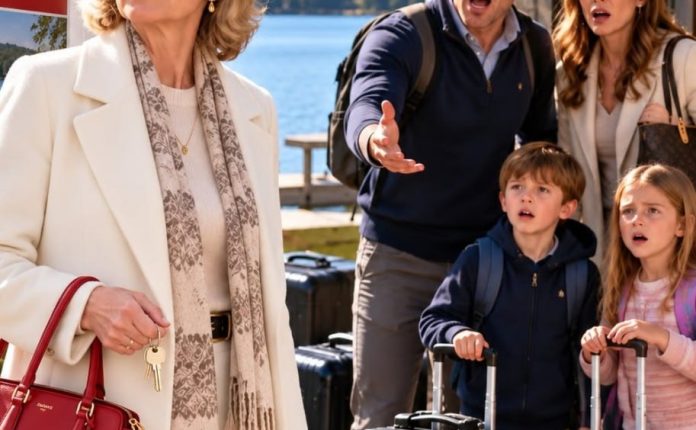
A month later, I watched the coastline disappear from a ship’s balcony.
Nobody had asked me to pay for the view.
That was my first thought.
It made me laugh quietly.
Susan, standing beside me, turned.
“What?”
“Nothing.”
“That was not a nothing laugh.”
I looked toward the water.
“I’m enjoying an experience without calculating whether a payment will arrive afterward.”
Susan smiled.
“Try to continue.”
The shore grew smaller.
Buildings became shapes.
Then colors.
Then a line I could no longer separate clearly from the land behind it.
The ship moved steadily.
I rested my hands on the railing.
Five years earlier, a cruise had become the occasion for my son to tell me that my money was welcome while my presence was not.
Now he had booked a cabin for me.
A cabin for his family.
One for Susan.
He had invited us.
He had paid.
And during the arrangements, nobody suggested that I should cover something because it would make matters easier.
That absence had been so noticeable that I almost asked whether there had been a mistake.
Then I reminded myself not to manufacture the old role merely because the new one felt unfamiliar.
I was a guest.
A mother.
A grandmother.
A woman having a birthday.
Those were enough reasons to be there.
Daniel and Martin had declined.
Daniel said someone still needed to work while the rest of us entertained ourselves.
Martin claimed the office was quieter when clients were at sea.
I told them both they sounded relieved.
Neither denied it.
I thought of them as the ship moved away.
Daniel with his blue folder.
Martin opening the office door.
The bank records.
The will.
The careful questions that prevented feelings from replacing facts.
They were not on the ship.
But without their work, the people who were might never have reached it together.
Susan leaned against the railing.
“I used to think George would find a ship like this irritating.”
“He would.”
“The announcements.”
“The prices.”
“The people blocking doorways.”
She laughed.
I looked at the horizon.
“Then he’d find something interesting about the way it was built and refuse to leave that subject alone.”
“Of course.”
We stood quietly.
The air moved against my face.
It carried salt, something different from the lake’s cooler smell.
I did not feel disloyal for enjoying it.
For a long time after George died, pleasure had arrived with a small question attached.
Was I leaving him behind?
Was happiness evidence that the grief had become less important?
It took years to understand that loving him did not require me to remain where the sadness was easiest to find.
I could miss him here.
I could miss him and still be glad.
Susan seemed to understand without my saying it.
“He should have told us more,” she said.
“Yes.”
“He would have liked seeing this.”
“Yes.”
Both answers belonged.
I did not need to choose between gratitude and grievance.
George had loved us.
He had protected things.
He had also left explanations too late.
The family had carried what remained.
Now we were allowed to enjoy the result without pretending the carrying had been easy.
Patrick came onto the balcony.
He stopped near the door.
“Am I interrupting?”
“No,” I said.
He came beside us.
For a moment, the three of us watched the diminishing coast.
“How’s the cabin?” he asked.
“Very nice.”
“Anything you need?”
I smiled.
“I’ll tell you.”
He nodded.
There was no frantic determination to make the trip flawless.
He did not need my birthday to become proof that every earlier mistake had been erased.
I liked that.
A celebration could be good without being perfect.
Someone might dislike a meal.
An outing might be canceled.
The children might argue.
Those things would not make us a failed family.
They would make us people traveling together.
Patrick looked toward Susan.
“You comfortable?”
“Yes.”
“Good.”
He stood with his hands resting on the railing.
I remembered him at Martin’s office five years earlier, trying to keep me from hearing his father.
Now he did not seem frightened of what anyone might say next.
He had earned that ease slowly.
A few moments later, Emma called from inside.
Patrick turned.
“I’ll be right there.”
He looked back at me.
“Enjoy this.”
“I am.”
Then he went.
Susan watched him leave.
“He looks different.”
“Older.”
“That too.”
I nodded.
“Less busy defending himself.”
“Yes.”
I looked at the sea.
For years, Patrick had mistaken appearances for safety.
A successful-looking business.
An expensive vehicle.
The right membership.
A house he expected to inherit.
He had thought those things could keep disappointment from reaching him.
Instead, they had given disappointment somewhere to hide until it became dangerous.
Now he had fewer impressive objects.
More truthful conversations.
A business he could describe accurately.
A home he paid for.
A wife who knew the financial facts.
Employees with a stake in what they had sustained.
It was a more substantial life.
It simply looked less extravagant from the road.
I was glad he understood the difference.
The first evening, we gathered before dinner.
The children were excited.
Susan had already found several things to enjoy and one thing about the layout she considered unnecessarily confusing.
Megan helped settle a question between the children without turning it into an argument.
Patrick arrived carrying an envelope.
I looked at it.
“Oh, no.”
He smiled.
“What?”
“If that contains legal documents, I’m declining the invitation.”
Susan laughed.
Patrick shook his head.
“No paperwork.”
“You have a history of optimistic descriptions.”
“I know.”
He held it out.
I took it.
The envelope was ordinary.
No firm’s name.
No seal.
No instruction requiring me to open it in front of a witness.
Still, for a moment, I remembered every envelope that had changed something.
The agreement.
George’s letter.
The brown packet from the bank.
The papers that returned thirty percent to Patrick and directed nineteen to the employee trust.
Paper had become a complicated thing in our family.
I opened this one slowly.
Inside was a photograph.
George and me.
Young.
Standing beside the unfinished lake house.
I knew the picture immediately.
The building behind us was not yet the house I would live in for so many years.
It was work.
Timber.
A plan becoming something physical.
George looked toward the camera with the faint impatience he brought to being asked to stop what he was doing.
I stood beside him, smiling more freely than I remembered smiling.
I touched the edge.
“Where did you get this?”
“From the family photographs.”
I nodded.
There was no secret attached to it.
That was a relief.
I looked at the picture again.
My younger self had no idea what the house would hold.
Patrick growing up.
George getting older.
Meals.
Repairs.
Arguments about things that seemed large at the time and later became almost nothing.
She did not know I would one day sell it.
She did not know the sale would uncover a company, a will, a debt, and a set of decisions that would change the family.
She simply stood beside her husband near something they were building.
I wanted to reach into the photograph and tell her to ask more questions.
I also wanted to leave her alone.
She was happy.
She had the right to that moment without being burdened by what I knew now.
Patrick watched my face.
“Turn it over.”
I did.
On the back, in his handwriting, were a few words.
What mattered was never the house.
I looked at him.
“What did you mean?”
He glanced toward the children.
Then Megan.
Then Susan.
Then me.
“This.”
I looked around.
Emma was trying to see the photograph.
Megan’s eyes were wet.
Susan had already found a tissue.
Patrick stood in front of me without offering an explanation of how much the cabins cost or how carefully he had planned the trip.
He had brought me a picture.
A memory.
And an understanding he once would have dismissed as something people said when they could not afford property.
I held the photograph against my chest.
Then I hugged him.
He held me.
For a moment, I felt the old instinct to reassure him about everything.
The years.
The guilt.
The mistakes.
But I did not need to erase the difficult things to love him.
They were part of the road that had brought him there.
He had faced them.
That was enough.
“I’m glad you understand,” I said.
He nodded against my shoulder.
“I’m sorry it took so long.”
“I know.”
He stepped back.
I looked at him properly.
My son.
Not a beneficiary waiting for an estate.
Not an emergency looking for funds.
Not a project I had to finish before I could rest.
A grown man responsible for his own choices.
Still capable of making mistakes.
Still capable of telling me the truth.
I loved him more easily when I no longer needed to pretend otherwise.
Emma reached for the photograph.
“Is that Grandpa?”
“Yes.”
“You look different.”
Susan laughed.
“We generally did.”
Emma studied the unfinished house.
“Was that before you lived there?”
“Before it was ready.”
She looked up.
“Were you excited?”
I smiled.
“Very.”
“Was Grandpa?”
“Yes. He expressed excitement by discussing practical problems.”
Patrick laughed.
“That stayed consistent.”
The children looked at the picture together.
I let them.
It was not a sacred object that could only be held by adults who understood all its consequences.
It was a family photograph.
It belonged among their questions.
George could remain part of their lives without becoming a test they had to pass.
We went to dinner.
There were small delays.
Someone had forgotten something.
One child wanted to change seats.
Susan asked a question about the menu that made Patrick smile because it sounded exactly like a question George would have asked.
Nothing was wrong.
We were simply together.
I noticed how little work I was doing to keep the evening pleasant.
I did not have to conceal resentment.
I did not have to calculate what someone might ask for later.
I did not have to turn every disagreement into a subject change.
The conversation could move naturally because the difficult facts of our lives were no longer hidden beneath it.
That was the real luxury.
Not the ship.
Not the balcony.
Not the meal.
The absence of the old strain.
After dinner, I returned briefly to the cabin.
I placed the photograph where I could see it.
Then I sat down.
The quiet was different from the quiet I had known at the lake house after George died.
Not because a ship was never truly silent.
There were sounds through the walls.
Footsteps.
Movement.
A distant announcement.
But I knew where the people I loved were.
They had invited me.
They expected me to return.
I could be alone for a little while without feeling excluded.
That distinction had become precious.
I looked at the photograph.
George’s hand rested near my shoulder.
I remembered the day in fragments.
The work.
The light.
The impatience of stopping.
I did not remember everything.
I no longer demanded that memory provide a complete record.
There were things I had forgotten.
Things George had not told me.
Things I had misunderstood.
Our marriage had still been real.
Love did not require full knowledge of every hour.
But it did require enough honesty that one person was not quietly deciding the other’s future.
I had learned that late.
Late was better than never.
I thought about the charitable trust.
The preserve.
The cottages.
People living alone without being left without choices.
George had made plans for them.
I had helped those plans become usable.
There was comfort in that.
Not because his intentions had made him flawless.
Because some of what he noticed had survived him and reached people who needed it.
I thought about Susan.
The years she and George had lost.
The private reconciliation.
The difficult role she played around Robert.
She had returned to the family through secrecy and danger, but she had stayed through ordinary afternoons.
That mattered more to me now than the astonishment of her revelation.
She was not only the woman who preserved the envelope.
She was the woman who knew where I kept the cups.
I thought about Megan.
The humiliation of discovering what her father had done.
The anger at Patrick.
The separation.
The apology in my apartment.
She had not come asking me to make her feel innocent.
She had acknowledged what she had assumed.
Then she changed how she behaved.
Her preferences remained.
Her certainty about my property did not.
That was repair I could live with.
And Patrick.
The five years had not made him a man without fear.
He still feared failure.
Still disliked disappointing people.
Still sometimes looked for the quickest reassuring sentence.
But he had learned to notice the impulse before building a debt around it.
He had learned that telling me bad news did not have to mean asking me to pay.
He had learned to let his wife know what was actually happening.
He had declined an acquisition because it would cost forty employees their jobs.
He had chosen to share nineteen percent with the people who kept the business alive.
Those decisions had weight because he understood what he gave up.
He was no longer generous chiefly with other people’s resources.
He could choose with his own.
I sat for a while.
Then I went back out.
The evening air was cooler.
The ship moved beneath a widening sky.
Patrick and Megan were nearby with the children.
Susan had found a comfortable place to sit and appeared pleased with the entire arrangement.
When she saw me, she shifted to make room.
“You disappeared.”
“Briefly.”
“Everything all right?”
“Yes.”
She looked at me.
Then she smiled.
“I believe you.”
That made me laugh.
I sat beside her.
For a long time, being believed had meant someone accepting the explanation I offered.
Now I valued being believed when I said something simple about myself.
I wanted to leave.
I wanted to stay.
I was tired.
I was happy.
Those statements did not require another person to approve them.
I had spent too many years treating my own needs as suggestions that could be overruled by someone else’s difficulty.
The change had not made me selfish.
It had made me available honestly.
If I offered something, it was because I chose to.
If I could not, I said so.
If someone was disappointed, we could remain family.
The evening continued.
The children grew quieter as they tired.
Megan kept track of them without looking as though every practical task belonged to her alone.
Patrick took his part.
Susan told another small story about George.
We laughed.
No one asked whether the family had healed.
It would have been an awkward question in the middle of an ordinary evening.
We were living the answer.
Not perfectly.
Not finally in the sense that nothing difficult could ever happen again.
But truthfully enough that we did not need the old arrangement to keep us together.
Later, Patrick came to stand beside me at the railing.
The sea was dark.
Lights from the ship moved across small changes in the water.
“Are you having a good birthday trip?”
“Yes.”
He smiled.
“No qualifications?”
I considered.
“The legal documents are noticeably absent.”
He laughed.
“I promised.”
“You did.”
He leaned on the railing.
“I keep thinking about the first cruise.”
“I noticed.”
“I don’t want this to be me trying to replace it.”
“It doesn’t.”
“Good.”
I looked at him.
“You can’t replace what happened.”
“I know.”
“But you can behave differently now.”
He nodded.
“That’s what I wanted.”
We stood quietly.
The ship’s movement was steady beneath our feet.
Patrick looked toward the water.
“I used to think consequences meant someone had decided they didn’t love me.”
I turned slightly.
“I know.”
“Dad refusing another rescue. You canceling payments. Selling the house.”
He paused.
“I made all of it personal in the wrong way.”
“It was personal.”
He looked at me.
“Your choices affected people you loved. Of course it was personal. That didn’t mean the consequences were a rejection of you.”
Patrick nodded slowly.
“I understand that better now.”
“I hoped you would.”
He took a breath.
“I wish I’d understood before.”
“So do I.”
There was no reason to soften that.
We could regret the cost without undoing the growth.
He looked toward his family.
“I don’t want the children to need all this to learn it.”
“Then tell them the truth while it’s smaller.”
Patrick smiled.
“That sounds like Dad.”
“He occasionally said something useful.”
We laughed.
Then he asked, “And you?”
“What about me?”
“What did you learn?”
I looked at the sea for a moment.
There were many answers.
That I could leave.
That a signature mattered.
That grief did not require preserving a house.
That enough money was enough.
That helping and preventing every consequence were not the same.
But beneath them was something simpler.
“My life wasn’t something you were waiting to receive.”
Patrick lowered his eyes.
“I know.”
“It was still happening.”
“Yes.”
I watched him.
He did not defend the man who had forgotten that.
He simply acknowledged him.
That was what made the next part possible.
“I have things I want to do,” I said.
“You should.”
“I intend to.”
He smiled.
“I know that now too.”
We returned to the others.
There were glasses on the table.
The children had become sleepy enough that their arguments lacked enthusiasm.
Susan looked at the stars.
Megan sat beside Patrick.
For a moment, I saw the family in pieces.
The wife whose trust had been broken.
The son whose confidence had concealed debt.
The sister who had spent years outside our lives.
The grandchildren who had grown through the adults’ mistakes.
And me.
A woman who had loved them all while allowing too much of her future to be treated as a resource.
We had not returned to the old family.
I did not want us to.
That family had depended on assumptions.
On payments.
On the convenient belief that I would always understand.
We had become people who could ask.
Who could answer.
Who could hear no and remain.
That was worth keeping.
Patrick lifted his glass.
“To Mom.”
Megan smiled.
“To Eleanor.”
Susan raised hers.
“To George.”
I looked at them.
George was absent.
That would always be true.
He was also part of what had brought us there.
His work.
His mistakes.
His concern.
The recorded voice that had told us to stop confusing love with rescue.
I held my glass a little longer.
Then I lifted it.
“To everyone paying for their own excursions.”
Patrick laughed first.
Then Megan.
Then Susan, who nearly spilled her drink.
The children began laughing because the adults were.
People nearby turned toward us.
No one hurried to quiet the moment.
No one needed to look more respectable.
We were a family on a ship.
An ordinary family, finally able to enjoy something ordinary about being together.
The stars remained above us.
The water moved below.
I thought of the lake house.
The pale gray walls.
The Hendersons’ greenhouse.
The repaired dock.
It was safe in someone else’s life.
The land was becoming useful in many lives.
The company belonged to the people now responsible for it.
George’s plans had reached their intended work.
Patrick’s future was no longer secured by treating mine as something already finished.
And my life was here.
In the chair I chose.
In the trip I accepted.
In the people I loved without paying to remain among them.
I took a sip.
Then I joined the laughter.
THE END
Disclaimer: This is a fictionalized story inspired by real-life situations. Names, characters, and details are used for storytelling purposes.
END PART 12