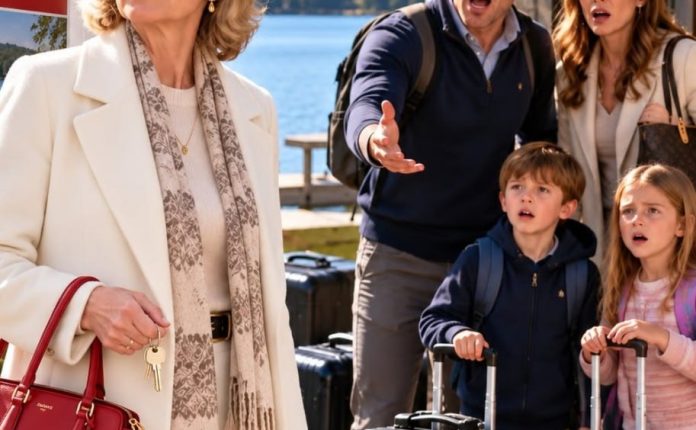
“George asked me to find you if Patrick ever tried to claim the lake property.”
I kept the chain on my apartment door.
The man in the hallway waited without reaching toward me. He wore a navy jacket that had faded along the seams, and his reading glasses rested against his chest on a cord. Beneath his arm was a blue folder secured with an overstretched elastic.
“My husband has been dead for years,” I said.
“I know.”
“Then you’ll understand why that isn’t a reassuring introduction.”
He lowered his eyes briefly.
“My name is Daniel Ross. Martin called me.”
The name meant something. I had found it in George’s letter that morning. Seeing the man attached to it did not make the situation easier to understand.
“How long ago?”
“About twenty minutes.”
Behind me, my little dining table was covered with papers. Patrick’s agreement. The letter. Notes I had made while speaking to Martin.
I had moved into this apartment to make my life simpler.
Apparently, simplicity had been waiting until I unpacked before leaving.
“Why would Martin call you?” I asked.
“Because of what you found.”
“Tell me what that was.”
“A letter George wrote to you.”
He answered without hesitation, but I did not move the chain.
There was a time when invoking George’s name would have been enough to get someone through my door. I would have offered coffee, pulled out a chair, assumed good intentions.
That morning, I was looking at a document bearing my signature beneath a promise I had never made.
My assumptions were no longer reliable security.
“How did you know him?”
“I was his accountant.”
“No. William Carter was his accountant.”
“William handled the household accounts and the ordinary company matters you knew about.”
“And you?”
“A separate group of investments.”
I looked at the blue folder.
George had run a construction company. He had come home with dust in the cuffs of his trousers and complained about the price of replacing a truck he should have replaced years earlier.
He was not the kind of man I associated with separate groups of anything.
“Are you sure you have the right Eleanor Bennett?”
“Yes.”
“Because my husband once spent three evenings comparing refrigerators.”
Daniel’s expression changed, not quite into a smile.
“That sounds like him.”
“It sounds like somebody who would have told me if he needed two accountants.”
“I can explain. But you should check who I am first.”
He moved his free hand slowly toward his inside pocket.
“Identification?”
I nodded.
He held it where I could read it without opening the door wider.
The photograph matched. So did the name.
I still called Martin.
Daniel waited in the hallway while I stood beside my kitchen counter with the phone pressed to my ear. Martin confirmed that he had contacted him.
“Let him show you the records,” he said. “Don’t sign anything.”
That instruction would once have seemed unnecessary.
Now it sounded like the first solid thing anybody had said all day.
I removed the chain.
Daniel stepped inside, looked around only enough to avoid the boxes near the entrance, and waited for me to indicate a chair.
The apartment was small. From the dining table, you could see the kitchen, the sitting room, and the short passage leading to my bedroom.
At the lake house, a visitor could disappear into another room.
Here, there was nowhere for either of us to hide.
He placed the folder on the table.
“Would you like coffee?”
“Only if you’re already making some.”
“I’m not.”
“Then no, thank you.”
I sat opposite him.
The elastic left a pale groove across the folder when he slipped it free. He opened the cover, then stopped before taking anything out.
“What have you been told?”
“That my son owns half the house I sold.”
Daniel’s mouth tightened.
“And do you believe that?”
“I believe someone has put considerable effort into making me believe it.”
I pushed Patrick’s agreement toward him.
He read the first page without touching the signature page. Then he turned it carefully, keeping the corners aligned.
“I didn’t sign that,” I said.
“I understand.”
“No. I need you to hear the actual sentence. I did not sign it.”
He met my eyes.
“I hear you.”
Until then, I had not realized how badly I needed someone to answer without adding a qualification.
No suggestion that I might have forgotten.
No reminder that grief affects memory.
No soothing reference to what George would have wanted.
Just an acknowledgment.
My son had uninvited me from a cruise I had helped pay for.
Even now, saying it privately to myself made it sound smaller than it had felt.
A holiday disappointment. A family disagreement. Something an older woman should rise above.
But the hurt had not been about the ship.
It was about how easily my presence had become inconvenient while my money remained welcome.
Patrick still expected me to help with the things they wanted to do once they reached the ports. Somehow, excluding me had not excluded my bank account.
I had spent years accepting that kind of arithmetic.
His business needed assistance. The children needed things. A payment was due. A temporary difficulty had become another temporary difficulty.
Every request came wrapped in an explanation.
Every explanation ended with me doing something about it.
During the cruise, I stopped.
I sold the lake house.
Susan handled the sale. The Hendersons bought it. I canceled the payments I had been carrying for Patrick, including the car payment, and moved into a place I could manage without organizing my days around other people’s plans.
I had not sold the house to lure anybody into a lesson.
I had sold it because I wanted to live in my own life again.
Then Patrick produced the agreement.
The house, he said, had never been entirely mine to sell.
That was when the familiar language changed.
Generosity became obligation.
A family home became an asset under dispute.
My decision became something other people expected to reverse.
Daniel listened while I told him this.
He did not interrupt when I described the cruise. He did not look embarrassed on Patrick’s behalf.
When I finished, he glanced toward George’s letter.
“May I?”
I passed it across.
He read it slowly.
Watching him read my husband’s handwriting hurt in a strange, specific way. George’s letters had always leaned slightly forward, as if the words had somewhere to be.
The sight had belonged to shopping lists and notes beside the kettle.
Now men were studying it as evidence.
Daniel set the letter down.
“He hoped you wouldn’t need this.”
“That isn’t the same as making sure I wouldn’t.”
“No.”
I appreciated the answer.
I loved George. That did not require me to approve of everything he had left unexplained.
“What did he keep from me?” I asked.
Daniel rested his hands on either side of the folder.
“Most of the precautions were designed to keep Patrick from getting control.”
“That doesn’t answer my question.”
“You’re right.”
He removed a financial statement and turned it toward me.
Near the top was a name I had never seen.
Bennett Shore Holdings.
I read it once, then again.
“Is this George’s?”
“Yes.”
“What does it hold?”
“Property.”
“The house?”
“Not the house parcel itself. Other property.”
“How much other property?”
He drew another sheet from the folder.
“George formed the company fourteen years ago. The first purchase was a commercial lot.”
I looked at the date.
Fourteen years.
I tried to remember that year as something other than a number printed on a financial statement.
We had been living at the lake. Patrick had already been building his own business. George still came home tired and washed his hands at the utility sink before touching the kitchen towels.
It was an ordinary year in my memory.
Apparently, ordinary had contained more than I knew.
“One lot,” I said.
“At first.”
“Then?”
“Another parcel. Some older rental buildings. A warehouse. Eventually, a substantial stretch of the north shoreline.”
“How substantial?”
“Thirty-two acres.”
I looked up.
“Lake Henderson?”
“Yes.”
“Our lake?”
“The same lake.”
Outside the apartment window, a delivery van stopped beside the curb. Someone slammed its rear door. The sound made me flinch.
Daniel waited.
I put one hand flat on the table.
“George would have told me.”
“He intended to.”
“When?”
“After the construction business was sold.”
“He retired.”
“He retired from running the construction business every day.”
“That sounds like an accountant’s distinction.”
“It is. It’s also what happened.”
I remembered George after retirement, leaving the house with an old folder under his arm.
Meetings, he would say.
Loose ends.
I had imagined insurance paperwork, pension arrangements, obligations attached to closing a business that had occupied most of his adult life.
I had not imagined thirty-two acres.
“Was this secret from everyone?”
“Not everyone.”
“From me.”
Daniel did not try to avoid it.
“Yes.”
The word was painful, but at least it was the right one.
He showed me the earliest statements.
The numbers were not extravagant. Small purchases, money moved from profits, maintenance costs, fees.
“This didn’t begin as a fortune,” he said.
“I didn’t ask whether it did.”
“I know. But it matters to understanding him.”
He explained that George had bought neglected property when few people wanted it. Some buildings needed work. Some land produced no income at all.
There had been years when the company’s value was mostly patience.
Then the county approved a highway.
Businesses followed the road.
Land that had seemed inconvenient became useful. Buildings people had ignored became locations somebody wanted.
Daniel traced the progression through the statements.
I could follow enough to see that the changes were real.
I could not yet connect them to the man who folded coupons into his wallet.
“You’re saying he kept doing this after he retired.”
“Yes.”
“And you handled the accounts.”
“Yes.”
“For all those years.”
Daniel took off his glasses.
“I should have expected this conversation to be harder.”
“For you?”
“For you.”
I looked down at the papers.
There were no dramatic photographs. No hidden jewels. No stranger claiming George had lived another life in another city.
There were columns.
Dates.
Property descriptions.
It was the quietness of the proof that unsettled me.
Everything looked possible.
Everything looked like something George might have done carefully, over time, without anyone noticing what it would become.
“What is it worth now?”
Daniel hesitated.
“An estimate won’t be the same as money available to spend.”
“I know the difference between a house and a bank balance.”
“Of course.”
“What is it worth?”
“Depending on the valuation, between eleven and thirteen million dollars.”
I laughed.
It came out sharply enough to embarrass me.
Daniel did not smile.
“You need to say that again.”
“Eleven to thirteen million.”
I leaned back, then stood because sitting had become impossible.
The chair caught slightly on the rug.
I moved to the kitchen and looked at the kettle without deciding whether to switch it on.
A nine-hundred-dollar refrigerator.
That was what I remembered.
George had asked whether the one I wanted did something the cheaper one did not.
I had told him it would keep vegetables cold without sounding like an aircraft taking off.
He had grumbled all the way to the store.
Eleven million dollars.
Maybe thirteen.
I turned around.
“Did he know?”
“The approximate value? Yes.”
“And still?”
Daniel understood without my finishing.
“He remained George.”
I wanted to be angry at that answer.
Instead, I remembered the truck.
The upholstery had torn near the driver’s door. He covered it with tape and insisted the engine was what mattered.
He would buy a tool once, maintain it for decades, and dislike anybody suggesting a new version was automatically better.
He was careful with money in a way that had sometimes felt stubborn and sometimes felt like love.
Now I could not tell which parts of that care had belonged to our shared life and which had belonged to a plan I had never been allowed to see.
“Why didn’t he tell me?”
Daniel waited until I sat again.
“Patrick’s borrowing changed the situation.”
“Patrick always borrowed.”
“This was larger than you were told.”
I closed my eyes briefly.
There it was again.
Another category of things I had not been told.
Seven years earlier, Patrick’s business had almost failed.
I remembered emergency conversations, George becoming quieter, Patrick promising that a difficult stretch would end if he could get past one immediate problem.
Daniel described suppliers who were owed money. Bank obligations. Private loans. A personal guarantee.
George had paid enough to keep the business operating.
Patrick promised to repay him.
“He didn’t,” Daniel said.
I looked at the edge of the folder.
“I know he didn’t repay everything.”
“He repaid none of that rescue.”
I let the distinction settle.
Two years later, there had been another request.
I remembered that one too, though not with the clarity Daniel’s records gave it.
The way George had stood outside after Patrick left.
The way he had answered me when I asked what was wrong.
Work, he had said.
I had assumed he meant Patrick’s work.
Perhaps he had meant the work of remaining Patrick’s father without becoming Patrick’s permanent solution.
“Then Robert Hale became involved,” Daniel said.
Megan’s father.
A man who spoke as though he had already read the instructions for every room he entered.
He had worked in estate planning and real-estate financing. He knew the language that made ordinary people feel they should defer.
Structures.
Protection.
Continuity.
I had heard those words often enough to associate them with prudent adulthood.
Daniel slid a proposed arrangement toward me.
“Robert discovered George had investments.”
“How?”
“We couldn’t establish that.”
“Then don’t guess.”
“George believed Patrick told Megan, and Megan told her father.”
“Believed.”
“Yes.”
I appreciated his correcting the certainty.
The document was full of provisions I would never have understood without help.
Daniel walked me through the relevant sections.
Robert wanted George’s assets gathered into a family structure. After George’s death, Patrick would have effective control.
“What would I have had?”
“Less authority than you had under George’s existing arrangements.”
“Access?”
“Subject to terms.”
“Whose terms?”
Daniel tapped a paragraph.
“Ultimately, the people controlling the structure.”
I read the sentence again.
It was not written as cruelty.
That made it worse.
No one had needed to describe me as a burden or an inconvenience. They had simply arranged a system in which other people could decide what I required.
“George refused?”
“Yes.”
“And Robert accepted that?”
“No.”
Another proposal followed.
Then another.
The changes were incremental enough to look negotiable. Each time, Patrick gained a little more power. Each time, something of mine became conditional.
I thought about the phrase family home.
How harmless it sounded.
How easily it could erase the person whose name was actually on the deed.
“What did George do?”
“He changed his estate plan.”
I looked at the letter.
“The missing will.”
Daniel nodded.
My pulse began beating harder.
The will used after George’s death had left me the lake house, the personal accounts, and the household assets everyone knew existed.
I had never thought of that as incomplete.
“How was the last will different?”
“It identified Bennett Shore Holdings specifically.”
I looked at the statements again.
“And it left the company to whom?”
“To you.”
I sat very still.
The apartment had seemed small when Daniel arrived.
Now it felt like the only manageable thing in the world.
“And because the will disappeared?”
“The company’s succession remained unresolved.”
“So it belongs to nobody?”
“That isn’t what I mean.”
He explained carefully, resisting the temptation to make the answer shorter than it should have been.
George had made arrangements for his membership interest to pass under his final testamentary documents. Without the correct documents being produced, nobody had completed the ownership process as intended.
The company had not vanished.
The properties had not vanished.
Daniel had maintained the necessary filings using money George had set aside to preserve the records and administration.
“You’ve been keeping this alive.”
“Yes.”
“Without speaking to me.”
His face showed the discomfort I wanted it to show.
“George gave me specific instructions.”
“George is not here.”
“I know.”
“Those instructions left me living as though none of this existed.”
“I understand why you’re angry.”
“I’m trying to decide how many people to be angry with.”
He did not defend himself immediately.
That helped.
Eventually, he explained the two circumstances under which George had told him to approach me.
The final will being properly admitted.
Or someone trying to assert ownership of the lake property through George.
“Patrick’s agreement,” I said.
“Yes.”
“The document with my signature.”
“Yes.”
I looked from that document to the blue folder.
Something intended to take from me had opened a door to something George intended me to have.
I could not enjoy the irony.
Not yet.
“Why the lake property specifically?”
Daniel unfolded a survey map.
I knew the outline of the house parcel immediately. The curve near the water. The driveway. The road leading out toward the highway.
Around that familiar shape were shaded sections.
“Bennett Shore owns much of the undeveloped north shoreline.”
His finger moved across the map.
Then stopped at the access road.
I leaned closer.
“That is shaded too.”
“Yes.”
“The Hendersons bought the house.”
“They did.”
“Does this mean I sold them something I didn’t own?”
“No. They bought the house parcel.”
“And the road?”
“The company holds the access interest.”
I pressed my fingers to my lips.
I had wanted to leave my house cleanly.
No traps for the buyers.
No uncertainty following them into their new kitchen.
“I need Martin to look at this.”
“Absolutely.”
“They must not be hurt because my family has decided to behave like this.”
Daniel nodded.
I studied the map again.
Patrick had demanded an interest in a house.
Robert had demanded half its proceeds.
But the house stood among assets neither of them had mentioned to me.
“Does Robert know about the company?”
Daniel’s expression changed.
“I believe he does.”
My phone rang.
Patrick.
I let it stop.
It rang again with Megan’s name.
Daniel watched the screen but said nothing.
Then an unfamiliar number appeared.
I answered.
“Mrs. Bennett? Robert Hale.”
His voice was smooth enough to make the morning sound routine.
“Robert.”
“I think we’ve reached a point where everyone should step back.”
“From what?”
“From the emotion surrounding this.”
I looked at the map.
“I’m listening.”
He said Patrick’s position was supported by an agreement.
I said I had never signed it.
Robert paused.
Then he advised me against accusations.
Not against false documents.
Against accusations.
Daniel reached for his phone, activated a recorder, and set it near mine.
“What do you want?” I asked.
“Acknowledgment of Patrick’s beneficial interest.”
“How much?”
“Fifty percent.”
“And after I acknowledge it?”
“Half the sale proceeds should be placed in escrow.”
“Is that everything?”
“For now.”
I repeated the last two words.
Robert made a small, patient sound.
“Eleanor, George wanted this property protected.”
“Did he tell you that?”
“We discussed it extensively.”
“Then perhaps you can explain the letter I found today.”
The silence was brief.
But Robert’s next question arrived without its polished wrapping.
“What letter?”
“A private letter from my husband.”
“What does it say?”
“That you wanted him to place the property into a family arrangement.”
“We discussed estate planning.”
“He wrote that he refused.”
“People reconsider.”
“Did George?”
“Yes.”
“What proves that?”
Another pause.
I watched Daniel watching me.
“We have documentation you may not have seen,” Robert said.
“So have I.”
He ended the call soon afterward.
For a moment, I listened to the empty line.
Then I put the phone down.
“He wants to know what you have,” Daniel said.
“I want to know what I have.”
“We need the original corporate records.”
“Where?”
“A bank vault.”
He began gathering the statements.
“Tomorrow morning. With Martin.”
“And the will?”
“We need to find out whether the archive package contains what George intended.”
He replaced the elastic.
Then, at the door, he stopped.
“There’s something else.”
I almost laughed.
“What now?”
“George recorded a statement.”
I gripped the back of my chair.
“A video?”
“Yes.”
“Did you watch it?”
“No. It was sealed with instructions.”
“For whom?”
“For you.”
After Daniel left, I stood at the window until the hallway light clicked off outside.
I did not feel wealthy.
I felt late.
Late to my husband’s plans. Late to my son’s choices. Late to discovering how many conversations about my future had happened without me.
That night, every ordinary object in the apartment seemed slightly unfamiliar.
I lay awake thinking of a recording I had not heard.
George’s voice existed somewhere inside a bank box.
So did an explanation.
At six forty the next morning, my phone lit up.
Patrick asked me not to go to the bank with Daniel.
I sat upright.
I had told him neither the name nor the destination.
Before I could decide whether to call, another message appeared.
There was something I needed to know, he wrote, before I opened that box.
END PART 1