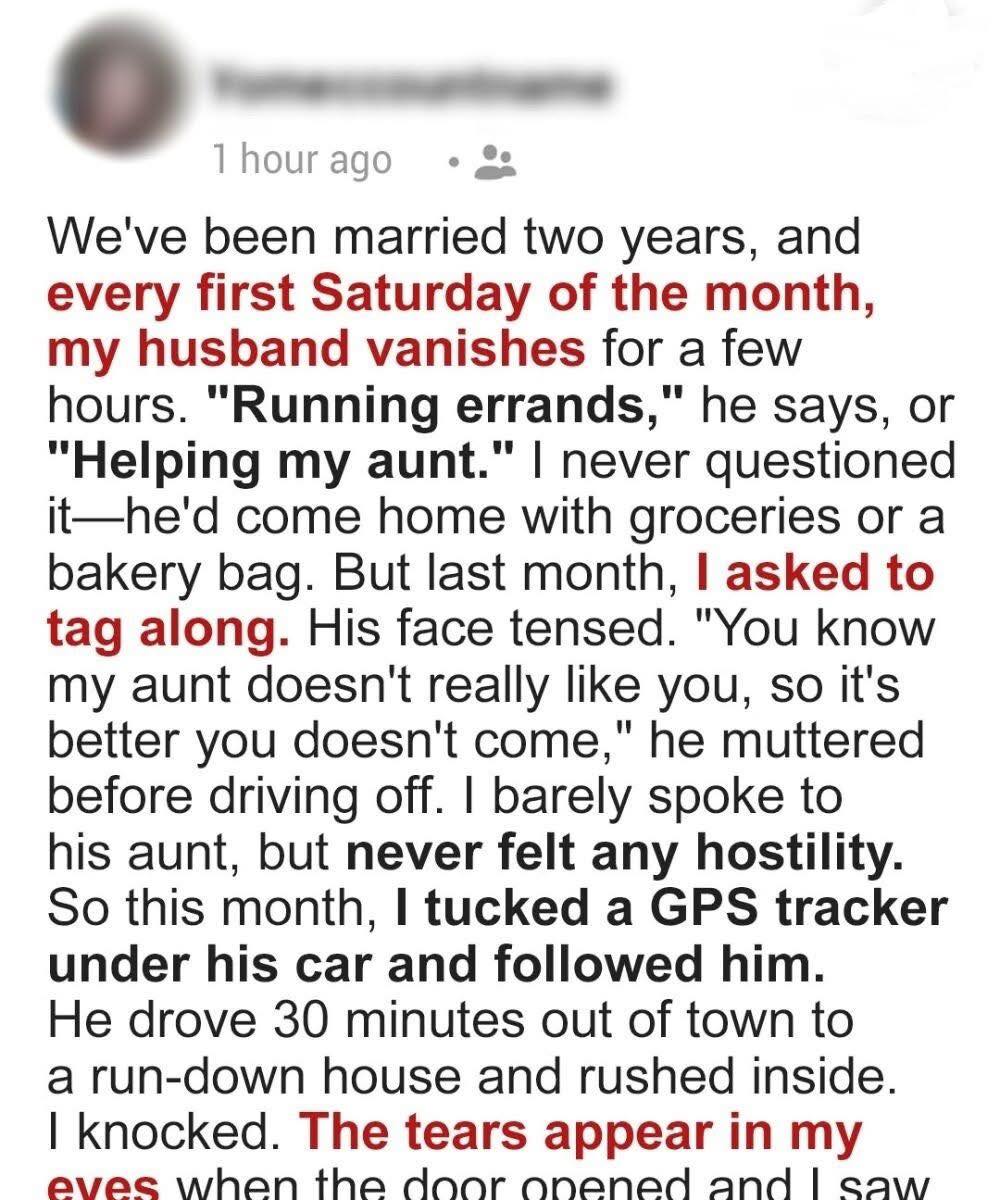
We’ve been married two years, and every first Saturday of the month, my husband, David, vanishes for a few hours. “Running errands,” he says, or “Helping my aunt.” I never questioned it—he’d come home with groceries or a bakery bag. But last month, I asked to tag along. His face tensed. “You know my aunt doesn’t really like you, so it’s better you don’t come,” he muttered before driving off. I barely spoke to his aunt, but never felt any hostility.
So this month, I tucked a GPS tracker under his car and followed him. He drove 30 minutes out of town to a run-down house and rushed inside. I knocked. The tears appear in my eyes when the door opened and I saw my husband sitting on a threadbare carpet, feeding a frail woman I had only ever seen in one faded, tattered photograph: his mother, the woman he told me had died in a car accident ten years ago.
The Saturday Ghost
For two years, I lived with a ghost. Not a literal one, but the ghost of a secret that occupied every first Saturday of the month. David was the perfect husband in every other way—attentive, hardworking, and deeply kind. But that one day a month was a closed door.
When he told me his Aunt Martha didn’t like me, it felt like a slap. Martha was a quiet woman who lived in a tidy condo on the other side of the city. We saw her at Christmas and Easter. She was always perfectly pleasant, if a bit reserved. The idea that she harbored a secret “hostility” toward me felt wrong, but I didn’t want to be the “pushy wife.” I let it go, assuming maybe there was some family drama I wasn’t privy to.
But curiosity is a slow-growing vine. It eventually chokes the life out of trust. The GPS tracker was a desperate move, born of a late-night panic that maybe “Aunt Martha” was code for “someone else.” I expected a motel. I expected a second family. I didn’t expect a shack on the edge of the county line.
The Reveal
The house was a disaster. The porch was sagging, and the paint was peeling in long, grey strips like dead skin. When David didn’t answer my text, I walked up the steps, my heart hammering against my ribs. I knocked, ready for a confrontation.
When the door opened, David stood there. He didn’t look angry. He looked defeated. He stepped aside, and that’s when I saw her.
She was sitting in a wheelchair, her hands gnarled by arthritis, her eyes clouded but focused on a small television in the corner. David was holding a bowl of soup. The room smelled of lavender and old paper.
“David?” I whispered. “You told me she was dead.”
He didn’t look at me. He looked at the floor. “I wanted her to be,” he said, his voice a jagged edge. “For her sake. And for mine.”
The Burden of the “Self-Made Man”
David and I met when he was a rising star at a tech firm. He was polished, educated, and seemed to have come from a world of stable, middle-class comfort. He told me his parents were gone—his father a distant memory, his mother a tragic loss in his late teens. I sympathized. I loved him for the strength it must have taken to build such a successful life on his own.
But David’s “success” was built on a foundation of deep, systemic shame.
As we sat in that cramped, dim living room while his mother drifted in and out of sleep, the truth poured out. His mother hadn’t died in a car crash. She had “died” to the world when her mental health collapsed following his father’s abandonment. She had spent years in and out of state facilities until David was old enough to take her out.
But David was ashamed. He was ashamed of the poverty he grew up in, the “hoarder house” that had been his childhood, and the woman who occasionally forgot who he was. When we started dating, he was so terrified that my “perfect” family would reject him if they saw where he came from that he invented a new history. He buried his mother in a fictional grave because he thought it was the only way I would love him.
The Mental Load of a Secret
For two years, David had been living two lives. He was the high-flying executive and doting husband from Monday to Friday. But on Saturdays, he was a caregiver. He used the “bakery bags” and “groceries” he brought home to explain his absence, but the reality was that he spent those hours scrubbing floors, managing her medication, and paying a local woman under the table to watch her the rest of the month.
This is the hidden “mental load” of the working class who “make it.” David wasn’t just managing our household; he was managing a hidden, decaying one. He was funneling thousands of dollars into a house I didn’t know existed, terrified that every cent spent was a betrayal of our shared future, yet unable to abandon the woman who had once done her best for him.
“I didn’t want you to see this,” he sobbed, his head in his hands. “I didn’t want you to see her like this. I wanted you to have a husband who was… whole. Not someone with a mother who lives in a dump and calls him by his father’s name half the time.”
The Myth of the Perfect Partner
David’s secret reveals a heartbreaking truth about modern relationships: the pressure to be “curated.” We live in an era of social media highlights and “perfect” origin stories. We feel that to be worthy of a partner, we must present a version of ourselves that is free from the messiness of our pasts.
David thought that by revealing his mother’s illness and his family’s poverty, he would become “damaged goods.” He didn’t realize that in marriage, the “ugly” parts are where the deepest intimacy is built. By keeping her a secret, he had robbed me of the chance to support him. He had been carrying a mountain on his back while I thought he was just out getting bagels.
His Aunt Martha wasn’t hostile; she was a co-conspirator. She had been helping him manage the secret, acting as a “buffer” and a fake destination to keep me off the trail. David hadn’t lied to protect himself; he lied because he thought he was protecting me from the “burden” of his reality.
The Road to Reconciliation
That night, we didn’t go home for hours. I helped him bathe her. I helped him change the sheets. I saw the way his hands shook when he touched her, a mix of love and profound resentment for the life she had been forced to live.
I realized then that the “Aunt Martha” lie wasn’t just a cover; it was David’s way of distancing himself from his own pain. If he told me she was his aunt, it was a chore. If he told me she was his mother, it was a tragedy.
We had a long, painful talk on the drive home. I told him that I wasn’t angry about his mother; I was angry that he thought so little of my love that he felt he had to hide her.
“You married me,” I told him. “You didn’t marry a spectator. You married a partner. If your mother needs care, we care for her. If the house is falling down, we fix it. You don’t get to decide what I can and can’t handle.”
Rebuilding the Foundation
It has been three months since I followed that GPS tracker. The run-down house is empty now. We moved David’s mother into a specialized care facility ten minutes from our home—one that is clean, bright, and has professional staff to manage her needs.
The financial strain is real, but it’s a shared strain now. We’ve had to cut back on vacations and eating out, but the house feels lighter. The “First Saturday” vanishings are gone. Now, we go together on Sunday afternoons. David’s mother still doesn’t always know who I am, but she smiles when I bring her those same bakery cookies David used to buy as “evidence” for his lies.
David is different, too. The tension in his shoulders has dissipated. He doesn’t flinch when his phone rings. He has stopped trying to be the “perfect man” and has started being a human man. He realized that my love wasn’t a reward for his success; it was a sanctuary for his struggle.
Why Secrets Destroy Even When They Protect
This experience taught me that secrets in a marriage are rarely about the “what.” They are about the “why.” David’s lie was a protective one, but it was still a wall. Every time he drove off to that house, he was telling me, “I don’t trust you with the real me.”
When we hold back our traumas or our family’s “shameful” secrets, we are essentially telling our partners that their love is conditional. We are saying, “You love the version of me I’ve created, but you wouldn’t love the version I actually am.”
To anyone reading this who is hiding a “run-down house” in their past: let your partner in. The fear of rejection is a shadow that grows longer the more you run from it. When you turn and face it together, the shadow disappears.
Final Reflection
I still have that GPS tracker. It’s sitting in a drawer in the kitchen. Sometimes I look at it and feel a twinge of guilt for the way I went behind David’s back. But then I think of the woman in the wheelchair and the look on David’s face when the secret finally broke.
The tears that appeared in my eyes that day weren’t just tears of shock. They were tears of relief. The mystery was over, and the real work of being a family could finally begin.
Marriage isn’t about two perfect people living a perfect life. It’s about two people standing in the middle of a mess and deciding that they’d rather be there together than anywhere else alone.
David’s mother is sleeping now, in a room filled with photos of the son she raised and the daughter-in-law who finally knows her name. And David is sitting on the couch next to me, his hand in mine, no longer a ghost in his own hallway.