The moving truck stopped outside Aunt Lydia’s house on a Sunday afternoon, and my mother told me I had until Monday to leave.
She said it from the bottom of the porch steps, as though she were reminding me about a dentist appointment.
“Pack whatever belongs to you, Jake. We don’t need to make this unpleasant.”
Behind her, Ryan stood with a manila envelope tucked against his chest. Two movers waited near the truck. One had already lowered the ramp.
I set my coffee on the table.
“Whose belongings are those?”
Ryan glanced over his shoulder at the open truck.
“Mine. Some of Mom’s things too.”
He wore sunglasses, although the porch shaded his face. I could see myself reflected in the lenses: seated, barefoot, one hand resting against the arm of Lydia’s old chair.
“You hired movers before talking to me?”
“We’ve already talked about this.”
“No. You’ve told me what you wanted.”
He lifted the envelope.
“And now it’s settled.”
My mother looked past me through the open front door. She had that measuring expression people get when they are deciding where furniture should go. For a moment, I wondered whether she had already chosen a place for Lydia’s dining table to disappear.
“You don’t need this whole house,” she said.
Neither of them asked whether I was all right.
Lydia had been gone for weeks. Her slippers were still under the bench near the kitchen. I had moved them twice while cleaning, then put them back because I couldn’t bring myself to decide where they belonged now.
But my mother hadn’t come to discuss grief.
Ryan hadn’t come to remember his aunt.
They had come with a truck.
I looked at the older mover. He was checking something on his phone, giving us the practiced privacy of a man who had probably witnessed plenty of arguments beside driveways.
“You might want to leave everything where it is,” I told him.
Ryan laughed.
“Don’t put him in the middle of this.”
“You brought him into the middle.”
Mom folded her arms.
“Jake, we’re not doing another afternoon of arguing.”
“Then you probably shouldn’t have brought a moving company.”
Her mouth tightened.
Ryan stepped closer to the stairs.
“Look, I know you’re upset. But there’s no point dragging this out. The paperwork’s finished.”
“What paperwork?”
“The deed.”
He patted the envelope.
“House is in my name.”
For a moment, neither of us moved.
An oak branch brushed against another above the driveway. Somewhere behind the house, a bird kept making the same sharp, impatient call.
Ryan seemed to mistake my silence for shock.
“Sorry, bro,” he said. “It’s done.”
I looked at the envelope, then at my mother.
She held my gaze.
That hurt more than Ryan’s grin.
She knew I had spent twelve years coming to this house every Thursday. She knew Lydia had been more than a relative I saw on holidays. She knew I still sometimes reached for my phone to call her before remembering.
And she was standing there telling me to pack.
“Out by Monday,” she repeated. “That gives you tonight to sort things.”
I leaned forward and picked up my coffee.
“You honestly thought I wouldn’t prepare for this?”
Ryan pulled off his sunglasses.
“For what? Your family getting what it deserves?”
Before I could answer, Mr. Whitmore came through the doorway behind me.
He had arrived earlier to discuss the documents his office had been notified about. I had asked him to stay when I saw the truck approaching.
My mother recognized him immediately.
The certainty in her face shifted.
Ryan glanced between us, then straightened, trying to recover the appearance of a man in charge of his own arrival.
Whitmore carried a black folder.
Nothing about him was dramatic. Dark trousers, a pale shirt, reading glasses folded into his breast pocket. He looked like someone who had expected a quiet working afternoon and found a moving truck blocking his view.
He stopped beside my chair.
“Good afternoon.”
Mom answered first.
“What are you doing here?”
“Reviewing a matter concerning the property.”
Ryan raised his envelope.
“Perfect. We can clear this up.”
Whitmore looked toward the truck.
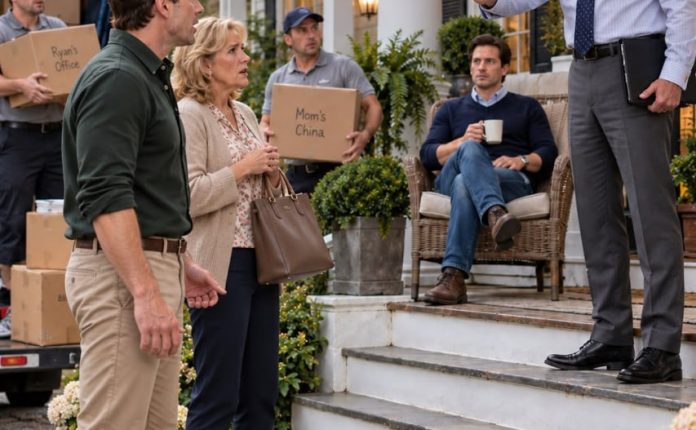
One mover had lifted a box from the stack near the opening. Written across its side in thick black marker were the words Mom’s China.
“Before anything comes inside,” Whitmore said, “I suggest you establish who has authority to occupy this house.”
The mover lowered the box.
Ryan’s laugh came too quickly.
“We’ve established it.”
He slid the envelope out from under his arm.
“I have the deed.”
Whitmore didn’t reach for it.
“You have paperwork.”
Ryan frowned.
“A deed.”
“A document claiming to transfer an interest in this property.”
“That’s what a deed does.”
“When executed by someone with the authority to make the transfer, yes.”
Mom moved closer.
“This is ridiculous. Everything was filed.”
“I’m aware.”
That stopped her.
Ryan turned toward her before looking back at Whitmore.
“How are you aware?”
“My office received notice.”
“From who?”
“From parties involved in the records.”
Whitmore opened the black folder.
Ryan watched his hands.
I had watched those same hands sort Lydia’s estate documents after her death. Whitmore had never hurried me through a signature. If I asked a question twice, he answered it twice. When I apologized for taking too long, he told me that signing something I understood was considerably more useful than signing something quickly.
That had been the first relief I felt after the inheritance became public within our family.
Someone was willing to slow things down.
Everyone else seemed to have a reason I should decide immediately.
Mom wanted to discuss Ryan’s needs.
Ryan wanted to discuss what was fair.
Relatives who had barely spoken to Lydia wanted to discuss what she would have wanted.
Whitmore wanted me to read the next page.
Now he removed several sheets and looked directly at my brother.
“You appear to believe Jake personally holds title to the house.”
“He inherited it.”
“Yes.”
“Then Mom helped transfer it.”
“Those are two different assertions.”
Ryan rubbed his thumb along the envelope’s seam.
“Can you just say what you’re trying to say?”
“Jake inherited Lydia’s estate. Three weeks later, he completed further planning concerning those assets.”
Ryan looked at me.
“What planning?”
I stayed seated.
Whitmore answered.
“The residence is held in an irrevocable trust.”
My mother blinked.
“A what?”
“A trust. The property was placed within that structure as part of Jake’s estate planning.”
Ryan stared at the pages.
Then he shrugged.
“All right. So he did some tax thing.”
“That is not an accurate description.”
“Whatever it is, he inherited the house first.”
“He did.”
“Then it was his.”
“At that point.”
Mom stepped onto the first stair.
“Jake owned this house.”
Whitmore looked at her.
“Previously.”
The word was quiet.
It made her stop.
Ryan held the envelope a little farther from his chest, as though he suddenly needed to inspect what he had been carrying.
I remembered signing the trust documents.
I had been tired that day. Not tired of Lydia, or of what she had left me, but tired of feeling that every conversation required me to defend a decision I hadn’t made.
I had never asked her for the house.
I had never asked what her accounts contained.
Until Whitmore explained the estate, eight hundred fifty thousand dollars had been a number with no place in my life.
Afterward, it seemed to follow me everywhere.
My mother would call to ask whether I had eaten, and three minutes later we would be discussing how unfairly life had treated Ryan.
Ryan would send a message about something ordinary, then ask whether I planned to sell investments.
The money had entered the room before I did.
The trust didn’t erase that pressure. It put something solid between the pressure and a decision.
I had rules to consult. Documents to read. Professional advice to seek.
For a person who had spent most of his life saying yes before considering whether he wanted to, that mattered.
Ryan pointed toward the house.
“Then who owns it?”
“Title is held through the trust,” Whitmore said.
“So Jake put it into some company?”
“No.”
“Then what are we talking about? A trust isn’t a person.”
“No, it is not.”
“This sounds like technical nonsense.”
Whitmore’s expression remained level.
“It is the technical detail that determines who can act concerning the property.”
Ryan stopped moving the envelope.
Mom came up another stair.
“If Jake created it, he can get rid of it.”
“An irrevocable trust does not simply disappear because a relative objects to it.”
“He can take the house out.”
“Not at will.”
“He can sell it.”
“Any action concerning the property must comply with the governing documents and applicable law.”
“Then he can give it to Ryan.”
“Again, that is not something accomplished by your preference.”
My mother looked at me.
For the first time that afternoon, she seemed to understand that my calm wasn’t a performance.
I wasn’t waiting for her to approve my objection.
I wasn’t trying to persuade Ryan to be reasonable.
There were facts they couldn’t alter by standing closer to me.
“You did this behind our backs,” she said.
“I handled my inheritance.”
“You knew how we felt.”
“Yes.”
“And you went ahead anyway.”
I put my cup down.
“That’s what making my own decision looks like.”
Ryan gave a sharp exhale.
“He knew we were entitled to some of it. That’s why he hid everything.”
Whitmore closed the folder halfway, keeping one finger between the pages.
“Your aunt’s will determined the distribution of her estate.”
“And she handed all of it to him.”
“Yes.”
“My mother was her sister.”
“Yes.”
“I was her nephew.”
“So was Jake.”
“That doesn’t answer anything.”
“It answers who had authority to decide.”
Ryan looked away, toward the upstairs windows.
I didn’t know then that he had already chosen one of those rooms for his office.
But I could see him trying to hold on to the house in his mind.
He wasn’t looking at a place where Lydia had lived. He was looking at something he had been told was finally his.
“Why would she give him everything?” he asked.
Whitmore studied him for a moment.
“That question concerns your relationship with your aunt.”
Ryan’s jaw moved.
“She was my family.”
“She was.”
“So what was wrong with me?”
Nobody answered immediately.
I could have repeated what Lydia had said during one of our Thursday evenings. She had been sitting at the kitchen table, peeling an orange with a butter knife because she refused to believe any task required the correct utensil.
“You come here because you want to see me,” she’d told me.
I had laughed.
“Usually.”
She had pointed the knife at me.
“That puts you ahead.”
At the time, I’d thought she was being funny.
Now my mother and brother stood in her driveway demanding an explanation of her affection as though it were an accounting error.
I didn’t want to use that memory as a weapon.
“She made her decision,” I said.
Ryan turned back.
“And you were happy to take it.”
“I was grateful. I was also grieving.”
“Convenient.”
Mom touched his arm.
The older mover cleared his throat.
“Excuse me.”
Ryan spun toward him.
“What?”
“We’re going to keep the truck loaded until you sort this out.”
“It is sorted.”
The mover glanced at Whitmore.
Then at me.
“With respect, sir, I don’t think it is.”
“I’m the one paying you.”
“For a move.”
“Exactly.”
“To a property you have permission to move into.”
Ryan pointed at the envelope.
“I have permission.”
Whitmore spoke before the mover could answer.
“These papers do not establish that.”
The younger mover had already picked up the box his partner had set down. He carried it back to the truck.
Ryan watched him.
“Seriously?”
The older man nodded.
“Yes, sir.”
“Because this guy says so?”
“Because there’s a dispute about whether you can move in.”
He didn’t sound frightened of Ryan.
He sounded like a man who wanted to finish a job without becoming part of somebody else’s problem.
Another box went back onto the truck.
Ryan’s Office.
I looked down at my hands.
A small, unwilling smile caught me before I could stop it.
Ryan saw.
“You think this is funny.”
“No.”
“You’re enjoying yourself.”
I stood.
His shoulders tightened, although I wasn’t moving toward him.
“I don’t enjoy being told to leave a house Lydia deliberately left to me.”
He started to interrupt.
I kept going.
“I don’t enjoy seeing strangers bring your boxes toward her door. I don’t enjoy Mom looking me in the face and giving me a deadline.”
Mom looked away.
“But you’re pleased we didn’t get it.”
“I’m relieved you didn’t take it.”
“That’s the same thing.”
“It doesn’t feel the same from where I’m standing.”
I picked up my cup because I wanted something ordinary in my hand. The coffee had gone cold.
Whitmore waited until the movers were both beside the truck.
“Who prepared the document, Ryan?”
My brother glanced at Mom.
She answered before he could.
“A property consultant.”
Whitmore’s eyebrows lifted slightly.
“What sort of consultant?”
“Real estate.”
“Did an attorney prepare it?”
“He handles these matters.”
“That wasn’t my question.”
Ryan held out the envelope.
“The county accepted the paperwork.”
Whitmore finally took it.
He removed the contents and looked through the pages without giving us a running commentary. The silence became harder to sit in than any of Ryan’s accusations.
Mom rubbed the inside of her wrist.
Ryan watched the top sheet.
I watched my mother.
She had been forceful about the deadline, forceful about my selfishness, forceful about what Lydia should have done.
Now she seemed unable to decide where to put her hands.
Whitmore looked up.
“A document being recorded does not necessarily mean it validly transfers title.”
Ryan’s face changed.
“But it went through.”
“It entered the records.”
“So it’s official.”
“It is recorded. Whether the assertions in it are valid is a separate matter.”
My brother looked at Mom.
She didn’t look back.
Whitmore laid the papers against the folder.
“If someone claimed authority they did not possess, this may extend beyond an argument within the family.”
“We didn’t forge anything,” Mom said.
The words came out fast.
The driveway went still.
Whitmore looked at her.
“I haven’t suggested a specific offense.”
Ryan lowered his envelope hand.
“Mom?”
She lifted her chin.
“I’m telling him what happened.”
“What happened?”
“Nothing improper.”
“What did you sign?”
“Ryan.”
“What did you sign?”
My mother looked irritated, but there was fear beneath it now. I recognized the irritation. It was what she used when a question threatened to stop being something she could manage.
“We were advised that I had standing as Lydia’s sister.”
Whitmore’s attention sharpened.
“Standing for what?”
“To correct the distribution.”
“By challenging the estate?”
“To correct who owned the house.”
“There is no general right to transfer someone else’s property because you disagree with a will.”
“The consultant said there were options.”
“There may be procedures for challenging an estate. That does not mean a person can prepare a transfer without authority.”
Ryan turned fully toward her.
“You told me this was finished.”
“It was supposed to be.”
“You said the house was mine.”
“That’s what I was told.”
“By a consultant?”
“He works with attorneys.”
“You said a lawyer handled it.”
“I said people who knew what they were doing.”
Ryan stared at her.
The distinction was one she would once have expected both of us to accept. I had heard versions of it all my life: she hadn’t promised, exactly; she hadn’t said that, precisely; we should have understood what she meant.
This time, Ryan didn’t help her past it.
“Who was he?”
She hesitated.
Whitmore waited.
Mom finally gave a name I didn’t recognize.
Whitmore did.
The change in his expression was slight, but she noticed it.
“What?” she asked.
He didn’t offer her reassurance.
“Did you pay him?”
“That is between me and him.”
“How much?” Ryan asked.
She looked toward the gate.
“How much, Mom?”
“Six thousand.”
Ryan blinked.
“Dollars?”
“Of course dollars.”
“For this?”
“He said he could resolve the situation.”
“Which money?”
She said nothing.
The movers had returned to their truck. The ramp made a dull metallic sound as one of them adjusted it.
Ryan took a step backward.
“Our account?”
“Ryan, we were trying to get you established.”
“You used the money in our account?”
“You were going to have a house.”
He pressed the heel of one hand against his forehead.
“Six thousand dollars.”
“It would have been worth it.”
“That’s what was left.”
His voice had lost its volume.
That made the words worse.
Mom reached for his arm again. He moved it away.
For the first time, I could see the gap between what she had done and what he believed she had done.
Ryan had wanted the house. He had arrived prepared to order me out. He wasn’t an innocent spectator.
But he hadn’t known everything.
He had accepted her version because it gave him what he wanted, and she had relied on that acceptance because it spared her questions.
Now the questions were coming.
“I thought an actual lawyer approved this,” he said.
“He told me he dealt with attorneys.”
“You keep saying that.”
“Because it’s true.”
Whitmore returned the pages to the envelope.
“Mrs. Carter, you should seek independent legal advice.”
My mother looked at him.
“Independent of whom?”
“Of anyone who prepared or recommended this filing.”
“And then what?”
“Then you can explain precisely what you were told, what you signed, and what was submitted.”
“Are you threatening me?”
“No.”
“Because this was a family matter.”
“It concerns property records and representations made in documents. Calling it a family matter does not resolve those issues.”
She looked at me then.
Not at Whitmore.
At me.
As though I were supposed to step between her and the consequences.
That reflex moved through me before I could stop it. I almost said we would work it out. I almost promised nothing bad would happen.
I didn’t know whether either statement was true.
So I said nothing.
Ryan shoved the envelope beneath his arm again, but there was no confidence in the gesture now.
“Come on,” he told her.
“We haven’t finished.”
“Yes, we have.”
“Jake needs to—”
“No. We need to find out what you paid for.”
My mother’s face tightened at being spoken to that way, especially in front of me.
But she went down the stairs.
At the bottom, she looked back once.
“You could have told us about the trust.”
“I could have.”
“Then this wouldn’t have happened.”
I held her gaze.
“You could have asked before hiring movers.”
She turned away.
Ryan spoke briefly to the older mover. I couldn’t hear every word, only the rough shape of frustration and the mover’s steady replies.
The truck pulled away first.
My mother stood beside Ryan’s car while he searched his pockets for the keys. Neither of them looked at the porch again.
When they finally drove down the long driveway, I remained standing.
The gate closed behind them.
Only then did I notice how hard I had been gripping the cup.
Whitmore set his folder on the table.
“Sit down, Jake.”
I did.
The chair creaked under me.
For several seconds, neither of us spoke. The afternoon had returned to its ordinary sounds, but I couldn’t make myself feel ordinary inside them.
“Can they take it?” I asked.
“Nothing I’ve reviewed gives them ownership merely because a document was recorded.”
“What happens next?”
“We examine the filing carefully and address the records. Their advisers will need to examine their position as well.”
I nodded.
My throat felt dry.
“How bad is this going to be?”
“That depends on the documents and the representations behind them.”
He spoke without promising an easy outcome. I was grateful for that, even though I wanted him to tell me everything had already ended.
He waited while I set the cup down.
Then he opened the black folder again.
“There’s something else Lydia asked me to give you under particular circumstances.”
He took out an envelope.
It was cream-colored, softened slightly at the corners, with my name written across the front.
I knew the handwriting before I had it in my hands.
Jake.
The J leaned farther than the rest of the letters. Lydia had always written it that way, on birthday cards, on the envelopes holding photographs she thought I should take home, on notes she taped to the refrigerator so I wouldn’t forget leftovers.
I ran my thumb beneath my name.
“When did she write this?”
“About eight months before she died.”
“Why am I only getting it now?”
“She left instructions.”
I looked up.
“What instructions?”
“That I should give it to you if your mother or brother attempted to interfere with the house after her death.”
I stared at him.
Behind us, the screen door moved gently in its frame.
Lydia had been gone for weeks.
And somehow she had still managed to be ready for Sunday.
END PART 1