The figure people remembered was eight hundred fifty thousand dollars.
When they asked about Lydia’s estate, that was usually the part they said first.
They wanted to know what it felt like.
They wanted to know what I would do.
Some spoke as though the money had removed every difficult decision from my life. Others spoke as though having inherited it meant every decision I made was now open for discussion.
The number was substantial. I never pretended otherwise.
It also wasn’t the entire inheritance.
There was a house to maintain.
There was land that continued growing whether I felt ready to care for it or not.
There were insurance questions, taxes, investments that didn’t hold the same value every day, and repairs that couldn’t be postponed simply because I found them emotionally inconvenient.
Lydia had done the work of owning things.
Now some of that work belonged to me.
At first, I thought responsibility would make the house feel less like hers.
A contractor would ask about a repair, and I would look around as though Lydia might emerge from another room and explain how she preferred it handled.
She didn’t.
I had to answer.
Sometimes I checked with professionals. Sometimes I made a decision and discovered afterward that another choice might have been better.
The house remained standing.
I began to understand that caring for it didn’t require getting everything right.
It required paying attention.
That was what Lydia had done for me.
She had noticed when I was tired before I explained why. She had noticed when I was speaking carefully to avoid admitting I was upset. She had noticed when I said something was fine and then stared at the floor.
Now I noticed the loose hinge, the damp patch, the weeds finding an opening beside the path.
The work was ordinary.
That helped.
After weeks of people arguing about what the house represented, I could spend an afternoon doing something it actually needed.
The trust remained part of the practical structure around those decisions.
I took advice.
I followed the terms.
I made plans without treating every relative’s suggestion as something I had to answer immediately.
Gradually, the number stopped arriving in my mind before the house did.
I saw the porch.
The kitchen.
The upstairs windows.
The place where I had spent Thursdays without ever imagining them as an investment.
Six months after the moving truck, my mother called on a Sunday.
“Are you at home?”
“Yes.”
“Could I come over?”
“Yes.”
She didn’t explain why.
I didn’t ask.
By then, I had learned that leaving room for someone to speak was different from rushing in to supply whatever might spare them discomfort.
She arrived carrying a small cardboard box.
For a moment, the sight of it tightened something in my chest.
Then she lifted the lid.
“Photographs.”
I stepped aside.
She came into the kitchen and set the box on the dining table.
Some of the pictures were loose. Others had been tucked into envelopes whose flaps had worn soft from being opened.
Mom sat down and began taking them out.
Lydia as a child.
My mother beside her.
Matching dresses.
A car with a shape so old it made the women standing beside it look even younger.
A beach.
Bare feet.
Faces I knew and faces I could only place by asking.
“They were together,” Mom said, arranging two photographs side by side. “These were from the same summer.”
I leaned closer.
Lydia had one hand on her hip. Mom was squinting toward whoever held the camera.
“They look annoyed.”
“They were annoyed.”
“Why?”
“The dresses.”
“Both of them?”
“We hated both.”
I laughed.
Mom smiled, and for a moment I could see the girl in the photograph inside the woman beside me.
She touched Lydia’s face with one fingertip.
“Your aunt said the collar was trying to choke her.”
“That sounds right.”
“She kept pulling it away from her neck. Our mother told her to stop fidgeting.”
“Did she?”
“No.”
We both laughed.
It wasn’t a large moment.
That made it easier to trust.
Mom moved another picture across the table. In it, the sisters stood close enough that their shoulders touched. Neither appeared to be measuring the other.
I wondered when she had stopped seeing those moments clearly.
Or whether she had always remembered them and simply placed other memories over them.
She looked down at the photographs for a long time.
Then she said, “I’m sorry.”
I waited.
She raised her eyes.
“For trying to take the house.”
My hands remained on the edge of the table.
The old version of me would have interrupted immediately.
It’s okay.
Don’t worry about it.
We all made mistakes.
I didn’t say any of those things.
Mom swallowed.
“And for involving Ryan the way I did.”
I nodded once.
She looked back at Lydia’s photograph.
“I wanted him to have it. But that wasn’t the only reason.”
“I know.”
“I didn’t want her decision to stand.”
The admission came slowly, each part requiring its own effort.
“I kept telling myself she had been unfair. That I was making things right. But she had the right to choose.”
I looked at her.
“That’s what I needed you to understand.”
“I do.”
Her eyes shone.
“I should have understood it before any of this.”
“Yes.”
She pressed a tissue beneath one eye.
“Are we all right?”
“No.”
Her face fell.
I let the answer sit before adding anything.
It wasn’t punishment. It was the state of things.
I loved my mother.
She had stood at the bottom of my porch and ordered me out of my home.
Both facts existed.
“But I think we can work toward it.”
She nodded.
“All right.”
“No more telling me what I have to give somebody.”
“I understand.”
“And no pretending something is settled because you’ve decided it should be.”
“I understand.”
I studied her face.
She wasn’t arguing over the wording.
She wasn’t turning the conditions into an accusation that I didn’t trust her.
She looked tired, embarrassed, and willing to remain in the conversation.
That was more useful than a perfect apology.
We spent the rest of the afternoon going through photographs.
She told me which beach it was, who owned the car, and why Lydia had cut her own hair in one picture and regretted it immediately.
I didn’t need Lydia to become flawless after death.
I liked hearing about the uneven haircut.
I liked knowing she had once been young enough to believe scissors and confidence were sufficient preparation.
Mom laughed telling it.
Then she grew quiet.
“I forget she was a girl sometimes.”
“So do I.”
“She was always older than me in my head.”
“She was your older sister.”
“I know. But even after we were both old.”
I looked at the pictures.
For years, my mother had carried Lydia as an authority she resented. I had carried her as a refuge. Neither version contained all of her.
The photographs helped.
They gave us someone neither of us had entirely known: a girl in an uncomfortable dress, a young woman beside a car, a sister laughing before every accomplishment had become something to compare.
When Mom left, she asked whether I wanted to keep some of the pictures.
“Yes.”
She separated a small group.
“Keep these.”
I thanked her.
The box she took home was lighter than the one she had brought.
So was the conversation.
But we didn’t declare anything repaired.
Some weeks afterward were awkward.
Mom sometimes started a sentence in the familiar way, offering advice that sounded very much like an instruction.
Then she stopped.
Occasionally I had to stop her.
Occasionally I had to stop myself from agreeing simply because she expected it.
Progress looked less like a single breakthrough than a conversation interrupted at the right moment.
A year after the truck arrived, I sat on Lydia’s porch with coffee in the same chair.
The oak trees had filled out again.
The gate still made its little hesitation before moving.
The house had survived a year of belonging to someone who often felt he was learning ownership one repair at a time.
Ryan pulled into the driveway alone.
He got out carrying a toolbox.
I had told him the kitchen faucet still leaked.
He lifted the box as he came toward the porch.
“You ever get that fixed?”
“No.”
“You know plumbers exist.”
“I’ve heard.”
“Then again, why pay someone when you can put your brother to work?”
“That’s the idea.”
He rolled his eyes.
At the door, he stopped.
“Can I come in?”
I looked at him.
A year earlier, he had arrived with movers and considered the question irrelevant.
Now he waited with a toolbox in his hand.
“Yeah,” I said.
He stepped inside.
The faucet repair took two hours.
Part of that time involved him telling me the job should be simple.
Another part involved him lying on his back under the sink, discovering why it wasn’t as simple as he had hoped.
I handed him tools when he asked.
Sometimes he asked for the wrong one.
Sometimes I handed him the wrong one.
Neither of us possessed Lydia’s confidence that any household task could be accomplished with whatever implement happened to be nearby.
Water ran across the bottom of the sink cabinet at one point.
Ryan looked up at me.
“Don’t say anything.”
“I wasn’t going to.”
“You were thinking something.”
“Yes.”
He went back to work.
When he finally emerged, his shirt was dusty and one sleeve was damp.
We turned the faucet on.
Then off.
We watched.
A drop formed slowly.
Ryan frowned.
“Wait.”
I waited.
The drop fell.
“That might be left over.”
“Of course.”
We waited some more.
It was repaired badly enough to be recognizably our work, but repaired well enough to stop the problem that had brought him there.
Ryan shut the toolbox.
“I’ll accept pizza.”
“I was planning on a certificate.”
“Pizza.”
I ordered it.
Mom came later.
She knocked.
That mattered too.
Not because I had imposed a rule that every arrival needed ceremony, but because permission had once been something she believed she could arrange for herself.
Now she let me open the door.
We ate in Lydia’s kitchen.
Ryan complained that he had spent two hours under a sink and should therefore choose the first slice.
Mom told him that was not how pizza worked.
He asked when she had become an authority.
She told him she had been feeding him for years.
For a second, the conversation hovered near something familiar and uncomfortable.
Then Ryan smiled.
“And doing a great job.”
Mom shook her head, but she was smiling too.
Nobody asked what the investment accounts were worth.
Nobody suggested a transfer.
Nobody spoke about the recorded documents or the six thousand dollars.
The silence around those subjects felt different from avoidance.
We knew what had happened.
We had discussed it.
We simply didn’t need to place it at the center of every meal.
I looked at the chair Lydia had used.
It was empty.
I wished she could have been there without wishing the evening were something other than what it was.
My family sat in her kitchen, bruised by what we had done and trying to behave differently.
She would probably have had something sharp to say about Ryan’s plumbing.
I could almost hear it.
People who heard about the confrontation later wanted to know what was in Whitmore’s black folder.
They asked as though he had produced a hidden will at precisely the right moment.
Or uncovered another fortune.
Or revealed something about Ryan that would explain why Lydia left him nothing.
There was no spectacular secret.
There were trust records.
Property information.
Correspondence.
A timeline.
Lydia’s letter.
Ordinary papers, prepared and kept where they could be found.
That was enough.
I had seen how my family tried to make their version of events feel finished before I could question it.
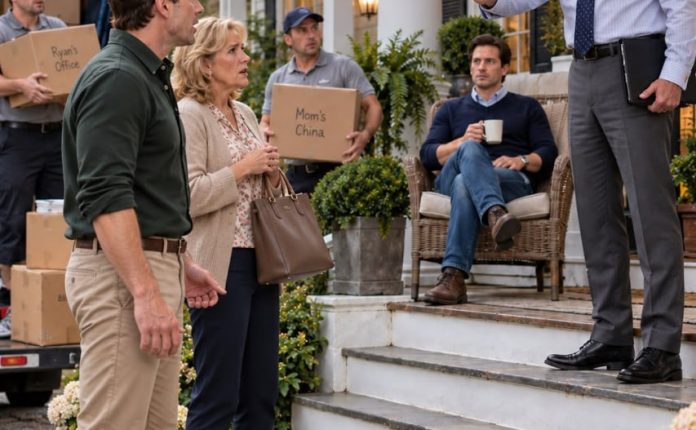
The truck helped.
The labeled boxes helped.
Ryan’s sunglasses, his envelope, my mother’s deadline: each gave the afternoon the appearance of a decision already made.
If I had reacted only to that appearance, I might have spent the first hour wondering where to go.
Instead, someone had checked the records.
Someone had kept the dates.
Someone could explain the difference between a document being recorded and a document creating valid authority.
Whitmore didn’t defeat them by speaking louder.
He asked them to establish what they claimed.
They couldn’t.
That distinction stayed with me.
It was familiar in my work, where a confident assertion still needed to be checked.
I had somehow believed family should be different.
Not exempt from mistakes, exactly.
Exempt from the need to verify.
The afternoon taught me how dangerous that assumption could become when affection and pressure occupied the same conversation.
I didn’t start treating every relative as a threat.
I did start reading before agreeing.
I started allowing silence after a demand.
I stopped believing a deadline became reasonable because my mother delivered it without raising her voice.
Three years have passed now.
I’m thirty-five.
I still work in cybersecurity, mostly from home.
Sometimes I take a call from a room Ryan once imagined as his office. I don’t think about that every time I enter it.
There are other things to think about.
Work.
The roof I had repaired last spring.
The gate that sticks when the temperature drops.
The dog that has decided one corner of the garden is a personal construction project.
Lydia’s house is still wrapped in ivy.
I keep an eye on it now instead of simply admiring how it looks.
Owning the place has changed what I notice.
Ryan comes about twice a month.
He has his own apartment, his own job, his own bills.
There are things he manages well and things he complains about.
He no longer talks about my house as though it is an answer waiting to be assigned to his problems.
Sometimes he brings food.
Sometimes he arrives to help with something and spends half the afternoon explaining why it would have been easier if I had done it differently.
I tell him he is welcome to leave.
He usually stays.
Mom visits too.
Our relationship has changed.
She sometimes wishes it could return to what it was.
I don’t.
There was warmth in the old relationship, but there was also a great deal I kept out of sight so the warmth wouldn’t be interrupted.
I know now that I can disagree with her and still open the door the following week.
She knows a request may receive an answer she doesn’t like.
We both survive it.
That has made some of our conversations shorter.
It has also made them more honest.
I don’t explain every refusal in six different ways until she finds one acceptable.
Sometimes I say I can’t.
Sometimes I say I don’t want to.
The first few times were harder than they should have been.
Now the words feel like part of an ordinary vocabulary I should have learned earlier.
Ryan eventually gave me the manila envelope.
He didn’t make a ceremony of it.
He brought it one afternoon and set it on the kitchen counter.
“You might as well have this.”
I looked at it.
“The original?”
“Yeah.”
“Why?”
He shrugged.
“I don’t want it.”
I could understand that.
For him, it held the shape of an embarrassment.
For me, it held a reminder I didn’t want to misplace.
I keep it in a drawer.
Not somewhere visitors can admire it.
Not somewhere Ryan has to see it whenever he comes over.
Beside it is Lydia’s letter.
The contrast matters to me.
One envelope carried a claim someone wanted me to accept.
The other carried the words of the person whose decision we were all supposed to respect.
When I open the drawer, I sometimes remember Ryan standing at the bottom of the porch, telling me there was nothing left to discuss.
He had sounded so certain.
I remember how close certainty can come to looking like proof when it belongs to someone you have known your whole life.
Then I remember my mother’s face when Whitmore said he was aware of the filing.
She had expected me to react.
She hadn’t expected anyone to have checked.
Lydia’s letter matters more than the envelope.
Especially the line about guilt and responsibility.
In my twenties, I had barely distinguished the two.
If Mom was unhappy, I searched for something I should have done differently.
If Ryan struggled, I wondered whether refusing him help made me selfish.
If someone said I had too much, I tried to reduce what I wanted until their discomfort looked smaller.
There were times I helped willingly.
I don’t regret those.
What I regret is how often I failed to ask myself whether I was choosing to help or merely trying to end the feeling that I had disappointed somebody.
Lydia saw that difference before I did.
She didn’t fix it by leaving me money.
Money made it more urgent.
But she left a decision clear enough that I eventually had to respect it, and words clear enough that I could return to them when respect felt difficult.
Sometimes I still replay the Sunday afternoon.
The ramp coming down.
Mom telling me to be gone by Monday.
Ryan lifting the envelope.
My cold coffee.
Whitmore stepping onto the porch.
I remember my own answer, the one about having prepared.
At the time, Mom and Ryan thought I was bluffing.
Later, people treated it like the clever line in a revenge story.
It didn’t feel clever when I said it.
It felt necessary.
I needed them to understand that I would not begin packing simply because they had arrived ready to occupy the place.
I had not set up the trust hoping to expose my mother in front of movers.
I hadn’t waited for Ryan to spend money on a truck so I could watch it leave.
I had wanted space to grieve and time to decide.
Lydia had left me both the resources and the opportunity.
My family’s expectations threatened to consume them before I could understand what they meant.
Once she died, people began speaking for her.
They knew what she would have wanted.
They knew what she would have considered fair.
They knew what she would have done if only she had understood Ryan’s situation properly, or my mother’s feelings, or how much everybody else needed.
The person missing from those explanations was Lydia.
She had already made a will.
She had already spoken to the lawyer.
She had already written the letter.
There was nothing respectful about making her wishes less clear so somebody else could feel better about them.
I didn’t owe everyone an outcome that pleased them equally.
I owed her care in handling what she had entrusted to me.
Some mornings, that care is paperwork.
Some afternoons, it is a repair.
Sometimes it is asking for advice instead of pretending I know what I’m doing.
And sometimes it is leaving the gate closed until I have decided whether I want company.
This morning, I carried my coffee onto the porch.
Sunlight came through the oaks in shifting patches.
The driveway was empty.
No truck waited near the gate.
No boxes stood beneath the steps.
On the table beside my chair was one of the photographs Mom had given me.
Lydia and my mother as girls.
Their knees were dirty.
Their bare feet pressed into the ground.
They had their arms around each other and were laughing at something outside the frame.
I looked at it for a while.
I didn’t need to know what had been funny.
I liked that there had been a time neither of them needed to win.
Beside the photograph lay Lydia’s letter.
I had brought it out because I was thinking about her, not because another problem had arrived.
I read the final paragraph.
She had told me to keep the house if I loved it, to sell it if that was the right decision, and to let the choice remain mine.
I folded the page along its familiar creases.
Then I looked back through the open door.
I loved the house.
I loved the kitchen where she had taught me to make pancakes and refused to let me forget the first batch I burned.
I loved the rooms where we watched implausible detectives find evidence neither of us would have overlooked.
I loved the porch where she complained about neighbors while planning what to bake for them.
I remembered her old dog asleep in the hallway, perfectly positioned to inconvenience anybody trying to pass.
I remembered the coffee she made too strong, then defended as though weaker coffee were a failure of character.
None of those memories required the house to be worth a particular amount.
They required Lydia.
For a long time, I had thought keeping the place would be a way to keep her close.
It has been.
But living here has also taught me that closeness survives changes.
The repaired roof doesn’t erase her.
My work filling a room doesn’t erase her.
Ryan fixing a faucet badly doesn’t erase her.
My mother apologizing at the dining table adds something the house can hold.
I can make a life here without treating every room as something I’m afraid to touch.
That is what Lydia gave me permission to do.
Ryan had come with movers because he saw real estate.
My mother had come with him because she saw a chance to overturn a choice that hurt her.
I had seen a home.
Not because I was more deserving in some way a spreadsheet could prove.
Not because being responsible meant I had earned a prize.
I had known the house when nobody was arguing about its value.
I had sat in it when the important question was whether Lydia wanted Chinese food or whether we should use what was already in the refrigerator.
I had come when the computer needed attention and when nothing needed attention at all.
The Thursdays had mattered while they were happening.
They hadn’t become meaningful only after Whitmore explained the estate.
That was the difference Lydia had understood.
I took a sip of coffee and heard the screen door settle behind me.
Later, there would be work.
The garden needed attention.
Ryan would probably call over the weekend.
Mom had photographs she still wanted to tell me about.
Life had become ordinary here again, though ordinary no longer meant keeping quiet at any cost.
I set the cup beside Lydia’s letter.
For twelve years, I had come up this driveway without asking what the house might someday give me.
I had knocked because she was inside.
Sometimes she opened the door before I reached it.
Sometimes she called from the kitchen and told me not to stand there letting the cold in.
And sometimes she came slowly down the hallway, smiling before either of us had said a word.
I would ask whether she wanted company.
She almost always did.
Everything that happened afterward began there, long before the will, the trust, the envelope, or the moving truck.
With a Thursday evening.
With someone waiting inside a house.
With the simple choice to keep showing up.
END PART 3