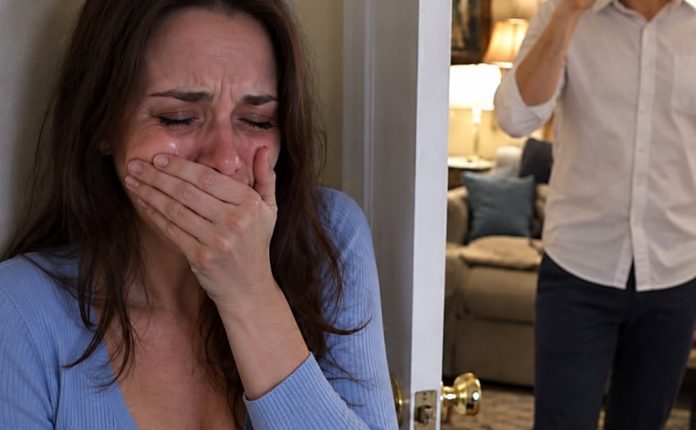
The first time I told my fiancé I would leave him, he was laughing.
We were on the couch after dinner, surrounded by the ordinary evidence of a life we were building together: two mugs on the coffee table, a folded load of laundry neither of us wanted to put away, a wedding checklist open on my laptop. I had spent the evening comparing hotel rooms for relatives. He had spent the last ten minutes scrolling through videos, occasionally tipping his phone toward me when something amused him.
Then he showed me a bride falling into a swimming pool.
At first, I thought it was an accident. The groom had one arm around her waist and another beneath her knees. She was smiling, one hand resting against his shoulder. He dipped her backward as though they were posing for a photograph. Then his hands opened. Her smile disappeared before she hit the water, and the people filming began to laugh.
My fiancé laughed with them.
“Look at his face,” he said, replaying the moment. “He knows exactly what he’s doing.”
I watched the bride surface. Her veil was plastered across her mouth. She reached toward the edge, but the fabric of her dress dragged behind her, making each movement awkward. Someone continued filming instead of helping. The groom bent over with laughter.
“That isn’t funny,” I said.
He glanced at me, still smiling. “It’s a pool. She’ll dry.”
“She didn’t agree to it.”
“You don’t know that.”
“Look at her.”
He watched the screen again. This time, I watched him. There was a small hesitation before he locked his phone, the kind that suggested he had noticed something he preferred not to discuss.
I closed my laptop. The wedding checklist disappeared, leaving our reflection in the dark screen.
“If you ever do that to me,” I told him, “I’ll walk away.”
He turned toward me.
“From the pool?”
“From you.”
For a moment, neither of us moved. The dishwasher hummed in the kitchen. Somewhere outside, a car door slammed, followed by the thin electronic chirp of a lock. I remember those sounds because the room had become so quiet around us that they seemed unusually clear.
Then he gave a short laugh.
“Come on.”
“I’m serious.”
“You think I’d actually throw you in a pool at our wedding?”
“I think you’re laughing at someone who trusted the person holding her.”
He set his phone facedown on the couch.
“I’m laughing at a video. That doesn’t mean I’m planning something.”
“I’m telling you now so there can’t be any confusion later.”
He rubbed his jaw, looking more inconvenienced than concerned. I knew that expression. He wore it when a conversation required more effort than he had expected, when something he considered settled turned out to matter to me.
I waited.
Eventually, he reached for my hand.
“Okay,” he said. “I wouldn’t do that to you.”
“Promise me.”
His thumb moved across my knuckles.
“I promise.”
I believed him.
That is the part I have returned to most often: not his laughter, not the splash, not even what he shouted afterward. I return to his face in our living room, his hand around mine, the ease with which he made a promise he would later break.
At the time, it felt like an ordinary disagreement resolved properly. We had different senses of humor. I had explained where mine stopped. He had listened, even if listening had taken him a minute. That was how I understood it.
I reopened my laptop, and we went back to planning our wedding.
We had chosen a small hotel with a garden, an outdoor terrace, and a pool beyond the reception space. The pool had not been a selling point for me. I liked the old trees, the pale stone walls, and the fact that my parents could stay upstairs without driving home late. He liked the terrace and the bar beside it.
The venue coordinator had shown us where photographs could be taken if the light was good. There were arches in the garden, a shaded walkway, and a broad section of paving beside the water. I remembered the pool when we discussed the schedule, but I did not treat it as a threat. He had promised. I did not believe I needed to organize my wedding around protecting myself from my fiancé.
Months passed in appointments, deposits, phone calls, and decisions that seemed urgent until the next decision arrived. We debated table sizes. We tasted food. We discovered that a simple invitation could become complicated if enough relatives had opinions about it.
There were moments when he made me laugh until I had to stop what I was doing. There were evenings when he brought home dinner because he knew I had spent too long answering messages. When my mother called with another concern about the seating plan, he took the phone and distracted her with a question about dessert.
Those things were real. I need them to be real when I remember the rest.
I was not marrying a stranger who had done nothing but disappoint me. I was marrying someone I loved, someone whose good qualities had become woven into my daily life. He knew which mug I reached for in the morning. He knew I needed a few quiet minutes after work before I could talk about my day. He had sat beside my father during a long family dinner and listened to stories I had heard since childhood.
That history made his promise easier to trust.
It also made the eventual betrayal harder to understand.
He liked an audience. I had known that from the beginning. If a story earned a laugh, he told it again, adjusting the timing until it worked better. At dinners, he could draw a quiet table into conversation. On trips, he volunteered to ask strangers for directions and usually returned with a joke as well as an answer.
I admired his confidence. I liked how easily he moved through rooms that made me hesitate.
Sometimes, though, his attention changed when his friends were there.
He became louder. A joke that would have ended naturally between us acquired another sentence, then another, until someone else stopped laughing. He could be thoughtful in private and strangely careless in a group, as though kindness were something he had to hide from people who might mistake it for weakness.
I had noticed. I had also explained it away.
Everyone behaves a little differently around old friends, I told myself. Everyone has habits that belong to an earlier version of their life.
There had been small incidents. Once, he repeated something I had told him privately because it fit a story he was telling. Another time, he kept teasing me about getting lost after I asked him to stop. Neither incident felt large enough to put beside a marriage. We discussed them. He apologized. Life continued.
Now I understand that a small incident does not need to predict a catastrophe to deserve attention. It only needs to show you what happens when your discomfort competes with someone else’s entertainment.
Back then, I still believed the conversations mattered more than the mistakes.
A few weeks before the wedding, we attended our final venue meeting. My mother came with us because she had collected questions in a notebook. My father stayed outside with a cup of coffee, saying he trusted us to decide whether the napkins should be folded like triangles or boats.
When we finished, I found him near the garden gate.
“How’s the project?” he asked.
“Expensive.”
He nodded gravely. “That part seems consistent.”
I laughed, and he handed me the coffee he had bought for me without asking.
We walked a little way together while my fiancé spoke with the coordinator about the sound system. The afternoon was warm. Someone was sweeping fallen leaves from the terrace, and the faint smell of chlorine traveled across the paving.
Dad looked toward the reception room.
“You happy with it?”
“With the venue?”
“With all of it.”
I took a sip of coffee before answering. He did not press me. That was one of the things I loved about him. He could ask a question and leave enough space for the truth.
“Yes,” I said. “I’m tired of making decisions, but yes.”
“Good.”
He slipped his hands into his pockets.
“Just remember, being tired of decisions isn’t a reason to stop making them.”
I rolled my eyes a little. “That sounds like something you’ve been waiting to say.”
“No. If I’d been waiting, it would have sounded wiser.”
We stood there smiling until my fiancé called my name from the terrace.
I did not mention the video to Dad that day. It seemed old and settled, too small to place in the middle of a conversation about being happy. I kissed his cheek, thanked him for the coffee, and went back inside.
I told him about it later, almost by accident.
We were at my parents’ house collecting a box of things my mother had saved for the wedding. There were candles, spare ribbons, and a framed photograph she wanted displayed near the guest book. My fiancé had gone out to move the car closer to the door.
Mom was talking about photographs when she mentioned the pool.
“Just be careful near the edge in that dress,” she said. “It’s a lot of fabric.”
“I already told him there will be no pool jokes.”
Dad looked up from the box he was carrying.
“What pool jokes?”
I gave them the short version. A video. A groom. A promise. I tried to make it sound as resolved as it felt to me.
Mom frowned. “Why would someone do that?”
“Because there was a camera,” Dad said.
I shrugged. “He knows how I feel.”
Dad studied me for a moment.
“And how do you feel?”
“If he did that after I told him not to, I’d leave.”
He nodded once.
“Then he knows.”
There was no dramatic warning. He did not tell me to cancel the wedding or suggest that he had never liked my fiancé. He simply accepted the boundary as mine and the responsibility as his.
That mattered later.
In the final week, the wedding stopped feeling like something we were arranging and began to feel like a train already moving. Guests confirmed their rooms. Deliveries arrived. My dress hung at my parents’ house because I did not want it crushed among the things in our apartment.
I loved that dress. Not because it was expensive or because I imagined strangers admiring it, but because I had felt like myself when I put it on.
The skirt was full without being enormous. The bodice fit closely enough that I could breathe and move without constantly adjusting it. My mother had cried quietly at the fitting, then pretended she was studying the hem.
When the seamstress asked me to walk, I did. I could already picture taking those steps toward him.
I had bought comfortable shoes for later, packed a small bag of practical things, and made arrangements for someone to bring us food if we became too busy talking to eat. I had thought about wind, rain, tired relatives, lost earrings, and spilled drinks.
I had not packed for humiliation.
Two nights before the wedding, he found me at the kitchen table checking the final schedule.
“You’re still working?”
“Just making sure nobody expects us in two places at once.”
He leaned down and kissed the top of my head.
“We could just turn up.”
“That would be a surprise to several people.”
He pulled out the chair beside me and looked at the paper. His finger stopped at the photograph session.
“Poolside shots?”
“That’s one option. The photographer said we’d decide based on the light.”
He nodded.
I looked at him.
“No surprises.”
He smiled. “You’ve organized the surprises out of everything.”
“I mean it.”
His expression softened, or seemed to.
“I know.”
That should have been reassuring. It was reassuring.
I want to be clear about that because people sometimes imagine there must have been one unmistakable warning, one moment when the entire future became visible and I deliberately looked away. There wasn’t. There were small things, mixed with loving things, and promises that sounded sincere.
I did not know what he would do.
I knew what I had told him.
The evening before the wedding, we had dinner with our families and the friends who had come early. He sat beside me, his hand resting on the back of my chair. When someone asked whether he was nervous, he said the hard part had been persuading me to put up with him.
Everybody laughed, including me.
Later, when we were leaving, one of his friends called after him about making the photographs memorable.
My fiancé turned around with a grin.
“They’ll be memorable.”
It was a harmless enough exchange. At least, that was how it landed then. Weddings were supposed to be memorable. People said it constantly, alongside words like perfect and magical, until none of them seemed to mean much.
I went upstairs with my mother. He stayed downstairs a little longer with his friends.
We had agreed to spend the night apart. I wanted the morning with Mom, and he said he wanted time with the men who had traveled for him. Before we separated, he kissed me in the hallway.
“See you tomorrow.”
“Don’t be late.”
“For this? Never.”
I watched him walk toward the stairs. He turned once and lifted his hand.
That was the last night I went to sleep believing I knew what our wedding would mean to him.
In the morning, the room filled gradually with voices, steam from coffee, and the rustle of garment bags. My mother kept setting things down and forgetting where she had put them. Someone opened the curtains, and sunlight spread across the carpet in a clean rectangle.
I ate half a piece of toast because everyone insisted I needed breakfast. Then I sat while my hair was pinned and my makeup was applied.
There is a peculiar vulnerability in being prepared for a wedding. People touch your face, lift your hair, fasten things behind you, and ask you to hold still. You spend hours being carefully assembled into a version of yourself that is meant to last through one important day.
When I finally stood in the dress, the room went quiet.
Mom came toward me with her hand over her mouth.
“Oh, sweetheart.”
I had imagined she might say something about how beautiful I looked. Instead, she reached for a loose thread near my shoulder, then lowered her hand because there wasn’t one.
“You look happy.”
“I am.”
At that moment, I was.
Dad knocked a few minutes later. Mom opened the door, and he stepped inside already wearing his suit, though his tie sat slightly crooked.
He stopped when he saw me.
I smiled. “You can say something.”
“I’m trying.”
His voice was rough enough that I looked away, giving him a second. He cleared his throat and pretended to inspect the windows.
“Good room. Plenty of light.”
Mom laughed through the tears she had been trying to hide.
I walked over and straightened his tie.
“You look nice.”
“So do you.”
He took my hands, glanced at the dress, and shook his head with a small, private smile.
“Your grandmother would have made everyone look at that hem.”
“She would have checked it herself.”
“Twice.”
We stood together for another moment before someone announced that it was time.
The ceremony took place beneath the garden trees. I remember the uneven sound of chairs as people stood, the pressure of Dad’s arm beneath my hand, and my fiancé waiting at the end of the aisle.
He looked nervous.
That relieved me. Nervous meant the day mattered. Nervous meant he understood that we were doing something larger than hosting a party.
When I reached him, his eyes moved over my face, and he whispered that I looked beautiful.
I believed him then, too.
Our vows were not clever. We had decided against jokes because I wanted us to say what we meant without hiding behind laughter. We spoke about choosing each other, telling the truth, and being people the other could rely on.
His voice shook once.
Mine shook more.
When he put the ring on my finger, he held my hand a second longer than necessary. I remember thinking that whatever had been difficult during the planning had brought us here, and that we would be glad, later, that we had kept going.
We kissed. People clapped. Someone cheered from the back.
For a little while, I was married and happy.
Afterward, the afternoon scattered into embraces, congratulations, and photographs. An aunt I rarely saw held both my shoulders and told me to eat. My mother kept smoothing the same small section of my skirt. Dad stood nearby, looking proud and a little displaced now that he had completed the part everyone expected of him.
My husband’s friends gathered around him near the terrace.
They were laughing about something. He caught my eye and smiled.
The photographer asked us to move toward the pool. The light, she said, was lovely there.
I glanced at the water. It was blue and still, broken only by small movements near the filters. The paving looked dry. There was plenty of room to stand.
My husband offered his hand.
“Come on.”
I took it.
We posed beside the pool with the hotel behind us and the afternoon sun slipping lower over the trees. The photographer asked us to turn slightly, then to look at each other. He brushed a strand of hair away from my cheek, and for an instant I forgot everyone else was watching.
Then his friends moved closer.
One of them raised a phone.
My husband looked over my shoulder, smiled at something I couldn’t see, and brought his hand firmly around my waist.
“We should do one more,” he said.
The photographer lowered her camera a fraction.
“What did you have in mind?”
He looked at me instead of answering her.
“You trust me?”
His smile was familiar. His voice was gentle. He was the man who had stood beneath the trees and promised to be someone I could rely on.
I rested my hand on his shoulder.
“Yes.”
END PART 1