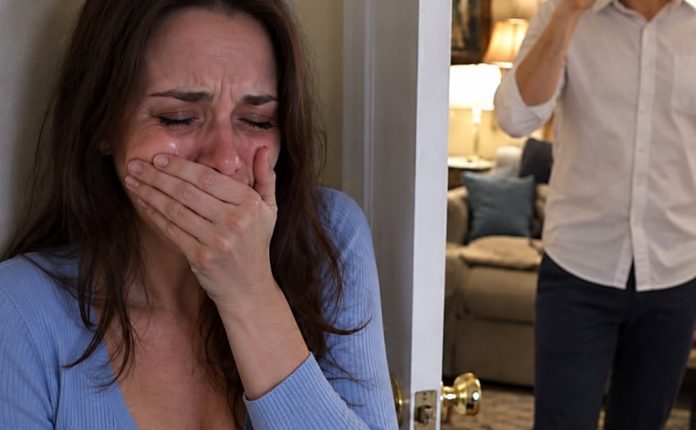
The email arrived while I was standing outside the house, trying to make my fingers work well enough to unlock my phone.
Funeral Home Confirmation—Service Scheduled for S. Pierce.
For several seconds, I read the subject line without understanding it. My attention kept returning to the front door. I had closed it quietly, but I couldn’t remember whether the latch had caught. Every sound from the street seemed too loud: a truck shifting gears, somebody dragging a garbage bin over concrete, my own breathing.
The message confirmed a deposit for a private memorial service in Westchester County. A tentative date had been reserved three weeks ahead. Logan Pierce appeared as the contact person.
The deceased was listed only as S. Pierce.
My name was Claire. My sister was Megan Sullivan. Neither of us matched the initial.
I scrolled down.
Our home address was attached to the booking. Logan’s name appeared on the payment information. In the notes, the funeral home had recorded a request for privacy and indicated that the remaining arrangements would be settled after an expected death.
I felt the cold first in my hands.
The email had come from Logan’s account. It looked like a forwarded confirmation sent to the wrong recipient. There was no explanation above it, no greeting, nothing to suggest that he had meant me to see it.
A few minutes earlier, I had heard him laughing on the telephone.
I had heard him say he had interfered with my brakes.
And I had heard him mention my sister’s funeral.
Now there was an actual funeral booking on my screen.
I couldn’t make the initial fit. I couldn’t tell whether the email belonged to the same plan, another plan, or some cruel attempt to frighten me. But uncertainty no longer gave me a reason to dismiss what I knew.
I was thirty-four years old. I had been married to Logan for eight years.
Until that afternoon, I had thought leaving him was the hardest thing I would ever have to do.
We had separated six weeks earlier. I was staying with Megan in Brooklyn while Logan remained in our house. When colleagues or acquaintances asked, I described the arrangement as temporary space while we worked through some difficulties.
It sounded reasonable. Adults sometimes needed time apart.
What I left out was how carefully I had learned to speak inside my own home.
During the last two years, a question could become an accusation before I finished asking it. If I wanted to know why money had disappeared from an account, Logan said I was monitoring him. If I asked when he would be home, he heard suspicion. If I disagreed at dinner with friends, the argument continued long after our guests left.
“You enjoyed making me look foolish.”
“I didn’t make you look foolish. I said I remembered it differently.”
“And you couldn’t wait until we were alone?”
Eventually, I stopped correcting anything.
I remember standing at our kitchen counter one morning, holding a mug I had already washed, rehearsing a question about a bank charge. I tried three different openings in my head. None sounded safe enough. I put the mug away and decided the charge could wait.
That was the sort of moment our marriage had become.
At the beginning, I wouldn’t have recognized that woman.
I met Logan at a charity fundraiser in Manhattan. He was thirty-one and worked in commercial property consulting. I handled corporate communications for a financial services company. We were seated near speakers that made conversation nearly impossible, and he leaned toward me to ask whether the band had been hired to discourage donations.
I laughed hard enough to spill a little wine.
For the rest of the evening, he seemed interested in everything I said. We talked about books we had abandoned halfway through, places we wanted to visit, and how neither of us knew anyone who looked comfortable at a formal fundraiser.
When he asked me to dinner, there was no reason to hesitate.
He remembered small things. A restaurant I mentioned once. The author whose new book I wanted. The fact that my mother disliked lilies because their smell gave her headaches.
He sent flowers to my office, but never lilies to Mom.
Megan liked him almost immediately.
She was three years younger than I was and less willing to confuse charm with kindness. Watching her relax around him reassured me. He teased her about stealing the last bread roll and told her that, eventually, she would have to accept him as an older brother.
She told him older brothers were expected to help carry furniture.
He promised.
His mother, Carolyn, was harder to read. She watched people as though they were interviewing for positions they hadn’t known were available. At our engagement dinner, she lifted her glass and said I was exactly the woman the Pierce family needed.
I thanked her.
Years later, I understood that she hadn’t meant a woman Logan could love well.
She meant someone dependable. Someone who could soften an unpleasant conversation, cover a forgotten obligation, and keep private difficulties private.
I had done all of those things before I realized they had become my job.
The trouble sharpened when Logan’s redevelopment project began losing money.
At first, there were ordinary setbacks. Construction delays. Costs higher than expected. A partner who hadn’t fulfilled an obligation. Logan spoke about them with irritation, but he still seemed certain he could recover.
Then certainty gave way to anger.
He drank more. He stayed awake late, taking calls behind closed doors. He began treating the groceries, the electric bill, and my occasional lunch with a friend as evidence of careless spending, although my salary covered most of our regular expenses.
The first request was for five thousand dollars.
He stood beside me while I logged into my savings account.
“It’ll be back before you notice it’s gone.”
I believed him.
The next request was for eight thousand. Then ten. Each came with a reason that sounded temporary: a payment held up, an expense that couldn’t wait, a short gap between money going out and money coming in.
I thought marriage meant helping when help was possible.
When I asked about repayment, he stared at me.
“Are you hoping the whole thing collapses?”
“Of course not.”
“Then why are you acting like another creditor?”
After that, asking became harder.
By the time I left, more than sixty thousand dollars had gone toward his business. Some came from savings I had built before we married. Some came from my grandmother’s inheritance. Some came from our joint account.
I couldn’t put a precise date on when helping him became paying to avoid an argument.
I only knew that each transfer bought less peace than the one before.
The last argument began with a line of credit I hadn’t known existed.
I had the statement on the counter when Logan came home. He looked at it, then at me, and sighed as though I had created the problem by finding it.
“You don’t understand how business works.”
“Then explain this.”
“I shouldn’t have to defend every decision in my own house.”
“Our house.”
He smiled at that. A small, unpleasant smile.
I told him I needed to stay somewhere else.
For a moment, he said nothing. I could hear the refrigerator running behind me. I remember wondering whether he would finally understand how serious things had become.
Instead, he told me to go and find out how long I could manage without him.
I packed a suitcase that evening.
Megan opened her apartment door in socks, with a dish towel over one shoulder. She looked at the suitcase, then at my face. She didn’t ask whether I had tried hard enough. She didn’t suggest sleeping on the decision.
She pulled me against her.
“You can stay.”
I cried before I managed to thank her.
Megan worked as a pediatric occupational therapist. Her apartment was full of the ordinary signs of a life she enjoyed: books stacked beside the couch, a bowl of oranges on the kitchen table, a bright blanket our mother had bought her.
She gave me the second bedroom and cleared a drawer without making a ceremony of it.
That night, we drank tea until it went cold.
I kept expecting my phone to ring. I kept looking at it even when it didn’t.
At nearly two in the morning, Megan took the empty mugs to the sink.
“You don’t have to decide everything tonight.”
I slept more deeply than I had in months.
Logan’s response to the separation changed from one day to the next.
Sometimes he was apologetic. He said stress had made him difficult and that I was remembering the worst moments while forgetting everything else.
Sometimes he threatened to make the financial arrangements unbearable.
Sometimes he sent messages that consisted of little more than reminders that I was still his wife, as though a legal relationship gave him permanent access to me.
One evening, he appeared outside Megan’s building.
He called and demanded that I come down.
I stood several feet from the window because I didn’t want him to see me.
Megan read my expression and held out her hand for the phone.
“No,” I said. “It’ll make him worse.”
“It isn’t our responsibility to make him reasonable.”
I didn’t go downstairs.
He called twenty-three times.
Afterward, Megan suggested contacting the police. I told her he was upset, that he would settle down, that involving anyone else might complicate the divorce before it had even started.
She didn’t argue all night. That was one of the differences between her and Logan.
But before she went to bed, she said, “Being angry doesn’t explain everything he does.”
I knew that.
I still wasn’t ready to live as though I believed it.
On the afternoon I returned for my car papers, Logan had told me he would be out until late.
I needed the vehicle title and insurance documents to arrange a different parking location. The car belonged to me, although he had used it during our marriage. It was still in our driveway while I dealt with the practical disorder of moving out.
I planned to collect the documents, retrieve a few things, and leave.
That evening, I was supposed to drive Megan and Mom to a birthday dinner.
I remember thinking about the reservation while I walked up the path. I wondered whether there would be enough time to change clothes before picking them up. Such a small concern. Such an ordinary afternoon.
The house looked the same.
A package lay near the front step. The curtains were half drawn. Inside, the hallway smelled faintly of coffee and the cleaner we used on the floors.
I closed the door softly out of habit.
Then I heard Logan.
At first, I thought he might be speaking on television or a recording. He was supposed to be away, and my mind tried to preserve that assumption even while his voice came clearly from the living room.
He was on the phone.
I stopped beside the narrow table where we used to leave our keys.
He laughed.
Then he said he had messed with my brakes.
I didn’t move.
There was a pause while the other person spoke. I couldn’t hear the response. Logan’s voice returned, easy and amused, mentioning my sister’s funeral as though it were a social occasion somebody might attend.
The hallway seemed to lose its shape around me.
I looked toward the living room door. It wasn’t fully closed. If he stepped out, he would see me.
For one terrible second, I wanted to go in.
I wanted him to notice me and look embarrassed. I wanted him to say it was a joke, a misunderstanding, something I had heard without context.
Then I thought about the car outside.
I thought about Megan climbing into the passenger seat that evening.
I backed toward the front door.
My bag caught against the edge of the hall table. I steadied it before anything fell. My heart was beating so hard that I could feel it in my throat.
I turned the handle slowly.
Outside, I kept walking.
I didn’t run until I was far enough away that he couldn’t see me from the living room window.
I called Megan before I knew what to tell her.
She answered with the bright impatience she used when she was between appointments.
“Did you get everything?”
“I need you to stay where you are.”
My voice made her stop.
“What happened?”
“I heard Logan say something. About the car.”
“What about it?”
I couldn’t get the entire sentence out. Saying it aloud would make it something that had actually happened.
“Don’t drive,” I told her. “Please. Just wait for me to call again.”
“Claire, where are you?”
“Outside the house. I’ve left.”
“Then keep going.”
I promised her I would.
After we hung up, I arranged a tow.
I was thinking badly by then. I understood that I couldn’t drive the car, but my next thought was that it couldn’t remain where Logan could reach it. Carolyn’s house came to mind because it was somewhere connected to the family, somewhere he wouldn’t be able to pretend it had vanished.
I gave the towing company her address.
I didn’t warn them about the brakes.
That omission would return to me almost immediately, but at the time I was struggling to complete one task before the next frightening thought arrived.
Then the funeral confirmation appeared.
I read it once, twice, and finally took a screenshot because I was afraid it might disappear.
A booked memorial. An expected death. Logan’s payment details.
I still didn’t know who S. Pierce was.
What I knew was enough.
I called the police.
The dispatcher’s voice was steady. She asked where I was and whether Logan could see me. I moved farther from the house while I explained that my estranged husband had spoken about interfering with my vehicle and about my sister’s funeral.
She asked whether I had driven the car.
“No.”
“Where is it now?”
I explained about the towing company.
Then she asked whether he could have accessed another vehicle Megan or I might use.
I looked at the passing traffic.
“I don’t know.”
She told me not to use either vehicle until the situation could be assessed.
I said yes to everything she asked me to do.
Two officers met me near the corner.
One spoke to me while the other watched the street. I showed them the email, Logan’s messages, and the towing company’s call details.
The officer reading the confirmation looked up when I mentioned Carolyn’s address.
“Does the driver know you’re concerned about the braking system?”
I shook my head.
He didn’t wait for me to explain why.
He contacted the company and told them about the suspected interference. Arrangements were made to preserve the car and move it safely to a secure location for examination.
I stood beside him, realizing that I had almost put a stranger into danger while trying to remove myself from it.
“I should have said something.”
“You’ve said it now,” he told me.
There was no comfort in pretending the mistake hadn’t mattered. But his practical response gave me something to follow. The car would be secured. Nobody needed to drive it. The evidence would be preserved.
I called Megan again.
This time, I could tell her where I was.
“I’m with the police.”
She went silent.
Then I told her what I had heard.
When I mentioned her funeral, she made a small sound I had never heard from her before.
“Mine?”
“I don’t know exactly what he meant.”
I hated that sentence. I hated how much was still unknown.
“But I need you to stay inside. Don’t go anywhere in a car.”
“Are you safe?”
“Yes.”
“Don’t go back.”
“I won’t.”
She was crying by then. I could hear her trying to keep her breathing quiet.
I wanted to tell her everything would be fine.
Instead, I repeated what I could honestly promise.
“I’m with the officers. They know. You aren’t dealing with this alone.”
The police arranged to contact her directly about precautions. Our mother was informed as well and went to stay with a relative.
I provided the messages Logan had sent during the separation and allowed the officers to examine the email on my phone.
Questions followed.
Did he own weapons? Had he threatened me before? Did he have access to our accounts? Had he ever hurt me physically?
The last question made me hesitate.
I had a ready answer, one I had used privately for years: he had never really hit me.
But the officer hadn’t asked that.
Logan had gripped my wrist hard enough that I hid it beneath a sleeve the next day. He had stood in doorways and refused to move when I wanted to leave an argument. Once, he shoved a chair across the kitchen, and it struck the wall close enough to make me flinch.
I told the officer those things.
Hearing them together was different from remembering each one separately.
There had always been an explanation. He was tired. He was frightened about money. The chair wasn’t aimed at me. He had apologized about my wrist.
The officer wrote without interrupting.
I didn’t have to persuade him that each incident belonged on the page.
That evening, Megan and I went to a hotel arranged through a victim-support service. We didn’t return to her apartment. The police wanted us away from places and routines Logan could predict while they assessed the danger.
I contacted my employer and asked for emergency leave.
I can’t remember exactly what I said. I remember looking at the hotel carpet while I spoke and being grateful that nobody asked me to make the explanation sound professional.
Megan sat on the bed with her shoes still on.
When I finished the call, she asked whether I wanted water.
I nodded.
She handed me a plastic cup. My fingers shook against it, and a little spilled onto the bedspread.
Neither of us mentioned the spill.
For a long time, we sat without speaking. The air conditioner clicked on. Somebody closed a door in the corridor. Each ordinary sound made me turn my head.
Eventually, Megan asked the question we had both been avoiding.
“Do you think he meant to kill us?”
I looked down at the cup.
“I don’t know everything he meant.”
“That isn’t what I asked.”
I knew.
I thought of his laugh, the ease in his voice, the car waiting outside like any other car on any other day.
“I think he was willing to have something happen that we wouldn’t survive.”
Megan pressed her hand against her mouth.
I moved closer, but for a moment I didn’t know whether to touch her. My own body felt unreliable, full of shaking I couldn’t stop.
Then she leaned against me.
We stayed that way until my shoulder went numb.
Later, she called Mom. I heard my mother’s voice through the phone, asking where we were and whether the room was secure. Megan told her enough to reassure her without pretending there was nothing to fear.
When she handed me the phone, Mom said my name twice.
“I’m here,” I told her.
“I know. I just needed to hear you.”
I closed my eyes.
The birthday reservation remained in my calendar. A reminder appeared while we were talking.
For a second, I stared at it.
Three people. One car. A familiar route. An evening planned around cake and candles.
I dismissed the reminder.
That was when the danger stopped being an abstract possibility attached to a sentence I had overheard.
Megan would have been beside me. Mom would have been in the back seat. I would have checked the mirror, put my bag down, and pulled out of the driveway without suspecting that anything had changed.
I hadn’t gone back to investigate Logan.
I had gone back for two documents.
Before we tried to sleep, an officer called to confirm that the car had been secured and that qualified personnel would examine it. He asked me to keep any further messages and avoid responding.
I put the phone on the bedside table with the sound turned up.
Megan asked whether I wanted the light left on.
“Yes.”
She didn’t tease me.
We lay in separate beds, both awake. I could hear her shift whenever somebody passed in the corridor.
At some point, she said, “You didn’t let him know you were there?”
“No.”
“Good.”
I turned toward her.
“I nearly did.”
She looked at me across the narrow space.
“But you didn’t.”
Until then, I had been replaying my mistakes: dismissing the calls, minimizing the doorway incidents, sending the car to Carolyn without warning the driver.
Megan held onto the decision I had made in the hallway.
I had heard enough to be frightened.
I had wanted an explanation.
And I had left before asking for one.
In the morning, the car would begin answering questions neither of us wanted to ask. For that night, we had only the locked hotel door, the officers’ instructions, and the knowledge that Logan did not know where we were.
Then my phone lit up.
A message from him filled the screen.
He wanted to know where the car had gone.
END PART 1