Darlene answered on the fifth ring.
“If this is about Sunday, I haven’t decided what time.”
I looked at the choir program on my dresser.
“I need Mama’s red Bible.”
A television murmured behind her. I heard a spoon strike the side of a mug.
“I told you I’d find it.”
“I’d like to get it tomorrow.”
“What’s the hurry?”
That question would not have bothered me the day before. Now I heard possibilities in it that might not have been there.
“I want it.”
“There were several Bibles.”
“The red one she kept beside her chair.”
“I know which one you mean.”
She sounded irritated, and I nearly told her everything to make the irritation stop. The habit was so familiar that I recognized it only because Mama’s note was still beneath my hand.
Read what I left there before you tell anybody.
“I can come after work,” I said.
Darlene sighed.
“Some boxes are in the garage. The rest are in storage. I’m not hauling everything out for one book.”
“I’ll look myself.”
“Fine. Six.”
When the call ended, I stayed beside the bed.
I didn’t think my sister was a criminal. I didn’t imagine her plotting in the dark. That would have been easier than what I actually knew: Darlene could convince herself that something was reasonable simply because she wanted it.
Once she had done that, everyone else became difficult.
I put the bank documents in a drawer.
The choir program went into my handbag.
Then I took out my notebook and made a list. Identification. Certified death certificate. Bank appointment. Red Bible.
Below those words, without meaning to, I wrote Mama.
I crossed nothing out.
That night, I slept badly.
Every time I closed my eyes, I saw the bank balance. Then I saw the tear in the hat. I wondered whether the brim would have opened if the mirror frame had been smoother, or whether I might have lived for years beside that dresser without ever finding it.
At three in the morning, I turned on the lamp.
I examined the hat again.
Near the split was a tiny row of stitches that did not match the original seam. They were close and even, made with ordinary blue thread rather than the stronger thread used elsewhere.
Mama’s stitches.
I knew them the way I knew her handwriting.
She always took a smaller stitch at the beginning and the end. She used to say a repair should not announce where it started.
I touched that short line with my thumbnail.
She had sat somewhere with a needle, folded the program, wrapped the card, and worked the opening closed.
The thought was more intimate than the money.
It was a picture of her doing something for me when I was not there to see it.
At work the next day, I made a mistake on a sleeve.
Nothing disastrous. I caught it before cutting. Still, my supervisor, Denise, noticed that I had measured the same section three times.
“Go get some air.”
“I’m fine.”
“I didn’t say you weren’t. Go stand outside for five minutes.”
I went to the back steps with a cup of coffee.
The alley smelled of warm pavement and laundry from the cleaners next door. A delivery driver was arguing with someone on the phone about a missing signature.
I called Mrs. Alvarez.
She confirmed our appointment for the following Tuesday and repeated the documents she needed. I had a certified copy of Mama’s death certificate among the papers from the funeral home. It was in the folder I had put away because I couldn’t bear to keep looking at it.
I asked whether finding the card meant I had done something improper.
“Finding it doesn’t give you authority to use it,” she said. “You’ve done the right thing by bringing it to us. We’ll handle the account through the appropriate process.”
“I haven’t used it.”
“I understand.”
Her calmness helped.
Before ending the call, I asked one more question.
“Did she come in recently?”
“I can discuss relevant records when we meet.”
I accepted that answer, though I wanted a glimpse of Mama walking through those doors on a day I had known nothing about.
At six, I parked outside Darlene’s house.
Her new dining table was visible through the front window. A bowl of lemons stood in the center, so yellow they looked artificial.
She opened the door in exercise clothes.
“You could’ve texted when you got here.”
“I just parked.”
“Well, come around.”
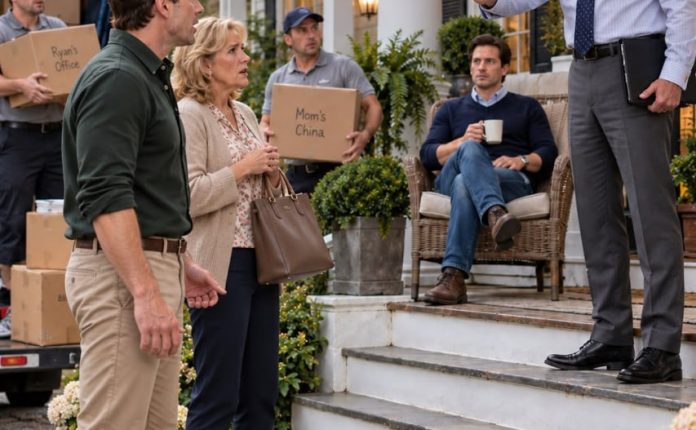
Her garage was crowded with cardboard boxes, a folded patio umbrella, and a washing machine she intended to sell. Mama’s belongings occupied one corner beneath an old bedspread.
Darlene pulled the bedspread away.
“There.”
I looked at the boxes.
Some bore my handwriting from the move. Kitchen. Photos. Winter clothes.
Others were labeled by Darlene.
Keep.
Sell.
Donate.
The word on the nearest box was Donate.
I knelt beside it.
“Careful with your knees,” she said. “You always complain about them.”
I had mentioned once that crouching during fittings made them ache.
“I’ll manage.”
She leaned against the washing machine while I opened the box.
Inside were paperbacks, a chipped vase, two framed prints, and a stack of church directories. I lifted each object carefully and placed it beside me.
The directories held photographs of people who had grown older beside Mama for half a century.
I could hear their voices as I turned the pages.
Darlene watched for perhaps a minute.
“I’m making tea. Do you want some?”
“No, thank you.”
“Suit yourself.”
When she left, I opened the next box.
There were recipe cards, sewing patterns, a little plastic basket of buttons, and a packet of letters tied with string. Mama had written Recipes on the packet even though the top envelope was addressed in Daddy’s handwriting.
I put it aside.
The third box held Bibles.
A large black one. A white gift Bible with a cracked clasp. A children’s Bible with my name inside, written in Mama’s hand.
No red one.
I sat back on my heels.
Through the open doorway, I could hear Darlene speaking to someone on the phone. Her voice was light, untroubled.
I checked beneath the books.
Then I checked the first box again.
When she returned, I asked whether anything had already gone to the charity shop.
“Some things.”
“Books?”
“I don’t remember.”
“You said the Bible was packed.”
“It was. Ellen, there were a hundred boxes.”
There had been fourteen.
I didn’t correct her.
“Which charity shop?”
She looked at the books spread across the floor.
“Are you really going to drive around asking about an old Bible?”
“Yes.”
Something in my voice made her stop.
“Why?”
“Mama wrote in it. I want her notes.”
That was true.
Darlene set her mug on the washing machine.
“I think there’s another book box inside.”
She went through the doorway and returned carrying a smaller carton.
It had been opened already.
“This was with the papers.”
I reached for it.
She kept her hands on the sides for a moment.
“Anything important belongs with the estate documents.”
I looked up.
“Of course.”
Then she released it.
The red Bible lay beneath a stack of old insurance booklets.
Its cover was worn almost pink along the edges. A ribbon hung from the bottom. One corner had the shallow bite mark left by a puppy we had owned when I was nineteen.
I lifted it out.
My relief was so strong that I had to lower my head.
“There,” Darlene said. “All that fuss.”
“Thank you.”
I gathered the other things I had set aside and asked whether I could take them.
She waved a hand.
“Please. Less for me to deal with.”
I carried the Bible, the letters, the buttons, and my childhood Bible to the car. Darlene followed me to the driveway.
“Are you all right?”
For the first time that evening, she sounded like my sister.
“I’m trying to be.”
She rubbed one thumb along the handle of her mug.
“I know the house was hard for you.”
I waited.
“I couldn’t keep it forever.”
“I never asked you to.”
“It feels like you wanted me to.”
That was the old turn in the conversation. My hurt became an accusation, and the accusation required me to reassure her.
I set the box in the back seat.
“I wanted a little time.”
“You had time.”
I closed the door.
“We don’t remember those weeks the same way.”
She looked toward the street.
“No, I guess we don’t.”
It was the closest we had come to telling the truth.
At home, I washed my hands before opening the Bible.
I did not know why that mattered. Perhaps because the cover smelled faintly of her bedroom, or because I had spent the evening handling dusty cardboard and didn’t want to leave fingerprints on whatever she had entrusted to me.
I sat at the kitchen counter.
The first pages held births and deaths. Daddy’s name. Mama’s parents. A cousin who died young. Darlene’s birthday and mine, written with the same blue pen.
The entries looked equal.
I stayed on that page longer than necessary.
Then I found Psalm 27.
The ribbon marked it.
Between two thin pages was an envelope, flattened almost completely. Mama had written my name across the front and taped the flap shut with a piece of clear tape that had yellowed at the edges.
Inside was a letter.
My dear Ellen,
If you have found the card, you have kept the hat.
I put the letter down.
For several seconds, I could not continue.
The sentence carried her certainty about me. She had trusted that I would keep the hat. She had also known why.
I picked it up again.
The account is for you. I arranged that at the bank. Mrs. Alvarez knows what papers you need. Please do not try to use the card. Take it to her.
I thought of the woman’s careful expression and understood it differently.
Mama had spoken my name in that office.
The letter continued.
I owe you an explanation about the house. I owe you explanations about other things too. Mr. Hensley has a packet for you. Ask him for the envelope I left in September. I asked him to keep it until you came yourself.
I read that paragraph twice.
Below it, her handwriting grew less steady.
You have spent too many years making sure everybody else could go on with their lives. Some of that was necessary. Some of it was because I let it be easier for me.
That sentence made me angry.
The feeling came so abruptly that I stood up.
For years, I had wanted her to recognize it. Now she had, on paper, when I could no longer answer her.
I walked to the sink and stood there with both hands on its edge.
Outside, my neighbor was calling her son in from the yard.
I went back to the letter.
Don’t mistake my silence for not seeing. I saw more than I admitted, and I should have said more while I could hear your answer.
There was another paragraph about the bank, then one about Darlene.
Your sister was promised the house long ago. I kept that promise. I have tried to make provision for you separately. These are two decisions, not one judgment about which daughter I loved.
At the bottom, she had added:
Please let Ellen finish reading before anyone starts arguing with her.
I smiled despite myself.
It was exactly the kind of sentence Mama would write as if she could still manage a room from elsewhere.
A second folded page contained a list of documents. Mr. Hensley’s telephone number. The bank’s branch address. A date.
There was also an envelope marked Darlene.
I did not open it.
I put both letters back on the counter and called Mr. Hensley.
His receptionist said he was with a client.
“Please tell him Ellen Bell found the note in her mother’s Bible.”
There was a brief pause.
“I’ll give him that message.”
He called twenty minutes later.
“I wondered when I might hear from you.”
My first response was not gratitude.
“Why didn’t you tell me?”
He did not pretend to misunderstand.
“Your mother gave me specific instructions.”
“She let me sit in your office thinking she had left me nothing.”
“I know that was painful.”
“Then why?”
He was quiet for a moment.
“I can explain what she asked me to do. I can’t explain all her reasons. She wrote those herself.”
I pressed the heel of my hand against my forehead.
“Did she know what Darlene would say?”
“She knew your family better than I did.”
That was not an answer.
It was also probably the only honest answer he could give.
We made an appointment for Monday morning. He asked me to bring the Bible letter and the bank paperwork.
Before we hung up, I asked whether there was any reason to keep this secret.
“You don’t have to turn your mother’s wishes into another obligation,” he said. “Read your documents first. Then make your own decision about what to share.”
I held on to that sentence.
That weekend, I did laundry, bought groceries, and mended the hat.
I left a small opening in the seam for now.
The hidden pocket no longer seemed like a clever surprise. It seemed like Mama’s way of saying something she had found too difficult to say directly.
I understood that impulse.
I also knew how much damage it could do.
At church on Sunday, Mrs. Greene asked whether I would like to sing with the choir.
“Your mama always said you had a lovely voice.”
“I haven’t sung in years.”
“Well, voices don’t expire.”
I thanked her and said I would think about it.
She touched my arm.
“You don’t have to hurry about everything anymore.”
I nearly cried at the church door.
Darlene wasn’t there.
After the service, I drove past Mama’s old house.
The new owners had painted the front door green. A tricycle sat beside the walkway. Someone had hung a bird feeder from the magnolia tree.
For the first time, I felt something besides loss when I looked at it.
The house was being lived in.
Mama would have liked that.
At Mr. Hensley’s office the next morning, he brought out a cream-colored envelope.
My name was on it.
Underneath, in Mama’s handwriting, were the words: For her own life.
He laid it between us.
“Before you open it, there are two practical matters.”
I waited.
“Your mother’s instructions concerning the bank were separate from the house. We’ll review the account documents and make sure everything is handled correctly. And you should understand that this packet includes personal letters as well as records.”
“Records of what?”
“Money she set aside. Money you provided. The reasons for her decisions.”
My throat tightened.
“I never asked her to keep track.”
“I know.”
Inside the envelope was a copy of a bank designation, a dated memorandum, and several pages of figures. Mama had kept receipts for things I had forgotten paying for.
A water heater.
Roof repairs.
A week of overnight help when I had the flu.
The deposit for a medical device.
Even small grocery totals appeared in the margins.
She had written Thank you beside some of them.
I covered my mouth.
Mr. Hensley looked away long enough for me to compose myself.
“There’s more,” he said gently.
The longest letter described the house.
Years before Daddy died, Darlene and her husband had helped Mama and Daddy through a difficult stretch. They had contributed money when Daddy’s work stopped and the mortgage payment became impossible.
I remembered that period.
I had not known the amount.
Mama had promised Darlene the house in return for helping them hold on to it. Over the years, that promise had become fixed in her mind, even after circumstances changed.
She had never sat us both down to explain.
Instead, she had relied on each daughter knowing only her own portion of the story.
Now the two portions were in my lap.
“I thought it meant she chose her,” I said.
Mr. Hensley folded his hands.
“She knew you might.”
“Knowing isn’t the same as stopping it.”
“No,” he said. “It isn’t.”
I appreciated him more for not trying to make Mama blameless.
The bank documents showed that her savings had been accumulated over many years. Sewing money. Small deposits. Interest. Amounts preserved when she could have spent them.
The account had not appeared in our household conversations because Mama considered it hers.
She had once been a woman who earned money before she became our mother.
I found myself sitting straighter.
At the bottom of one page was a note:
Ellen kept saying she would do her own shop later.
Later needs to arrive.
I read it without moving.
Then my phone vibrated.
Darlene.
I let it ring.
She called again before I left the office. Then a message appeared.
Why are you meeting with Mama’s lawyer without telling me?
I showed it to Mr. Hensley.
He glanced at the screen.
“Did you tell her about your appointment?”
“No.”
“She called this morning regarding another matter. My receptionist mentioned that I was unavailable.”
I closed my eyes.
Nothing secret had happened. A small piece of ordinary office information had reached the person I wasn’t ready to explain myself to.
I drove home before answering.
Darlene picked up immediately.
“What did he give you?”
“Some personal papers Mama left for me.”
“What papers?”
“Letters. Information about an account.”
The silence changed.
“What account?”
“One Mama maintained.”
“How much?”
“I’m still working through the documents.”
“You need to tell me.”
“I need to finish reading them.”
“Ellen, I’m handling her estate.”
“I know. I’m speaking with the bank and Mr. Hensley.”
Her breathing grew audible.
“If she had money set aside, that needs to be accounted for.”
“It will be.”
“No. I mean she told me—”
She stopped.
I leaned back against my kitchen counter.
“She told you what?”
“That she was keeping something for the family.”
“For whom?”
“For emergencies. For later. You know how she talked.”
I looked at the letter about my shop.
“I know how she wrote.”
Darlene went quiet again.
Then she said, “Don’t do anything until I’m there.”
“My appointment is tomorrow.”
“What time?”
“Ten.”
“I’ll meet you.”
“I haven’t invited you.”
“I don’t need an invitation to ask questions about my mother’s money.”
She ended the call.
I stood with the phone in my hand, listening to the refrigerator hum.
All weekend, I had wondered whether finding the hat meant the worst misunderstanding between us was finally ending.
Now my sister knew there was money.
And she had already decided that my mother’s instructions were something she could step in front of.
END PART 2