My grandmother, Evelyn, was a woman of silence and secrets. She lived in a sprawling, drafty Victorian manor that smelled of lavender, old parchment, and the metallic tang of oil. While the rest of the family saw her as a lonely eccentric who had lost her grip on reality, I saw a woman who moved through life with a precision that bordered on the supernatural. She didn’t just live; she measured.
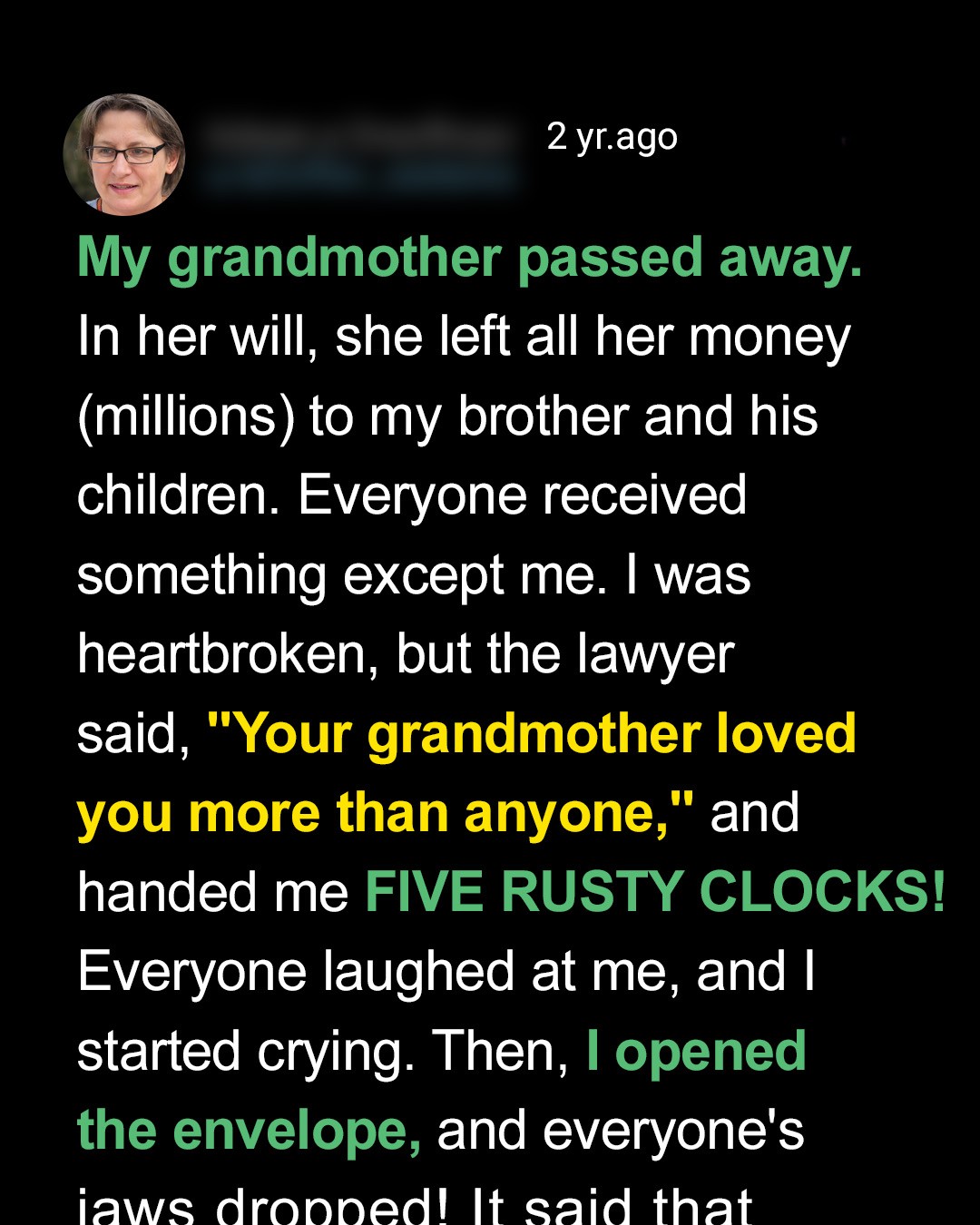
When she passed away at ninety-four, the vultures—otherwise known as my extended family—descended. My brother, Mark, arrived at the lawyer’s office in a bespoke suit, already mentally spending the inheritance he was sure was coming his way. Mark was the “golden child,” a high-flying hedge fund manager who measured success in zeroes. I, on the other hand, was the “disappointment”—a high school history teacher who spent my weekends volunteering at the local museum.
We gathered in the mahogany-paneled office of Mr. Sterling, Evelyn’s lifelong attorney. The atmosphere was thick with greed.
“To my grandson, Mark,” Mr. Sterling read, his voice steady. “I leave the entirety of my liquid assets, including all investment portfolios and cash reserves, totaling approximately twelve million dollars.”
Mark let out a breath he’d been holding, a smirk playing on his lips. My cousins whispered in awe. Then came the properties, the jewelry, and the cars—all distributed among the cousins and aunts. Everyone received a slice of the pie. Everyone except me.
Finally, Mr. Sterling looked at me. His eyes weren’t pitying; they were intense. “And to my granddaughter, Sarah, whom I loved more than anyone…”
He reached under the desk and pulled out a heavy, stained cardboard box. He set it in front of me with a dull thud. Inside were five clocks. They were hideous. They were encrusted with rust, their glass faces cracked, their wooden casings warped by what looked like decades of damp storage.
A silence fell over the room, followed by a sharp burst of laughter from Mark.
“Five rusty clocks?” Mark wheezed, wiping a mock tear from his eye. “I guess Grandma really did know who the ‘museum curator’ in the family was. Enjoy your junk, Sarah. Maybe you can sell them for scrap metal to pay your rent.”
The laughter rippled through the room. I felt the heat rise in my cheeks, the sting of tears blurring my vision. It wasn’t about the money—it never was. It was the public rejection. I had been the one who visited her every Sunday. I was the one who held her hand when she couldn’t remember her own name. And this was my reward? A box of garbage?
Mr. Sterling cleared his throat, silencing the room. “There is also this,” he said, handing me a thick, cream-colored envelope sealed with red wax. “Your grandmother was very specific. You are to open this only when you are alone with your inheritance.”
I clutched the box and the envelope, ignoring the snickering of my relatives as I practically ran from the office.
The Secret in the Gears
I didn’t go home. I drove to the small workshop in the back of the museum where I spent my spare time. I set the five clocks on the workbench. Up close, they looked even worse. They were various shapes—a carriage clock, a small mantel clock, a wall clock, and two pocket watches that looked like they’d been submerged in a swamp.
With trembling hands, I broke the wax seal on the envelope. Inside was a single sheet of parchment and a small, intricate brass key.
The letter read:
“Sarah, my dearest. The world sees the surface; you see the soul. Mark will spend his millions on things that rust and fade. I have given you something that grows. Time is the only currency that matters, but only if you know how to wind it. Look behind the rust. Each clock is a chapter. Each gear is a secret. Use the key, and remember: the most valuable things are often hidden in plain sight.”
I looked at the first clock—the carriage clock. I began to clean it, not with the intention of selling it, but out of a habit of respect. As I wiped away the grime with a specialized solvent, I realized the “rust” wasn’t rust at all. It was a thick, protective resin, painted on to look like decay.
Beneath the coating lay exquisite, hand-chased gold.
My heart hammered against my ribs. I used the brass key on a tiny, almost invisible keyhole at the base of the clock. A small drawer clicked open. Inside wasn’t money. It was a legal document—a deed to a plot of land in downtown San Francisco that Grandma had purchased in the 1950s and “forgotten” to include in the public ledger of her estate. Its value was astronomical.
I moved to the second clock. Beneath the fake grime was a masterpiece of 18th-century horology, a Breguet that belonged in the Louvre. Inside its casing, I found a collection of uncut blue diamonds, tucked into the space where the chime mechanism should have been.
By the time I reached the fifth clock—the smallest pocket watch—I was shaking. This one didn’t have a deed or jewels. When I opened the back, I found a microfiche. I took it to the museum’s reader.
It wasn’t a bank account. It was a list of names, dates, and account numbers. It was the “Shadow Ledger” of the family’s textile business from the 1920s—proof that the original family fortune had been built on a series of patents that had been illegally diverted. Those patents were still active, generating tens of millions in royalties annually to a shell company Mark now technically “owned”—but the ledger proved that the rightful owner of the patents was whoever held the physical documentation.
Me.
The Confrontation
Three months later, the “millions” Mark had inherited were already dwindling. He had bought a yacht, a penthouse, and made several disastrous “sure-bet” investments. He called me, his voice dripping with faux-concern.
“Hey, Sarah. How’s the scrap metal business? Listen, I’m hosting a gala on the yacht next week. If you need a loan for a dress, just let me know. I wouldn’t want you showing up looking like one of your clocks.”
“Actually, Mark,” I said, my voice calmer than it had ever been. “I’d love to come. I have something of Grandma’s I’d like to show the family.”
The gala was a display of grotesque wealth. The entire family was there, sipping champagne and patting Mark on the back. When the time came for toasts, I stood up.
“Grandma Evelyn left us all something,” I began. “She gave Mark money. She gave the rest of you pieces of her life. And she gave me five rusty clocks.”
Mark smirked, raising his glass. “And we’re all very sorry about that, Sarah. Really.”
“Don’t be,” I said. I signaled to the waiters, who brought out the five clocks. They had been professionally restored. They gleamed under the chandeliers—gold, platinum, and rare woods, ticking in a perfect, hauntingly beautiful synchronization.
The room went silent. These weren’t junk. They were priceless artifacts.
“But the clocks were just the packaging,” I continued. I laid out the documents. I explained the land deed. I showed the diamonds. And then, I looked Mark directly in the eye.
“And then there’s the matter of the patents, Mark. The twelve million you got was the ‘liquid’ part of the estate. But the royalties from the family patents—the ones that fund your ‘investments’—those were never legally yours. Grandma left the proof of ownership in the fifth clock. She knew you’d never look past the surface. She knew you’d laugh at anything that didn’t look like a paycheck.”
The color drained from Mark’s face. He looked at the documents, then at the clocks, then back at me. The “golden child” suddenly looked very small.
“You can’t do this,” he whispered. “We’re family.”
“We are,” I agreed. “And as family, I’m going to do what Grandma wanted. I’m going to use this fortune to fund the museum, to preserve history, and to ensure that ‘time’ is never wasted again. As for your lifestyle, Mark… I suggest you start learning how to measure your own success. Because the clock is officially ticking.”
The Legacy of Time
I didn’t strip Mark of everything. I wasn’t cruel. But I took control of the patents and the land, placing them into a trust that favored education and preservation rather than luxury cars and yachts.
The five clocks now sit in a custom-built display in my living room. They don’t just tell the time; they tell a story. They are a reminder that my grandmother was never senile. She was a master architect of character. She knew that if she had given me the money outright, the family would have sued me into oblivion or manipulated me out of every cent.
By hiding the inheritance in “trash,” she ensured that only the person who truly loved her—the person who would value the “junk” simply because it was hers—would ever find the treasure.
Mark eventually had to sell the yacht. He now works as a mid-level consultant, and while we speak on holidays, there is a distance between us that no amount of money can bridge. He still looks at those clocks with a mixture of awe and resentment whenever he visits.
As for me, I still teach history. But now, when I tell my students that “those who do not learn from the past are doomed to repeat it,” I think of my grandmother. She taught me that the most important things in life aren’t found in a bank account. They are found in the patience to look deeper, the kindness to stay when others leave, and the wisdom to know that true wealth is something you wind up, day by day, with your own two hands.
Every Sunday, I sit in my study, take out the little brass key, and wind the five clocks. And as the synchronized ticking fills the room, I can almost hear Grandma Evelyn’s voice, whispering through the gears: “Well timed, Sarah. Well timed.”