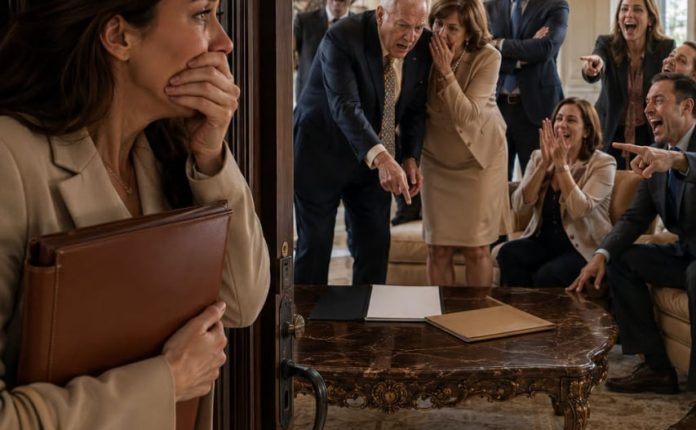
The cake was in the trash can when I went to fetch it. For a moment, I thought I had opened the wrong lid. Then I saw the silver sugar crown I had made for Emma, tipped against a coffee filter. One pink tower had broken away from the rest of the cake. Buttercream streaked the black liner, and the little horse Emma had asked me to put beside the castle was pressed into a takeout carton. Outside my parents’ kitchen window, her friends were gathering around the birthday table. Someone called for the candles.
I had left the cake on the far end of the counter twenty minutes earlier, covered in its tall cardboard box. It had survived the drive across town, a turn I had taken too quickly, and a warm afternoon in my parents’ crowded house. Getting it into the garbage had required someone to lift the box away, pick up a two-tier cake, and push it down among the scraps. I heard ice shift in a glass behind me and turned.
My older brother, Ryan, stood at the sink in a pale-blue shirt and polished shoes. He looked past me at the open trash can, then took a drink of iced tea. “Did you move Emma’s cake?” I asked. He said it had been taking up too much room. I waited for him to add that he had put it somewhere safe. Instead, he set down his glass and asked whether I needed the counter for something else. I asked him directly if he had thrown it away. “Claire, you make cakes for a living,” he said. “You can make another.”
“I made that one for your niece.” My voice came out lower than I expected. I could hear Emma on the back steps, telling a friend about the candles she had chosen. Ryan glanced toward the door. He had come to the party because our parents were hosting it, though he had spent the afternoon complaining about how little wedding planning anyone had done. He and Vanessa were supposed to review their seating chart with us after the children left. He looked at the ruined cake and gave a small shrug. “She won’t remember every cake she ever eats.”
Emma opened the door before I could answer. She was wearing the paper crown she had decorated at breakfast, bent on one side from running under the sprinkler. Her brown curls were damp at the temples. “Are we ready?” she asked, looking toward the counter. Then she followed my gaze to the bin. I reached to close the lid, but she had already seen the pink icing. She came nearer without making a sound. “Is that mine?” she asked.
Ryan let out a breath through his nose. “It was too much cake for a little kid.” Emma looked up at him. She was five that day, old enough to recognize the sugar horse, young enough to think there might be a reason that made sense. “But it’s my birthday,” she said. Ryan’s face tightened. He told her she wasn’t worth wasting an expensive cake on. There were children laughing beyond the screen door, a refrigerator humming beside me, and my daughter staring at an adult she knew, trying to understand why he had said that to her.
I picked her up. She held on so tightly that the edge of her paper crown pressed against my cheek. My mother came into the kitchen as I reached for Emma’s backpack. Diane took one look at the bin and asked Ryan what had happened. He said the cake had slipped while he was clearing the counter. “It didn’t slip,” I said. My mother’s eyes went to the backyard, where our guests were waiting. She offered to buy cupcakes. When I told her what Ryan had said to Emma, she told me he had been stressed about the wedding and asked me to lower my voice.
Dad appeared behind her. He heard enough to understand: the cake was in the trash, Ryan had put it there, and Emma had heard him insult her. He looked at his watch. “The guests are outside,” he said. He wanted us to settle it without upsetting them. I looked from him to my mother. Neither had asked Emma if she was all right. She had tucked her face against my neck, so I could not see her expression, but I could feel her breathing hitch. I told them we were leaving.
I carried Emma through the backyard past the balloons she had helped me tie to the fence. My cousin Rachel was standing near the table, holding a packet of candles. She glanced at my face, then at Emma, and stepped aside. A few people asked where we were going. I said we had to leave and kept walking. I did not want Emma to stand there while everyone learned what had happened. In the car, she handed me her crown so I could fasten her seat belt. One of its paper points had torn. I put it carefully on the seat beside her.
We drove several blocks before she spoke. “Did Uncle Ryan throw it away because I was bad?” I pulled into a quiet side street. She was watching me in the mirror, waiting for an answer she could carry home with her. I told her she had done nothing wrong. Ryan had chosen to be unkind, and I was sorry I had not reached her before he spoke. “Does he hate me?” she asked. I could not tell her what was in his head. I told her that whatever he thought, she had deserved her cake and the people at her party had wanted to celebrate her. She nodded, though I could see she was still trying to make sense of it.
At our apartment, Emma asked to keep the torn crown. I found a piece of tape and repaired it while she changed into pajamas. She had wrapped presents waiting by the couch, but she was too tired to open them. I laid her beside me in my bed. She fell asleep with the crown on the nightstand, close enough to touch. I remained there until her breathing grew steady. Then I went to the kitchen, where the faint smell of vanilla from the night before still hung in the air, and opened my laptop.
There was an email waiting for approval of the final schedule for Ryan Bennett and Vanessa Hale’s wedding. Ryan had talked about the Whitmore Country Club for months, first as an impossible wish and then, after I made a call, as though the date had been secured through his own influence. The message named my company, Bennett & Bloom Events, as the corporate sponsor of the booking. I had seen those words many times. That night I read them with Emma’s question still in my ears.
I was twenty-seven, a single mother, and the owner of an event planning and catering business with employees, contracts, and a calendar booked well ahead. At family dinners, Ryan called my work “party decorating.” My parents rarely corrected him. They knew enough about the business to ask for food, flowers, or help when they needed it. Mom had once called during a client tasting to ask whether I could put together appetizers for her book club that evening. Dad could remember Ryan’s changing job titles at the real estate firm but still described me to his friends as someone who “did events.”
For years, I had treated that difference as a nuisance I could live with. Ryan was six years older, confident in the way people can be when mistakes have always been made smaller for them. When I won a scholarship, Dad asked whether it would lead to a stable job. When Ryan bought a used luxury car, Mom took photographs of it from every angle. After Emma was born, I kept bringing her to family gatherings because I wanted her to know her grandparents. They were affectionate when it was easy. They missed school events, forgot things she had told them, and called me afterward to ask for a favor.
Ryan’s engagement had made the old pattern harder to ignore. Vanessa’s family was wealthy and well connected. Her father owned commercial property, and her mother knew many of the people who chaired the city’s charity events. Ryan began speaking about their friends and houses as though proximity to them had changed him. He complained about our parents’ neighborhood while continuing to arrive there for Sunday dinner. Every family occasion became a chance to discuss the wedding. At Emma’s party, he had checked his phone between conversations and reminded me twice that he needed the seating chart before the weekend was over.
Three months earlier, Mom had come to my office upset because the Whitmore Country Club had no available Saturday for Ryan and Vanessa. Vanessa’s parents expected that venue. Invitations were being planned around the date, and Ryan had apparently told people he could arrange it. Eleanor Whitmore, the club’s owner, had trusted my company with corporate dinners and charity events for nearly four years. I called her. A prime Saturday had recently opened, and she agreed to offer it through my corporate partnership. I signed a personal guarantee on behalf of Bennett & Bloom and secured a rate that saved the couple more than fifteen thousand dollars.
At the dinner celebrating the booking, Ryan had raised a glass to the advantages of knowing the right people. Vanessa’s parents thanked him for finding a way in. I watched him accept their praise, telling myself I had helped because he was my brother, not because I expected an announcement. That explanation had become useful to me. It let me ignore the way he spoke about my work until he needed it. It let me keep offering more than he had ever thought to ask for with any kindness.
I pulled up the venue agreement. The guarantee did more than reduce the price; it was the basis for the club’s exception to its usual booking process. If my company withdrew before the final service period, the discounted agreement could end. Ryan and Vanessa could still seek a booking on their own, subject to the club’s availability and standard terms. My phone lit up while I was reading. Ryan told me to stop making a scene and bring Emma back because Mom had bought cupcakes. A second message asked me to come tomorrow to finish the seating chart.
I looked toward my bedroom. Emma was asleep under a quilt, her birthday shirt folded over the chair. Ryan knew she had seen the cake. He knew what he had said. His messages gave both less attention than the seating chart. I thought about the staff whose work depended on my decisions and about whether I had any duty to keep my company attached to an event whose groom treated me and my daughter this way. I read the agreement once more, then wrote to Eleanor. I withdrew Bennett & Bloom’s corporate endorsement and financial guarantee, effective immediately.
I kept the email brief. I did not ask Eleanor to punish Ryan or Vanessa, and I did not describe the scene in the kitchen. I said there was a personal conflict that meant I could no longer stand behind the booking. Eleanor replied that she understood and would send the matter to her contracts department. Without my endorsement, the couple would need to qualify independently. I shut the laptop. For several minutes, I sat at the table listening for Emma through the bedroom door. My mother sent one more message: I would regret embarrassing my brother.
Click here to continue reading: PART 2: By Morning, My Brother’s Venue Was in Jeopardy, and His Fiancée Had Heard a Different Story
While Everyone Waited to Sing for Emma, I Found Her Birthday Cake Beneath the Kitchen Garbage
Part 1 of 4